The Bolan Pass is a mountain corridor in Balochistan, Pakistan, running about 89 kilometres through the Central Brahui Range between the Kachhi plain at Sibi and the plateau around Quetta. For thousands of years it has been one of the great gateways between the Indus lowlands and the highlands of Afghanistan and Central Asia — crossed by traders, nomadic herders and invading armies long before roads or railways existed. In the 1880s British engineers threaded a railway through its gorges with 20 tunnels and 396 bridges, a feat still counted among the great railway achievements of the colonial era. This bolan pass travel guide covers its real history, the route, the weather, what to see along it, and the safety picture you must understand before planning anything. Note the honest warning up front: foreign governments currently advise against travel to Balochistan, and this guide explains that situation plainly in the safety section below.
Quick Facts
- Location: Balochistan, Pakistan — a gorge running from near Sibi in the south up to the Quetta plateau in the north.
- Altitude: Rises from the low Kachhi plain (Sibi) to the Quetta plateau at around 1,600+ metres.
- Famous For: The historic 89 km gorge; the 19th-century Sibi–Quetta railway with its tunnels and bridges; an ancient caravan and invasion route; the Jaffar Express and Bolan Mail trains.
- Nearest City: Quetta (at the northern end) and Sibi (at the southern end).
- Accessibility: The N-65 highway and the railway run through the pass between Sibi and Quetta; Quetta International Airport is the nearest airport.
- Known Landmarks: Pir Ghaib waterfall near the middle of the pass; the Mehrgarh archaeological mounds at the southern foot; Mach railway junction; the Khundilani gorge.
- Best For: Railway enthusiasts, history buffs, and travellers interested in one of South Asia’s great historic corridors — when conditions allow.
Why Visit Bolan Pass
Few places in Pakistan carry as much history per kilometre as the Bolan Pass. This is the corridor through which the wealth of the Indus plains moved west and the armies of the west moved east. Ahmad Shah Durrani marched through it to invade India in 1748. The British Army of the Indus laboured through it in 1839 on its way to Kandahar. For centuries before that, camel caravans and nomadic tribes used it as the southern counterpart of the Khyber Pass. To travel the Bolan is to travel one of the oldest trade arteries of South Asia.
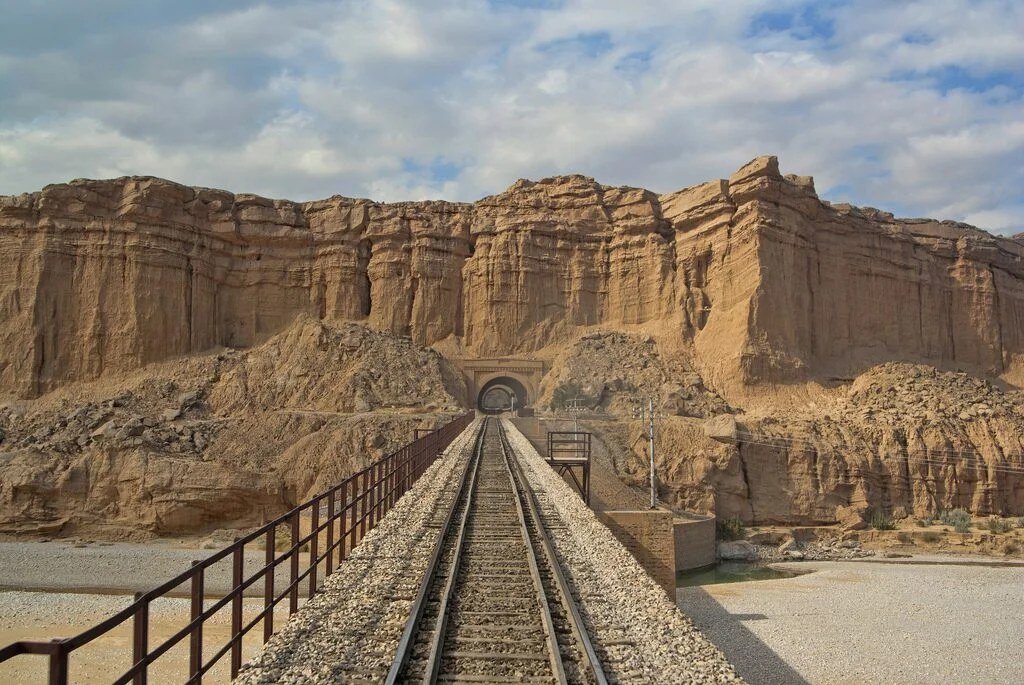
The railway is the second reason. Built in the 1880s as part of the line from Sibi to Quetta and on towards Chaman, the Bolan railway climbs through narrow gorges on gradients that defeated the first alignment — floods destroyed the original track along the Bolan stream, and the engineers had to reroute through the Mashkaf valley. The result, with its tunnels, iron bridges and impossible curves, is still cited as one of the remarkable engineering works of the 19th century in this region. Riding the Bolan Mail or the Jaffar Express through the pass, when services run, is one of the classic railway journeys of Pakistan.
The third reason is the landscape itself. The pass cuts through bare, folded mountains — conglomerate cliffs rising hundreds of feet at the Khundilani gorge, limestone narrows at Sir-i-Bolan so tight that, as the old gazetteers put it, three horsemen could barely ride abreast. It is stark, dramatic country, utterly different from the green valleys of the north.
But honesty comes first with the Bolan Pass. As of 2026, the UK’s Foreign Office advises against all travel to Balochistan, and the US State Department lists it as “Do not travel”. The 11 March 2025 hijacking of the Jaffar Express inside a tunnel in the pass — an attack in which dozens of people were killed — is the reason the warnings are current. This guide is written as a historical and geographical reference. If you are a Pakistani traveller, check the latest local security situation and travel only with reliable local guidance; if you are a foreign visitor, follow your government’s advice. The pass will still be here when the situation changes, and understanding it now is the best preparation for visiting later.
History of Bolan Pass
The Bolan route is ancient. Long before any road or rail, it was one of the main passages connecting the Indus plains with the Balochistan highlands and onward to Kandahar and Central Asia, used by traders, invading armies and nomadic tribes moving with the seasons. The Mehrgarh mounds at the pass’s southern foot — one of the world’s earliest farming settlements, going back some 9,000 years — show that people were living and moving through this corridor at the very dawn of agriculture.
The pass enters recorded military history with the great invasions of India. The Afghan ruler Ahmad Shah Durrani used the Bolan route for his invasion of India in 1748, alongside the more famous Khyber route. The pass was the natural corridor for any power based at Kandahar aiming at the riches of the Indus plain.
The British era began with the First Anglo-Afghan War. In February 1839, Sir John Keane led an army of about 12,000 men — the Army of the Indus — through the Bolan Pass towards Kandahar, and eventually on to the capture of Ghazni. Contemporary accounts describe an appalling march: the pass was narrow, with overlapping cliffs on both sides, and guns had to be dismantled to get them through. At places, one account notes, no one could take three steps in camp without seeing a dead human or animal.
British control came formally in the 1870s and 1880s. Robert Sandeman founded the Quetta agency in 1877 and secured the pass from raiding by Baloch tribesmen, chiefly the Marris. After the Treaty of Gandamak (1879) brought the route under British influence, the Bolan was selected for the first alignment of the Sind–Pishin railway from the plains to the plateau. In 1883 Sandeman negotiated with the Khan of Kalat, Khudadad Khan, and secured British control of the pass in exchange for an annual fee.
The railway itself was built through the 1880s. The first alignment followed the Bolan stream up to the plateau, but the destructive action of floods forced its abandonment; the line was rebuilt to follow the Mashkaf valley and join the Bolan at Mach. An alternative, longer route through the Harnai valley was adopted for ordinary traffic, with the Bolan loop kept for emergencies. The line eventually extended to Quetta, to Chaman on the Afghan frontier through the Khojak Pass, and west towards Iran — strategic infrastructure built to counter Russian influence, and an engineering marvel by any standard.
In the 20th century the pass remained a vital road and rail link between Sibi and Quetta. The line carried famous trains — the Bolan Mail between Karachi and Quetta, and the Jaffar Express. The modern era has been harder: the security situation in Balochistan has repeatedly disrupted services, most dramatically with the hijacking of the Jaffar Express inside a Bolan tunnel on 11 March 2025. That event is the single biggest reason the pass sits under travel advisories today.
Top Things to Do in Bolan Pass
Ride the Railway Through the Gorge
The signature experience of the Bolan Pass is the train journey itself. The line from Sibi climbs through the gorge past tunnels, over iron bridges and around curves that were laid out in the 1880s. The Bolan Mail (Karachi–Quetta) and the Jaffar Express are the famous services on this corridor. Services have been disrupted by the security situation, so check the current Pakistan Railways schedule and advisories before planning around a train — and take the warnings in the safety section seriously.
Drive the N-65 Through the Pass
The highway between Sibi and Quetta follows the pass and is the way most travellers see it today. The drive climbs from the hot Kachhi plain into the mountains, through the narrow limestone section at Sir-i-Bolan and the wide conglomerate cliffs of the Khundilani gorge, emerging onto the Quetta plateau. It is roughly 89 km of some of the starkest scenery in Pakistan. Drive in daylight, keep fuel topped up, and travel with local advice on current conditions.
Visit Pir Ghaib Waterfall
Near the middle of the pass, not far from the road, the Pir Ghaib waterfall drops through the rocks — a startling patch of green water and shade in the middle of arid mountains. It is the pass’s best-known natural landmark and the traditional halfway resting point on the Sibi–Quetta journey. The site has a small shrine association, hence the name (“the hidden saint”).
Explore the Mehrgarh Mounds
At the southern foot of the pass, near Sibi, lie the mounds of Mehrgarh — one of the oldest known farming settlements in the world, with remains going back around 9,000 years. The people who first domesticated animals and grew crops in this region lived at the mouth of the same corridor you are travelling. It puts the “historic route” claim of the Bolan Pass into a perspective measured in millennia, not centuries.
Stop at Mach
Mach is the railway junction town where the Mashkaf alignment meets the Bolan proper. It is a working railway town rather than a tourist stop, but for railway enthusiasts it is a key point on the line — the place where the engineers solved the flooding problem that defeated their first alignment.
Famous Places In and Around Bolan Pass
Quetta (Hanna Lake, the old bazaar, the Archaeological Museum of Balochistan); Ziarat and its juniper forests; Sibi at the southern mouth of the pass; the Mehrgarh archaeological site; Mach railway town; the Khundilani gorge; Pir Ghaib waterfall; the Khojak Pass and Chaman on the extended line; Kolpur and Spezand railway stations in the hills above Quetta.
How to Reach Bolan Pass
The pass lies between Sibi and Quetta, so you reach it via either end. The honest advice first: check the current security situation and your government’s travel advice before setting out, and travel with reliable local guidance.
- From Karachi: Around 690 km to Quetta, roughly 8–9 hours by road via the N-25 (RCD Highway) through Khuzdar and Kalat, or the Bolan Mail train from Karachi to Quetta when running. From Quetta the pass begins on the road south to Sibi.
- From Lahore: A very long road journey (the best part of a day and a half of driving); most travellers fly from Lahore to Quetta and then travel the pass by road from the Quetta end.
- From Islamabad: Similarly a long two-day road journey; flying to Quetta is the practical option, then the N-65 south from Quetta into the pass.
- Nearest airport: Quetta International Airport, with flights from Karachi, Lahore and Islamabad.
- The pass itself: About 89 km from Sibi up to Quetta — roughly 2–3 hours by road depending on traffic and stops, longer by train.
- Road conditions: The N-65 through the pass is a major highway but runs through remote, arid country with long gaps between services. Travel in daylight, carry water, and keep the fuel tank full.
- Transport options: Private car or hired 4×4 with a local driver is the sensible option; public vans and buses run between Sibi and Quetta; the railway (Bolan Mail, Jaffar Express) when services are operating.
Route Details
The classic traverse starts at Sibi, on the Kachhi plain. From Sibi the road and railway head north-west, skirting the hills to Rindli and then entering the gorge proper along the Bolan stream. The railway’s modern alignment swings through the Mashkaf valley and rejoins the Bolan at Mach, while the road follows the gorge through the Khundilani narrows and Sir-i-Bolan, past the turn-off for Pir Ghaib waterfall, climbing steadily until the mountains open onto the Quetta plateau. The whole traverse is about 89 km. Coming from the Quetta side, you simply reverse it: leave Quetta on the N-65 south, climb over the Kolpur–Spezand hills, and drop into the gorge. Whichever direction you travel, plan the drive for daylight hours and check conditions locally before you go.
Where to Stay in Bolan Pass
There is no tourist accommodation inside the pass itself — it is a transit corridor, not a resort. Travellers base themselves at either end. Quetta is the practical base: the city has the widest range of options, from budget guesthouses to mid-range and better hotels, mostly around the cantonment, the city centre and the roads near the airport. Sibi, at the southern end, has simpler budget hotels and guesthouses suited to an overnight stop.
Because the pass is a day’s traverse rather than a destination to linger in, most itineraries treat it as part of a Quetta-based trip: stay in Quetta, drive or ride through the pass to Sibi (or part of it, such as Pir Ghaib) and return the same day. Book accommodation in Quetta in advance during winter, when domestic tourism to the city peaks, and confirm the current security guidance with your hotel or a local contact before heading into the pass.
Where to Eat: Local Foods of Bolan Pass
The food of the Bolan corridor is the food of Balochistan: meat-heavy, bread-based and cooked over open fire. The signature dish is sajji — whole lamb or chicken roasted on skewers around a fire, eaten with hot naan — and Quetta’s sajji shops are famous across Pakistan. Khaddi kabab, meat slow-baked in a pit dug in the ground, is the traditional Baloch feast dish. The everyday bread is kaak, a hard, stone-baked loaf that keeps for days and was made for travellers and shepherds.
Quetta, your base at the northern end, is also famous for its dry fruits and nuts — almonds, pistachios and apricots from the highland orchards — sold in the bazaars around the city centre, and for its green tea (kahwa) culture. Eat at busy, well-established restaurants in Quetta or Sibi rather than at isolated roadside stops in the pass itself, drink bottled water, and carry snacks and water for the drive through the gorge, where there are long stretches with no services.
Weather in Bolan Pass
The pass climbs from one of the hottest plains in Pakistan to a high plateau, so the weather changes dramatically along its 89 km. The old gazetteers described it well: summer heat in the pass is very high, while in winter, near its head, the cold is extreme and the ice-cold wind rushing down the narrow outlet is destructive. Sibi, at the southern mouth, is among the hottest towns in the country; Quetta, at the northern end, gets winter frost and occasional snow.
| Season | Temperature Range | Conditions |
|---|---|---|
| Winter (Dec–Feb) | Around 0°C to 20°C | Mild at the Sibi end, freezing at the Quetta end with icy winds funnelling through the gorge. The coldest, windiest time in the pass. |
| Spring (Mar–Apr) | Around 15°C to 32°C | Pleasant and dry; the most comfortable season for the drive. Sibi Mela season at the southern end. |
| Summer (May–Aug) | Around 25°C to 42°C | Very hot on the Sibi side and through the lower gorge; cooler as you climb towards Quetta. Carry plenty of water. |
| Autumn (Sep–Nov) | Around 10°C to 32°C | Dry and clear; good driving weather, cooling fast towards November at the Quetta end. |
Language and Culture of Bolan Pass
The pass sits at a cultural crossroads, and the population changes as you climb it. Around Sibi and the southern gorge the people are mainly Brahui-speaking, with Balochi widely spoken to the west; towards Quetta and the northern end, Pashto predominates. Urdu works as a common language in the towns and with drivers and hotel staff.
This is tribal Balochistan, and the culture is shaped by tribal codes of honour, hospitality and self-reliance. Guests are traditionally treated with great respect, but the society is conservative: dress modestly, ask permission before photographing people (especially women), and accept that some areas and homes are private. The tribes of the region — Marri, Bugti, Raisani and others in the wider area — have a long history tied to this pass, including the raiding bands the British had to pacify in the 1870s. Showing knowledge of and respect for that history goes a long way with local people.
Shopping in Bolan Pass
The pass itself has no markets — it is a transit gorge. The shopping happens at either end. Quetta’s bazaars are the real prize: dry fruits and nuts (almonds, pistachios, chilgoza pine nuts), Balochi embroidery, tribal jewellery, rugs and carpets, and onyx handicrafts. The main bazaar area around the city centre is where locals shop, and prices are reasonable with polite bargaining expected.
At the Sibi end, the town bazaar serves the local agricultural and livestock economy, and during the February Sibi Mela the mela grounds become a huge temporary market for animals, handicrafts and tribal goods. Buy dry fruits in Quetta rather than at roadside stops in the pass, check the quality of embroidery and jewellery before paying, and keep receipts for anything valuable. There are no shopping malls in the pass — and none needed.
Local Events and Festivals
The Sibi Mela, held every year in February at Sibi, at the southern mouth of the pass, is one of the great traditional festivals of Balochistan. It began as the annual tribal jirga — a meeting of Baloch tribal chiefs that goes back to the 15th century — combined with a mela, and the British formalised it as an annual darbar with a fair; the first organised Sibi Mela was held in January 1885. Today it is a famous horse and cattle show: thousands of tribesmen gather with their animals for tent pegging, camel races, horse and cattle parades, livestock trading, folk dances, cultural shows, and exhibitions of handicrafts and tribal dress. If your visit to the Bolan region coincides with February, the mela at Sibi is the single best window into the living culture of the pass’s southern gateway. Confirm the exact dates locally each year, as they shift slightly.
Travel Tips for Bolan Pass
Packing Essentials
Layers are essential — the temperature difference between Sibi and Quetta can be 15 degrees or more on the same day. A warm jacket even in spring and autumn, sun protection and a cap for the glare of the gorge, sturdy shoes, and far more water than you think you need. A basic first-aid kit and any personal medication, since there are no pharmacies in the pass.
Safety Tips
This is the most important section of this guide. Foreign governments currently advise against all travel to Balochistan, including the Bolan Pass, and the 2025 Jaffar Express hijacking showed why. Pakistani travellers should check the latest local security situation, travel in daylight, use the main N-65 highway, keep to a plan shared with someone who knows your route, and take guidance from local authorities, your hotel, or a reputable local operator. Do not wander off the main road into side valleys, do not travel the pass at night, and do not rely on mobile coverage in the gorge. If conditions feel wrong, turn back — the pass will wait.
Money & Connectivity
Carry all the cash you need in rupees before entering the pass — there are no ATMs in the gorge. Quetta and Sibi have banks and ATMs. Mobile signals are patchy to non-existent inside the gorge itself; coverage returns near the towns at either end. Download offline maps before you go, and let someone know your expected arrival time.
Best Time to Visit Bolan Pass
Spring (March to April) — Best
The most comfortable season for the traverse: dry, clear and neither freezing at the top nor scorching at the bottom. February’s Sibi Mela at the southern end makes late winter/early spring doubly attractive.
Autumn (October to November) — Good
Dry, clear driving weather with cooling temperatures. The light in the gorge is at its best for photography, and the summer heat is gone from the Sibi side.
Winter (December to February) — Cold at the top
Possible but harsh: the Quetta end and the head of the pass can be bitterly cold, with icy winds funnelling through the narrows. The Sibi end stays mild. Only for travellers prepared for real cold.
Summer (May to August) — Hot at the bottom
The Sibi side and lower gorge are extremely hot. The traverse is still drivable, but start early, carry extra water, and expect the landscape at its starkest and driest.
Final Thoughts
The Bolan Pass is not a picnic spot. It is a corridor of empires — a place where the geography of South Asia forced every army, caravan and railway to squeeze through the same 89 kilometres of rock. The tunnels and bridges of the 1880s railway, the narrows at Sir-i-Bolan, the waterfall at Pir Ghaib and the 9,000-year-old mounds of Mehrgarh at its foot make it one of the most historically dense landscapes in Pakistan.
Today the pass waits behind a security situation that keeps most travellers away, and this guide has been honest about that. Read it as an introduction, not an itinerary — learn the history, understand the route, and keep the Bolan on your list for the day the advisories lift. When that day comes, the train through the gorge will still be one of the great journeys of the subcontinent. Until then, Quetta’s bazaars and museums, including the Archaeological Museum of Balochistan, offer a safer first step into the region’s story — and you will find more northern journeys in our Hunza Valley guide.
FAQs
Where is the Bolan Pass?
In Balochistan, Pakistan — an 89 km gorge through the Central Brahui Range between Sibi on the Kachhi plain and Quetta on the Balochistan plateau.
What is the Bolan Pass famous for?
Its history as an ancient caravan and invasion route between the Indus plains and Kandahar, and its 19th-century railway (built in the 1880s) with 20 tunnels and 396 bridges. Ahmad Shah Durrani used it in 1748 and the British Army of the Indus marched through it in 1839.
Is it safe to visit the Bolan Pass?
As of 2026, foreign governments advise against all travel to Balochistan, and the March 2025 Jaffar Express hijacking in the pass underlines the risk. Pakistani travellers should check the latest local security situation and travel only in daylight with local guidance.
How long is the Bolan Pass and how long does it take to cross?
About 89 km from Sibi to Quetta — roughly 2–3 hours by road, longer by train, depending on conditions and stops.
What is the best time to visit?
March to April for the most comfortable weather; October to November is also good. February brings the Sibi Mela at the southern end. Winters are bitterly cold at the Quetta end, summers extremely hot at the Sibi end.
Can I take the train through the Bolan Pass?
The Bolan Mail (Karachi–Quetta) and Jaffar Express use this corridor, and the ride is one of Pakistan’s classic railway journeys — but services have been disrupted by the security situation, so check Pakistan Railways schedules and current advisories before planning.
What is there to see in the pass?
Pir Ghaib waterfall near the midpoint, the Khundilani gorge and Sir-i-Bolan narrows, the railway’s tunnels and bridges, the junction town of Mach, and the Mehrgarh archaeological mounds at the southern foot near Sibi.
Where should I stay?
There is no accommodation in the pass itself. Base yourself in Quetta (widest choice of hotels) or Sibi (simpler budget options) and traverse the pass as a day trip.