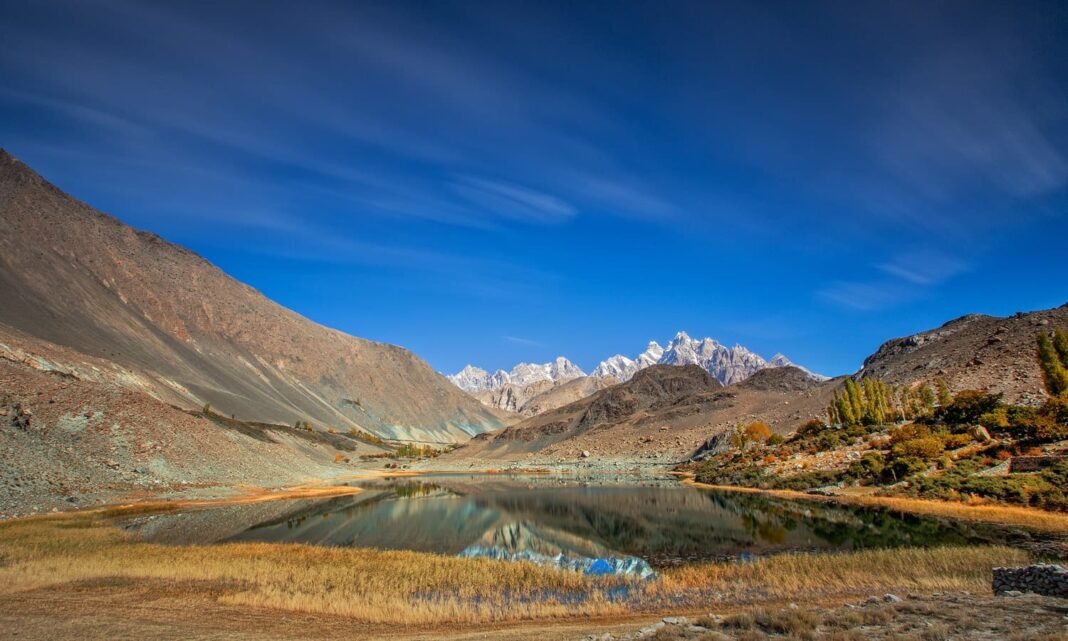
Borith Lake is a high, still lake in the Gojal Valley of upper Hunza, Gilgit-Baltistan, sitting at around 2,500–2,600 metres above sea level in a small hollow between glaciers. It is not the biggest lake in Hunza and not the most famous — that honour goes to Attabad — but travellers who make the short detour off the Karakoram Highway consistently call it one of the most peaceful places in the valley. The lake is brackish, fed by the meltwater of the Ghulkin Glacier, ringed by the Passu, Ghulkin and Batura glaciers, and for part of the year it is a sanctuary for migrating wildfowl travelling between the plains of Pakistan and Central Asia. This borith lake travel guide covers how to reach it, what to do there, the best time to visit, where to stay and eat, and the treks that start from its shore.
Quick Facts
- Location: Gojal Valley, upper Hunza, Gilgit-Baltistan — about 2 km north of Hussaini village, near Gulmit on the Karakoram Highway.
- Altitude: Around 2,500–2,600 metres (8,200–8,500 feet) above sea level.
- Famous For: Mirror-calm saline waters; a stopover for migratory ducks and waders; the trailhead for the Passu (White) Glacier hike; boating and birdwatching.
- Nearest City: Gilgit, about 150 km to the south; the nearest villages are Gulmit and Hussaini.
- Accessibility: Reached by a roughly 2 km unpaved jeep track from Hussaini village, or a 2–3 hour trek from Gulmit across the end of the Ghulkin Glacier.
- Known Landmarks: Passu Glacier and the Passu Cones, Hussaini Suspension Bridge, Ghulkin Glacier, Gulmit village.
- Best For: Nature lovers, birdwatchers, photographers, trekkers, and travellers who want Hunza without the crowds of Karimabad.
Why Visit Borith Lake
Borith Lake is the quiet answer to Hunza’s busier sights. Attabad Lake gets the tour buses and the jet skis; Borith gets the birdwatchers, the trekkers and the travellers who linger. The lake sits in a natural amphitheatre of ice — the Passu, Ghulkin and Batura glaciers all visible from a single vantage point — and on a calm morning its surface throws back a perfect reflection of the peaks. It is the kind of place where you sit on the shore for an hour and realise you have been staring at nothing, happily.
The second reason is the birds. Borith is a recognised sanctuary for migrating wildfowl. In spring, from roughly March to June, ducks arrive from the warmer parts of southern Pakistan and rest here on their way north to the cooler waters of Central Asia; from September to November the migration reverses. A scientific survey of the lake and its surroundings recorded 161 migratory bird species. Bring binoculars in the migration months and the lake becomes a wildlife experience, not just a scenic one.
The third reason is what starts here. Borith is the trailhead for one of the most rewarding short glacier hikes in upper Hunza — the descent to the snout of the Passu Glacier, with its crevassed white ice and the golden-brown Passu Cones rising behind it. Boats are available on the lake in season, the shoreline walk is easy and beautiful, and a small inn on the shore means you can stay the night and see the lake at dawn, when it is at its very best.
Finally, Borith is a window into Gojal’s Wakhi culture without any staging. The hamlet of Borith belongs to the people of Ghulkin, who use the land for summer grazing and irrigation; the walk past Borith Bala and the deserted settlement of Shahabad — abandoned long ago when its water supply failed — is a quiet lesson in how hard-won life is at this altitude. For a fuller northern itinerary, pair this with our Hunza Valley guide and the Attabad Lake guide.
History of Borith Lake
Borith Lake has no palaces, battles or ancient monuments attached to it — its history is the history of the Gojal Valley and the Wakhi people who live in it. Gojal is the uppermost part of Hunza, a chain of villages strung along the Karakoram Highway towards the Khunjerab Pass and the Chinese border. For centuries these villages lived by a mix of terraced farming, apricot orchards and summer pastures, moving livestock up to high grazing grounds like Borith in the warm months.
The hamlet of Borith itself is part of Ghulkin village. The residents of Ghulkin have long used the Borith land for irrigation and summer grazing, living up at Borith during the summer season. The lake, a saline body of water in a small hollow, is fed by meltwater from the Ghulkin (and nearby Hussaini) Glacier — a soda lake, as locals describe it, high in minerals rather than a sweet-water lake.
The wider region’s recorded history is the history of the former princely state of Hunza, ruled by the Mirs of Hunza until the state was dissolved in 1974. One local tradition holds that the lakeside spot now occupied by the hotel was once used as a hunting lodge by the Mir of Hunza, who came here for the migratory birds — a reminder that Borith’s reputation as a bird sanctuary is older than tourism. The now-deserted settlement of Shahabad, passed on the trek towards Passu, was abandoned many years ago when its water supply failed and the village slowly desertified — a common story in these mountains, where water is everything.
Borith became known to travellers with the opening of the Karakoram Highway and the growth of Hunza tourism from the 1980s onward. It has stayed deliberately small: a couple of places to stay, a few boats, and the trails. That is its appeal, and the reason it still feels like a discovery.
Top Things to Do in Borith Lake
Boat on the Lake
In the summer season, rowboats are available on Borith Lake, and a slow circuit of the water is the classic Borith experience. The lake is small enough that an hour on the water feels unhurried, and from the middle you get the full ring of glaciers and the reflection of the Passu Cones. Go early in the morning for the calmest water and the best light — and the fewest people.
Hike Down to the Passu Glacier
The standout trek from Borith is the descent to the snout of the Passu Glacier (also called the White Glacier). The walk down from the lake takes roughly 45 minutes to 2 hours each way depending on the route and your pace, over uneven moraine terrain to the crevassed ice. The contrast is extraordinary: the still, dark lake above, and below it a river of white and grey ice with the Passu Cones towering behind. Wear proper trekking shoes, carry water, and stay on the marked path — glaciers are dangerous near their edges.
Go Birdwatching
Time your visit for the migration and Borith becomes one of the best birding spots in Gilgit-Baltistan. From March to June, ducks and waders arrive from the south heading for Central Asia; from September to November the movement reverses. Bring binoculars and a field guide, keep your distance, and go at dawn when the birds are most active. The 161 migratory species recorded here include ducks, geese, gulls and waders.
Trek from Gulmit Across the Ghulkin Glacier
The adventurous way to reach Borith is on foot from Gulmit: a 2–3 hour trek across the end of the Ghulkin Glacier. The route crosses rough glacial terrain with the ice on one side and the valley dropping away on the other — a proper taste of Karakoram trekking without any technical difficulty. A local guide is strongly recommended for the glacier crossing.
Walk to the Hussaini Glacier
A shorter option from the lake area: about an hour’s trek each way brings you to the Hussaini Glacier. It is an easy half-day walk that gives you a second glacier in a single day, and the views back towards the lake and the Passu Cones are superb.
Walk the Shore to Borith Bala and Shahabad
Follow the southern side of the lake past the settlement of Borith Bala towards the deserted village of Shahabad. The walk is gentle, the views constant, and Shahabad’s empty houses — abandoned when the water ran out — are a haunting reminder of how marginal life is at this altitude. Continuing on, the longer trail crosses towards Passu (about 4–5 hours from Ghulkin to Passu), for those with a full day and a guide.
Photograph the Passu Cones at Sunset
The Passu Cones — the serrated, golden-brown peaks officially called the Passu Cathedral — are most spectacular at sunset, when the low light sets them glowing. The lakeshore and the Glacier Breeze restaurant viewpoint near the lake are both excellent vantage points. This is the photograph that defines upper Hunza.
Famous Places In and Around Borith Lake
Passu Glacier (White Glacier) and the Passu Cones; Hussaini Suspension Bridge (about 10 minutes away); Ghulkin Glacier; Gulmit village with its centuries-old houses; Attabad Lake; the Batura Glacier viewpoint; Sost, the last town before Khunjerab; Khunjerab Pass and the China border (a full day trip).
How to Reach Borith Lake
Borith Lake sits just off the Karakoram Highway in Gojal, upper Hunza. You travel the KKH to Hussaini village (between Gulmit and Passu), then turn off on the roughly 2 km unpaved track up to the lake — a jeep or a sturdy car can manage it in dry weather, and many visitors simply walk up.
- From Islamabad: The long way is the Karakoram Highway to Gilgit — a full day’s drive of 12–14 hours through Besham and Chilas — then onward up the KKH to Hunza. The fast way is the roughly one-hour flight from Islamabad to Gilgit (weather-dependent; book flexible tickets).
- From Lahore: Travel to Islamabad first (4–5 hours by motorway), then follow the Islamabad route above. Most Lahore-based travellers fly to Gilgit via Islamabad.
- From Karachi: Fly to Islamabad and connect to the Gilgit flight, or fly to Islamabad and drive the KKH. There are no direct commercial flights from Karachi to Gilgit.
- Nearest airport: Gilgit Airport, about 150 km south of the Passu/Gulmit area — roughly 3–4 hours by road up the KKH to Borith.
- The last stretch: From the KKH at Hussaini, the 2 km track to the lake takes 10–15 minutes by jeep. Alternatively, trek in from Gulmit across the Ghulkin Glacier (2–3 hours) with a guide.
- Road conditions: The KKH is paved but mountainous, with landslide-prone sections (especially around Attabad) that can close after heavy rain. The lake track is unpaved and rough — fine in dry summer weather, tricky after rain.
- Transport options: Private car or hired jeep with a local driver is the standard; public vans and coasters run the KKH between Gilgit, Karimabad, Gulmit and Sost; tour operators in Gilgit and Karimabad run day trips to the upper Hunza lakes.
Route Details
From Gilgit, follow the Karakoram Highway north through the Hunza Valley — past Karimabad, Aliabad and Attabad Lake — into Gojal. About 150 km from Gilgit you reach Gulmit; continue a few kilometres to Hussaini village, watched over by the Passu Cones. Turn off the highway onto the unpaved track signposted for Borith Lake and climb about 2 km to the lakeshore, where the inn, the boats and the trailheads are. If you are trekking, start from Gulmit, cross the end of the Ghulkin Glacier with a guide (2–3 hours), and arrive at the lake on foot. From the lake, the Passu Glacier trail descends from the far shore. Allow a full day for the lake plus the glacier hike, or stay overnight at the lakeside inn and do the trails at dawn.
Where to Stay in Borith Lake
Staying at the lake itself is part of the experience, and there are a couple of verified options right on the shore. The Borith Lake Inn offers heated rooms on the shoreline — one of the few overnight options in this stretch of Gojal, and the one most often recommended for its location. The Borith Lake Hotel & Resort, run by the family of Tawakal Khan, is the other lakeside stay; travellers consistently praise the hospitality and the dawn views over the water. Both are simple mountain lodgings rather than luxury hotels — expect clean rooms, hot food and extraordinary views.
If the lakeside places are full, Gulmit village (a few kilometres down the highway) has guesthouses and small hotels, and Passu has its well-known lodges with Passu Cones views. Karimabad, about an hour south, has the widest range of Hunza accommodation, from backpacker hostels to comfortable hotels. Book ahead in the peak summer months (June–August) and for the autumn colours season in October; outside those windows you can usually find a room on arrival. Camping near the lake is possible — bring a proper cold-weather tent and sleeping bag, as nights are cold even in summer.
Where to Eat: Local Foods of Borith Lake
The food around Borith is the food of Gojal: Wakhi mountain cooking based on what the high valleys produce. Expect hearty, simple dishes — chapshuro (a savoury meat pie, the Wakhi speciality), steamed momos, dawdo (a thick hand-pulled noodle soup), buckwheat pancakes, and dishes built around dried apricots, mulberries, walnuts and almonds. Butter tea (salted, churned with yak butter) is the traditional drink and genuinely warming at altitude; sweet milk tea is available everywhere too.
The lakeside inn serves meals to guests, and the Glacier Breeze restaurant near the lake is known for its views of the Passu Cones (travellers rate its apricot cake). For more choice, Gulmit village has cafes serving local food — the village is known for its traditional dishes and its apricot products. A meal at a local restaurant is budget-friendly; carry snacks and water for the treks, as there is nothing to buy once you leave the lakeshore. Try the dried apricots and apricot oil — Gojal’s orchards produce some of the best in the country.
Weather in Borith Lake
At around 2,600 metres, Borith has a true mountain climate: short, pleasant summers and long, hard winters when the lake freezes over completely. The lake is at its best from late spring to autumn; in winter it is a sheet of ice under snow, beautiful but accessible only to the hardy. Weather changes fast in the Karakoram, so carry a jacket even on a sunny summer day.
| Season | Temperature Range | Conditions |
|---|---|---|
| Winter (Dec–Feb) | Around -10°C to 5°C | Lake frozen solid; snow likely; very few visitors. Only for well-equipped winter travellers. |
| Spring (Mar–May) | Around 0°C to 18°C | Migratory birds arrive (March–June); apricot and cherry blossom in the villages; snow still on the peaks. |
| Summer (Jun–Aug) | Around 10°C to 28°C | Best trekking and boating weather; long daylight; peak visitor season. |
| Autumn (Sep–Nov) | Around 0°C to 20°C | Poplars and apricot trees turn gold and red; reverse bird migration; clear, crisp air. |
Language and Culture of Borith Lake
Gojal is Wakhi country — Wakhi, an Eastern Iranian language, is the mother tongue of the villages around Borith, including Ghulkin and Hussaini. Burushaski is spoken lower down the valley, and Urdu is understood everywhere; English works with guides, hotel staff and younger people.
The people of Gojal are predominantly Ismaili Muslims, followers of the Aga Khan, and the community is known across Pakistan for its emphasis on education — Hunza’s literacy rates are among the highest in the country. Village life revolves around the farming calendar: blossom season, the summer move to high pastures like Borith, and the autumn harvest. Visitors are welcomed warmly, but this is a conservative mountain society: dress modestly, ask before photographing people, and respect that homes, fields and irrigation channels are private and vital. If you are invited for tea — and you may well be — accept; Wakhi hospitality is genuine and generous.
Shopping in Borith Lake
There is no bazaar at the lake — the shopping is in Gulmit and along the KKH. Gulmit’s carpet shops sell handwoven rugs and traditional textiles, and the village is a good place to buy dried apricots, apricot oil, walnuts and almonds from the local orchards. Hunza is also known for its gemstones (aquamarine, topaz and tourmaline come from these mountains), sold in shops in Karimabad and Gilgit — buy from reputable dealers and get a receipt.
Handmade woollen caps, shawls and embroidered purses are widely sold in the tourist shops of Karimabad and Gulmit and make good, light souvenirs. Prices are reasonable and gentle bargaining is normal. There are no shopping malls anywhere near Borith — and that is exactly the point.
Travel Tips for Borith Lake
Packing Essentials
Layers for big day-night temperature swings: a warm fleece or jacket even in summer, a windproof outer layer, sun protection (the high-altitude sun is fierce), a cap and sunglasses. Sturdy trekking shoes with grip for the moraine and glacier trails. Binoculars in the migration months (March–June, September–November). A headlamp, a reusable water bottle, and snacks for the trails.
Safety Tips
The main risks at Borith are mountain risks, not crime — the area is peaceful and the people welcoming. Never walk on the frozen lake in winter unless locals confirm it is safe. Stay on marked paths near glaciers; crevasses and unstable moraine are real dangers. Do not hike alone — weather changes fast. Acclimatise: at 2,600 metres most people feel fine, but take it easy on the first day if you have come straight up from the plains. Carry water and sunblock on every walk.
Money & Connectivity
Carry cash in rupees — there are no ATMs at Borith, and the nearest ones are in Gulmit/Passu or back in Karimabad and Gilgit. Small shops and the inn may not take cards. Mobile signals (SCO, and patchy Jazz/Telenor) reach the lake area but data can be slow; download offline maps before leaving Gilgit. The inn and some cafes offer Wi-Fi of varying reliability.
Best Time to Visit Borith Lake
Spring (Mid-March to May) — Best for birds and blossom
Migratory ducks and waders pass through from March to June, and the apricot and cherry blossom fills the villages below with fresh snow still on the Passu Cones. Cool, quiet and magical — arguably the finest season.
Summer (June to August) — Best for activities
Perfect walking weather for the Passu Glacier descent, boating on the lake, and long light for photography. The busiest season; book the lakeside inn ahead.
Autumn (September to November) — Best for colours
Poplars, apricot and cherry trees turn yellow, orange and deep red around the lakeshore, the reverse bird migration passes through, and the air is crystal clear. October is superb.
Winter (December to February) — Frozen
The lake freezes completely — a sheet of ice under snow, beautiful in photographs but with no boating, no birds and bitter cold. Only for equipped winter travellers.
Final Thoughts
Borith Lake is proof that the best places in Hunza are not always the famous ones. It has no crowds, no jet skis and no viewpoints with queues — just a still, mineral lake in a ring of glaciers, birds passing through on journeys longer than any human road, and trails that lead straight onto living ice. Stay the night at the lakeside inn, walk the shore at dawn, and descend to the Passu Glacier before the day-trippers arrive.
Come in spring for the birds and the blossom, in summer for the hikes, or in autumn for the colours — and give Borith the unhurried day it deserves rather than a rushed photo stop. If you are building a northern itinerary, our Explore Pakistan collection and the Malam Jabba guide will help you plan the rest. Borith will quietly become the part of Hunza you talk about most.
FAQs
Where is Borith Lake?
In the Gojal Valley of upper Hunza, Gilgit-Baltistan — about 2 km north of Hussaini village, near Gulmit on the Karakoram Highway, at around 2,500–2,600 metres above sea level.
What is the best time to visit Borith Lake?
April to October. Spring (mid-March–May) is best for migratory birds and blossom, summer for boating and glacier hikes, and October for autumn colours. The lake freezes in winter.
How do I reach Borith Lake?
Drive the Karakoram Highway from Gilgit (about 150 km, 3–4 hours) to Hussaini village, then take the 2 km unpaved track up to the lake — or trek in from Gulmit across the Ghulkin Glacier (2–3 hours) with a guide.
Is Borith Lake safe for families?
Yes. The area is peaceful and the lakeside walk is easy. Keep children supervised near the water and off glacier ice, and carry warm layers — mountain weather changes fast.
Can you boat on Borith Lake?
Yes, rowboats are available in the summer season. An hour on the calm morning water, with the glaciers reflected around you, is the classic Borith experience.
Where can I stay near Borith Lake?
The Borith Lake Inn (heated rooms on the shoreline) and the Borith Lake Hotel & Resort are right at the lake. Gulmit and Passu have more guesthouses, and Karimabad (about an hour south) has the widest choice.
What is the Passu Glacier hike from Borith like?
A 45-minute to 2-hour descent each way over moraine to the crevassed snout of the Passu (White) Glacier, with the Passu Cones behind it. Wear trekking shoes, carry water, stay on the path, and consider a local guide.
What birds can I see at Borith Lake?
It is a sanctuary for migrating wildfowl — ducks, geese, gulls and waders. A survey recorded 161 migratory species. Visit March–June or September–November, at dawn, with binoculars.