Quick Facts
- Location: The Gasherbrum massif of the Karakoram Range, Gilgit-Baltistan, Pakistan, on the border with China, about 8 km from K2.
- Altitude: 8,051 metres (26,414 feet), the 12th highest mountain in the world.
- Famous For: Its vast 1.5-km-long summit ridge and its classic 1957 first ascent without supplementary oxygen. It also sits on the legendary Concordia trek.
- Nearest City: Skardu, the mountaineering capital of Baltistan and gateway to the Baltoro Glacier.
- Accessibility: Fly or drive from Islamabad to Skardu, then take a jeep to Askole. From there, trek for several days up the Baltoro Glacier via Concordia to Broad Peak Base Camp at about 4,800 m.
- Known Landmarks: Concordia, the Baltoro Glacier, the Gilkey Memorial, K2 Base Camp, and the Gondogoro La pass.
- Best For: Serious mountaineers attempting an 8,000-metre peak. Fit trekkers on the K2/Concordia trek also come to stand at the foot of a giant.
Why Visit Broad Peak
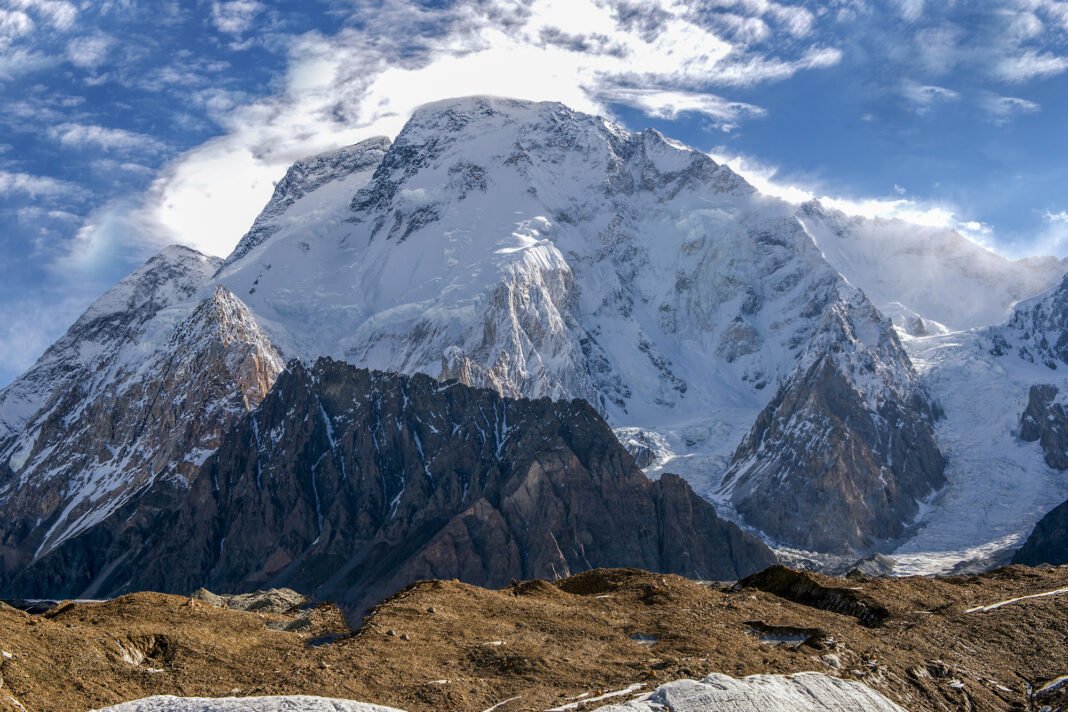
Broad Peak is not a mountain you simply visit; it is a mountain you earn. Rising to 8,051 metres in the heart of the Karakoram, it is the twelfth highest peak on earth. It dominates the head of the Baltoro Glacier. Its summit ridge stretches nearly a kilometre and a half. Early explorers named the whole mountain for its breadth. Also, to stand at Broad Peak Base Camp, at roughly 4,800 metres on the Godwin-Austen Glacier, with K2 looming eight kilometres away and the Gasherbrum peaks crowding the horizon, is to stand in the greatest mountain amphitheatre on the planet.
A Golden Age First Ascent
For climbers, Broad Peak holds a special place in Himalayan history. Meanwhile, it was first climbed on 9 June 1957 by four Austrians, Fritz Wintersteller, Marcus Schmuck, Kurt Diemberger and Hermann Buhl, who reached the summit in pure alpine style, without high-altitude porters and without supplementary oxygen. Buhl, already a legend as the first man to climb Nanga Parbat in 1953, would die weeks later on neighbouring Chogolisa, giving the 1957 expedition a heroic and tragic lustre it has never lost. Today Broad Peak is considered one of the more approachable of the fourteen 8,000-metre peaks. These makes it a classic objective and a respected stepping stone toward K2.
For trekkers who will never clip into a fixed rope above 6,000 metres, Broad Peak is still the centrepiece of the greatest walk in the Karakoram. The Concordia trek, up the 63-kilometre Baltoro Glacier past the Trango Towers, Urdukas and Goro, ends at the glacial junction of Concordia, and from there a day’s walk brings you to Broad Peak Base Camp itself. You sleep in expedition tents, you acclimatise like a climber. You look up at a wall of ice and rock that rises more than three vertical kilometres above you.
This Broad Peak travel guide covers both journeys: the expedition to the summit and the trek to its foot. Also, neither is easy, neither is cheap, and both demand respect for altitude, weather and the remoteness of the Karakoram. But for those who go, Broad Peak delivers what few places on earth can: the feeling of standing at the edge of the possible.
History of Broad Peak
Unlike the ancient cities of the plains, Broad Peak’s recorded history begins with European exploration. The English name was introduced in 1892 by the British explorer Martin Conway, who named it after the Breithorn in the Alps, another peak famed for a broad summit. In the Balti language it is rendered as Falchan Kangri. The peak is part of the Gasherbrum massif in Baltistan, on the border between Pakistan and China, and apart from the main summit at 8,051 m it has two subsidiary eight-thousander summits of its own: Rocky Summit at 8,028 m and Broad Peak Central at 8,011 m.
Triumph and Tragedy in 1957
The first ascent, on 9 June 1957, remains one of the great feats of mountaineering’s golden age. Also, the Austrian expedition was led by Marcus Schmuck and included Hermann Buhl, the most famous climber of his generation. All four members, Schmuck, Wintersteller, Diemberger and Buhl, reached the summit, climbing alpine-style without supplementary oxygen and without high-altitude porters. It was the eleventh of the world’s fourteen 8,000-metre peaks to be climbed. The triumph was shadowed almost immediately: Buhl, attempting the neighbouring Chogolisa shortly afterwards, fell to his death. The mountain world lost one of its brightest figures in the same season Broad Peak was won.
Broad Peak’s story did not end in 1957. Meanwhile, the first winter ascent came on 5 March 2013. The Polish team of Maciej Berbeka, Adam Bielecki, Tomasz Kowalski and Artur Małek reached the summit in the depths of the Karakoram winter, one of the landmark achievements of modern Himalayan climbing. In 2015, the Swiss climber Ueli Steck stunned the climbing world with a record ascent of the peak in only about 20 hours. And in the summer seasons since, Broad Peak has become one of the most frequently attempted 8,000-metre peaks, valued as serious but achievable, and often climbed as preparation for K2.
For trekkers, the mountain’s history is the history of the Baltoro itself: the great glacier highway that carried the 1957 expedition and every expedition since, past camps whose names, Paiyu, Urdukas, Concordia, are now part of mountaineering folklore. The Gilkey Memorial near K2 Base Camp, a cairn of plaques for climbers lost on K2 and the surrounding peaks, stands a day’s walk from Broad Peak Base Camp and puts the whole enterprise in humbling perspective.
Top Things to Do in Broad Peak
Trek to Concordia, the Throne Room of the Mountain Gods
The essential Broad Peak experience for non-climbers is the trek to Concordia at about 4,690 m, the junction of the Baltoro, Godwin-Austen and Abruzzi glaciers. The walk from Askole takes 8 to 10 days through camps at Jhola, Paiyu, Khoburtse, Urdukas and Goro II, with a rest and acclimatisation day usually taken at Paiyu. Also, At Concordia you are surrounded by four 8,000-metre peaks, K2, Broad Peak, Gasherbrum I and Gasherbrum II, in a panorama many consider the finest in the Himalaya and Karakoram.
Stand at Broad Peak Base Camp
From Concordia, a six-kilometre round trip along the Godwin-Austen Glacier brings you to Broad Peak Base Camp at roughly 4,800 m. Also, in summer the camp is a small tent city of expeditions from around the world, prayer flags snapping in the wind, climbers resting between rotations. Even if you go no higher, standing beneath the mountain’s vast west face, watching the summit ridge catch the morning light, is unforgettable.
Visit K2 Base Camp and the Gilkey Memorial
Most Concordia trekkers continue one more day to K2 Base Camp at about 5,150 m, passing the Gilkey Memorial on the way. Also, the memorial, a cairn of plaques naming climbers who died on K2 and nearby peaks, is one of the most moving places in the Karakoram. In fact, pairing it with Broad Peak Base Camp gives you the two great base camps of the Baltoro in a single trek.
Attempt the Summit (Expedition Climbers)
For qualified mountaineers, Broad Peak via the standard West Spur and West Face route is a full expedition of 45 to 60 days. Meanwhile, the climbing involves long glacier approaches, steep snow slopes and a high ridge traverse, with camps established up the mountain after acclimatisation rotations. In fact, it demands advanced high-altitude skills, glacier travel competence and fixed-rope experience. Organised expeditions run each summer, typically June to August, with logistics handled from Skardu.
Cross the Gondogoro La
Many Broad Peak and K2 treks return via the Gondogoro La, a 5,585-metre pass that crosses from the Baltoro side into the Hushe valley. Also, the crossing involves a pre-dawn start, fixed ropes on the upper slopes and one of the great descents in trekking, with views back over the entire Concordia amphitheatre. It turns the trek into a spectacular round trip rather than an out-and-back.
Photograph the Karakoram Giants
The Baltoro is a photographer’s paradise: the Trango Towers at Paiyu, Masherbrum from Urdukas. Also, the four 8,000-metre peaks from Concordia and Goro. Clear mornings are the rule rather than the exception in the summer season. The light on Broad Peak’s broad summit at dawn is worth every step of the approach.
Famous Places In and Around Broad Peak
- Concordia (4,690 m) — the glacial junction and most famous campsite in the Karakoram.
- K2 Base Camp (5,150 m) — the foot of the world’s second highest mountain, a day from Broad Peak BC.
- Gilkey Memorial — the moving cairn of plaques honouring climbers lost on K2 and nearby peaks.
- Urdukas (3,900 m) — the last grassy campsite, with sweeping views of the Trango Towers and Masherbrum.
- Paiyu (3,420 m) — the traditional rest camp beneath Paiyu Peak, with the first great views of the Trango Towers.
- Askole (3,048 m) — the last village of the Braldu valley, where the trek begins and porters are hired.
- Gondogoro La (5,585 m) — the high pass crossing to the Hushe valley on the return route.
How to Reach Broad Peak
Every journey to Broad Peak begins in Skardu. From Islamabad you either fly to Skardu, about an hour when the weather cooperates, or drive the Karakoram Highway, roughly 640 km and 16 to 20 hours via Chilas. From Skardu a 6 to 7-hour jeep drive up the Shigar and Braldu valleys reaches Askole at 3,048 m, the last settlement, where the trek begins. The trek itself follows the Baltoro Glacier: Askole to Jhola, Paiyu (with an acclimatisation day), Khoburtse, Urdukas, Goro II, Concordia, and finally Broad Peak Base Camp at about 4,800 m, 8 to 10 days of walking in all.
From Islamabad (approx. 640 km by road, or 1-hour flight): The flight to Skardu is spectacular but frequently cancelled in bad weather, so build buffer days into your plan. The road alternative via the Karakoram Highway to Chilas (about 480 km) and on to Skardu is long but reliable and offers superb views of Nanga Parbat at the Indus junction.
From Pakistan’s Major Cities
From Lahore (approx. 900 km to Islamabad, then as above): Fly or drive to Islamabad first; there are no direct connections to Skardu. Also, most expeditions and treks assemble in Islamabad for briefings, permits and equipment checks.
From Karachi (approx. 1,800 km): Fly to Islamabad, then to Skardu. The full journey from Karachi to Broad Peak Base Camp typically takes the best part of a week even before the trek begins, so plan accordingly.
Nearest airport: Skardu International Airport, with daily flights from Islamabad in good weather. Transport options: private jeeps for the Skardu to Askole leg are standard. Also, the trek itself is done on foot with porters, and expeditions use licensed tour operators who handle permits, liaison officers, porters, food and high camps. In fact, independent trekking on the Baltoro requires the same permits and is not a casual undertaking.
Route Details
- Islamabad to Skardu: fly (1 hour, weather permitting) or drive the Karakoram Highway via Chilas (16 to 20 hours). Briefing and preparations in Skardu.
- Skardu to Askole by jeep: 6 to 7 hours up the Shigar and Braldu valleys to 3,048 m. Overnight in tents; porters and supplies organised here.
- Trek Askole to Jhola (3,150 m), then to Paiyu (3,420 m): 2 to 3 days, with a rest and acclimatisation day at Paiyu beneath the Trango Towers.
- Paiyu to Khoburtse (3,795 m) to Urdukas (3,900 m): entering the Baltoro moraine, the last grassy camp, with views of Masherbrum.
- Urdukas to Goro II (4,295 m) to Concordia (4,690 m): deep on the glacier, Broad Peak growing ahead, then the great junction itself.
- Concordia to Broad Peak Base Camp (4,800 m): a day trip along the Godwin-Austen Glacier. Expeditions continue with acclimatisation rotations and high camps; trekkers typically continue to K2 Base Camp and return via Concordia, optionally crossing the Gondogoro La.
Where to Stay in Broad Peak
There are no hotels beyond Skardu, so accommodation on a Broad Peak trip falls into three phases. In Skardu, the full range exists: comfortable hotels used by expeditions for briefings and rest days, mid-range guesthouses, and budget lodges. Book through your tour operator, who will know which hotels handle expedition groups well. In Askole, the last village, accommodation is in expedition tents or simple local lodges arranged by your operator.
On the trek and at Broad Peak Base Camp, you sleep in tents, full stop. Trekking groups carry their own tents, kitchen tents and dining tents, with porters moving the loads between camps. At base camp in summer there is a small seasonal community of expeditions, but no permanent structures and no services beyond what each team brings. A good sleeping bag rated for extreme cold, an insulated mat and a reliable tent are not comforts here but survival equipment. Trekkers should confirm with their operator exactly what camping equipment is provided and what they must bring.
Where to Eat: Local Foods of Broad Peak
On the mountain, you eat what the expedition kitchen produces: hearty, high-calorie meals designed for altitude, typically rice, lentils, pasta, soups and tinned foods, plus endless chai. Also, porters and cooks on the Baltoro are famously resourceful. The food at base camp is better than you might expect. Bring personal snacks, energy bars, dried fruit and chocolate, for the long walking days. Skardu’s bazaar is the place to stock up.
In Skardu itself, eat Balti food. Also, the local cuisine reflects the region’s Tibetan heritage: mamtu, steamed meat dumplings. Thentuk, a hearty hand-pulled noodle soup; balay, another beloved noodle dish; and prapoo with apricot oil. Butter tea, salty and warming, is the drink of the mountains. Skardu is famous for its apricots, fresh in summer and dried year-round, and apricot oil is a local specialty worth buying. A dhaba meal in Skardu town is budget-friendly. Hotel restaurants cost more but offer familiar Pakistani and Chinese dishes for returning trekkers craving variety.
Weather in Broad Peak
The Karakoram makes its own weather, and at Broad Peak Base Camp you are at 4,800 m, where summer is a relative term. Also, the climbing and trekking season runs June to August. The Baltoro is at its most stable, but even then storms can pin teams in their tents for days, temperatures drop sharply at night. In fact, the sun at altitude burns fiercely by day. Winter is absolute: the first winter ascent in March 2013 was a siege against cold that few can imagine. These ranges are approximate; conditions vary enormously with exact altitude and exposure.
| Season | Temperature Range (at Base Camp, approx.) | Conditions |
|---|---|---|
| Winter (Nov-Mar) | -30 to -15°C | Extreme cold, deep snow, high winds; only for elite winter expeditions. |
| Spring (Apr-May) | -20 to -5°C | Still winter-like at altitude; approach routes opening; unstable weather. |
| Summer (Jun-Aug) | -10 to 5°C | Climbing and trekking season; clearest weather, but storms still strike. |
| Autumn (Sep-Oct) | -20 to -5°C | Rapid cooling, increasing snow; the season closes by October. |
Language and Culture of Broad Peak
The people of the valleys below Broad Peak are the Balti, who speak Balti, a Tibetic language, alongside Urdu. Also, this is widely understood. In fact, Baltistan is predominantly Twelver Shia Muslim. The culture blends Central Asian, Tibetan and Islamic influences: you see it in the architecture of Skardu’s old town, in the food, and in the warm, formal hospitality. Porters from Askole and the Braldu valley are the backbone of every expedition, and their mountain knowledge is generations deep.
Visitors should respect local norms. Dress modestly in Skardu and the villages; ask before photographing people; greet with a handshake and “Assalam-o-Alaikum”. Also, on the trek, the Balti porters’ code is worth learning: they bake their bread communally at Paiyu, they observe prayer times. In fact, they expect fair treatment, which licensed operators are required to provide. Tipping porters and kitchen staff at the end of a trek is customary and deeply appreciated. At the Gilkey Memorial, behave with the quiet respect the place demands.
Shopping in Broad Peak
There is nothing to buy beyond Skardu, so do all your shopping there. Skardu’s bazaar is well stocked for expeditions: dried apricots and apricot oil, almonds and other dry fruits, woollen caps, gloves and socks, pashmina shawls. Balti handicrafts including woodwork. Specialised mountaineering equipment should be brought from home or Islamabad.. Still, trekking supplies, gas canisters, batteries and basic gear are available, There are no shopping malls on the route, and none at base camp. Skardu’s bazaar is your last and best chance.
Travel Tips for Broad Peak
Packing Essentials
For trekkers: broken-in boots, a four-season sleeping bag, down jacket, waterproof shell, warm layers, glacier sunglasses, high-SPF sunscreen and lip balm, headlamp, water purification, and personal medication including altitude medication only on medical advice. For climbers, the list is expedition-grade and your operator will provide a full kit list. Everyone: pack for delays, the Skardu flight is cancelled often, and buffer days are not optional.
Safety Tips
Altitude is the great danger. Ascend slowly, respect the acclimatisation days at Paiyu and elsewhere, and descend immediately if symptoms of altitude sickness appear. Also, never trek the Baltoro without a licensed guide, proper permits and a liaison officer where required. Crevasses, rockfall and sudden storms are real hazards. Register with your operator and embassy as appropriate, and carry a satellite communicator, there is no mobile signal on the glacier.
Money & Connectivity
Carry all the cash you will need in rupees from Skardu. Also, there are no ATMs or card facilities beyond it, and porters and villages operate on cash. Mobile signals reach Askole patchily and vanish on the glacier. Inform family of your itinerary and expected return, since you will be out of contact for the duration of the trek.
Best Time to Visit Broad Peak
Summer (June to August)
The season for both climbing and trekking. Also, the Baltoro is at its most stable, the days are longest, and base camp is inhabited by expeditions. In fact, June and July offer the best climbing conditions; August remains good for trekking. Book operators well in advance.
September
A short shoulder season for trekking: fewer people, clear air, but rapidly cooling temperatures and increasing snow at the high camps. Most expeditions have left by mid-September.
Winter (October to May)
Not a tourist season. The 2013 first winter ascent proved the mountain can be climbed in winter, but only by elite teams with massive logistics. Also, trekkers should not attempt the Baltoro in these months.
Final Thoughts
Broad Peak occupies a rare middle ground in the Himalaya: serious enough to command the respect of the world’s best climbers, accessible enough that a fit trekker can stand at its base camp and look up at the same summit ridge. Also, the 1957 Austrians climbed it without oxygen and without porters. In fact, the 2013 Poles climbed it in winter. And every summer, ordinary determined people walk the Baltoro to stand where they stood.
Whether you go to climb or to trek, go prepared, go with a good operator, and go in summer. The Karakoram does not forgive carelessness, but it rewards reverence richly. For more mountain journeys, see our Hunza Valley guide and Malam Jabba guide, and browse Explore Pakistan for the full collection.
FAQs
Where is Broad Peak located?
In the Gasherbrum massif of the Karakoram Range in Gilgit-Baltistan, Pakistan, on the border with China, about 8 km from K2 and reached via the Baltoro Glacier from Askole.
How high is Broad Peak?
8,051 metres (26,414 feet), making it the 12th highest mountain in the world. Also, its summit ridge stretches nearly 1.5 km, which is how it got its name.
What is the best time to visit Broad Peak?
June to August for both climbing expeditions and the Concordia trek; September is a cooler shoulder season for trekking. Also, the mountain is effectively closed to visitors in winter.
How do I reach Broad Peak Base Camp?
Fly or drive from Islamabad to Skardu, take a 6 to 7-hour jeep to Askole, then trek 8 to 10 days up the Baltoro Glacier via Paiyu, Urdukas and Concordia to base camp at about 4,800 m.
Can a non-climber visit Broad Peak?
Yes. Also, the Concordia trek brings fit trekkers to Broad Peak Base Camp without any technical climbing. You need good fitness, acclimatisation discipline and a licensed operator, but no mountaineering skills.
Is Broad Peak safe?
It is a serious high-altitude environment with objective hazards: altitude sickness, crevasses, storms and extreme cold. Also, with a reputable operator, proper acclimatisation and the right season, the trek is undertaken safely by hundreds each year. In fact, the climb remains for expert mountaineers only.
Where do I stay on a Broad Peak trip?
Hotels in Skardu, then expedition tents from Askole onward, including at Broad Peak Base Camp. There are no lodges or permanent structures on the glacier.
What is the history of the first ascent?
Broad Peak was first climbed on 9 June 1957 by Austrians Fritz Wintersteller, Marcus Schmuck, Kurt Diemberger and Hermann Buhl, in alpine style without supplementary oxygen. Meanwhile, the first winter ascent followed on 5 March 2013 by a Polish team.