


Quick Facts
- Location: Upper Chitral District, Khyber Pakhtunkhwa — a mountain town on the Chitral River, in the foothills of Buni Zom.
- Altitude: Around 2,085 metres (6,841 feet) above sea level.
- Famous For: Being the headquarters of Upper Chitral District, its striking fan-shaped glacial landforms, the nearby Qaqlasht Meadows, and the spring Jashn-e-Qaqlasht festival.
- Nearest City: Chitral town, roughly 80 kilometres to the south (about 2.5–3 hours by road).
- Accessibility: Reached by road from Islamabad via the Lowari Tunnel to Chitral, then north along the Chitral River. Islamabad–Chitral flights shorten the journey.
- Known Landmarks: Qaqlasht Meadows (over 2,200 metres), the Shahi Masjid, Booni Bazaar, and the Shipishoon meadow above the town.
- Best For: Trekkers and adventurers using it as a base for the upper valleys, culture lovers timing the spring festival, photographers, and travelers who like their mountain towns working and real rather than resort-polished.
Why Visit Buni (Booni)
Every great mountain region has a town like Booni: not the postcard, but the place that makes the postcards possible. Perched at 2,085 metres on the Chitral River, Booni is the headquarters of Upper Chitral District — the administrative and market heart of the high valleys, the last proper town before the road climbs toward Mastuj, the Yarkhun valley, and the Broghil passes. Travelers speeding through on their way to wilder places often miss it. Those who stop discover one of the most rewarding bases in the Hindu Kush.
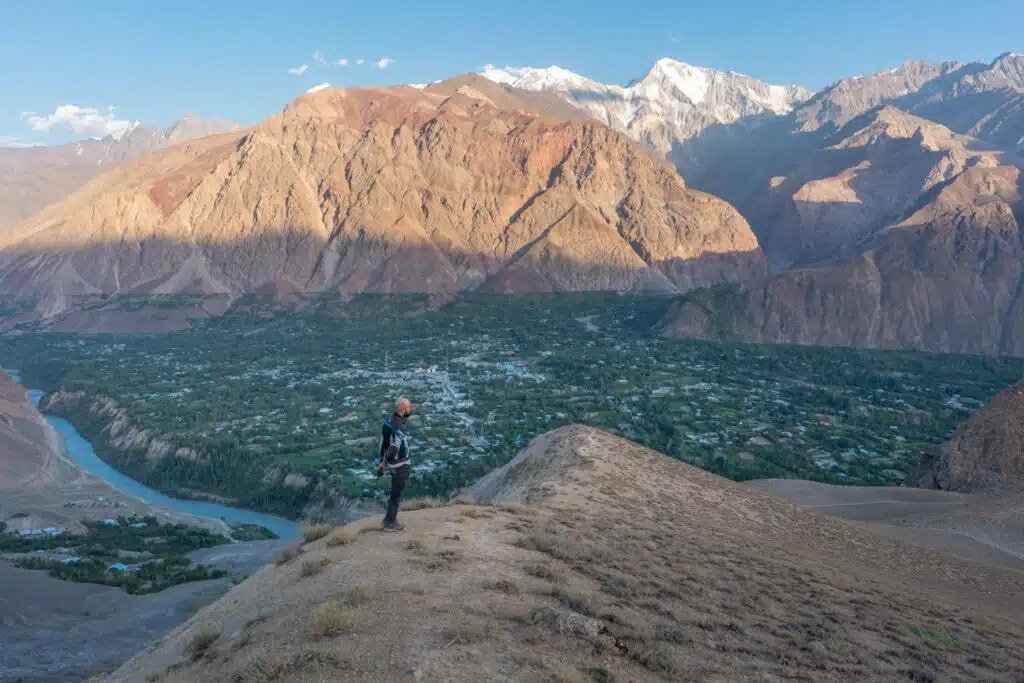
Start with the setting. Booni sits in the foothills of Buni Zom, its famous fan-shaped landforms — built by ancient glacial deposits — spreading beneath the town like a geological amphitheater. Above it rise the Qaqlasht Meadows, a vast plateau over 2,200 metres high that turns velvet green each spring and hosts one of the region’s great festivals. Look west and the white pyramid of the Tirich valley peaks fills the horizon. This is big-mountain country, and Booni puts you right in the middle of it, with proper beds, a real bazaar, and hot food at the end of every trekking day.
Then there is the culture. Booni is a Kho town — the Kho people, speaking Khowar, are Chitral’s main ethnic group — and it wears its heritage proudly: the old Shahi Masjid from the princely era, a bustling bazaar, and a community famous across the region for its educational achievements. In April the town becomes the gateway to Jashn-e-Qaqlasht, the ancient spring festival of freestyle polo, traditional wrestling, and music on the meadows above. In winter, the Shipishoon meadow above the village hosts skiing. In summer, Booni is the launch pad for treks into the Yarkhun, Torkhow, and Broghil valleys.
Booni is perfect for trekkers who want a real town as their base rather than a tent, for festival travelers chasing the April celebrations, for photographers drawn to the fan-shaped valley and the big peaks, and for anyone driving the great Chitral–Mastuj–Gilgit route who wants to break the journey somewhere with genuine character. It is not a resort — it is better than that. It is a working mountain capital, and it will treat you like a guest, not a customer.
History of Buni (Booni)
Booni’s recorded modern history begins in 1885, when it was established under the British government as an administrative center — a telling date, marking the moment the high valleys were drawn into the strategic chessboard of the Great Game. But the town’s deeper story belongs to the princely state of Chitral, ruled for centuries by the Katoor dynasty under the title of Mehtar. The old Shahi Masjid in Booni, attributed to the Mughal era by local tradition, hints at even older connections between these valleys and the empires to the south.
Through the princely period, Booni grew as a market and garrison town on the route north — the place where the valleys of Torkhow, Yarkhun, and Mastuj met the main Chitral artery. When the princely state merged into Pakistan in the late 1960s, Booni continued its administrative role, and in recent years, with the old Chitral district divided, it became the headquarters of the new Upper Chitral District — cementing its status as the capital of the high valleys.
The town’s more dramatic recent history is written in water and ice. Lying near glacial lakes beneath Buni Zom, Booni has faced flooding several times, most severely in August 2024, when glacial melting combined with heavy monsoon rains devastated parts of the region. The floods were a stark reminder of the climate pressures facing the entire Hindu Kush-Himalaya region — and of the resilience of mountain communities that rebuild, replant, and carry on. Visitors today will find a town that is very much alive: its bazaar busy, its schools renowned, and its meadows waiting for spring.
Top Things to Do in Buni (Booni)
Climb to the Qaqlasht Meadows
The single essential Booni experience. The vast Qaqlasht plateau, over 2,200 metres above sea level, spreads above the town like a green ocean — in early spring it blooms with lime-green grass and tiny yellow flowers, with jagged Hindu Kush peaks hammering the horizon. The sunset views from the top, reaching toward the far Wakhan, are worth the climb alone. In April the meadows host the great spring festival (see below); the rest of the year they are perfect for picnics, photography, and easy hiking.
Experience Jashn-e-Qaqlasht in April
If you can time your visit for April, do it. Jashn-e-Qaqlasht is the ancient spring festival of northern Chitral — a tradition locals trace back thousands of years, once organized by the region’s rulers and revived in modern times as a calendar event. The four-day celebration features freestyle polo of the mountain communities, football, tug of war, shot putt (the oldest living sport in the region), traditional wrestling, marksmanship with the antique muzzle-loader “chikit,” the endangered sport of Bodi Dik, and day-and-night cultural events with reed instruments, the Chitrali sitar, the pasture flute, and poetry. Thousands of visitors, including international travelers, now attend.
Visit the Shahi Masjid
Booni’s historic Shahi Masjid, attributed by local tradition to the Mughal era, is known for its intricate architecture and is a favorite stop for history and architecture enthusiasts. It stands as a quiet monument to the centuries when these valleys were tied to the empires of the south.
Wander Booni Bazaar
The town’s bustling bazaar is the commercial heart of Upper Chitral — shops selling everything from traditional handicrafts and dried fruits to modern necessities, with ATMs and small eateries. It is the best place to stock up before heading into the upper valleys, and a fine spot for people-watching over a cup of tea.
Trek from Booni into the High Valleys
Booni is the classic launch pad. Head north to Mastuj and onward — east toward Gilgit via the Shandur route, or north into the Broghil valley. West lies the beautiful Torkhow valley; the famous multi-day trek into the Rech and upper Yarkhun valleys starts nearby. Closer to town, the lush Shipishoon meadow above the village draws crowds in spring and summer — and hosts skiing in winter. The Charun rock inscription, preserved under a UNESCO-supported shelter just off the main road south of town, makes a fascinating stop on the way in or out.
Famous Places In and Around Buni (Booni)
- Qaqlasht Meadows — the great plateau above town; festival ground in April, hiker’s paradise year-round.
- Shahi Masjid — Booni’s historic Mughal-era mosque.
- Booni Bazaar — the market heart of Upper Chitral.
- Shipishoon Meadow — lush green meadow above the village; skiing in winter.
- Charun Rock Inscription — ancient inscription preserved under cover by the main road.
- Mastuj — the next town north, gateway to Yarkhun, Broghil, and the Shandur route to Gilgit.
- Torkhow Valley — a beautiful side valley west of the main route.
How to Reach Buni (Booni)
Booni lies about 80 kilometres north of Chitral town along the Chitral River, and every route to it runs through Chitral. The journey is long but spectacular — this is one of Pakistan’s great mountain road trips.
From Islamabad: Drive north through Mardan and Dir, then through the 10.4-kilometre Lowari Tunnel into Chitral — the full Islamabad–Chitral leg takes 10–14 hours. From Chitral town, continue north along the river to Booni: about 80 kilometres, roughly 2.5–3 hours by shared jeep, van, or private car, with dramatic valley views the whole way.
From Lahore: Take the M-2 to Islamabad (4–5 hours), then follow the Islamabad route. Most Lahore travelers overnight in Islamabad or Dir.
From Karachi: Fly to Islamabad (about 2 hours) and continue overland or by air to Chitral. The full road journey from Karachi is not practical in one stretch.
From Gilgit: The adventurous alternative — the long mountain road via Shandur Pass and Mastuj to Booni. Check seasonal road conditions; the pass is typically open in summer only.
Nearest airport: Chitral Airport, with scheduled Islamabad flights when mountain weather permits. Islamabad International Airport is the main gateway for the overland route.
Road conditions and transport: The Lowari Tunnel section is paved; the Chitral–Booni road follows the river on a mountain shelf — paved in stretches, rough in others. Shared jeeps and vans run regularly between Chitral town and Booni; private hire gives more flexibility for stops at Charun and the viewpoints. Winter travel is possible via the tunnel, but upper routes (Shandur, Broghil, Yarkhun) close with snow. The road stays open to Booni itself in winter, when the town sits snow-dressed and quiet.
Route Details
Classic itinerary: Day 1 — pre-dawn departure from Islamabad, drive via Dir and the Lowari Tunnel to Chitral town (night halt). Day 2 — morning drive north to Booni (2.5–3 hours), stopping at the Charun rock inscription; afternoon in Booni Bazaar and the Shahi Masjid. Day 3 — full day at the Qaqlasht Meadows (hiking, photography, sunset). Day 4 onward — onward to Mastuj and the upper valleys, or return to Chitral. For Jashn-e-Qaqlasht in April, add festival days and book transport and beds well ahead.
Where to Stay in Buni (Booni)
For a mountain town of its size, Booni offers solid options. The PTDC Motel Booni is the reliable standby — clean, government-managed rooms at reasonable rates, popular with families and first-time visitors. Beyond it, the town has a range of private hotels, guesthouses, and mountain lodges across budget and mid-range tiers, plus good-quality village guesthouses in the surrounding settlements for a more local experience. Facilities are comfortable rather than luxurious: expect hot water and heating in the better places, simpler arrangements in budget lodges. Winter visitors should confirm heating; summer visitors should book ahead for April (festival) and the June–August trekking season. For the upper valleys beyond Booni, accommodation thins out fast — stock up on comfort here.
Where to Eat: Local Foods of Buni (Booni)
Chitrali food is distinct from the Punjabi and Pashtun cuisines most Pakistanis know, and Booni is a great place to discover it. Start with shoshp — flat wheat noodles in a savory broth — and zholai, the tangy soured-milk dish that is pure mountain comfort. Pandir muzhi (local cheese preparations) appears in various forms, and the valleys’ dried apricots, mulberries, and walnuts are eaten with everything. Trout from the mountain streams, chapli kebabs, and pulao are widely available for less adventurous palates, and the bazaar’s dhabas serve filling Pakistani staples at budget-friendly prices. In April, festival food stalls around Qaqlasht add to the feast. A full day of eating in Booni costs a fraction of city prices — and the apricots alone are worth the trip.
Weather in Buni (Booni)
At 2,085 metres, Booni has a true mountain climate: warm, sun-drenched summers (the valley’s direct sun exposure makes summer days surprisingly warm), and extremely cold winters. The average annual temperature is around 15.6°C, with about 418mm of precipitation yearly — most of it falling as winter snow and spring rain.
| Season | Temperature Range | Conditions |
|---|---|---|
| Winter (Dec–Feb) | -10 to 5°C | Extremely cold, snow-dressed town; upper valleys snowbound; skiing at Shipishoon |
| Spring (Mar–May) | 5–20°C | Apricot and cherry blossoms; Jashn-e-Qaqlasht in April — the valley’s most photographed weeks |
| Summer (Jun–Sep) | 15–30°C | Warm days, long light; full access to trekking routes; occasional rain |
| Autumn (Oct–Nov) | 5–20°C | Poplars and orchards turn gold and red; dry, still air; superb photography |
Language and Culture of Buni (Booni)
Booni is a Kho town: the residents are Kho people (also called Chitralis), and Khowar — the language of Chitral — is the mother tongue. Urdu is widely spoken and understood, especially in the bazaar and hotels. The population includes both Ismaili and Sunni Muslims, living side by side in the valley’s tradition of tolerance. Kho culture is famous for its hospitality, its music (the Chitrali sitar is beloved across the north), its polo, and its poetry — and Booni, known for its educational achievements, is one of the culture’s proudest centers. Visitors should dress modestly, ask before photographing people, and accept offered tea graciously — refusing hospitality is taken more seriously here than in the cities. During religious observances, keep noise down near mosques and follow local custom.
Shopping in Buni (Booni)
Booni Bazaar is the place to shop for the upper valleys. Look for the region’s signature souvenirs: the pakol (the round Chitrali wool cap now famous worldwide), hand-woven woolen shawls and fabrics, and traditional embroidery. Food souvenirs are the real prize — dried apricots, mulberries, walnuts, and local honey, all produced in the surrounding valleys and sold fresh in the bazaar. Prices are fair and bargaining is gentle. Stock up here before heading north: beyond Booni, shops become few and far between. There are no shopping malls — and that is exactly as it should be.
Local Events and Festivals
Booni’s festival calendar centers on Jashn-e-Qaqlasht, held on the Qaqlasht Meadows each April to celebrate the arrival of spring. The festival’s roots run deep — local tradition traces it back thousands of years to the era of Chitral’s princely rulers, and it was revived in modern times as an annual calendar event. The four days feature freestyle polo of the Hindu Kush mountain communities, football, tug of war, cricket, shot putt, traditional wrestling, marksmanship with the antique “chikit” muzzle-loaders, the endangered sport of Bodi Dik, and day-and-night cultural programs of reed-instrument music, Chitrali sitar, pasture flute, and poetry. The festival now draws thousands of visitors, including international travelers, and has become Upper Chitral’s signature event. Exact dates are announced each year — typically mid-April — so confirm before traveling and book early.
Travel Tips for Buni (Booni)
Packing Essentials
Sun protection is critical — the high-altitude sun is fierce even when the air is cool. Bring layers for big day-night temperature swings, sturdy trekking shoes, a warm jacket for evenings (year-round), and a water bottle. If trekking onward, carry a basic first-aid kit and any personal medications.
Safety Tips
Booni is a settled, welcoming town on the main Chitral artery. The main risks are environmental: stay clear of stream beds and flood channels during rain (the region’s glacial-flood history, including August 2024, is a real caution), check weather before mountain drives, and use experienced local drivers on the upper roads. Travel with a companion or guide when trekking beyond the town.
Money & Connectivity
ATMs exist in Booni Bazaar, but carry sufficient cash — machines can run dry in peak season and cards are rarely accepted. Mobile signals cover the town but weaken quickly in the side valleys; download offline maps before leaving Chitral town. Jazz and Telenor have the best coverage in the region.
Best Time to Visit Buni (Booni)
Spring (Mid-March–Mid-April) — Festival Season
The valley’s most beautiful weeks: apricot and cherry blossoms across the orchards, the meadows greening, and Jashn-e-Qaqlasht filling Qaqlasht with polo, music, and crowds. Book early.
Summer (Mid-April–Mid-October) — Trekking Season
Long, warm days with temperatures of 15–25°C and full access to the Yarkhun, Torkhow, Broghil, and Mastuj routes. The classic season for adventure travelers.
Autumn (Mid-October–Mid-November) — Golden Season
Poplars, apricots, and cherries turn yellow, orange, and deep red under dry, still skies. Fewer visitors, razor-sharp mountain views, superb photography.
Winter (Mid-November–Mid-March) — Snow Season
The road via the Lowari Tunnel stays open, the town sits snow-dressed, and skiing happens at Shipishoon. Cold but magical — for travelers who like their mountains quiet and white. The upper valleys are snowbound.
Final Thoughts
Booni will never be the most famous town in the Hindu Kush, and the Kho people who live there seem perfectly happy about that. While the tour buses chase the famous valleys, Booni gets on with being what it has always been: the working capital of the high country, the keeper of the spring festival, the town at the foot of the meadows where the mountains begin in earnest.
Come in April for the polo and the blossoms, in summer for the great treks north, in autumn for the gold, or in winter for the snow and the silence. Whichever season you choose, Booni will do what mountain capitals do best — feed you, shelter you, point you toward the high valleys, and send you on your way with a story. In a region full of destinations, it is that rarest of things: a genuine base camp with a soul.
FAQs
Where is Buni (Booni) located?
Booni is a town in Upper Chitral District, Khyber Pakhtunkhwa, on the Chitral River in the foothills of Buni Zom — about 80 kilometres (2.5–3 hours) north of Chitral town.
Is Booni the same as Buni?
Yes — Buni and Booni are two spellings of the same town (بونی). Both are widely used.
What is Booni famous for?
Being the headquarters of Upper Chitral District, its fan-shaped glacial landforms, the nearby Qaqlasht Meadows, and the Jashn-e-Qaqlasht spring festival each April.
When is the best time to visit Booni?
Mid-March to mid-April for blossoms and the Qaqlasht festival; mid-April to mid-October for trekking; October–November for autumn colors; winter for snow and skiing at Shipishoon.
How do I reach Booni from Islamabad?
Drive to Chitral via the Lowari Tunnel (10–14 hours) or fly Islamabad–Chitral, then continue 80 km north to Booni by jeep or van (2.5–3 hours).
Is Booni safe for tourists and families?
Yes — it is a settled district headquarters on the main route, welcoming to visitors. Take normal mountain precautions: local drivers, weather awareness, and caution near streams in rainy weather.
Where can I stay in Booni?
The PTDC Motel Booni plus a range of private hotels, guesthouses, and village lodges across budget and mid-range tiers. Book ahead for April and the summer trekking season.
What local food should I try in Booni?
Chitrali specialties like shoshp (noodle broth), zholai (soured milk), and local cheese, plus dried apricots, walnuts, and honey from the bazaar. For more northern adventures, see our Hunza Valley guide and the Explore Pakistan collection.
, Upper Chitral? Discover why it deserves your visit, the best time to go, top things to do and how to reach.)