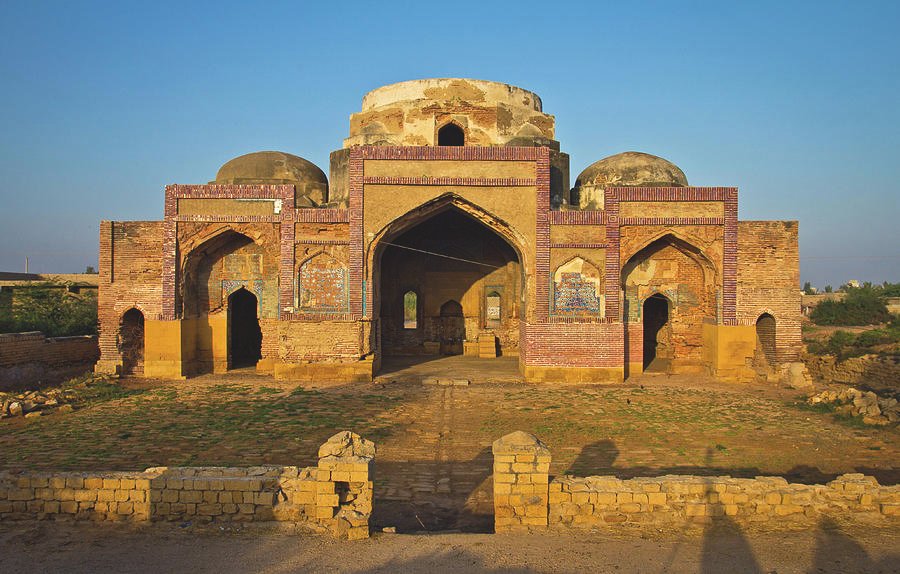
Every traveller who has stood before Lahore’s Badshahi Mosque has felt the full thunder of Mughal architecture. But a few kilometres away, near the railway station, stands a mosque that captures the same spirit in miniature — Dai Anga’s Mosque, built in 1635 by the wet nurse of Emperor Shah Jahan, its walls blazing with the blue, orange, and yellow tilework that made Lahore famous. This Dai Anga’s Mosque travel guide will show you why this exquisite small mosque deserves your visit — and the best time to go.
Heritage lovers and architecture fans, this one is for you. If you have ever wished you could see a Mughal mosque up close without the crowds — close enough to touch the tiles, to study every floral motif — Dai Anga’s Mosque is your answer. It is a scaled-down jewel of the same tradition that produced the Badshahi and Wazir Khan mosques, built by a remarkable woman, battered by history, and still alive with daily prayer. Come for the tiles; stay for the story.
Quick Facts
- Location: Naulakha area, southeast of Lahore Railway Station, Lahore, Punjab, Pakistan
- Nearest City: Lahore city centre — minutes from the railway station
- Famous For: A 1635 Mughal mosque commissioned by Dai Anga, Shah Jahan’s wet nurse; exquisite blue, orange, and yellow qashani tilework
- Accessibility: Road — easy to reach by car, rickshaw, or on foot from the railway station area
- Known Landmarks: The three-domed prayer hall; 84-foot-wide courtyard; four minarets
- Best For: Architecture lovers, history enthusiasts, heritage photographers, and travellers exploring Mughal Lahore
Why Visit Dai Anga’s Mosque
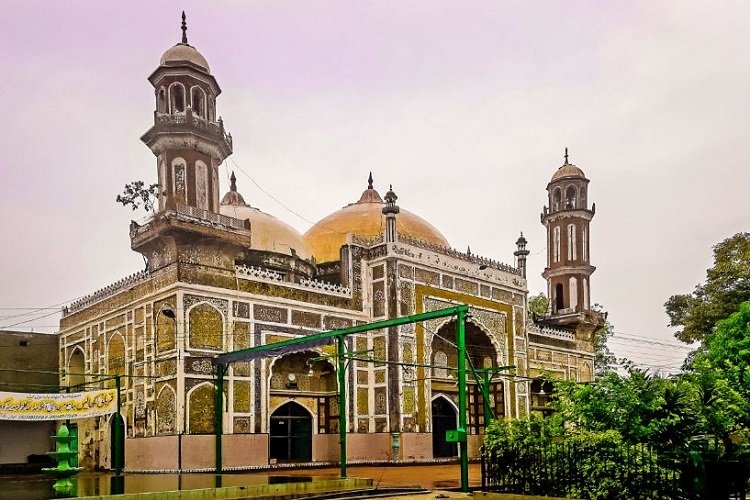
Let us start with the tiles. The exterior of Dai Anga’s Mosque is wrapped in qashani tilework — predominantly blue, orange, and yellow — laid out in floral designs so fine that they echo the great Wazir Khan Mosque across the walled city. Stand before the central facade in the morning light and the colours seem to glow from within the brickwork. For lovers of Islamic art, this is one of Lahore’s most rewarding small sites: every panel rewards close looking, and there are no crowds jostling you away from it.
The story behind the mosque is just as compelling. It was commissioned by Dai Anga — born Zeb-un-Nisa — the wet nurse of the Mughal Emperor Shah Jahan, one of the most respected women of the royal household. She had it built before departing on the Hajj pilgrimage, a pious foundation from a woman whose family served the Mughals with distinction: her husband Murad Khan served Emperor Jahangir as Magistrate of Bikaner, and her son Muhammad Rashid Khan was reckoned the finest archer in the kingdom before dying in the service of Shah Jahan’s eldest son, Dara Shikoh. To visit this mosque is to meet Mughal history through the eyes of the remarkable women who shaped it.
Then there is the sheer drama of its survival. This mosque has been a gunpowder magazine under Maharaja Ranjit Singh, the private residence of a British newspaper editor, and the office of a railway traffic manager — sold to the railway for Rs 12,000 in the 19th century. In 1903, after Lord Curzon himself expressed dismay at its treatment, it was returned to the Muslim community and restored as a place of worship. Few buildings in Pakistan have lived so many lives. Standing in its courtyard, you are standing in a survivor.
And unlike so many monuments, this one is alive. Dai Anga’s Mosque is an active place of worship — the call to prayer still sounds from its minarets, and the community still gathers in its courtyard. Visiting lets you experience Mughal architecture not as a museum piece but as a living, breathing part of Lahore. Come with respect, and you will be welcomed.
History of Dai Anga’s Mosque
The mosque is said to have been built in 1635, in the reign of Shah Jahan — the emperor of the Taj Mahal — though an inscription within the mosque dates it to 1649. It was commissioned by Dai Anga, born Zeb-un-Nisa, the emperor’s wet nurse and a woman of great standing at the Mughal court. She ordered its construction before her departure for the Hajj, the pilgrimage to Makkah — a final pious act before the journey of a lifetime. Inscriptions in the mosque also record that its construction was supervised by a certain Maqbul, whose identity remains uncertain.
Dai Anga’s family was woven into the fabric of the empire. Her husband, Murad Khan, served the Emperor Jahangir as Magistrate of Bikaner. Her son, Muhammad Rashid Khan, was celebrated as the best archer in the kingdom and died fighting in the service of Dara Shikoh, Shah Jahan’s eldest son. Her own tomb — known as Gulabi Bagh — stands elsewhere in Lahore, in the Begumpura area, and the two monuments together tell the story of one extraordinary family.
The mosque’s later history reads like an adventure novel. After the decline of Mughal power, it fell into rough hands: under Maharaja Ranjit Singh it was used as a military magazine, a storehouse for gunpowder. Following the British annexation of Punjab in 1849, it was converted into a private residence for Henry Cope, the editor of the Lahore Chronicle — imagine living your daily life inside a 17th-century mosque. Cope later sold it to the Punjab and Delhi Railway Company for Rs 12,000, and the building served as the office of the railway traffic superintendent, the old Mohallah Dai Anga having been acquired for the railway.
Rescue came in 1903. Lord Curzon, the Viceroy, expressed his dismay at the treatment of the mosque and other Mughal monuments, and the building was reclaimed, conserved, and returned to the Muslim community as a place of worship. Today it is listed as a Protected Heritage Monument of the Archaeology Department of Punjab — and, beautifully, it is once again what its founder intended: a living mosque.
Top Things to Do in Dai Anga’s Mosque
Remember that this is an active mosque. Visit outside prayer times, dress modestly, remove your shoes, and ask permission before photographing worshippers. With that respect shown, the mosque rewards you richly.
Study the Qashani Tilework
Begin with the exterior facade, the mosque’s glory. The central portion is elaborately decorated with predominantly blue, orange, and yellow qashani tilework — floral designs laid with a precision that echoes the Wazir Khan Mosque. Move slowly along the wall and pick out individual motifs: each panel is a small masterpiece of 17th-century ceramic art. Morning light brings the colours alive.
Walk the 84-Foot Courtyard
The mosque is fronted by a courtyard some 84 feet wide — a generous open space that gives the small building room to breathe. Stand at its centre and take in the composition: the three-section prayer hall, the central 19-foot dome flanked by two 16-foot domes, the four minarets. It is a masterclass in Mughal proportion, scaled down to human size.
Enter the Prayer Hall
Step inside (when prayers are not in progress) and look up at the three domes from within. The interior once displayed fine frescoes; these have largely been replaced by modern tiles over the centuries, but the bones of the 17th-century design remain — the arches, the proportions, the play of light. Sit quietly for a few minutes and feel the calm that has drawn worshippers here for nearly four centuries.
Trace the Building’s Many Lives
As you walk the courtyard, run through the mosque’s biography in your mind: a noblewoman’s pious foundation in 1635; a Sikh-era gunpowder magazine; a British editor’s residence; a railway office; and finally, since 1903, a mosque again. Few buildings anywhere have been so many things. Look for the worn patches and repairs — each is a scar with a story.
Pair It with the Tomb of Dai Anga
Complete the family story with a visit to the Tomb of Dai Anga — the Gulabi Bagh — in Begumpura, not far away. The mosque and the tomb were raised by and for the same remarkable woman, a century-defining figure of Mughal Lahore. Visiting both in one day gives you the full arc of her legacy.
Famous Places In and Around Dai Anga’s Mosque
- Tomb of Dai Anga (Gulabi Bagh): The founder’s own tomb in Begumpura — the essential companion visit.
- Cypress Tomb: The strange, beautiful tower-tomb just north of the Tomb of Dai Anga.
- Lahore Railway Station: The grand colonial-era station, a landmark in its own right, just northwest.
- Badshahi Mosque: The great imperial mosque — compare its scale with Dai Anga’s intimate proportions.
- Wazir Khan Mosque: The tilework masterpiece whose ceramics echo Dai Anga’s facade.
- Lahore Fort: The imperial fortress, a short drive away in the old city.
How to Reach Dai Anga’s Mosque
Dai Anga’s Mosque sits in the Naulakha area, southeast of Lahore Railway Station — right in the urban heart of Lahore, which makes it one of the easiest heritage sites in the city to reach. Any driver in Lahore knows the railway station; from there it is a short hop.
From Islamabad: About 375 km via the M-2 motorway, roughly 4.5 to 5 hours by car. From Lahore’s motorway exits, follow signs toward the railway station / Naulakha. Daewoo and other bus services run constantly between Islamabad and Lahore.
From within Lahore: The mosque is minutes from the railway station by rickshaw or car — ask for “Dai Anga Masjid” near Naulakha. Careem, Uber, and auto-rickshaws all serve the area, and it pairs perfectly with a walled-city day covering the Badshahi Mosque, Lahore Fort, and Wazir Khan Mosque.
From Karachi: Around 1,200 km by road, so fly — about 1 hour 45 minutes to Allama Iqbal International Airport, then 30–40 minutes by road to the mosque area.
The nearest airport is Allama Iqbal International Airport, Lahore, and the nearest railway station is Lahore Railway Station itself — fitting, given the mosque’s own railway history. The surrounding streets are busy and congested; a rickshaw handles the final approach best. Visit between prayers (mid-morning is ideal) and dress modestly.
Route Details
- Reach Lahore via M-2 (from Islamabad), flight, or rail (from Karachi and elsewhere).
- Head for Lahore Railway Station, the area’s great landmark.
- From the station, go southeast toward Naulakha — ask any driver for “Dai Anga Masjid.”
- Remove shoes, dress modestly, and enter outside prayer times; the courtyard is the best place to begin.
- Combine with the Tomb of Dai Anga (Gulabi Bagh) and the Cypress Tomb in Begumpura for the full story.
Where to Stay in Dai Anga’s Mosque
The mosque is in central Lahore, so you stay in Lahore — and the city offers superb options at every price, all within a short ride of Naulakha.
Luxury: Lahore’s five-star hotels around Gulberg and the Mall Road offer full-service comfort — pools, spas, and fine dining — about 20–30 minutes from the mosque depending on traffic.
Mid-range: Gulberg, Model Town, and Johar Town have excellent three- and four-star hotels and serviced apartments at sensible prices, well connected to the railway station area.
Budget and guesthouses: The railway station area and the old city have numerous budget hotels and family-run guesthouses — basic, convenient, and unbeatable for travellers building their days around Mughal monuments. Staying near the station puts Dai Anga’s Mosque within walking distance.
For a Mughal-heritage itinerary, base yourself near the old city or Gulberg: the mosque, the Badshahi Mosque, the Lahore Fort, and the Wazir Khan Mosque then all fall within easy reach.
Where to Eat: Local Foods of Dai Anga’s Mosque
You are in Lahore — eating well is unavoidable. The streets around the railway station and Naulakha are lined with humble, excellent eateries serving daal, sabzi, chanay, and fresh tandoori roti at very budget-friendly prices: this is where working Lahore eats, and the food is honest and delicious.
For the full Lahori experience, make the short trip to Fort Road Food Street near the Badshahi Mosque: nihari, paya, seekh kebabs, mutton karahi, and chargha, eaten with the illuminated mosque as your backdrop. Lakshmi Chowk offers the old city’s legendary dahi bhallay, gol gappay, and late-night halwa puri. Finish with kulfi or rabri, and never leave Lahore without a tall glass of lassi. A street-level meal is budget-friendly; mid-range restaurants cost more but remain excellent value.
Weather in Dai Anga’s Mosque
Dai Anga’s Mosque shares Lahore’s climate — fierce summers, a dramatic monsoon, and mild winters. Since the best of the mosque is its outdoor tilework and courtyard, the cool months are the time to come.
| Season | Temperature Range | Conditions |
|---|---|---|
| Winter (Dec–Feb) | 7°C – 22°C | Mild days, cool nights, occasional morning fog; perfect for heritage walks. |
| Spring (Mar–Apr) | 15°C – 34°C | Pleasant in March, heating up by April; visit in the morning. |
| Summer (May–Jun) | 26°C – 40°C+ | Intensely hot and dry; visit at dawn or dusk only. |
| Monsoon (Jul–Sep) | 27°C – 36°C | Heavy rain, especially July–August; humid, with glorious light after storms. |
| Autumn (Oct–Nov) | 14°C – 34°C | Dry and cooling; October is one of Lahore’s most pleasant months. |
Language and Culture of Dai Anga’s Mosque
The mosque stands in a Punjabi-speaking neighbourhood where Urdu is universally understood; English is widely spoken in hotels and by guides. Lahore’s culture is famously warm and hospitable — expect curiosity and kindness from locals.
Because this is an active mosque, etiquette matters more here than at a ruin. Dress modestly — cover shoulders and knees, and women should carry a headscarf. Remove your shoes before entering the prayer hall or stepping onto prayer mats. Avoid visiting during the five daily prayers (especially the Friday noon congregation) unless you are there to pray, keep your voice low, and always ask before photographing worshippers. A respectful visitor is a welcome visitor — and the community that prays here is proud of its beautiful mosque.
Shopping in Dai Anga’s Mosque
There is no market at the mosque itself, but Lahore’s great bazaars are a short ride away. Anarkali Bazaar — one of South Asia’s oldest markets — is the place for khussay (embroidered shoes), shawls, and Mughal-inspired handicrafts. Ichhra and Liberty Market offer fabrics, clothes, and jewellery at bargain prices, while the stalls near Fort Road sell miniature paintings, camel-skin lamps, and calligraphy — perfect mementos of a mosque-centred trip. Bargaining is expected: start around two-thirds of the asking price, keep smiling, and enjoy it.
Travel Tips for Dai Anga’s Mosque
Packing Essentials
Modest clothing (a headscarf for women), comfortable slip-on shoes (you will remove them often), a sun hat, sunscreen, water, and a camera. A small pair of socks is useful — mosque courtyards can be hot underfoot in summer. Carry a power bank; the tilework will keep your camera busy.
Safety Tips
The railway station area is busy and best visited during daylight. Keep valuables discreet in crowds, use ride-hailing rather than unknown vehicles, and stay aware of your surroundings as in any big-city transport hub. Inside the mosque, watch your step on the old stonework and do not lean on fragile sections.
Money & Connectivity
ATMs are plentiful around the railway station and in Lahore’s commercial districts — withdraw before heading into the old lanes. Mobile signals are strong across Lahore on all major networks with excellent 4G. Nearby street vendors are cash-only, so keep small notes handy.
Best Time to Visit Dai Anga’s Mosque
Winter (November to February) — The Ideal Season
Cool, clear days made for lingering in the courtyard with your camera. This is the best time to visit Dai Anga’s Mosque — the tiles glow in the low winter sun, and the walk from the railway station is a pleasure.
Spring (March to April) — Lovely Mornings
March is delightful; April warms up. Visit mid-morning, then continue to the walled city’s other mosques before the heat builds.
Summer and Monsoon (May to September) — For the Hardy
Lahore’s summer is punishing. If you visit then, come at dawn, and note that monsoon light after a storm can be spectacular for photography — just watch for slippery courtyard stones.
Autumn (October) — The Sweet Spot
October’s dry, golden days are arguably the finest for photographing the tilework — clear skies, soft light, and comfortable temperatures.
Final Thoughts
Dai Anga’s Mosque is proof that in Lahore, greatness comes in all sizes. It has no imperial scale, no royal patron — just a remarkable woman, a handful of master tile-makers, and a small courtyard where the colours of the Mughal age still burn bright after nearly four centuries. It has survived as a gunpowder store, a newspaper editor’s house, and a railway office; today it survives as what it was always meant to be — a place of prayer, and a place of beauty.
So when you are in Lahore, take the short detour to Naulakha. Stand in the courtyard, look up at the blue and yellow tiles, and remember Zeb-un-Nisa — the wet nurse of an emperor, who built for eternity before sailing for the Hajj. For more of Pakistan’s hidden heritage, explore our Explore Pakistan collection — and if you are heading north, our Malam Jabba guide shows you the mountains at their best.
FAQs
Where is Dai Anga’s Mosque located?
In the Naulakha area, southeast of Lahore Railway Station, Lahore, Punjab.
Who built Dai Anga’s Mosque?
It was commissioned by Dai Anga (born Zeb-un-Nisa), the wet nurse of Mughal Emperor Shah Jahan, in 1635 (an inscription dates it to 1649), before her Hajj pilgrimage.
When is the best time to visit?
November to February, when Lahore’s weather is cool and ideal for exploring the courtyard and tilework.
How do I reach Dai Anga’s Mosque?
Fly or drive to Lahore, then take a rickshaw or car to Naulakha near the railway station — ask for “Dai Anga Masjid.” From Islamabad it is about 375 km via the M-2.
Is it an active mosque?
Yes — it is a living place of worship. Visit outside prayer times, dress modestly, and remove your shoes.
Is it safe for families?
Yes, during daylight hours. The area around the railway station is busy, so keep children close and valuables discreet.
What is the mosque famous for?
Its exquisite blue, orange, and yellow qashani tilework, its three domes (19 ft central, 16 ft flanking), and its extraordinary history — from gunpowder magazine to railway office to restored mosque.
What else should I see nearby?
The Tomb of Dai Anga (Gulabi Bagh), the Cypress Tomb, the Badshahi Mosque, the Wazir Khan Mosque, and the Lahore Fort.
What food should I try nearby?
Lahore’s classics — nihari, paya, chanay, and kebabs at Fort Road Food Street or Lakshmi Chowk, with kulfi and lassi to finish.