Quick Facts
- Location: Leepa Valley, Hattian Bala District, Azad Jammu and Kashmir
- Altitude: Around 2,490 metres (8,170 feet) above sea level
- Famous For: Green alpine meadows, walnut and apple orchards, gateway point into Leepa Valley, snow in winter
- Nearest City: Muzaffarabad, about 71 kilometres away
- Accessibility: Reached by road from Reshian (4 km); 4×4 jeep recommended after Reshian Pass
- Known Landmarks: Dao Khan Pass, AJK Tourism rest house, terraced fields and traditional wooden houses
- Best For: Nature lovers, families, photographers, campers and anyone seeking a quiet mountain escape
High in the hills above the Leepa Valley floor sits Dao Khan, a village that most travellers pass through on their way into Leepa but that deserves a stop of its own. This dao khan travel guide will help you decide whether this quiet hamlet should be your next mountain destination in Azad Kashmir.
Why Visit Dao Khan
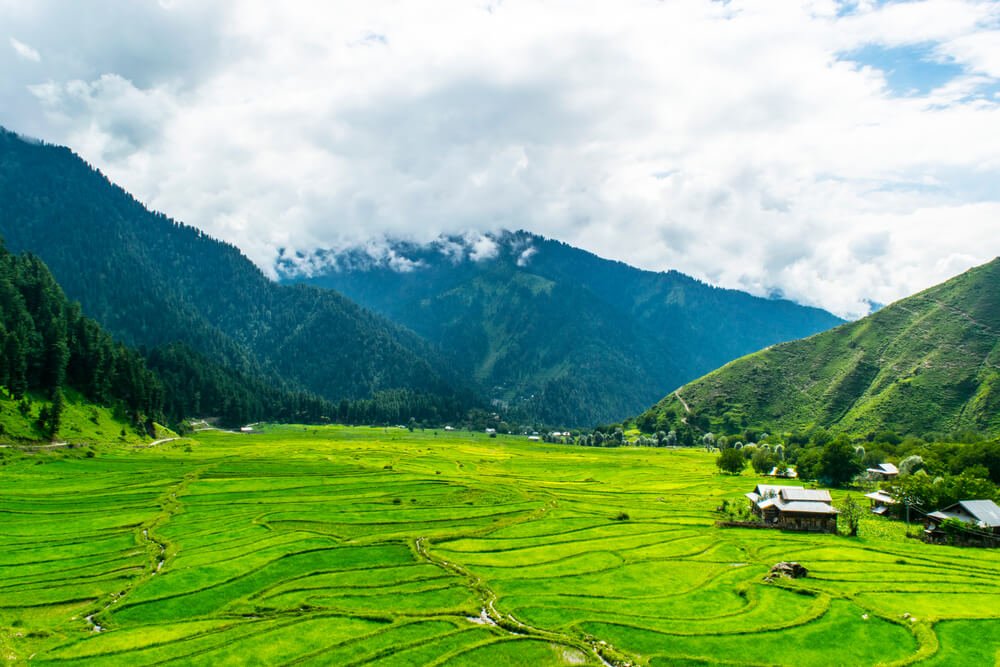
Dao Khan is one of those rare places where you arrive planning to stay an hour and end up staying a day. Perched at nearly 2,500 metres on the Reshian side of Leepa Valley, it is the first major meadow hamlet travellers meet after crossing the high Reshian Pass — and the change in mood is instant. The narrow, climbing road opens onto broad green pastures dotted with walnut and apple trees, traditional timber-and-mud Kashmiri houses, and a view that rolls all the way down the valley. It feels like the mountain exhaling after the steep climb up.
What makes Dao Khan special is that it sits right between two worlds. Behind it lies the forested ascent from Reshian, with Sher Gali top at 2,750 metres just beyond the trees; ahead of it lies the full spread of Leepa Valley — the red-rice fields, the orchards, the villages of Moji, Leepa and Chananian. From Dao Khan you can genuinely feel like you are standing at the doorway of one of the most beautiful valleys in Pakistan, and that is exactly what this place is: the doorway. Many seasoned travellers say the Dao Khan meadows are the best single viewpoint on the entire Reshian–Leepa route.
It is also wonderfully low-key. Dao Khan has no bazaars, no traffic, no crowds. A handful of local families, terraced wheat and maize fields, grazing cattle and sheep, and the government rest houses where travellers have stayed for years. If your idea of a perfect trip is a morning chai on a grassy slope with clouds moving through pine forest, Dao Khan is your place. And because it sits at a comfortable altitude — high enough for cool air even in July, low enough to explore without altitude trouble — it suits families, older travellers and first-time mountain visitors as well as hardy trekkers.
For photographers, the light here is the real prize. Dawn mists lift off the meadows to reveal tiered green ridges; late afternoon sun turns the wooden houses gold. In winter, the same meadows bury themselves under heavy snow, and Dao Khan becomes a small white wilderness accessible only to those willing to brave the Reshian Pass road. Whichever season you choose, this is Azad Kashmir at its most honest — no commercial tourism, just mountain, field, forest and sky.
History of Dao Khan
Dao Khan does not have the written, date-stamped history of a fort or a city — and that is true of most villages in the Leepa Valley. Its story is really the story of Leepa itself: a remote, self-sufficient Kashmiri valley near the Line of Control that lived for centuries on farming, timber, fruit orchards and the famous terraced rice fields that still define its landscape. The valley’s five sectors — Nowkot, Kasirkot, Dao Khan, Leepa and Chananian — reflect an old administrative and clan-based division of this high valley, and Dao Khan has always been the western gateway sector, the one travellers from Muzaffarabad meet first.
For much of its history, Leepa Valley was reached only by footpaths and mule tracks over the Reshian Pass, and villages like Dao Khan survived winters in near isolation, storing walnuts, dried fruit, maize and red rice from autumn harvests. The Kashmir conflict after 1947 left the valley close to the Line of Control, and for decades tourism here was minimal — the region simply was not on travellers’ maps the way Neelum Valley was.
That began to change in the 2000s as road work improved the Muzaffarabad–Reshian route, and the AJK Tourism and Archaeology Department placed rest houses at key points, including Dao Khan. In recent years, Leepa Valley — and with it Dao Khan — has quietly entered the itineraries of domestic travellers hunting for the “next” Kashmir destination after Neelum, and travel writers and vloggers have brought its meadows to national attention. Dao Khan remains what it has always been: a working mountain village that happens to sit on one of the prettiest roads in the country.
Top Things to Do in Dao Khan
Walk the Dao Khan Meadows
The meadows around the village are the main event. Early morning walks through the pasture, between walnut trees and terraced fields, give you the classic Leepa Valley panorama — layered green ridges fading into the haze. Bring a camera; the combination of wooden houses, grazing cattle and drifting cloud makes for endlessly changing compositions.
Drive or Hike to Sher Gali Top
A short distance beyond Dao Khan toward Leepa, the road climbs to Sher Gali top at about 2,750 metres, where on a clear day you can see mountain tops as far as Rati Gali in Neelum Valley and Kaghan Valley. It is cold even in summer, so carry a jacket. The road is a classic Himalayan hairpin descent through forest — one of the great short drives in Azad Kashmir.
Explore Traditional Kashmiri Houses
Dao Khan’s timber-and-mud houses, with their steep wooden roofs built to shed heavy snow, are beautiful examples of Kashmiri mountain architecture. Walk the village lanes, greet the residents, and see how the famous red rice is threshed and stored. Locals are famously hospitable, and a polite request often ends with an invitation to sit for tea.
Overnight Camping Under the Stars
With almost no light pollution, the night sky above Dao Khan is spectacular. Campers can pitch tents on the meadows (ask a local family for permission and a spot) and wake to sunrise breaking over the valley. Summer nights are cool and comfortable; winter camping is only for the well-equipped.
Visit the Reshian Viewpoint on the Way In or Out
Reshian, just 4 kilometres away, offers sweeping views back toward Muzaffarabad and across the Jhelum valley. Most travellers stop here for photos; from Dao Khan it makes an easy short drive or a pleasant hour-long walk.
Famous Places In and Around Dao Khan
- Reshian: The gateway hamlet below Dao Khan, famous for panoramic views and the start of the Reshian Pass road.
- Sher Gali Top (2,750 m): The high point between Dao Khan and Leepa, with views to Neelum and Kaghan on clear days.
- Moji Village: The first village of the valley proper after the Sher Gali descent, with classic wooden houses.
- Leepa Village: The heart of the valley, about an hour’s drive ahead, known for rice fields, orchards and apple terraces.
- Manda Kuli Bela: Large flat green meadows deeper in the valley, a favourite picnic spot.
- Shamsha Bari: A forested area of Leepa Valley ideal for short walks.
- Muzaffarabad: The capital city of Azad Kashmir, 71 km back down the road, with the Red Fort and old bazaars.
If you are building a longer Kashmir itinerary, pair this trip with our guides to other northern favourites — the Malam Jabba travel guide is a good companion read, and the whole Explore Pakistan series covers the region in depth.
How to Reach Dao Khan
There is only one practical road into Dao Khan: the Muzaffarabad–Hattian Bala–Reshian–Dao Khan–Leepa route. From Islamabad you drive to Muzaffarabad first (about 140 km via the Murree–Kohala or Muzaffarabad Expressway route, roughly 4 hours), then continue north-east from Muzaffarabad toward Hattian Bala and Reshian. The 71 km stretch from Muzaffarabad to Dao Khan takes 3–4 hours depending on road conditions and traffic, as the road climbs steeply to the Reshian Pass before dropping to Dao Khan’s meadows.
From Lahore the journey is longer — Lahore to Islamabad is about 380 km (4–5 hours on the motorway), then add the Islamabad–Muzaffarabad–Dao Khan legs, making this a full-day drive that many travellers split with a night in Islamabad or Muzaffarabad. From Karachi, the realistic option is to fly to Islamabad and then drive; the road distance exceeds 1,500 km and is not practical in one go.
The nearest airport is Islamabad International Airport. There is no railway station anywhere near the valley. Local transport on the Reshian–Dao Khan section is best done in a 4×4 jeep or a sturdy car — the final climb to Reshian Pass (about 3,200 metres) is narrow, with hairpin bends and occasional landslide patches, especially after rain. Public transport runs as far as Hattian Bala and sometimes Reshian in season; beyond that, hire a jeep locally or join a tour van from Muzaffarabad. In winter the road beyond Reshian frequently closes with snow — always check current conditions before setting out between December and March.
Route Details
- Islamabad → Muzaffarabad (about 140 km, 3.5–4 hours) via Murree–Kohala road or Muzaffarabad Expressway.
- Muzaffarabad → Hattian Bala (about 25 km) — paved road, bazaar town for supplies and fuel.
- Hattian Bala → Reshian — mountain road climbing steadily; stop at viewpoints.
- Reshian → Reshian Pass (about 3,200 m) — the highest, narrowest section; drive slowly.
- Reshian Pass → Dao Khan (about 4 km down) — the road drops into the famous meadows; the AJK rest houses are here.
- Dao Khan → Sher Gali (2,750 m) → Leepa village — onward into the valley proper.
Where to Stay in Dao Khan
Accommodation in Dao Khan is simple and that is part of the charm. The best-known option is the AJK Tourism Department’s guest house in the village — an eight-room rest house with basic full amenities and, by all accounts, a lovely view of the surrounding meadows. It is popular in season, so try to book in advance through the tourism department in Muzaffarabad.
The AJK Forest Department also maintains a rest house here. Both are mid-range government guest houses rather than luxury hotels: clean rooms, meals on request, and unbeatable locations. Private hotels are few at Dao Khan itself, but a short drive onward into Leepa village and Reshian offers more guesthouses and small family-run hotels of mid-range standard. Many travellers simply use Dao Khan as a scenic stop and sleep in Leepa, where the choice is wider.
For the adventurous, camping on the meadows is the most memorable option of all — tents, a campfire and a sky full of stars. Bring your own gear, warm bedding even in summer, and all food supplies, as there are no shops in the village. Carry cash; there are no ATMs anywhere near.
Where to Eat: Local Foods of Dao Khan
Dao Khan has no restaurants in the conventional sense — meals come from the guest houses, from local families, or from your own supplies. But the food of the Leepa Valley is worth the trip on its own. The valley’s signature is its unique red rice, grown on the terraced fields you will see all around — a variety rarely found elsewhere in Pakistan, traditionally served with red beans (lobia). Ask your host to serve you this combination; it is the taste of Leepa.
Wider Kashmiri mountain cooking is on offer too: slow-cooked mutton, haak (collard greens cooked in mustard oil), dum aloo, and the famous noon chai (pink salty tea) served with local breads. In the orchards of Dao Khan and Leepa grow apples, walnuts and apricots — fresh in autumn, dried through winter — and local honey, harvested from small bees in the valley, is considered exceptional. Walnuts from this region are bought by traders in Karachi even before harvest.
Stock up in Muzaffarabad or Hattian Bala before climbing: bread, snacks, and any special food you need. A hot meal at a guest house is budget-friendly by city standards. And whatever you do, accept the kahwa or noon chai if a villager offers — refusing hospitality is a bigger mistake than any wrong turn.
Weather in Dao Khan
At around 2,490 metres, Dao Khan has a true mountain climate: cool summers, cold winters, and weather that can change in an hour. Pack layers whatever the month. The road’s winter closures are the single biggest weather factor in planning — always confirm access before a December-to-March trip.
| Season | Temperature Range | Conditions |
|---|---|---|
| Winter (Dec–Feb) | -5 to 8 °C | Heavy snowfall; the meadows turn into a white wilderness. Road from Reshian often closed. |
| Spring (Mar–May) | 5 to 20 °C | Melting snow, blooming orchards, fresh green fields. Roads reopen by April–May. |
| Summer (Jun–Aug) | 12 to 28 °C | Lush green meadows, cool breezes, occasional monsoon showers. Peak visiting season. |
| Autumn (Sep–Nov) | 5 to 22 °C | Golden fields, apple and walnut harvest, clear skies. Beautiful and quieter. |
Language and Culture of Dao Khan
The people of Dao Khan and the wider Leepa Valley are Kashmiris with deep mountain traditions, speaking the local Pahari/Kashmiri dialect alongside Urdu, which every visitor can use to communicate. Life here is rural and agricultural — families work the terraced fields, tend orchards and livestock, and store the autumn harvest to carry them through the snowbound winter.
Culture is warm and hospitality-driven. Guests are genuinely honoured, and you will often be offered tea or a meal with little warning. Dress modestly out of respect for local norms — this is a conservative rural community, and women travellers should keep shoulders and legs covered. Ask permission before photographing people, especially women and children. The valley is close to the Line of Control; carry your CNIC or passport, cooperate with any checkpoints, and avoid wandering toward restricted border areas.
Shopping in Dao Khan
Dao Khan itself has no shops to speak of — buy what you need in Muzaffarabad or Hattian Bala on the way up. The valley’s real shopping happens in Leepa’s small bazaar and from village homes: dried walnuts, apricots and apples, local honey, and hand-woven items. Kashmiri shawls and embroidered cloth can occasionally be found through local families; prices are negotiable and buying direct supports the household economy. There are no shopping malls anywhere near — and that is rather the point of coming here.
Travel Tips for Dao Khan
Packing Essentials
Warm layers even in summer (nights are cold at 2,490 m), a windproof jacket, sturdy walking shoes, sunscreen and sunglasses, a first-aid kit, power bank, torch, and all food and cash you will need. Winter trips need full snow gear and a flexible schedule in case the road closes.
Safety Tips
The Reshian Pass road is narrow with steep drops — drive in daylight, never at night, and let an experienced local driver take the wheel if you are unsure. Carry CNIC/passport for checkpoints. Mobile signals are patchy; tell someone your plan before the climb. Avoid the LoC-adjacent ridgelines; stick to village and meadow areas.
Money & Connectivity
Carry all cash from Muzaffarabad or Hattian Bala — no ATMs, no card payments in the village. Jazz and Telenor signals work intermittently in the valley; expect long stretches with no coverage. Electricity can be intermittent; a power bank is essential.
Best Time to Visit Dao Khan
Summer (June to August) — The Classic Season
The meadows at their greenest, orchards in fruit, cool air and fully open roads. This is when most travellers come, and when the guest houses are busiest. Book ahead.
Autumn (September to November) — The Photographer’s Season
Harvest time: golden fields, walnut and apple picking, crisp clear skies and far fewer visitors. Arguably the most beautiful weeks of the year here.
Spring (April to May) — The Bloom
Melting snow feeds waterfalls, orchards blossom, and the valley wakes up green. Roads are usually open by late April.
Winter (December to March) — For Snow Seekers Only
A stunning white wilderness, but the Reshian road frequently closes and temperatures drop well below freezing. Attempt only with local guidance and a flexible plan.
Final Thoughts
Dao Khan is not a place that shouts for attention — it is a place that rewards the traveller who stops. In a region full of famous valleys, this quiet meadow village at the doorstep of Leepa offers something increasingly rare: mountain beauty without the crowds, hospitality without the performance, and a landscape that changes by the hour. Whether you stay an hour on the way to Leepa or a week in a rest-house room above the clouds, Dao Khan earns its place in your Kashmir story.
Come in summer for green meadows, in autumn for harvest gold, and come prepared — with warm clothes, a full tank, cash in pocket and an open schedule. The valley will take care of the rest. Plan your route with this dao khan travel guide, check the road before you climb, and let the mountains do what they do best: slow you down.
FAQs
Where is Dao Khan located?
Dao Khan is a village in Leepa Valley, Hattian Bala District of Azad Jammu and Kashmir, about 71 km from Muzaffarabad and 4 km from Reshian, at an altitude of around 2,490 metres.
What is the best time to visit Dao Khan?
May to November is the best window, with June–August the greenest and September–October the most golden. Winter brings heavy snow and frequent road closures.
How do I reach Dao Khan from Islamabad?
Drive Islamabad to Muzaffarabad (about 140 km, 4 hours), then continue via Hattian Bala and Reshian over the Reshian Pass — 71 km more, taking 3–4 hours. A 4×4 or sturdy car is recommended.
Is Dao Khan safe for tourists?
Yes — it is a peaceful, hospitable village. Carry ID for checkpoints, avoid restricted border areas, drive the mountain road in daylight, and check winter road conditions before travelling.
Is Dao Khan good for families?
Very. The altitude is comfortable, the guest houses are family-friendly, and the meadows are safe for children to explore. Pack warm clothes for everyone.
Where can I stay in Dao Khan?
The AJK Tourism Department guest house (eight rooms) and the Forest Department rest house are the main options; camping on the meadows is also popular. More guesthouses are available onward in Leepa village.
What local food should I try?
Leepa’s famous red rice with red beans (lobia), walnuts, apples, apricots, local honey, noon chai (pink tea) and Kashmiri mountain dishes like haak and dum aloo.
Can I visit Dao Khan in winter?
Only with caution — the Reshian Pass road frequently closes in snow and temperatures fall well below freezing. The snow scenery is spectacular if you can get there with local help.