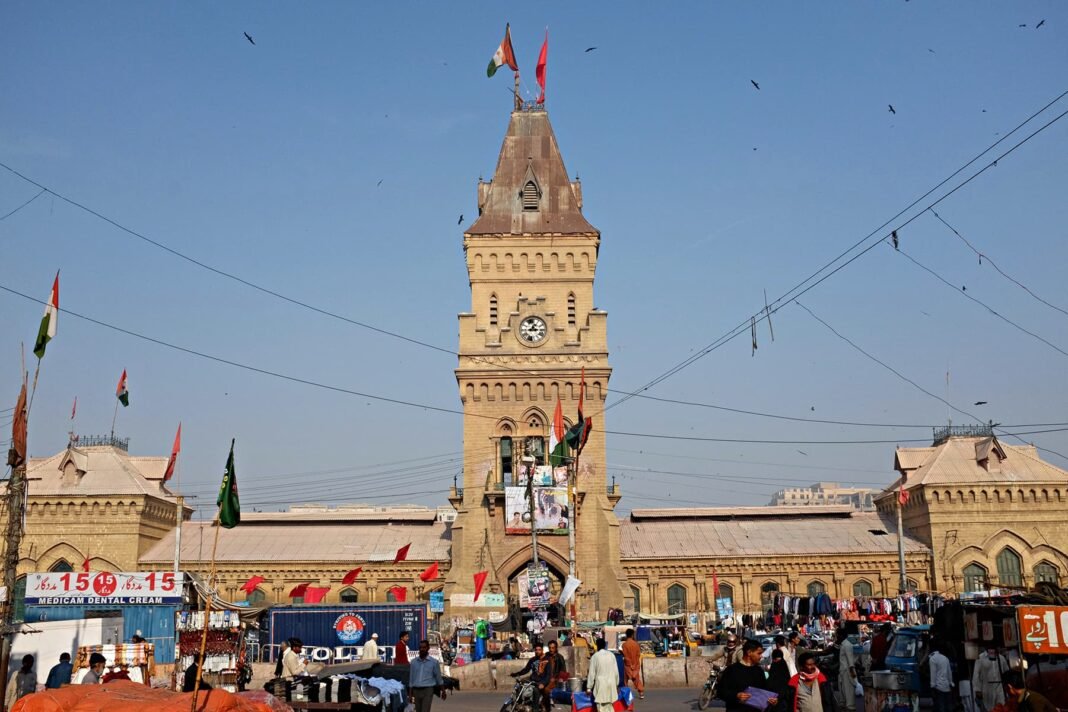
Some markets sell groceries. Empress Market sells history. Standing at the beating heart of Saddar in Karachi, this 19th-century stone bazaar — with its towering clock, arched galleries, and the smell of fresh spices hanging in the air — is the single best place in Pakistan to feel what a colonial port city once was, and what a modern megacity still is. If you want to understand Karachi beyond the headlines, you don’t start at a mall. You start here, where the city has come to shop every single day since 1889. This Empress Market travel guide will help you decide when to go, what to see, what to eat nearby, and how to make the most of one of the most atmospheric half-days of sightseeing in the country.
Quick Facts
- Location: Saddar, Karachi, Sindh — at the junction of Preedy Street, Abdullah Haroon Road, and MA Jinnah Road
- Altitude: Sea level (coastal city)
- Famous For: Indo-Gothic colonial architecture, the 140-foot clock tower, spice and dry-fruit stalls, and being Karachi’s most historic working bazaar
- Nearest City: Karachi itself — the market sits in the city center
- Accessibility: Very easy — reachable by car, taxi, ride-hailing, bus, and the Karachi Circular Railway vicinity; walking once you’re in Saddar
- Known Landmarks: The 140-ft clock tower with skeleton dials, the central courtyard with its four galleries, Frere Hall and Jahangir Park nearby
- Best For: History lovers, photographers, food travelers, architecture enthusiasts, and anyone who wants the real Karachi
Why Visit Empress Market
Because very few places in Pakistan let you time-travel for free. Empress Market opened in 1889, when Karachi was a growing colonial port and Queen Victoria was Empress of India. Walk under its vaulted arches today and you are walking the same galleries where traders have haggled over spices, cloth, and fresh produce for well over a century. The building itself is the attraction: honey-colored stone, cusped arches, a courtyard ringed by galleries, and above it all a 140-foot clock tower that has watched this city grow from a modest port town into a megacity of 17 million people.
But this is not a museum piece behind glass — it is gloriously, noisily alive. Mounds of red chillies and turmeric glow beside pyramids of dates and dried apricots. Butchers, fishmongers, spice merchants, and textile sellers work the same stalls their grandfathers worked. The surrounding Saddar streets — full of Victorian-era facades, old cinemas, and tea stalls — make the whole neighborhood feel like an open-air museum of Karachi’s past. If your idea of travel is standing in the middle of a city’s real, beating heart rather than posing in front of a monument, Empress Market is exactly where you belong.
Photographers, take note: the light inside the courtyard in the morning, filtering through the arches, is extraordinary. The clock tower photographs beautifully at golden hour. And the street life around the market — porters balancing loads, old men sipping chai, the rainbow of the spice stalls — is some of the richest documentary material in the country. Food travelers get their reward a short walk away on Burns Road, Karachi’s legendary food street, where the same day can end with nihari, haleem, kebabs, and kulfi.
Finally, come for the story. This market was built on ground where sepoys were executed after the 1857 uprising against British rule — a deliberate act of colonial symbolism. To stand there knowing that history, then watch a 21st-century city swirl around the old stone, is to understand something real about Pakistan: layered, resilient, and endlessly absorbing its past into its present. That is why this place deserves a morning of your trip — not as a shopping errand, but as an education in what Karachi truly is.
History of Empress Market
The Empress Market was constructed between 1884 and 1889 and named for Victoria, Empress of India. According to contemporary accounts, the site was chosen partly to prevent the erection of a monument honoring the sepoys who were executed there after the failed 1857 uprising against British rule — a stark reminder that colonial architecture was often as much about power as it was about commerce.
The foundation stone was laid on 10 November 1884 by James Fergusson, the then Governor of Bombay (who also laid the foundation of the Merewether Memorial Tower), and the market was inaugurated on 21 March 1889. It was designed by James Strachan, the Karachi municipal engineer, in the Indo-Gothic style — vaulted roofs, cusped arches, and a 140-foot-high clock tower studded with leopard heads and fitted with skeleton iron dials on all four sides. The foundations were completed by the English firm of A.J. Attfield, and the building itself was constructed by the local firm of Mahoomed Niwan and Dulloo Khejoo. The building was arranged around a courtyard of 130 by 100 feet, with four galleries each 46 feet wide, providing accommodation for 280 shops and stall keepers. At the time of its construction it was one of only seven markets in Karachi — and at the opening ceremony, the then commissioner noted that only Crawford Market of Bombay surpassed it in beauty and grace in the whole British Presidency.
The market kept growing with the city. In 1954, the Karachi Municipal Corporation increased the number of shops to 405 and built an additional 1,390 shops and cabins outside the building, gradually surrounding the old stone with dense informal commerce. In 1995, the government designated Empress Market a protected heritage site. Then, in November 2018, following a Supreme Court order, an anti-encroachment operation removed more than 1,000 informal stalls around the building. The operation reopened views of the historic facade for the first time in decades — but it also cost many long-standing traders their livelihoods, a reminder of the human cost behind urban renewal. In recent years, restoration efforts have aimed to repair the aging British Raj structure, and the market continues its second century as both a working bazaar and one of Karachi’s most important heritage landmarks.
Top Things to Do in Empress Market
Admire the Indo-Gothic Architecture
Before you buy a single thing, slow down and look at the building. The pointed cusped arches, the vaulted roofs, the symmetry of the four galleries around the central courtyard — this is one of the finest surviving examples of colonial civic architecture in Pakistan. Walk the full loop of the galleries, look up at the clock tower from the courtyard, and notice how the design keeps the interior cool and ventilated despite Karachi’s heat. The tower’s four skeleton iron dials and chiming clock were state-of-the-art in the 1880s and remain the market’s signature silhouette against the Saddar skyline.
Explore the Spice and Dry-Fruit Stalls
The most sensory part of any Empress Market travel guide is the spice quarter. Stalls heaped with red chillies, turmeric, cardamom, cinnamon, and blended masalas line the galleries, and the air carries their warmth for meters around. Next to them, vendors sell dates, dried apricots, pistachios, almonds, and walnuts in generous mounds — the dry-fruit trade has been a staple here for generations. Take your time, ask before photographing vendors (a smile and a small purchase go a long way), and buy a bag of mixed dry fruit; it makes an excellent gift and costs far less than in a supermarket.
Wander the Produce, Meat, and Fish Halls
Empress Market remains a working food bazaar, and the produce, meat, and fish sections show Karachi’s food economy in full flow. Fruit and vegetable vendors display the season’s best from Sindh and beyond — mangoes in summer, citrus and guavas in winter. The meat and fish halls are busy, old-school, and not for the faint of heart, but they are fascinating for anyone interested in how a city of millions feeds itself. This is daily-life Karachi at its most unfiltered.
Browse Textiles and Household Goods
Beyond food, the galleries hold cloth merchants, tailors’ suppliers, and household-goods stalls selling everything from cooking pots to plastic ware. Prices here are honest working-market prices, and gentle bargaining is expected. It is a good place to pick up everyday fabrics and simple souvenirs without the markup of the city’s boutiques.
Visit the Bird and Pet Shops
One of the market’s quirkiest traditions is its cluster of pet shops selling birds, fish, and small animals. The colorful cages draw crowds of children and curious visitors. Whether or not you buy anything, the bird section is a lively, photogenic corner of the market — just move through respectfully and keep your camera low-key.
Walk Saddar’s Colonial Streetscape
The experience doesn’t end at the market doors. The streets around Empress Market — Preedy Street, Zaibunnisa Street, Abdullah Haroon Road — are lined with Victorian-era buildings, old banks, bookshops, and tea houses. A slow walk in any direction rewards you with colonial facades, street vendors, and the controlled chaos that makes Saddar feel like a living museum. Pair it with the market visit and you have a full heritage morning.
Famous Places In and Around Empress Market
- Frere Hall — completed in 1865, this early colonial-era building with its gardens is a short drive away and one of Karachi’s loveliest heritage spots.
- Burns Road Food Street — Karachi’s legendary food street, famous for nihari, haleem, kebabs, and kulfi; the perfect evening follow-up to a market morning.
- Jahangir Park — a recreational park located near the market, good for a breather after the crowds.
- Mazar-e-Quaid (Jinnah Mausoleum) — the white marble mausoleum of Pakistan’s founder on MA Jinnah Road, an essential Karachi stop.
- Mohatta Palace — a 1927 palace-turned-museum in Clifton showcasing art and heritage exhibitions.
- Bagh Ibne Qasim — Clifton’s large seaside park, ideal for a sunset walk after your Saddar explorations (see our Bagh Ibne Qasim travel guide).
- Abdullah Shah Ghazi Shrine — the revered seaside shrine in Clifton, one of Karachi’s most visited spiritual sites (see our Abdullah Shah Ghazi Shrine travel guide).
How to Reach Empress Market
Reaching Empress Market is straightforward because it sits in the middle of Karachi, Pakistan’s largest city and main transport hub. If you are already in Karachi, the market is a 20 to 40-minute drive from most central areas — Clifton, DHA, Gulshan, or the airport — depending on traffic. Saddar is one of the most congested parts of the city, so plan extra time, and consider parking a little farther out and walking the last stretch. Ride-hailing apps operate widely in Karachi and are the simplest option for visitors. Local buses and minibuses also converge on Saddar from every direction.
From Lahore, Karachi is roughly 1,200 km to the south — a full day’s drive via the motorway network (M-2/M-3/M-4/M-5 to Sukkur, then the N-5/M-9 corridor to Karachi), typically 14 to 16 hours with stops. Overnight and daytime flights from Lahore to Jinnah International Airport take about 1 hour 45 minutes, and trains on the Karachi–Peshawar line run daily. From Islamabad, the road distance is roughly 1,400 km (18 to 20 hours of driving), while direct flights take around 2 hours. From Jinnah International Airport, Empress Market is about 15 to 20 km — a 30 to 45-minute drive depending on traffic.
Route Details
- By air: Fly into Jinnah International Airport (Karachi), then take a ride-hailing car or taxi via Shahrah-e-Faisal toward Saddar.
- By road from the airport: Follow Shahrah-e-Faisal west, turn onto the Saddar roads leading to Preedy Street — Empress Market sits at the junction with Abdullah Haroon Road and MA Jinnah Road.
- Within Saddar: Once you see the clock tower, you’re there. The market occupies a full block; enter through any of the arched gateways.
- By train: Arrive at Karachi Cantonment (Cantt) Railway Station and take a 10 to 15-minute taxi or rickshaw ride to Saddar.
- Timing tip: Go in the morning (9 to 11 AM) when the market is fully awake but the midday heat and the worst of the crowds haven’t arrived yet.
Where to Stay in Empress Market
Empress Market is a day-visit destination in central Karachi, not an overnight stop in itself — but where you stay in the city shapes your experience of it. The good news is that Karachi offers accommodation for every budget within easy reach of Saddar. Budget travelers will find simple guesthouses and budget hotels in and around Saddar itself, putting the market, Burns Road, and the colonial streetscape within walking distance. Mid-range hotels cluster along Shahrah-e-Faisal and in Gulshan-e-Iqbal, offering comfortable rooms with easy ride-hailing access to the market in 20 to 30 minutes. For a more polished stay, the Clifton and DHA areas near the sea host the city’s well-known upscale hotels and serviced apartments — a 25 to 40-minute drive from Empress Market depending on traffic, but with the bonus of sea-view evenings after your heritage morning. Whatever your tier, staying anywhere central keeps the market, Frere Hall, and Burns Road all within one easy day’s plan.
Where to Eat: Local Foods of Empress Market
You don’t eat lunch inside Empress Market — you eat around it, and Karachi rewards you richly for the short walk. Head to Burns Road, the city’s legendary food street, for the definitive Karachi meal: slow-cooked nihari (beef shank stew eaten with naan), haleem (a thick wheat-and-meat porridge topped with ginger and fried onions), seekh kebabs and fry kebabs from decades-old shops like Waheed Kabab House, and bun kebabs from street carts. Finish with matka kulfi or falooda from the famous dessert shops, or rabri — sweetened condensed milk simmered low and slow. For something lighter, Karachi’s biryani — fragrant, fiery, and served everywhere — is a national icon in its own right, and a cold lassi from Punjab Lassi House washes it all down.
The beauty of eating near Empress Market is the price: this is working-city food at working-city prices. A hearty street-food dinner with dessert on Burns Road is genuinely budget-friendly — expect to eat very well for a few hundred rupees per person. Most of the old food street’s vendors accept cash only, so carry Pakistani rupees. For a sit-down meal, the Food Centre building on Burns Road offers cleaner, family-friendly seating with the same classic dishes. And if you want the full local rhythm, do what Karachiites do: market in the morning, rest through the afternoon heat, and Burns Road in the evening when the street is at its liveliest.
Weather in Empress Market
Karachi sits on the Arabian Sea, which gives it a coastal climate: milder than the interior plains but humid for much of the year. Winters are the city’s glory season — dry, sunny, and genuinely pleasant. Summers are hot and humid, and the monsoon brings sticky heat with occasional heavy rain. Because Empress Market involves a lot of walking outdoors, the weather matters more than you might think; plan your visit for the cooler months if you have the choice.
| Season | Temperature Range | Conditions |
|---|---|---|
| Winter (Nov–Feb) | 10–26°C | Dry, sunny, and comfortable — the ideal season for market wandering and Saddar walks |
| Spring (Mar–Apr) | 20–35°C | Warming up; mornings still pleasant, afternoons getting hot |
| Summer (May–Jun) | 28–38°C | Hot and humid sea air; visit early morning and stay hydrated |
| Monsoon (Jul–Sep) | 28–34°C | Humid with occasional heavy showers; streets can flood briefly after rain |
| Autumn (Oct) | 22–34°C | Heat easing off; a good shoulder month for visiting |
Language and Culture of Empress Market
Karachi is Pakistan’s most diverse city, and you will hear it in the market: Urdu is the common language of trade, English is widely understood in shops and hotels, and you’ll also catch Sindhi, Punjabi, Pashto, Balochi, and more in the crowd. The vendors are Karachi’s famous mix of communities — Muhajirs, Memons, Punjabis, Pashtuns, Baloch, and others — which is part of why the market feels like the whole country compressed into a few acres.
Culturally, a few notes help. Dress modestly and comfortably — loose clothing and closed walking shoes, since you’ll be on your feet in a crowded place. Bargaining is normal and expected, but keep it friendly; a smile and a little Urdu (“kitnay ka hai?” — how much is it?) goes a long way. Always ask before photographing people, especially women. The market is busiest and most atmospheric in the morning, and Friday afternoons are quieter during prayer time. As in any crowded bazaar anywhere in the world, keep your wallet secure and your bag zipped.
Shopping in Empress Market
Shopping here is about authenticity and value, not boutiques. The star buys are spices — freshly ground masalas, whole cardamom, cinnamon, and chillies sold by weight — and dry fruits: dates, pistachios, almonds, dried apricots, and walnuts in generous mounds. The textile stalls sell everyday fabrics and ready-made basics at honest prices, and the household-goods section is a treasure hunt of kitchenware and practical items. The pet and bird shops are worth browsing even if you’re not buying. For a modern contrast, Atrium Mall on nearby Zaibunnisa Street offers branded shopping, a food court, and cinemas if you want air-conditioned retail after the bazaar. Bargain politely everywhere in the market — the first price is a starting point, not a verdict.
Travel Tips for Empress Market
Packing Essentials
Comfortable closed walking shoes (the market floors are old stone), a light daypack, sunscreen and a hat for the courtyard and street walks, a reusable water bottle, and cash in small notes. A camera or phone with good low-light ability helps inside the galleries. If visiting in winter, a light jacket for the sea breeze; in summer, the lightest clothes you own.
Safety Tips
Saddar is busy and generally safe for daytime visitors, but it is crowded — keep valuables out of sight, use a cross-body bag, and be alert in the densest lanes. Go in the morning or early afternoon rather than late at night. Stick to well-lit main streets after dark. Traffic around the market is chaotic; cross roads carefully and use footbridges where available.
Money & Connectivity
Carry cash — most market vendors and Burns Road food stalls are cash-only. ATMs are easy to find on the main Saddar roads (banks line Abdullah Haroon Road and Zaibunnisa Street). Mobile signals from all major networks are strong throughout central Karachi, and mobile data works well for ride-hailing and maps.
Best Time to Visit Empress Market
Winter (November to February) — The Perfect Season
This is when Karachi shows off. Dry air, blue skies, temperatures in the teens and twenties — you can wander the market and Saddar’s streets for hours in complete comfort. If you can choose your dates, choose these months.
Spring (March to April) — Still Lovely
Mornings remain pleasant and the market is at full energy. Visit before noon to beat the afternoon warmth, and you’ll have a wonderful time.
Summer (May to June) — Go Early
Karachi’s humid heat is real, but it doesn’t have to stop you. Arrive at opening time, do the market in the cooler morning hours, retreat to air conditioning at midday, and return to Burns Road in the evening when the sea breeze picks up.
Monsoon and Autumn (July to October) — The Shoulder Months
Humidity is high and sudden downpours can snarl traffic, but between showers the city is green and the crowds thinner. October, as the heat breaks, is the pick of this stretch.
Final Thoughts
Empress Market is not the shiniest attraction in Pakistan, and that is precisely its power. It is a working monument — a place where 19th-century stone still does its original job in a 21st-century megacity. Come for the architecture, stay for the spices, the street life, and the stories, and leave with a deeper understanding of Karachi than any museum could give you.
Pair your visit with Burns Road in the evening and Frere Hall or the Quaid’s Mausoleum in the afternoon, and you have one of the finest single days of urban exploration in the country. Few destinations reward curiosity as generously as this one — so bring your camera, your appetite, and your sense of wonder. For more ideas across the country, browse our Explore Pakistan collection.
FAQs
Where is Empress Market located?
Empress Market is in Saddar, central Karachi, Sindh, at the junction of Preedy Street, Abdullah Haroon Road, and MA Jinnah Road.
What is the best time to visit Empress Market?
November to February, when Karachi’s weather is dry and pleasant. Mornings (9–11 AM) are the best time of day.
How do I reach Empress Market?
It’s in central Karachi — a 30 to 45-minute drive from Jinnah International Airport, or 10 to 15 minutes from Karachi Cantonment Railway Station. Ride-hailing apps are the easiest option for visitors.
Is Empress Market safe for tourists?
Yes, during daytime it is busy and generally safe, though crowded. Keep valuables secure, use a cross-body bag, and be careful crossing the chaotic roads around Saddar.
Is Empress Market good for families?
Yes — children enjoy the bird shops, the colorful spice stalls, and the clock tower. Go in the morning, keep the visit to 1–2 hours, and combine it with nearby Jahangir Park.
Where should I stay near Empress Market?
Budget guesthouses in Saddar put you within walking distance; mid-range hotels line Shahrah-e-Faisal; upscale options are in Clifton and DHA, 25–40 minutes away.
What food should I try near Empress Market?
Walk to Burns Road for nihari, haleem, seekh kebabs, bun kebabs, biryani, and desserts like matka kulfi, falooda, and rabri — all at very budget-friendly prices.
Why is it called Empress Market?
It was built between 1884 and 1889 and named in honor of Queen Victoria, who was the Empress of India. The foundation stone was laid on 10 November 1884 and the market opened on 21 March 1889.