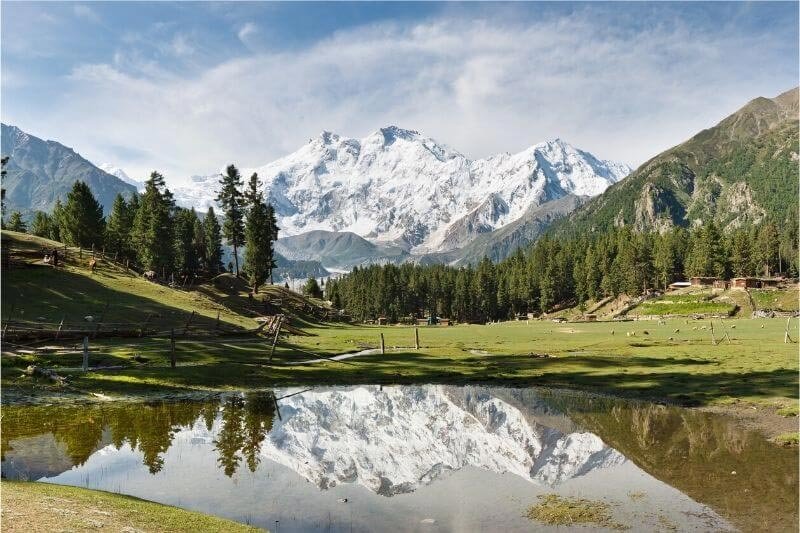
There is a meadow in the mountains of Gilgit-Baltistan where the grass grows absurdly green, the pine forest smells like the beginning of the world, and a wall of rock and ice called Nanga Parbat rises so close you feel you could reach out and touch it. The German climbers who first saw it in the 1930s called it Marchenwiese — “fairy tale meadows” — and the name stuck because nothing else fit. Fairy Meadows is not the easiest place to reach in Pakistan. That is precisely the point. The jeep track, the trek, the thin air — they filter out everyone except those who truly want to be there. And everyone who makes it agrees: this is one of the great mountain views on Earth, earned the honest way. This Fairy Meadows travel guide will help you decide if this is your trip, when to go, and exactly how to reach it.
Quick Facts
- Location: Raikot Valley, Diamer District, Gilgit-Baltistan, Pakistan — beneath the Raikot (north) face of Nanga Parbat
- Altitude: Around 3,300 meters (10,800 feet) above sea level
- Famous For: The dramatic close-up view of Nanga Parbat (8,126 m, the world’s ninth-highest mountain), alpine trekking, wooden huts, and stargazing
- Nearest City: Chilas, on the Karakoram Highway
- Accessibility: Moderate to challenging — 4×4 jeep from Raikot Bridge to Tato village, then a 3–4 hour trek on foot; no road to the meadow itself
- Known Landmarks: The Raikot Face of Nanga Parbat, Beyal Camp, Reflection Lake, the Raikot Glacier, the pine forests of the meadow
- Best For: Trekkers, adventure travelers, photographers, nature lovers, and anyone chasing the classic Pakistan mountain experience
Why Visit Fairy Meadows
Because some views change you, and this is one of them. Stand in the middle of Fairy Meadows at dawn, when the first light hits the Raikot Face of Nanga Parbat and the whole 5,000-meter wall turns gold, and you will understand why mountaineers have been obsessed with this mountain for a century. This is not a distant postcard peak — it is a mountain so close and so vast that it fills your entire southern sky. Few places on the planet put you face-to-face with an 8,000-meter giant without requiring technical climbing, and none of them is quite like this: a soft green meadow, ringed by pine forest, staring straight at the “Killer Mountain.”
Then there is the journey itself, which is half the magic. The jeep track from Raikot Bridge to Tato is one of the most thrilling rides in Pakistan — steep, narrow, and spectacular. The trek up through the pine forest, gaining over a thousand meters, strips away the noise of ordinary life step by step. By the time the trees part and the meadow opens up with Nanga Parbat towering above it, you feel like you have arrived somewhere the modern world forgot to spoil. The meadow is about 1.5 kilometers of green, wildflowers in summer, silence always, and at night a sky so dark the Milky Way looks close enough to touch.
Fairy Meadows is also perfectly pitched for real travelers rather than elite mountaineers. You don’t need ropes, crampons, or expedition experience — you need reasonable fitness, good boots, and a sense of adventure. Families with older children, couples, groups of friends, and solo trekkers all make this journey every season. And once you’re there, the options multiply: day hikes to Beyal Camp at 3,500 meters, treks toward the Nanga Parbat Base Camp at 3,900 meters, horse rides around the meadow, or simply doing nothing at all — which, with that view, is a legitimate and wonderful activity.
Finally, come for the people. The meadow’s wooden huts and camps have been run by local families since 1992, and the Shina-speaking communities of the Raikot Valley are the soul of this place. They drive the jeeps, carry the porters’ loads, cook the food, and tell the stories — including the old local belief that fairies dwell in these meadows. Visiting here supports one of Pakistan’s finest examples of community-based mountain tourism. Choose Fairy Meadows, and you’re choosing the trip you’ll still be talking about in twenty years.
History of Fairy Meadows
Fairy Meadows, locally known as Joot, was for centuries a quiet grazing ground for yaks and goats in the Raikot Valley, part of the Diamer region of what is now Gilgit-Baltistan. The communities here spoke Shina and lived by herding, subsistence farming, and the rhythms of a high mountain valley — the meadow’s extraordinary setting beneath Nanga Parbat was simply home, not yet a destination.
That changed with the age of Himalayan mountaineering. Nanga Parbat — 8,126 meters, the ninth-highest mountain in the world, and notorious as the “Killer Mountain” for its deadly climbing history — drew European expeditions from the early 20th century. German climbers exploring the area in the 1930s were so struck by the meadow’s alpine beauty that they named it Marchenwiese, “fairy tale meadows,” and the English version of the name stuck in mountaineering literature. In 1953, the meadow entered world history when Austrian climber Hermann Buhl used the area as part of his approach before making the first-ever ascent of Nanga Parbat — a legendary solo summit that remains one of mountaineering’s greatest feats. Local legend, meanwhile, holds that the meadows are inhabited by fairies — which may well be where the romance of the name truly comes from.
For decades after, Fairy Meadows remained known mainly to climbers and a handful of intrepid travelers. Since 1992, local families have operated camping sites in the area, and in 1995 the Government of Pakistan declared Fairy Meadows a National Park in recognition of its ecological importance. Since 2021 it has been part of the larger Nanga Parbat National Park. From a mountaineers’ staging ground it has grown, step by careful step, into one of Pakistan’s most beloved trekking destinations — while remaining, mercifully, reachable only by jeep and foot, which has protected it from the overdevelopment that easier places suffer.
Top Things to Do in Fairy Meadows
Watch Sunrise on the Raikot Face
This is the reason you came. Set your alarm before dawn, wrap yourself warmly, and watch the first light strike Nanga Parbat’s Raikot Face. The wall of rock and ice — nearly 5,000 vertical meters rising above the meadow — ignites from grey to gold to blinding white. One honest note for your planning: the huge peak you see from the meadow is actually the North Peak (7,816 m); the true summit (8,126 m) hides behind its massif and the Silver Saddle. The view is no less staggering for it — arguably the most dramatic mountain face in the country.
Trek to Beyal Camp
A half-day hike from the meadow, Beyal Camp sits at around 3,500 meters and brings you noticeably closer to the mountain, with the forest thinning into high alpine terrain. The trail is straightforward for anyone who managed the main trek, and the sense of the mountain looming larger with every step is unforgettable. Many visitors rate the Beyal walk as the highlight of their trip.
Trek Toward Nanga Parbat Base Camp
For the ambitious, the trail continues past Beyal toward the Nanga Parbat Base Camp at around 3,900 meters. This is a long, demanding day — or an overnight with camping gear and a guide — crossing serious high-mountain terrain with the Raikot Glacier for company. You don’t need to be a climber, but you do need strong legs, acclimatization, and respect for the altitude. Standing at the foot of the Killer Mountain’s base camp is a genuine expedition-grade memory.
Visit Reflection Lake
A short walk from the meadow lies a small, still lake that on calm mornings mirrors Nanga Parbat perfectly — the classic Fairy Meadows photograph. Go early, before any breeze ripples the surface, and bring patience: the reflection shot is worth the wait.
Horse Riding and Forest Walks
Horses are available at the meadow for gentle rides around the grassland and into the pine forest — a lovely option for tired legs or for children. The forest trails themselves are worth slow wandering: wildflowers carpet the meadow in summer, and the scent of pine at 3,300 meters is something you will remember for years.
Stargazing
With no city lights for a hundred kilometers, Fairy Meadows has some of the darkest skies in Pakistan. On a clear night the Milky Way stretches overhead in full glory. Bring a warm jacket, lie back on the grass, and look up — it costs nothing and it is priceless.
Famous Places In and Around Fairy Meadows
- Nanga Parbat Base Camp (3,900 m) — the staging ground for summit attempts on the Raikot Face; a serious full-day trek from the meadow.
- Beyal Camp (3,500 m) — the classic half-day viewpoint hike above the meadow.
- Reflection Lake — the mirror-still lake near the meadow, perfect for sunrise photography.
- Raikot Glacier — the glacier descending from Nanga Parbat that feeds the stream flowing to the Indus.
- Tato Village — the trailhead village where the jeep track ends and the trek begins; porters and horses available here.
- Chilas — the nearest town on the Karakoram Highway, your gateway to Raikot Bridge.
- Babusar Top — the spectacular high pass on the route from Naran; a natural add-on to the journey (see our Babusar Top travel guide).
- Astore Valley — another jewel of the region, often combined with a Fairy Meadows trip (see our Astore travel guide).
How to Reach Fairy Meadows
Getting to Fairy Meadows is a two-stage adventure, and you should plan it as part of the experience rather than an obstacle. First, reach Raikot Bridge on the Karakoram Highway — about 80 km south of Gilgit, or roughly an hour’s drive east of Chilas. Most travelers arrive via Gilgit (by air from Islamabad, or by road up the KKH) or drive the KKH from the south through Chilas. From Islamabad, the classic route is the Karakoram Highway north through Mansehra, Battagram, and Chilas to Raikot Bridge — roughly 500 to 600 km of mountain road, a full long day’s drive (14 to 16 hours including stops), so most people break the journey overnight in Naran or Chilas. From Lahore, add the motorway stretch to Islamabad first (about 4 to 5 hours), making it a two-day journey to the bridge. From Karachi, fly to Islamabad or Gilgit and continue by road — the overland route from Karachi is a multi-day expedition in itself.
Stage 1: Raikot Bridge to Tato Village by jeep. From the bridge, a rough 15–16 km 4×4 track climbs steeply to Tato village at around 2,200 meters. This is one of Pakistan’s most famous jeep tracks — narrow, exposed, and not for the nervous. Only locally operated, union-registered jeeps are allowed on it, and the ride takes 1.5 to 2.5 hours. Register at the Raikot checkpoint before departing. Recent reports put the union-set fare at roughly PKR 16,000–20,000 per jeep round trip (shared by 5–6 passengers), though fares can rise in peak season — confirm locally before you go.
Stage 2: Tato Village to Fairy Meadows on foot. From Tato it’s a 5–6 km trek, gaining over 1,000 meters through pine forest, taking 3 to 4 hours at a steady pace. The trail is well-marked and not technically difficult, but the altitude gain is significant — take it slowly, drink water, and rest when you need to. Porters and horses are available in Tato to carry luggage.
Route Details
- Islamabad → Raikot Bridge: Drive the Karakoram Highway (N-35) north via Mansehra and Chilas — 14 to 16 hours with stops; break the journey at Naran/Babusar or Chilas.
- Gilgit → Raikot Bridge: About 80 km south on the KKH, roughly 2.5 to 3 hours by road.
- At Raikot Bridge: Register at the checkpoint, hire a union-registered jeep, and settle in for the 1.5–2.5 hour climb to Tato.
- Tato → Fairy Meadows: Trek 5–6 km (3–4 hours) through pine forest to the meadow at 3,300 m. Porters available.
- Season note: The jeep track is typically open from late May to early October; outside these months, snow closes the route.
Where to Stay in Fairy Meadows
Accommodation at Fairy Meadows is refreshingly simple — there are no hotel chains, no room service, and no neon signs. What you’ll find are locally run wooden huts, basic guesthouses, and tented camps operated by families from the surrounding valleys, a tradition going back to 1992. The huts are simple but sturdy: a bed, blankets, and a roof over your head with the greatest view in Pakistan outside your door. The camps offer tents with mattresses and sleeping bags, plus shared dining areas where everyone gathers in the evening. Facilities are basic — expect shared washrooms and limited hot water — but the hospitality is genuine and warm. Book through a reputable tour operator or contact the camps directly in advance during peak season (June to August), when the limited beds fill up fast. For the full experience, spend at least two nights: one for arrival, one for Beyal or the base camp trek, and a buffer day in case weather delays your jeep or your legs.
Where to Eat: Local Foods of Fairy Meadows
Dining at Fairy Meadows is hearty mountain fare, and after a day on the trails you’ll be grateful for it. The huts and camps serve simple, filling meals cooked on site: daal, rice, chicken curry, chapati, lentils, and vegetable dishes, with hot chai appearing at exactly the right moments. Breakfasts are typically parathas with omelettes and tea — the fuel you’ll need for the day’s hiking. The region is famous for its apricots and walnuts; dried apricots from the valleys make the perfect trail snack, and you’ll find them sold in Chilas and Gilgit on your way up. Carry your own energy bars, dry fruit, and water-purification options for the trek itself, since there are no shops between Tato and the meadow. Prices at the camps are higher than in the cities — everything is carried up by jeep and porter — so budget accordingly and consider it part of supporting the local tourism economy.
Weather in Fairy Meadows
At 3,300 meters, Fairy Meadows has a true alpine climate: even summer nights are cold, weather changes fast, and winter buries the meadow in snow. The meadow is effectively closed from late October to April, when the jeep track is snowbound. Within the open season, conditions vary enormously — pack for four seasons in one day, especially if you’re trekking higher toward Beyal and base camp.
| Season | Temperature Range | Conditions |
|---|---|---|
| Winter (Nov–Mar) | Around −10 to 5°C | Deep snow; the meadow is closed and inaccessible to visitors |
| Spring (Apr–May) | Around 0 to 15°C | Snow melting; the track usually opens in late May depending on conditions |
| Summer (Jun–Aug) | Around 8 to 22°C | Warmest and greenest; wildflowers in bloom; busiest season with occasional afternoon showers |
| Autumn (Sep–Oct) | Around 0 to 15°C | Crisp air, golden light, fewer crowds; nights turn properly cold by October |
Language and Culture of Fairy Meadows
The valleys around Fairy Meadows are home to Shina-speaking communities of Diamer district, whose lives revolve around farming, herding, and increasingly tourism. Urdu is widely understood by anyone involved in tourism, and basic English gets you by at the camps. The culture here is mountain culture: hospitable, conservative, and deeply tied to the land. Dress modestly — long trousers and covered shoulders for everyone, and women travelers should carry a shawl. Ask before photographing people. The local economy depends heavily on the short tourist season, so hiring local jeeps, porters, and guides directly is both the practical choice and the respectful one. And remember the old belief that fairies dwell in these meadows — whether or not you believe it, treat the place with the reverence its name suggests: carry your litter out, stay on trails, and leave the wildflowers for the next traveler.
Shopping in Fairy Meadows
This is not a shopping destination, and that’s part of its charm. What you can buy is small, local, and meaningful: dried apricots and walnuts from valley orchards, simple handicrafts and woolen caps sold by local families, and the occasional handmade souvenir at the camps. Do your serious souvenir shopping in Gilgit or Chilas on the way — Gilgit’s bazaars offer Hunza-region handicrafts, gemstones, and dried fruits at better selection and prices. At the meadow itself, every rupee you spend goes directly to the mountain communities, so buy the apricots.
Travel Tips for Fairy Meadows
Packing Essentials
Broken-in trekking boots with ankle support, a warm down or fleece jacket (even in summer), thermal layers, a waterproof shell, a good sleeping bag liner, sun protection (the UV at 3,300 m is fierce), a headlamp, a first-aid kit with altitude-sickness medication, water bottles and purification tablets, energy snacks, and a power bank — there is limited electricity at the camps. A camera is non-negotiable; a tripod earns its weight for the night sky.
Safety Tips
The real risks here are mountain risks, not security ones — the region is considered one of Pakistan’s safer trekking areas. Respect the altitude: ascend slowly, hydrate constantly, and descend if you develop a severe headache, nausea, or dizziness. The jeep track is genuinely hair-raising; use only union-registered jeeps and don’t pressure drivers to hurry. Check weather and track status close to your travel dates, register at the Raikot checkpoint, and never trek to base camp alone — hire a local guide. Travel insurance that covers high-altitude trekking is strongly recommended.
Money & Connectivity
Bring all the cash you’ll need in Pakistani rupees — there are no ATMs beyond Chilas/Gilgit, and none at the meadow. Mobile signals are patchy to nonexistent at Fairy Meadows itself; some networks catch a bar or two at certain spots, but plan to be offline and tell family beforehand. Download offline maps before you leave the KKH.
Best Time to Visit Fairy Meadows
Late May to June — Spring Awakening
The track opens (snow permitting), the meadow turns green, and the crowds haven’t arrived yet. Cool, fresh, and photogenic — an excellent choice if your dates are flexible.
July to August — Peak Season
Warmest weather, wildflowers at their peak, and the full buzz of the mountain season. Also the busiest and the most expensive — book huts and jeeps in advance, and expect afternoon cloud build-ups.
September to Early October — The Photographer’s Season
Many experienced travelers call this the best window: crystal-clear air, golden autumn light on the Raikot Face, thinning crowds, and crisp nights perfect for stargazing. Go before mid-October, when the cold becomes serious and the season winds down.
Final Thoughts
Fairy Meadows asks something of you — a long drive, a white-knuckle jeep ride, a steep trek through thin air. And then it pays you back a hundredfold with a sunrise on Nanga Parbat that no photograph quite captures. It is the rare destination that is exactly as magical as its name promises.
Go in September if you can, stay at least two nights, walk to Beyal, and spend one evening doing absolutely nothing but watching the stars come out over the Killer Mountain. Some trips are vacations. This one is a story you’ll tell for the rest of your life. For more northern adventures, explore our Hunza Valley guide and the wider Explore Pakistan collection.
FAQs
Where is Fairy Meadows located?
Fairy Meadows (locally called Joot) is in the Raikot Valley of Diamer District, Gilgit-Baltistan, at around 3,300 meters beneath the north face of Nanga Parbat.
What is the best time to visit Fairy Meadows?
Late May to early October, when the jeep track is open. September to early October offers the clearest skies and fewest crowds; July–August is warmest but busiest.
How do I reach Fairy Meadows?
Drive the Karakoram Highway to Raikot Bridge, take a union-registered 4×4 jeep 15–16 km to Tato village (1.5–2.5 hours), then trek 5–6 km uphill for 3–4 hours to the meadow.
Is Fairy Meadows safe for tourists?
Yes — it is considered one of Pakistan’s safer trekking regions for security. The real risks are altitude, weather, and the rough jeep track, so go prepared and use registered local jeeps and guides.
Is Fairy Meadows suitable for families?
Families with older children and teenagers manage it well; the trek is demanding for small children or anyone with mobility issues. Reasonable fitness is required.
Where can I stay at Fairy Meadows?
Locally run wooden huts, basic guesthouses, and tented camps operated by valley families. Facilities are simple — book ahead in peak season and plan at least two nights.
What food is available at Fairy Meadows?
The camps serve simple, hearty meals — daal, rice, chicken, chapati, parathas, and endless chai. Bring your own trail snacks and water purification for the trek.
Can you see the summit of Nanga Parbat from Fairy Meadows?
Not quite — the great peak visible from the meadow is the North Peak (7,816 m); the true summit (8,126 m) stays hidden behind it. The view is still one of the most dramatic in Pakistan.