


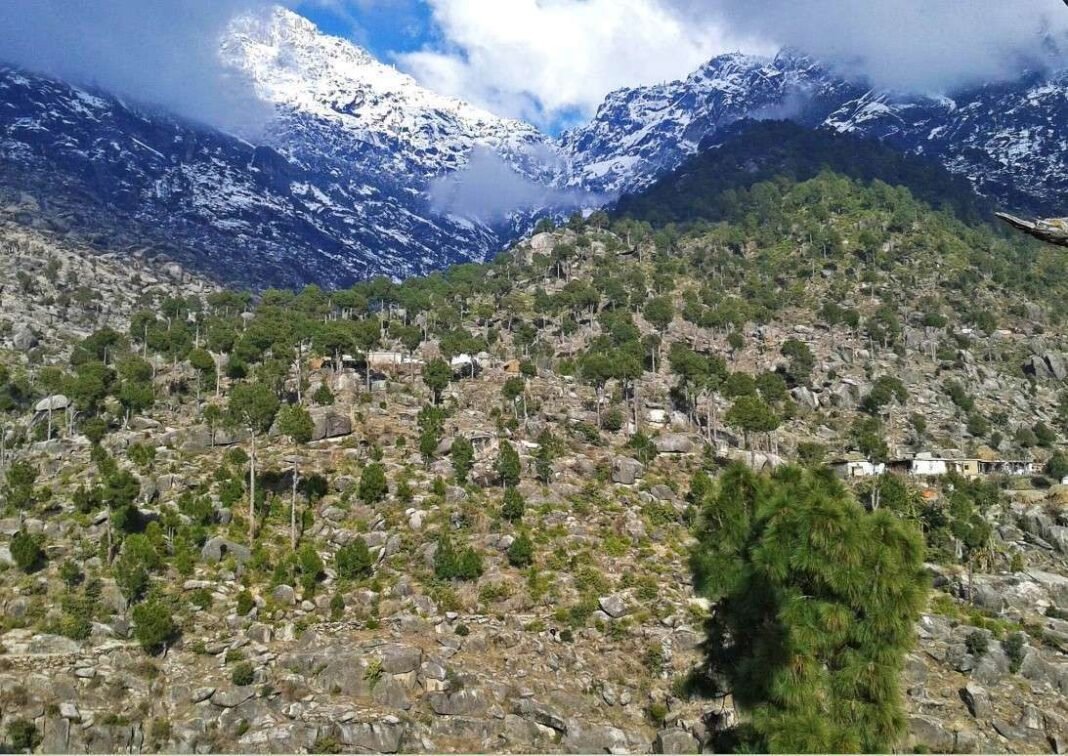
Some mountains are famous for their height, and some for their holiness — Mount Elum is famous for both. Rising to about 2,800 meters (9,200 feet) on the border of Swat and Buner districts in Khyber Pakhtunkhwa, Elum Ghar is the highest peak in the region, snow-covered for much of the year, and it has been sacred ground for millennia: Hindus made pilgrimage to its summit until 1947, Buddhists revere it as the place where a previous incarnation of the Buddha gave up his life, and one prominent scholar proposed its summit as Aornos, the mountain fortress of Alexander the Great. Today it is a hiker’s mountain — streams, small lakes, and sweeping views — wrapped in some of the deepest history in Pakistan. If you want a trek that is equal parts adventure and pilgrimage, this Elum Ghar (Mount Elum) travel guide will show you why this remarkable peak deserves your visit.
Elum Ghar is not an easy mountain, and that is part of its appeal. The hike to the summit — the locals call the top Jogiano Sar — climbs through forests and alpine meadows past gushing streams, with the city of Mingora visible far below from the top. Along the way you walk through layers of history: Gandharan Buddhist sites in the valleys beneath, the route Hindu pilgrims took to the summit’s Ram takt, and valleys where archaeologists believe Indus Valley remains still lie untouched. Come in late spring or summer for the classic trek, or in winter to see the peak in its full snow-covered glory from below. This guide covers the mountain’s extraordinary history, the trek and the best things to do around it, how to reach it from Islamabad, Lahore, and Karachi, where to stay, what to eat, the weather, language and culture, shopping, local events, travel tips, and the best time to visit.
Quick Facts
- Location: On the border of Swat and Buner districts, Khyber Pakhtunkhwa — west of Pir Baba’s shrine in Buner
- Altitude: Around 2,800 meters (9,200 feet); the highest peak in the region
- Famous For: Sacred mountain of Hinduism (until 1947) and Buddhism; summit called Jogiano Sar; hiking with streams and lakes; proposed site of Alexander’s Aornos
- Nearest City: Mingora (Swat), visible from the summit; the trek commonly starts from Marghuzar, a short drive from Mingora
- Accessibility: Moderate — drive to Marghuzar/Mingora, then a full-day guided hike to the summit; a local guide is strongly recommended
- Known Landmarks: Jogiano Sar summit; Ram takt site; Pir Baba’s shrine (Buner side); Amluk Dara stupa in the valley below
- Best For: Experienced hikers, history lovers, spiritual travelers, photographers, and adventure seekers
Why Visit Elum Ghar (Mount Elum)
Visit Elum Ghar because very few mountains in the world compress this much meaning into a single summit. For Hindus, the peak — Jogiano Sar — held the Ram takt, where Ram Čandar was believed to have spent part of his forest exile, and thousands made the annual Sawan pilgrimage here until 1947. For Buddhists, the mountain is believed to be where a previous incarnation of the Buddha gave up his life, and the valleys below are studded with Gandharan stupas like Amluk Dara. For historians, the summit is a candidate for Aornos, the “eagle’s nest” fortress that Alexander the Great stormed in 326 BC — a proposal made by the great Indologist Giuseppe Tucci. You do not just climb Elum Ghar; you climb through three thousand years of sacred history.
The mountain earns its visitors physically, too. The hike from the Marghuzar side is a proper full-day trek — forests giving way to alpine slopes, gushing streams to cross and small lakes to rest beside, and a summit panorama that takes in Mingora and the Swat valley on one side and the Buner valley on the other. It is snow-covered most of the year, which gives the upper mountain a serious, Himalayan character rare at this altitude. For trekkers who have done the Galiyat and Murree hills and want something wilder and emptier, Elum is the natural next step.
Elum Ghar is also refreshingly uncommercialized. There are no chairlifts, no bazaars at the top, no crowds of selfie-takers — just the mountain, your guide, and the occasional shepherd. The local communities of Swat and Buner are known for their hospitality, and hiring a local guide connects you to people who know every stream and shortcut. In an age of overdeveloped viewpoints, a mountain that still demands effort and rewards it with solitude is precious.
Finally, the mountain sits in one of Pakistan’s richest cultural landscapes. The Swat valley below — the “Switzerland of Pakistan” — holds Butkara’s stupas, the Swat Museum at Saidu Sharif, and Barikot’s ancient Bazira; Buner holds the shrine of Pir Baba and the Char Sar valleys. An Elum trek anchors a whole Swat–Buner journey. Start with our Amluk Dara Stupa guide and Bazira Barikot guide to plan the valleys around your climb.
History of Elum Ghar (Mount Elum)
Elum Ghar’s recorded significance stretches back to antiquity, and its history is best told as the story of a sacred mountain claimed — reverently — by successive faiths. In Buddhist tradition, the mountain is believed to be the site where a previous incarnation of the Buddha gave up his life, and the summit was already “an object of pious pilgrimage in Buddhist times,” as archaeologists working in Swat have noted. The great Gandharan stupa of Amluk Dara lies on the route Hindu pilgrims later took to the sacred height, and the whole Swat valley — ancient Uddiyana — was one of Buddhism’s holiest lands.
The Hindu chapter is the best documented. The summit, called Jogiano Sar, was believed to hold the Ram takt — the “throne of Ram” — where Ram Čandar was believed to have spent part of his banbas, or forest-dwelling exile. (Scholars note this tradition is not found in Valmiki’s Ramayana, but it was deeply real to the pilgrims.) Every year, Hindus celebrated Sawan Sangran at the Ram takt: on the first night of the month of Sawan they held vigil through the night, worshipping and reciting their holy book, and at dawn the pandit led them up the mountain to the takt, where prasad was distributed and circumambulation performed. Shelters stood on the mountain for the pilgrims until they were removed by the Wali of Swat, Miangul Abdul Wadud. The pilgrimage continued until 1947; after Partition, with the Hindu community’s migration, the festival ceased — though the mountain’s sanctity is still remembered.
Classical history may touch the summit too. After Alexander the Great’s forces took the Swat valley in 326 BC, the surviving defenders fled to the great rock fortress the Greeks called Aornos. The Italian Indologist Giuseppe Tucci proposed that Aornos stood on the summit of Mount Elum — a striking theory, given the peak’s commanding position and its sheer granite faces. It remains a proposal rather than a certainty, but standing on Jogiano Sar with the valleys spread below, you can feel why a scholar would look at this mountain and see Alexander’s last fortress of the campaign.
More recent history is quieter but still evocative. Local accounts hold that ruins connected with the Indus Valley Civilization lie around the mountain, largely undug — “a great treasure of knowledge for archaeologists,” as one account puts it. The mountain is famous in local lore for its snakes and cobras near the top, enshrined in the Pashto proverb that when a snake reaches its youth, it goes to Mount Elum. In modern times the peak has become a hiker’s objective rather than a pilgrim’s, but the layers — Buddhist, Hindu, Greek, and local — are still there for the traveler who knows where to look.
Top Things to Do in Elum Ghar (Mount Elum)
Trek to the Jogiano Sar Summit
The summit trek is the essential Elum experience. Most hikers start from the Marghuzar side — about a 40-minute drive from Mingora — and climb through forest and alpine meadow toward the 2,800-meter top. The route passes gushing streams and small lakes, and the final slopes open to a panorama taking in Mingora and the Swat valley. It is a full-day undertaking: start very early, carry water and food, wear proper hiking boots, and go with a local guide who knows the route and the weather. In winter the upper mountain is snowbound and the trek becomes a serious mountaineering proposition; late spring through early autumn is the realistic window.
Visit the Ram Takt Site
At the summit area, ask your guide about the site of the Ram takt — the “throne of Ram” that drew Hindu pilgrims here for generations until 1947. Little physical remains of the pilgrim shelters survive, but standing where the Sawan Sangran pilgrims held their dawn circumambulation, with the valleys falling away on every side, is a powerful moment. Treat the site with the respect its history deserves.
Explore the Buddhist Valley Sites Below
Elum’s Buddhist history is best appreciated in the valleys at its feet. The stupa of Amluk Dara — on the old pilgrims’ route to the sacred height — is easily accessible and beautifully set, with a crystal stream running behind it. Butkara I, II, and III around Mingora and Saidu Sharif, and the Swat Museum’s Gandharan collection, complete the picture. Our Amluk Dara guide and Butkara I guide cover these in detail.
Visit Pir Baba’s Shrine (Buner Side)
On the Buner side of the mountain stands the shrine of Pir Baba (Syed Ali Tirmizi) at Pacha Kalay — one of the region’s great spiritual centers, drawing devotees for centuries. Combining the Elum trek with the shrine gives you the mountain’s full spiritual spectrum: Buddhist, Hindu, and Sufi Muslim sacred geography in a single journey. Dress modestly and observe shrine etiquette.
Photograph the Peak from the Valleys
Not every traveler will summit — and Elum rewards viewers too. The mountain’s freestanding granite faces dominate the Buner valley and are visible, in good weather, from far across Swat. Dawn and dusk light on the snow-covered upper slopes is spectacular; the Marghuzar valley and the road toward Buner offer fine viewpoints. This is also the safe way to “do” Elum in winter, when the peak is at its most beautiful and the trek at its most demanding.
Famous Places In and Around Elum Ghar (Mount Elum)
- Jogiano Sar — the summit of Elum Ghar (~2,800 m) and the historic Ram takt site
- Marghuzar — the valley town below the Swat-side trekking route, home of the White Palace
- Amluk Dara Stupa — Gandharan stupa on the old pilgrims’ route (see our Amluk Dara guide)
- Pir Baba’s Shrine — the great Sufi shrine on the Buner side at Pacha Kalay
- Mingora & Saidu Sharif — Swat’s twin cities: bazaars, the Swat Museum, Butkara stupas (see our Butkara III Mingora guide)
- Barikot (ancient Bazira) — the historic town Alexander besieged (see our Bazira Barikot guide)
- Char Sar, Buner — scenic valleys of Buner (see our Char Sar guide)
How to Reach Elum Ghar (Mount Elum)
Elum Ghar is reached via Swat — drive to Mingora/Marghuzar, arrange a local guide, and trek. It is a genuine expedition by the standards of these guides, so plan it as the centerpiece of a Swat–Buner trip rather than a casual stop.
Route Details
- From Islamabad (~240 km, 4–5 hours): Take the M-1 motorway to the Swat Motorway interchange and follow the Swat Motorway to Chakdara, then continue to Mingora/Saidu Sharif. The motorway has made Swat dramatically more accessible — what was once a grueling drive is now a comfortable half-day journey. From Mingora, Marghuzar (the usual trek base) is a short drive of about 40 minutes into the hills.
- From Lahore (~400 km, 9–11 hours): Take the M-2 to Islamabad, then follow the Islamabad route above. Most Lahore travelers break the journey with a night in Islamabad or drive straight through in a private car.
- From Karachi: Fly to Islamabad (about 2 hours) and continue by road to Swat — the only practical option. There is no commercial airport in Swat valley itself for scheduled flights.
- The trek: From Marghuzar, the hike to Jogiano Sar is a full-day trek (up and down) on a mountain route — not a marked tourist trail. You must hire a local guide: ask at your hotel in Marghuzar or Mingora, or arrange through a Swat-based tour operator. Start at first light, carry 2–3 liters of water, food, rain protection, and warm layers.
- Buner-side access: The mountain can also be approached from Buner district (via the Pir Baba area), but the Marghuzar/Swat route is the established trekking approach. Discuss options with your guide.
- Road conditions by season: The Swat Motorway runs year-round; the hill road to Marghuzar can be affected by winter snow and monsoon rains. The trekking window is roughly May to October; in winter, admire the peak from the valleys.
Where to Stay in Elum Ghar (Mount Elum)
You do not sleep on the mountain — you base yourself in the valleys and trek it in a day. Marghuzar, the Swat-side trek base, has hotels and guesthouses, including the famous White Palace — the former summer residence of the Wali of Swat, now a historic hotel — which makes a wonderfully atmospheric base for an Elum expedition. Mingora and Saidu Sharif, 40 minutes away, offer Swat’s widest range of accommodation: budget hotels and guesthouses for backpackers, comfortable mid-range hotels for families, and a few upscale options.
On the Buner side, Daggar (Buner’s main town) and the Pir Baba area have basic guesthouses for travelers combining the shrine with the mountain. Book ahead in the summer tourist season (June–August), when Swat fills up. For the trek itself, experienced and properly equipped trekkers sometimes camp on the lower slopes — but this demands full mountain equipment, a guide, and respect for the weather, which can turn fast at 2,800 meters. Most visitors are happier with a hotel bed in Marghuzar and a dawn start.
Where to Eat: Local Foods of Elum Ghar (Mount Elum)
Swat’s food is hearty mountain fare, and your trek deserves good fuel. The valley is famous for its trout — river trout grilled or fried with local spices is the signature dish, served at restaurants along the Swat river and in Mingora. Chapli kebabs, chicken karahi, and desi murgh are staples everywhere; maize-flour bread (served with local honey or desi ghee) is traditional in the higher villages. Doodh patti — strong milky tea — is the drink of the mountains, and you will want it after a long descent.
In Marghuzar and Mingora, hotel restaurants serve Pakistani, Chinese, and continental basics; the bazaars offer dhabas with fresh tandoori roti, daal, and kebabs at budget-friendly prices. Buner side: simple village eateries serve karahi, kebabs, and tea. For the trek, pack high-energy food — dried fruit, nuts, parathas — and plenty of water; there are streams on the mountain but carry your own supply. A celebratory trout dinner in Mingora after the summit is a Swat tradition worth adopting.
Weather in Elum Ghar (Mount Elum)
At 2,800 meters, Elum Ghar makes its own weather: the peak is snow-covered most of the year, summers are short and cool at altitude, and storms can arrive fast. The valleys below are far milder — plan for two climates in one trip.
| Season | Temperature Range (at altitude) | Conditions |
|---|---|---|
| Winter (Dec–Feb) | -10 to 5°C | Heavy snow on the upper mountain; trekking not feasible; valleys cold but accessible |
| Spring (Mar–May) | 0 to 15°C | Snow melting; upper slopes still snowy early on; trekking window opens by late May |
| Summer (Jun–Aug) | 10 to 22°C | The trekking season; cool at altitude, monsoon showers possible; valleys warm |
| Autumn (Sep–Nov) | 0 to 15°C | Clear skies, crisp air; good trekking early in the season; snow returns by late autumn |
Mountain weather is unpredictable — carry warm and waterproof layers even on a sunny summer morning, and turn back if weather closes in. The summit is not worth a storm.
Language and Culture of Elum Ghar (Mount Elum)
Elum Ghar stands in the Pashtun belt: Pashto is the language of Swat and Buner, and you will hear it in every village and bazaar. Urdu is widely understood, especially in Mingora and among guides and hotel staff; English works in hotels and with tour operators. Learning a few Pashto greetings — “Starray mashey” (good morning, roughly) — earns warm smiles, though your guide will handle the real conversations.
Pashtunwali, the Pashtun code of hospitality, is famously generous to guests — travelers in Swat and Buner are routinely offered tea and help. Return the respect: dress modestly (covered arms and legs; women should carry a headscarf for shrines and villages), ask before photographing people, and accept offered tea graciously. The mountain itself is sacred ground to multiple faiths — treat the summit and its historic sites with quiet reverence, take all litter back down, and keep noise low. If visiting Pir Baba’s shrine, observe standard shrine etiquette: remove shoes where required, dress conservatively, and follow the lead of devotees.
Shopping in Elum Ghar (Mount Elum)
The mountain has no shops — your shopping happens in the valleys. Mingora’s bazaar is Swat’s commercial heart: famous for Swati shawls and woolen garments, embroidered fabrics, local honey, walnuts and other dry fruits, and carved wooden handicrafts. The trout may be Swat’s signature dish, but the shawl is its signature souvenir — warm, beautiful, and genuinely useful after a mountain trek. Saidu Sharif has bookshops and craft outlets near the museum.
On the Buner side, village markets sell tobacco, maize products, and everyday goods rather than souvenirs — authentic, but not the place for gifts. Bargaining is normal in Mingora’s bazaar; polite but firm gets the best prices. There are no shopping malls in the trekking areas, and none are needed: a Swati shawl bought where it was woven beats any mall purchase.
Local Events and Festivals
Elum Ghar’s festival history is poignant. Until 1947, the mountain’s great annual event was the Hindu festival of Sawan Sangran at the Ram takt: pilgrims kept vigil through the first night of the month of Sawan — worshipping and reciting scripture — then ascended at dawn for prasad and circumambulation of the takt. With Partition and the migration of the Hindu community, the festival ceased, and the pilgrim shelters were removed in the era of the Wali of Swat. It is remembered now as history rather than celebrated as an event — but knowing it transforms a summit visit.
In modern times, local accounts describe Jashn-e-Elum, a summer gathering in which youth from nearby villages escape the valley heat for a few days in the mountain’s cool air, traditionally held around the end of July or beginning of August. Travelers hoping to coincide with local festivities should check locally before planning — dates and scale vary year to year. Swat’s wider cultural calendar (including events in Mingora and Kalam in summer) can round out a trip; ask your hotel or guide what is on during your visit.
Travel Tips for Elum Ghar (Mount Elum)
Packing Essentials
This is a real mountain trek — pack like one. Broken-in hiking boots with ankle support, a daypack, 2–3 liters of water capacity, high-energy food, warm layers (fleece and a windproof/waterproof shell), sun protection (the high-altitude sun is fierce), a first-aid kit, a headlamp, and a power bank. A walking stick helps on the descent. In summer, add rain protection; outside June–September, add serious cold-weather gear and reconsider whether the trek is feasible at all.
Safety Tips
Hire a local guide — this is non-negotiable on an unmarked mountain route. Start at first light and plan to be off the upper mountain well before dark. The mountain is known for snakes near the top in warmer months: watch where you put hands and feet, wear boots, and give any wildlife a wide berth. Check the current security and travel situation for Swat/Buner before your trip through official advisories and local contacts; the region has welcomed tourists for years, but conditions should always be verified, not assumed. Tell your hotel your trekking plan and expected return time.
Money & Connectivity
Carry all the cash you will need: Mingora has ATMs and banks, but Marghuzar and the villages have limited facilities, and there is nothing on the mountain. Mobile coverage reaches the valleys and lower slopes on the major networks but fades higher up — download offline maps, and do not rely on a phone signal for safety. Your guide is your safety net; the phone is a backup.
Best Time to Visit Elum Ghar (Mount Elum)
Summer (June–August): The Trekking Season
The classic window: snow largely gone from the route, long daylight hours, cool mountain air while the valleys bake. This is when to attempt the summit. It is also Swat’s peak tourist season — book Marghuzar/Mingora hotels ahead. Perfect for: the summit trek, photography, and combining Elum with a full Swat valley tour.
Autumn (September–October): The Clear-Sky Season
Crisp air, sharp visibility, golden valley colors, and thinner crowds. Early autumn can be superb for trekking; by late October, snow begins returning to the upper slopes. Perfect for: experienced trekkers, photographers, and travelers who prefer quiet trails.
Winter (November–March): The Viewing Season
The peak wears its full snow mantle — magnificent to look at, not to climb. Base yourself in Mingora or Marghuzar, photograph Elum from the valleys, and explore Swat’s stupas, museums, and bazaars instead. Perfect for: sightseers, photographers, and history-focused travelers.
Spring (April–May): The Awakening Season
Valleys green and blooming, the mountain still snowy above — beautiful, but the trekking route is usually still snowbound until late May. Perfect for: valley sightseeing, Buddhist heritage sites, and planning a summer return for the summit.
Final Thoughts
Elum Ghar is the rare mountain that rewards every kind of traveler. Trekkers get a serious, beautiful full-day climb with streams, lakes, and a summit panorama. History lovers get a peak sacred to Buddhists and Hindus, a candidate for Alexander’s Aornos, and valleys full of Gandharan stupas. Spiritual travelers get a mountain that has drawn pilgrims for millennia — and still does, in its quieter way. It asks for effort, a guide, and respect; it repays with solitude and story in equal measure.
If Swat is on your list, put Elum Ghar at its center: trek it in summer, walk its Buddhist valleys, pay your respects at Pir Baba’s shrine, and eat trout in Mingora afterward. For more northern inspiration, browse our Explore Pakistan collection — and if you want another great Swat climb, our Malam Jabba guide pairs perfectly.
FAQs
Where is Elum Ghar (Mount Elum) located?
On the border of Swat and Buner districts in Khyber Pakhtunkhwa, west of Pir Baba’s shrine — about 2,800 meters (9,200 feet) high, the tallest peak in the region.
How high is Mount Elum?
Around 2,800 meters (9,200 feet) above sea level. Its summit is locally called Jogiano Sar.
Why is Elum Ghar historically important?
It was a Hindu pilgrimage site until 1947 (the Ram takt and the annual Sawan Sangran festival), is revered in Buddhist tradition as the place where a previous incarnation of the Buddha gave up his life, and was proposed by scholar Giuseppe Tucci as the site of Alexander the Great’s fortress of Aornos (326 BC).
How do I trek to the summit?
Base yourself in Marghuzar or Mingora (Swat), hire a local guide, and allow a full day for the up-and-down trek. The realistic trekking window is roughly June to September; start at first light with water, food, and proper hiking gear.
How do I reach Elum Ghar from Islamabad?
Drive the M-1 and Swat Motorway to Mingora/Saidu Sharif (~240 km, 4–5 hours), then continue to Marghuzar (about 40 minutes) — the usual trek base. From Karachi or Lahore, fly or drive to Islamabad first.
What is the best time to visit?
June to August for the summit trek; September–October for clear skies and valley sightseeing; winter for viewing the snow-covered peak from below (not for climbing).
Is the trek safe?
With a local guide, proper gear, an early start, and verified current conditions, it is a standard Himalayan-foothill trek. Go with a guide, watch for snakes near the top in warm months, carry water, and check travel advisories for the region before you go.
What else can I see nearby?
Amluk Dara Stupa, Butkara stupas and the Swat Museum at Saidu Sharif, Barikot (ancient Bazira), Pir Baba’s shrine, Char Sar in Buner, and Mingora’s bazaars — Swat and Buner are dense with history.
, Pakistan? Discover why it deserves your visit, the best time to go, top things to do and how to reach.)