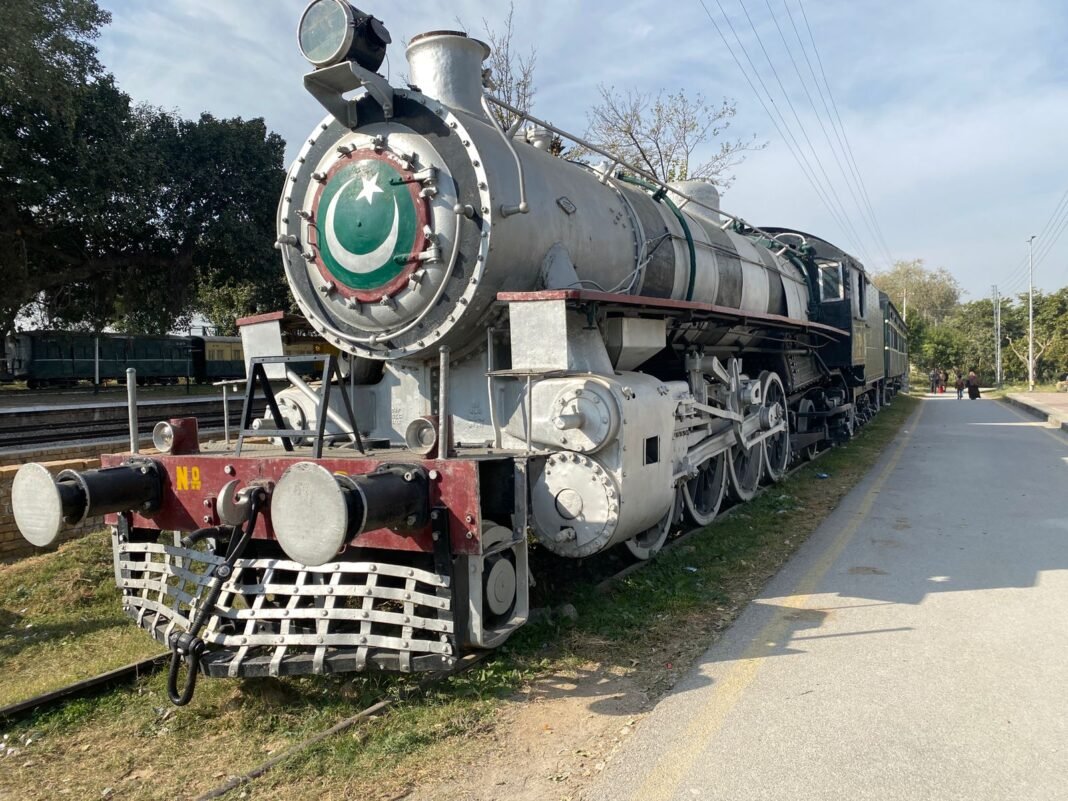
In the suburbs of Islamabad, at a junction station the British built in 1882, sits one of Pakistan’s most atmospheric museums. The Golra Sharif Railway Museum, officially the Pakistan Railways Heritage Museum, keeps more than 150 years of railway history inside the grey sandstone walls of a working station: steam locomotives, royal saloons that carried Quaid-e-Azam Muhammad Ali Jinnah and Lord Mountbatten, Morse code machines, and a token machine captured in the 1965 war. Around a dozen trains still stop at the platform outside every day, so history rumbles past while you explore. If you love heritage, photography, or simply a wonderful day out near the capital, this Golra Sharif Railway Museum travel guide shows why it deserves your visit and when to go.
Quick Facts
- Location: Golra Sharif Junction railway station, near Sectors E-11 and F-13, Islamabad, at the southeast of the Margalla Hills
- Altitude: Around 1,994 feet above sea level
- Famous For: The Pakistan Railways Heritage Museum: two galleries, 18 vintage locomotives and coaches, and the royal saloon used by Quaid-e-Azam Muhammad Ali Jinnah
- Nearest City: Islamabad (a 20-30 minute drive from the city centre); the shrine of Golra Sharif is minutes away
- Accessibility: Reached by road via Srinagar Highway and Margalla Road, or by train, around a dozen trains stop at Golra station daily
- Known Landmarks: The 1882 station building, the museum galleries, the outdoor locomotive yard, Quaid-e-Azam’s royal saloon
- Best For: Railway enthusiasts, history buffs, photographers, families with children, and school trips
Why Visit Golra Sharif Railway Museum
This is not a museum where history sits behind glass in a silent hall. Golra Sharif is a living railway station, and that changes everything. You walk past the vintage locomotives in the yard, and then a real passenger train, the Karachi-bound Awam Express among them, blares its horn and pulls into the platform. The past and the present share the same tracks. Few museums in Pakistan give you that thrill of continuity, of standing inside history while it is still working.
The collection itself is extraordinary. The museum’s two galleries hold relics from more than 150 years of rail heritage, stretching back to the British Raj and the days of undivided India. The crown jewel is the royal saloon once used by India’s last viceroy, Lord Mountbatten, and Pakistan’s founder, Quaid-e-Azam Muhammad Ali Jinnah, described by the museum’s curator as one of the finest saloons in the collection. Where else in the country can you step inside the carriage that carried the founder of the nation?
Golra Sharif is also a photographer’s dream. The station building, with its stone and terracotta walls, is one of the best-preserved colonial railway stations in the Potohar region. The retired steam locomotives in the yard, the Victorian furniture and crockery in the galleries, the old signals and lamps, every corner offers a frame. Visit in the golden light of early morning or late afternoon and you will understand why heritage photographers call this the strongest single stop on the region’s railway trail.
Finally, it is wonderfully easy and family-friendly. A short drive from Islamabad, usually free or nominally priced entry, open grounds where children can marvel at the giant locomotives, and the shrine of Golra Sharif minutes away for a combined day of heritage and spirituality. It is the perfect answer to the weekend question of where to take visiting guests or restless kids.
History of Golra Sharif Railway Museum
The story begins with the station, not the museum. Golra Sharif station was set up by the British in 1882 as part of the North-Western Railway, serving the garrison city of Rawalpindi. In 1912 it was upgraded to a junction, becoming a strategic point on the railway network that connected Peshawar, Kohat, Havelian, and Multan. At the turn of the 20th century, during Britain’s Afghan military campaigns, the station served as a main logistics artery for British India, funnelling troops and supplies toward the frontier. Its stone building, platforms, and yards have witnessed more than 140 years of the subcontinent’s history.
The museum itself was established on 26 September 2003, when Pakistan Railways converted the historic station into the Pakistan Railways Heritage Museum, with the aim of preserving and conserving the country’s rail heritage. The galleries were filled with objects dating back to 1861: signals, meters, communication equipment, emergency gear, Victorian furniture with classic crockery, long-arm rest chairs, clocks, watches, and medical kits, tracing the railway’s story from the first British lines to the present day.
The collection grew into one of the finest railway assemblages in South Asia. Alongside the two indoor galleries, the outdoor yard filled with 18 locomotives and coaches, including steam engines from the collections of foreign governments such as Canada and India. The museum was renovated in 2018, and in November 2025 the station received a further upgrade, with Pakistan Railways renovating the building and adding modern surveillance systems while preserving its heritage character.
Today the museum documents not just machines but the social impact of the railways: how the iron road changed trade, travel, and everyday life across the subcontinent. Its artifacts, from a Morse code machine to the surgical instruments of the railway hospital, from railway police guns to the Neal’s ball token machine captured from Khemkaran station during the 1965 Pakistan-India war, tell the human story behind the steel. It has become a major attraction for tourists, school groups, and railway enthusiasts from across Pakistan and abroad.
Top Things to Do in Golra Sharif Railway Museum
Step Inside Quaid-e-Azam’s Royal Saloon
The single unmissable exhibit. This luxurious saloon carriage once served India’s last viceroy, Lord Mountbatten, and Pakistan’s founder and first governor-general, Quaid-e-Azam Muhammad Ali Jinnah. The curator calls it one of the finest saloons in the collection, and stepping inside, among the period furnishings, you feel the weight of the history it carried. Take your time here; this is the museum’s soul.
Explore the Two Galleries
The indoor galleries are a treasure trove of railway memorabilia. Look for Mountbatten’s kerosene heater, the vintage railway police guns, the ticket punching machine, signal sticks and lamps, flags, drinking vessels, and the Morse code machine that once carried messages along the line. The long pendulum by Gillet and Johnston of Croydon, London, dated 1899, is another treasured piece, as is the collection of bells, kerosene lamps, and Victorian crockery.
Walk the Locomotive Yard
Outside, the yard holds the giants: 18 locomotives and coaches, including magnificent steam engines. Do not miss the 1826 steam locomotive Rx 207, one of the oldest machines on display, and the saloon gifted by the Maharaja of the Indian state of Jodhpur to his daughter on her wedding, a reminder of the princely luxury the railways once served. The locomotives photograph beautifully in the morning light.
See the 1965 War Relic
Among the most evocative exhibits is the Neal’s ball token machine captured from Khemkaran station during the Pakistan-India war of 1965. It is a tangible piece of military history sitting inside a railway museum, and a reminder of how deeply the railways were woven into the subcontinent’s conflicts as well as its commerce.
Watch the Working Station
Time your visit so you can watch a train arrive. Around a dozen trains stop at Golra Sharif station daily, and there is something magical about standing among century-old locomotives while a modern express rolls in. The contrast is the museum’s best exhibit, and it costs nothing extra.
Combine With the Golra Sharif Shrine
The shrine of Pir Meher Ali Shah is minutes from the station. Pair the museum with the shrine’s marble courtyards, its langar meal, and its peaceful atmosphere for a day that covers two completely different centuries of heritage. See our Golra Sharif travel guide for the full shrine experience.
Famous Places In and Around Golra Sharif Railway Museum
Golra Sharif Shrine: The great Sufi shrine of Pir Meher Ali Shah, minutes away. Faisal Mosque: Islamabad’s iconic national mosque, about 20 minutes by car. Taxila: The ancient Gandhara city, east of the Margallas, with its world-famous museum and ruins. Margalla Hills: Hiking trails with panoramic city views. Shah Allah Ditta Caves: Ancient Buddhist caves in the Margalla foothills.
How to Reach Golra Sharif Railway Museum
The museum sits at Golra Sharif Junction railway station, near Sectors E-11 and F-13 in Islamabad, at the southeast of the Margalla Hills. By road, it is a 20 to 30 minute drive from central Islamabad via Srinagar Highway and Margalla Road; follow the signs for Golra Sharif village and the railway station. From Rawalpindi, take Peshawar Road toward Islamabad and follow signs for E-11 and Golra.
From Lahore, drive to Islamabad via the M-2 motorway (about four hours) and continue to Golra, an easy day trip. From Karachi, fly to Islamabad International Airport and take a taxi or ride-hailing car, roughly a 30 to 40 minute drive to the station. Uniquely, you can also arrive by rail: around a dozen trains stop at Golra Sharif station every day, so check the Pakistan Railways schedule and ride in like a traveller from another era.
Route Details
From central Islamabad (Blue Area), take Jinnah Avenue west to Srinagar Highway, continue toward the Margallas, and exit toward Sectors E-11/F-13. Follow the local signs for Golra Sharif railway station; the museum is housed in the historic station building itself, with the locomotive yard alongside the platforms. Parking is available at the station. If you are combining the visit with the shrine, the shrine complex is a few minutes away in the old Golra village.
Where to Stay in Golra Sharif Railway Museum
The museum is a half-day visit, and visitors stay in Islamabad, which offers the country’s widest range of accommodation. The nearby sectors of E-11, F-11, and D-12 have comfortable mid-range hotels and guesthouses within minutes of the station, while Blue Area, F-6, F-7, and the airport road host everything from budget guesthouses to five-star hotels.
Families often prefer the serviced apartments in E-11 and F-11 for space and convenience, while budget travellers will find simple, clean guesthouses across the residential sectors. Book ahead on public holidays and during the shrine’s Urs, when the area fills with visitors; for most of the year, availability is good and prices competitive.
Where to Eat: Local Foods of Golra Sharif Railway Museum
There is no restaurant inside the museum, but you will not go hungry. The streets around Golra village and the shrine are lined with dhabas serving classic desi fare: nihari, haleem, daal fry, chicken karahi, kebabs, and fresh tandoori roti at budget-friendly prices. The shrine’s langar, a few minutes away, serves free meals to all visitors daily.
The E-11 and F-11 markets nearby offer cafes, fast food, and desi restaurants for more variety, and Islamabad’s famous eateries are a short drive away. Pack water and snacks if you are visiting with children, since exploring the locomotive yard in the sun works up an appetite and a thirst.
Weather in Golra Sharif Railway Museum
The museum shares Islamabad’s climate. The galleries are indoors, but the locomotive yard is fully open to the sky, so plan your visit for the cooler parts of the day in summer. Spring and autumn offer the most comfortable weather for wandering the yard and photographing the locomotives.
| Season | Temperature Range | Conditions |
|---|---|---|
| Winter (Dec-Feb) | Around 0 to 18°C | Cool, clear days; excellent for the outdoor yard; pack a warm jacket for mornings |
| Spring (Mar-Apr) | Around 15 to 28°C | Mild and pleasant; the best season for a full visit, galleries and yard alike |
| Summer (May-Jul) | Around 30 to 40°C | Hot at midday; visit early morning or late afternoon; the galleries offer shade |
| Autumn (Aug-Nov) | Around 18 to 32°C | Fresh post-monsoon air; golden light for photography; very comfortable |
Language and Culture of Golra Sharif Railway Museum
The museum’s culture is the culture of Pakistan Railways: a proud, century-old institution with its own traditions, uniforms, and lore. The staff are usually happy to share stories about the exhibits, and many have railway families going back generations. Urdu and Punjabi are the working languages, with English widely understood.
Treat the exhibits with the respect they deserve: these are irreplaceable artifacts. Do not climb on the locomotives unless an attendant invites you to, do not touch delicate instruments, and keep children close in the yard where the tracks are live and real trains pass. Photography is generally allowed and encouraged, but ask the staff about any restricted areas.
Shopping in Golra Sharif Railway Museum
The museum does not have a large souvenir shop, so set your expectations accordingly; the real take-home is your photographs. The bazaar around the nearby shrine sells religious items, chadars, attar, and traditional crafts that make meaningful souvenirs. For general shopping, the E-11 and F-11 markets are minutes away, and Islamabad’s malls are a short drive for anything else.
Travel Tips for Golra Sharif Railway Museum
Packing Essentials
Bring a camera, this is one of the most photogenic heritage sites near Islamabad. Wear comfortable walking shoes and a hat, since the locomotive yard is open and sunny. Carry water, especially in summer, and a small amount of cash for entry (usually free or nominal) and the nearby food stalls.
Safety Tips
The museum is a safe, family-friendly site, but it is also a working railway station: stay off the live tracks, hold children’s hands on the platforms, and never try to cross in front of a train. Supervise children around the locomotives and heavy equipment in the yard.
Money & Connectivity
Entry to the museum is free on most days, though a nominal fee may apply at times; timings can vary, so it is worth confirming before you visit. Carry cash for food and transport. All major mobile networks have excellent coverage in the area, with strong 4G signals.
Best Time to Visit Golra Sharif Railway Museum
Spring (March to April)
The ideal season: mild weather for the outdoor yard, soft light for photography, and comfortable temperatures in the galleries. Combine with the Margalla Hills trails for a perfect spring day.
Autumn (September to November)
Clear skies, golden afternoon light on the locomotives, and fewer crowds. An excellent time for photographers and families alike.
Winter (December to February)
Crisp, clear days are wonderful for the yard, and you will have the museum largely to yourself. Mornings are chilly, so dress warmly.
Summer (May to August)
Visit early in the morning or late in the afternoon to avoid the midday heat in the yard. The galleries provide a shaded break, and monsoon rains cool things down in July and August.
Final Thoughts
The Golra Sharif Railway Museum is a reminder that history does not have to be distant to be moving. Here, in a working station at the foot of the Margalla Hills, you can run your hand along the steel of a century-old locomotive, step into the saloon that carried Quaid-e-Azam, and then watch a modern express pull into the same platform. It is heritage you can hear, smell, and feel, and it sits less than half an hour from the capital’s centre.
Go on a clear morning, take your time in the galleries, linger in the locomotive yard, and then walk over to the shrine of Golra Sharif for the second half of your day. Few day trips in Pakistan offer so much history in so few kilometres. For more railway heritage, see our guide to the Faisalabad Railway Station, and browse the full Explore Pakistan collection for your next destination.
FAQs
Where is the Golra Sharif Railway Museum?
The museum is located at Golra Sharif Junction railway station, near Sectors E-11 and F-13 in Islamabad, at the southeast of the Margalla Hills, a 20-30 minute drive from central Islamabad.
When was the museum established?
The Pakistan Railways Heritage Museum was established on 26 September 2003 at the historic Golra Sharif station, which itself dates back to 1882. The museum was renovated in 2018 and the station upgraded again in 2025.
What can I see at the museum?
Two galleries of railway memorabilia, 18 vintage locomotives and coaches in the outdoor yard, the royal saloon used by Quaid-e-Azam Muhammad Ali Jinnah and Lord Mountbatten, an 1826 steam locomotive, Morse code machines, vintage signals and lamps, and a token machine captured in the 1965 war.
How do I reach the museum from Islamabad?
Drive via Srinagar Highway and Margalla Road to Golra Sharif (20-30 minutes), take a taxi, or arrive by train: around a dozen trains stop at Golra Sharif station daily.
Is there an entry fee?
Entry is free on most days, though a nominal fee may occasionally apply. Timings can vary, so confirm before visiting.
Is the museum good for children?
Yes, children love the giant locomotives and the open yard. Supervise them closely, since it is a working station with live tracks and passing trains.
Can I combine it with the Golra Sharif shrine?
Absolutely. The shrine of Pir Meher Ali Shah is only minutes away, making the museum and the shrine a perfect combined half-day or full-day trip. See our Golra Sharif travel guide.
What is the best time to visit?
March to April and September to November offer the most comfortable weather and the best light for photography. In summer, visit early morning or late afternoon to avoid the midday heat in the locomotive yard.