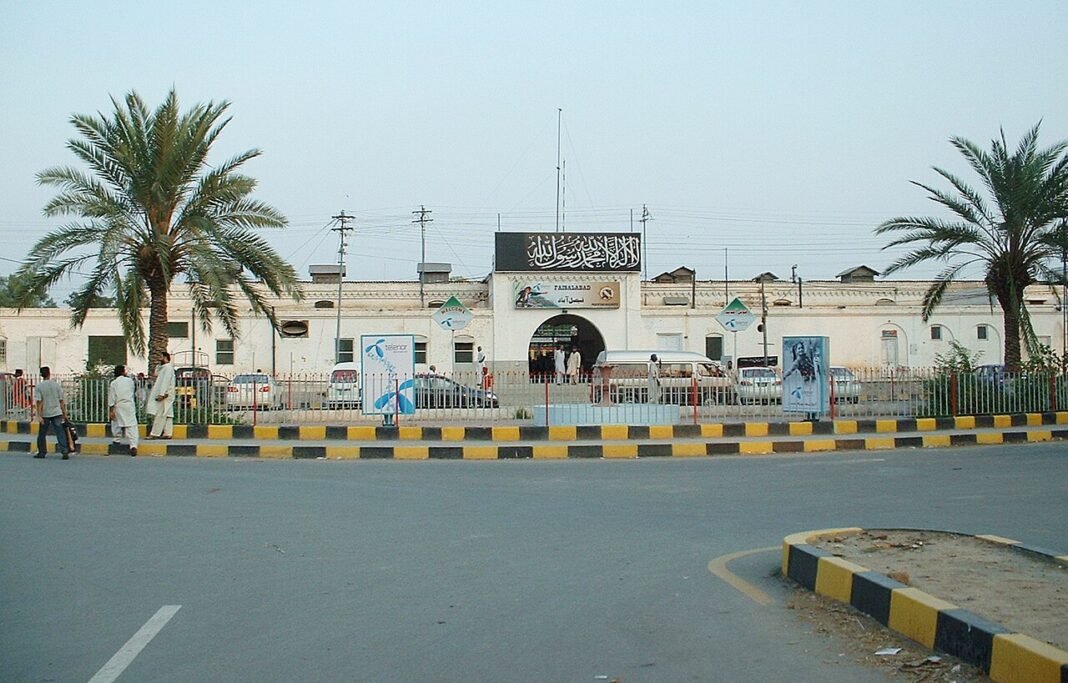
Most travelers pass through railway stations without a second glance. Faisalabad Railway Station deserves better. Built in 1896, when the city was still called Lyallpur and the British were laying steel across the Punjab, this is one of the grandest surviving Victorian-era stations in Pakistan — a red-brick landmark with a Greek-style colonnaded entrance, arched windows, high ceilings, and its own clock tower, recognized as historical heritage by the government of Pakistan. It still does its original job every day, dispatching trains to Karachi, Lahore, Rawalpindi, Islamabad, Quetta, and Peshawar. Whether you’re a railway enthusiast, a heritage hunter, or simply passing through the “Manchester of Pakistan,” this Faisalabad Railway Station travel guide will show you why this 19th-century station is worth a deliberate visit — and what to see, eat, and explore around it.
Quick Facts
- Location: Rajbah Road, Faisalabad, Punjab, Pakistan — on the Khanewal–Wazirabad Branch Line
- Altitude: Around 180 meters (590 feet) above sea level (Punjab plains)
- Famous For: Victorian-era colonial architecture, the Greek-style pillared entrance, and its role as the main rail hub of Pakistan’s textile capital
- Nearest City: Faisalabad itself — the station is in the city center
- Accessibility: Very easy — in central Faisalabad, reachable by car, taxi, rickshaw, and local transport; station code FSLD
- Known Landmarks: The colonial station building with its clock tower, 7 platforms, the nearby Ghanta Ghar (Clock Tower) and its eight bazaars
- Best For: Railway enthusiasts, colonial-heritage lovers, photographers, and travelers using Faisalabad as a Punjab base
Why Visit Faisalabad Railway Station
Because it is a working time machine. Few heritage buildings in Pakistan still perform their original function as faithfully as this one: every day, more than a century after it opened, trains still roll in and out beneath the same Victorian arches. Stand on the platform and you’re standing where British officers, post-independence leaders, and generations of Punjabi travelers have stood — the red brick, the arched windows, the high ceilings, and the grand Greek-style entrance with its long pillars are all still there, still doing their job. For anyone who loves railway heritage, this is one of the finest stations in the country to simply be in.
The architecture alone justifies the trip. The station was lavishly designed in the popular Western style of the Victorian era: the grand entrance follows ancient Greek lines, with long pillars flanked by smaller ones supporting the edifice — a vocabulary borrowed from the great Western architects of the Renaissance and Victorian periods, echoing even the Acropolis and Parthenon. Inside, arched windows, red brickwork, and lofty ceilings show the confident hand of colonial railway engineering, while the station’s own clock tower keeps its own quiet time over the platforms. It has been recognized as historical heritage by the government of Pakistan, and walking its length feels like a guided tour of 1890s ambition.
Then there’s what the station unlocks. Faisalabad — the Manchester of Pakistan, the country’s textile capital — is one of Punjab’s most characterful cities, and the station sits at its heart. From here, the extraordinary Ghanta Ghar clock tower and its eight radiating bazaars are a short ride away (see our Clock Tower Ghanta Ghar travel guide), along with the Lyallpur Museum, Jinnah Garden, and the city’s legendary food streets. The station makes the perfect starting point for a heritage day: arrive by train the romantic way, step out into 1896, and walk straight into the living history of Lyallpur.
Finally, come for the romance of the rails themselves. In an age of motorways and budget flights, there is something deeply satisfying about traveling Pakistan by train — the chai vendors on the platform, the bookstalls, the slow unfolding of the Punjab outside the window. Faisalabad station, with express trains connecting it to nearly every major city, is one of the best places in the country to experience that romance firsthand. Choose the train, and the journey becomes the destination.
History of Faisalabad Railway Station
The history of Faisalabad Railway Station is the history of Lyallpur itself. The railway line to the area was started in 1895, and in 1896 it was opened to Faisalabad — then a brand-new canal-colony town named Lyallpur after Sir James Lyall, the Lieutenant Governor of Punjab (1887–1892), who had championed the Chenab Colony settlement scheme. The station building, constructed in that same pioneering year, was designed in the Victorian Western style that the British were stamping across their empire’s railway network.
The line grew quickly. In 1898 the railway was laid from Wazirabad to Faisalabad, and the line was later extended to Shorkot; in 1900 it was merged with the Khanewal section, greatly increasing the young town’s importance as a transport and trade hub. Local historical accounts record charming details of those first years: in 1899 the first train ran from Wazirabad to Faisalabad behind engine number eight — which burned wood instead of coal — driven by Ghulam Rasool, whom the locals nicknamed “Lasso.” The colonial government spent some 77 lakh 41 thousand rupees on the project, and alongside the station rose the Munshi Mohalla and the circular road that shaped the old city’s layout.
After Partition in 1947, the station became part of Pakistan Railways and kept its central role as the region’s rail hub. In the 1970s the city itself was renamed: Lyallpur became Faisalabad in honor of Saudi King Faisal bin Abdul-Aziz, and the station — formerly Lyallpur Railway Station, station code FSLD — took the new name with it. Through every change, the 1896 building has endured: its Victorian-Greek architecture, red brick, and clock tower surviving into the 21st century as a recognized heritage landmark and the beating heart of rail travel in central Punjab.
Top Things to Do in Faisalabad Railway Station
Admire the Victorian Station Building
Start with the exterior: the grand Greek-style entrance with its long pillars, the red-brick facades, the arched windows, and the clock tower. Walk the full length of the building and notice how the Victorian design handles the Punjab heat — high ceilings, deep verandas, and thick masonry. Early morning light flatters the brickwork beautifully, and the building photographs best from across the forecourt.
Soak Up Platform Life
The station has seven platforms, and they are pure Pakistan: tea vendors with their kettles, bookstalls, families seeing off travelers, porters in red shirts, and the long-distance expresses rolling through. Even if you’re not catching a train, an hour on the platform with a cup of chai is one of the most atmospheric experiences in Faisalabad. The current and advance reservation offices, food and drink stalls, bookshops, and the cargo and parcel offices all hum with daily life.
Ride a Train the Classic Way
Faisalabad is served by well-known expresses — including the Akbar Express, Badar Express, and Faisalabad Express among others — connecting it directly with Karachi, Lahore, Rawalpindi, Islamabad, Quetta, and Peshawar. Booking a daytime journey to Lahore lets you experience the historic line in comfort. Check Pakistan Railways’ current schedules when planning, as timings change seasonally.
Visit the Old Control Room and Heritage Corners
Ask around (politely) about the station’s older sections — the old control room and vintage platform furniture survive in places, and railway staff are often proud to point out the building’s heritage features to interested visitors. A little courtesy goes a long way.
Step Out into Lyallpur’s Heritage Quarter
The station is your gateway to the city’s colonial core. Within a short ride: the Ghanta Ghar clock tower (built 1903–1905 in memory of Queen Victoria) at the center of the eight bazaars laid out like the Union Jack; the Lyallpur Museum, which tells the city’s story from canal colony to textile giant; Jinnah Garden (the old Company Bagh) with its memorial to Sir James Lyall; and the Gumti water fountain, a 1930s Anglo-Islamic monument. Music lovers can seek out the neighborhood of the ancestral house of Nusrat Fateh Ali Khan, the legendary qawwali maestro born in Faisalabad.
Famous Places In and Around Faisalabad Railway Station
- Ghanta Ghar (Clock Tower) — the iconic 1900s tower at the heart of eight bazaars; the soul of the city (see our Clock Tower Ghanta Ghar travel guide).
- The Eight Bazaars — Katchery, Chiniot, Aminpur, Bhawana, Jhang, Montgomery, Karkhana, and Rail bazaars, ringed by Gole Bazaar; the ultimate Faisalabad shopping walk.
- Lyallpur Museum — galleries of photographs, tools, and artifacts tracing Faisalabad from Lyallpur to today.
- Jinnah Garden (Company Bagh) — the historic park with the memorial to Sir James Lyall.
- Gumti Water Fountain — the 1930s Victorian-Mughal fountain, a beautifully preserved Raj-era monument.
- Nusrat Fateh Ali Khan’s Faisalabad — the city of the qawwali legend’s birth and ancestral home, a pilgrimage for music lovers.
How to Reach Faisalabad Railway Station
The most fitting way to reach Faisalabad Railway Station is, of course, by train. The station sits on the Khanewal–Wazirabad Branch Line with direct services to Karachi, Lahore, Rawalpindi, Islamabad, Quetta, and Peshawar. From Lahore, Faisalabad is around 180 km — roughly 2.5 to 3 hours by road via the M-3 motorway, or a comfortable few hours by rail. From Islamabad, the distance is around 330 km (about 4.5 to 5.5 hours by road via the M-2/M-3). From Karachi, it’s a long haul of around 1,150 km — best done by overnight train or a 2-hour flight to Lahore or Islamabad followed by the road/rail leg to Faisalabad.
By road, Faisalabad is well connected by motorway: the M-3 links it directly to Lahore, and the M-4 connects toward Multan and the south. The station itself is on Rajbah Road in the city center — any taxi, rickshaw, or ride-hailing car in Faisalabad knows it. If you’re arriving by train, you’ll step straight out of 1896 and into the city; the Ghanta Ghar bazaars are minutes away by rickshaw.
Route Details
- By train (recommended): Book on a Lahore–Faisalabad or Karachi–Faisalabad express via Pakistan Railways; arrive at FSLD and walk out through the heritage building.
- By road from Lahore: Take the M-3 motorway south to the Faisalabad interchange (about 2.5–3 hours), then follow city roads to Rajbah Road and the station.
- By road from Islamabad: M-2 to the M-3 junction, then south to Faisalabad (4.5–5.5 hours).
- Within Faisalabad: The station is central — rickshaws and ride-hailing are plentiful; allow extra time in the congested streets around the old city.
- Onward: From the station forecourt, rickshaws run to Ghanta Ghar, the eight bazaars, Jinnah Garden, and the Lyallpur Museum.
Where to Stay in Faisalabad Railway Station
The station is a visit, not a hotel — but Faisalabad offers solid options for every budget within minutes of Rajbah Road. Budget travelers will find simple hotels and guesthouses in the old city near the station and Ghanta Ghar, putting the heritage quarter on your doorstep. Mid-range hotels cluster along the main commercial roads — Satiana Road, Susan Road, and the Canal Road corridor — offering comfortable, modern rooms a 10 to 20-minute drive from the station. For a more upscale stay, the developments along Canal Road and in the newer housing areas host the city’s better-known larger hotels with full amenities. Wherever you stay, base yourself with the station and Ghanta Ghar on day one: arrive by train, explore the bazaars on foot, and you’ll have the essential Faisalabad experience without needing to cross the city.
Where to Eat: Local Foods of Faisalabad Railway Station
Faisalabad’s food is classic central-Punjabi — hearty, desi-ghee-forward, and unpretentious. Near the station and in the old city, start the day with siri paye (slow-cooked trotters and head meat, a Lahori-Punjabi breakfast institution) or halwa puri with a tall glass of lassi. For lunch, the dhabas around the bazaars serve daal fry, chicken karahi, and saag with makkai di roti in winter. The city’s sweet shops are famous for barfi, gulab jamun, and patisa made in pure desi ghee — buy a box to take home. Evening brings seekh kebabs, chapli kebabs, and bun kebabs from street grills, plus dahi bhalle and fruit chaat for lighter cravings. As ever in Punjab’s food cities, the best meals are the cheapest: a full dhaba dinner near the station is genuinely budget-friendly, and the station’s own tea stalls serve some of the most honest chai in the city.
Weather in Faisalabad Railway Station
Faisalabad sits on the hot Punjab plains, and its climate is extreme at both ends: summers are among the hottest in the province, winters bring cool, foggy mornings. The station visit is short and mostly shaded, but if you’re combining it with the Ghanta Ghar bazaars on foot — which you should — the season matters a great deal. Winter is by far the most comfortable time to explore the old city.
| Season | Temperature Range | Conditions |
|---|---|---|
| Winter (Nov–Feb) | Around 5–20°C | Cool and pleasant; foggy mornings in Dec–Jan can delay trains — check schedules |
| Spring (Mar–Apr) | Around 18–35°C | Warming fast; pleasant mornings, hot afternoons by April |
| Summer (May–Jun) | Around 30–45°C | Intensely hot; explore the station early morning and rest at midday |
| Monsoon (Jul–Sep) | Around 28–38°C | Humid with monsoon showers; the heat breaks intermittently |
| Autumn (Oct) | Around 20–35°C | Heat easing; a good shoulder month for the bazaars |
Language and Culture of Faisalabad Railway Station
Punjabi (the Majhi dialect) is the language of Faisalabad’s streets, bazaars, and platforms — warm, musical, and spoken fast. Urdu is universally understood, and you’ll get by fine with it everywhere at the station. English works at hotel desks and with younger travelers. Faisalabadis are famous across Pakistan for their hospitality and their humor — the city has produced an outsized share of the country’s comedians, musicians, and qawwals (Nusrat Fateh Ali Khan chief among them), and that cultural confidence shows in everyday interactions. Dress is casual and modest; bargaining in the bazaars is expected and friendly. At the station, standard platform etiquette applies: queue at the reservation office, keep your ticket handy, and ask staff before wandering into restricted railway areas.
Shopping in Faisalabad Railway Station
The station’s bookstalls and tea stalls are for travelers; the real shopping is a rickshaw ride away in the eight bazaars around Ghanta Ghar — and this is where Faisalabad shines. Each bazaar has its specialty: cloth and textiles (the city’s lifeblood — it is the Manchester of Pakistan, after all), jewelry, spices, crockery, and everyday goods, all at wholesale-adjacent prices. The Rail Bazaar, true to its name, stretches toward the station side of the old city. Textile lovers can buy quality fabric — bedsheets, towels, and unstitched cloth — at prices far below the big-city malls, since you’re buying at the source. Haggle with good humor; the first price is an invitation to negotiate, not an insult. (Note: no shopping malls are claimed here — the bazaars are the authentic Faisalabad retail experience.)
Local Events and Festivals
Faisalabad’s great public gatherings center on Ghanta Ghar, minutes from the station. The Juloos-e-Muhammadi religious rally holds its central gathering at the Clock Tower each year, and the city’s biggest Muharram procession also passes through the tower chowk — solemn, massive, and deeply significant for participants. On Eid (both Eid-ul-Fitr and Eid-ul-Adha, dates following the Islamic lunar calendar) and Pakistan’s Independence Day (14 August), the tower is the ceremonial heart of the city: flags are hoisted, speeches delivered, and the bazaars light up. If your visit coincides with one of these occasions, expect crowds, closed roads around the center, and an unforgettable atmosphere — plan transport accordingly.
Travel Tips for Faisalabad Railway Station
Packing Essentials
Comfortable walking shoes for the platforms and bazaars, sun protection (the Punjab sun is serious), a water bottle, and cash in small notes for rickshaws, tea stalls, and bazaar bargaining. In winter, a warm jacket for foggy mornings; in summer, the lightest clothes you own and a cap.
Safety Tips
The station and old city are busy and generally safe during the day. Keep valuables secure in crowds, use registered ride-hailing or known rickshaw stands at night, and be cautious crossing the hectic roads around the station forecourt. In December–January fog, allow extra time — trains can run late.
Money & Connectivity
Carry cash — bazaar vendors, dhabas, and rickshaws are cash-only. ATMs are easy to find on the main roads (Satiana Road, Susan Road, Canal Road). Mobile signals from all major networks are strong across Faisalabad, and data works well for maps and ride-hailing.
Best Time to Visit Faisalabad Railway Station
Winter (November to February) — The Ideal Season
Cool, comfortable, and perfect for walking the platforms and the eight bazaars. The morning fog adds atmosphere (and occasional train delays — check schedules). This is when Faisalabad is at its best.
Spring (March to April) — Pleasant Mornings
Good light for photography and manageable temperatures before noon. A fine shoulder season for the heritage walk.
Summer (May to June) — Go at Dawn
Fiercely hot, but the station’s shaded platforms and high-ceilinged halls are bearable early. Do the outdoor bazaar walk at sunrise, then retreat.
Monsoon and Autumn (July to October) — The Break
Monsoon showers cool things intermittently; October’s easing heat makes it the pick of the shoulder months for combining station and bazaars.
Final Thoughts
Faisalabad Railway Station is proof that heritage doesn’t have to sit behind glass. It is 1896 architecture still punching the clock every single day — dispatching expresses, sheltering travelers, and anchoring one of Punjab’s great cities. Come for the Victorian brickwork and the Greek pillars; stay for the platform chai, the bazaars, and the overwhelming hospitality of the Manchester of Pakistan.
Ride in by train if you possibly can — arriving the historic way is half the experience — then walk out into Lyallpur’s living history. Few stations in the country reward a visit like this one. For more journeys across Pakistan, browse our Explore Pakistan collection and our Badshahi Mosque travel guide for more Mughal and colonial heritage.
FAQs
Where is Faisalabad Railway Station located?
The station is on Rajbah Road in central Faisalabad, Punjab, on the Khanewal–Wazirabad Branch Line. Its station code is FSLD.
What is the best time to visit Faisalabad Railway Station?
November to February, when the Punjab plains are cool and comfortable for walking the station and the nearby bazaars.
How do I reach Faisalabad Railway Station?
By train directly (services from Karachi, Lahore, Rawalpindi, Islamabad, Quetta, and Peshawar), or by road — around 2.5–3 hours from Lahore via the M-3 motorway, 4.5–5.5 hours from Islamabad.
Is Faisalabad Railway Station safe for tourists?
Yes — it is a busy, working station that is generally safe during the day. Keep valuables secure in crowds and use registered transport at night.
Is Faisalabad Railway Station good for families?
Yes — children love watching the trains, and the visit pairs perfectly with the nearby Clock Tower bazaars and Jinnah Garden for a full family day.
Where should I stay near Faisalabad Railway Station?
Budget hotels near the old city put you closest; mid-range options line Satiana Road, Susan Road, and Canal Road; larger upscale hotels are along Canal Road and the newer developments.
What food should I try near Faisalabad Railway Station?
Classic central-Punjabi fare: siri paye or halwa puri with lassi for breakfast, daal fry and chicken karahi at the dhabas, seekh kebabs in the evening, and desi-ghee sweets like barfi and patisa.
When was Faisalabad Railway Station built?
The station opened in 1896, when the city was still called Lyallpur (named for Sir James Lyall). The railway line was started in 1895, extended from Wazirabad in 1898, and the city was renamed Faisalabad in the 1970s after Saudi King Faisal.