Quick Facts
- Location: Near Nagarparkar, Tharparkar district, Sindh — in the Thar Desert of southeastern Pakistan
- Altitude: Around 250 metres above sea level (low desert terrain)
- Famous For: A white-marble Jain temple with 52 domes, the oldest surviving Jain frescoes in the northern subcontinent, and a place on Pakistan’s UNESCO World Heritage tentative list
- Nearest City: Nagarparkar (the town), about a 20–25 km drive; Mithi is the district’s main town, roughly an hour’s drive away
- Accessibility: Reached by road from Karachi (about 450 km via Mirpurkhas, Mithi and Islamkot); the last stretch is desert road — best in a sturdy car with a local guide
- Known Landmarks: The marble temple itself with its painted canopy, 24 small cells, the three mandapas, plus the nearby Viravah Temple and Karoonjhar Mountains
- Best For: History lovers, photographers, architecture admirers, spiritual seekers, and adventurous travellers who want to see Pakistan’s rarely visited side
Why Visit Gori Temple
Some places in Pakistan are famous because everyone goes to them. Gori Temple is special because almost no one goes — and the few who do never forget it. Picture this: you are driving through the golden-brown dunes of the Thar Desert, the air is dry and warm, peacocks call from the acacia trees, and then, rising out of the emptiness, you see a gleaming white-marble temple crowned with 52 domes. It feels like a mirage, but it is real — and it has been standing there for more than six centuries.
This is one of the oldest Jain temples in the entire subcontinent, dedicated to Parshvanatha, the 23rd Tirthankara. Its ceilings carry the oldest surviving Jain wall paintings in the northern subcontinent — vivid frescoes of Parshvanatha being welcomed by yakshas and yakshinis, painted centuries before cameras or guidebooks existed. You will not find ropes, ticket counters or selfie queues here. You will likely have the whole temple to yourself, with only the wind and the bats for company, and that solitude makes the carvings and paintings feel ten times more powerful.
Gori Temple is also a window into a side of Pakistan many people never hear about: the deep Jain and Hindu heritage of Tharparkar. This district is home to one of the largest Hindu populations in the country, and temples here were not demolished or abandoned after 1947 — many are still cared for by local communities. Visiting Gori is a quiet statement that Pakistan’s heritage belongs to every faith that ever called this land home.
If you are the kind of traveller who collects experiences rather than checkboxes — who would rather sit for an hour in a 650-year-old marble mandapa than in a food court — this desert temple should be high on your list. Come for the architecture, stay for the silence, and leave with one of the most unusual stories in your travel album.
History of Gori Temple
The Gori Temple — also called Gori jo Mandar, or the Temple of Gori — is a Śvetāmbara Jain temple that belongs to the Nagarparkar temple complex. The most widely accepted date for its construction is 1375–1376 CE, when it was built in a Gujarati style during the ascendancy of the Sodha Rajputs in the Parkar country. It was dedicated exclusively to Lord Parshvanatha, the 23rd Jain Tirthankara, and for several centuries it was a celebrated Jain tirtha — a pilgrimage centre drawing devotees from across the region.
The temple’s own legends go back much further. One old account says it was built in 300 AD by a Jain devotee named Gorichom (or Goricho), after whom the village and temple are named. Jain texts give a dramatic story: the image of the deity was originally installed in Patan (in present-day Gujarat) in Samvat 1228, then buried underground for safekeeping during a period of unrest. It was rediscovered in 1375–76, purchased by a wealthy merchant named Megha Sa for 500 coins, and brought to Tharparkar — where, according to the tale, an angel appeared to him in a dream and told him to build a temple at the spot in the desert where freshwater and building stone would be found. Megha Sa built the temple and founded a village named Gori beside it, and his son Mahio completed its central tower.
An inscription on the temple records repairs in 1715 CE, proof that it was maintained for centuries. But the temple also carries the scars of conflict: it was damaged by fire and gunpowder during a colonial military action under Colonel Tyrwhitt — the marks of that attack are still visible on its stones today. In 1716, the local ruler reportedly moved the temple’s main image to a fort for safekeeping; it was buried and reburied in secret locations, and when the ruler died in captivity in 1832 without revealing its hiding place, the idol was lost for good.
In 2016, the Gori Temple, together with the other Jain temples of Nagarparkar, was placed on Pakistan’s UNESCO World Heritage tentative list as the Nagarparkar Cultural Landscape — formal recognition that this lonely marble temple is a heritage treasure of world significance.
Top Things to Do in Gori Temple
Stand Beneath the Painted Canopy
The single most unforgettable moment at Gori Temple comes the instant you step through the entrance canopy and look up. The domed ceiling is covered in frescoes — the oldest surviving Jain paintings in the northern subcontinent — showing Parshvanatha being welcomed by yakshas and yakshinis, alongside images of the Tirthankaras Neminatha and Mahavira. The colours have survived six centuries of desert sun and sand. Bring a good torch or use your phone light; the dim interior makes the paintings glow when you light them directly, and the curved pillars framing them are masterpieces of stone carving in their own right.
Walk the Three Mandapas
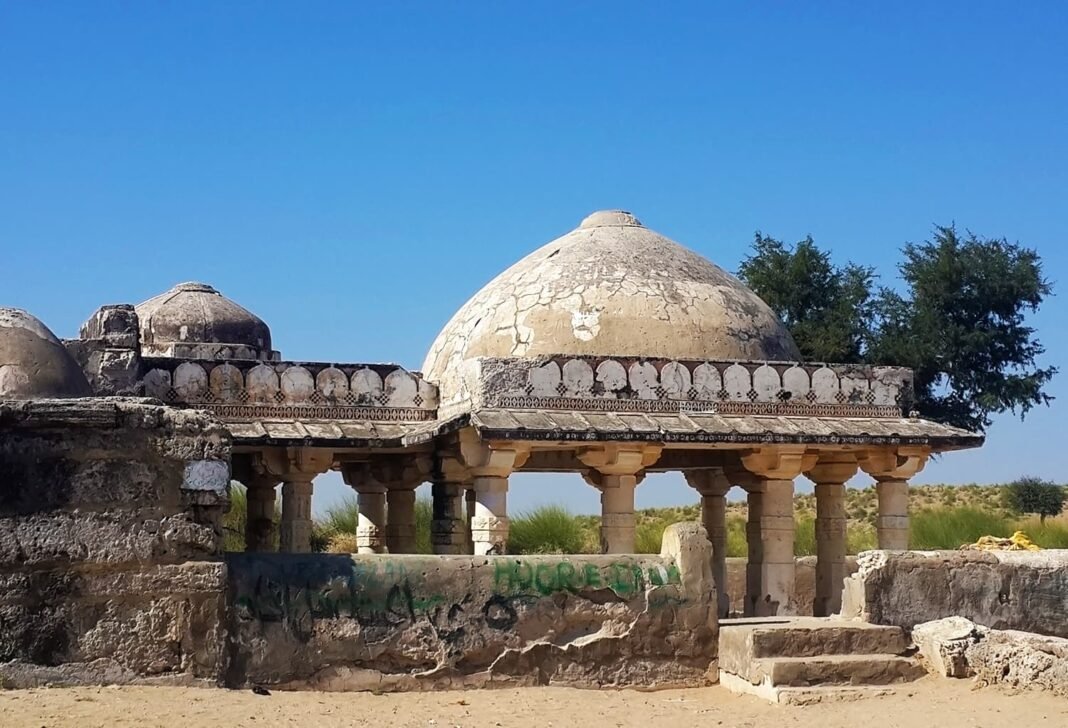
The temple follows the classic plan of Gujarati Jain temples, with three pillared halls (mandapas) leading into each other before you reach the shrine. The outer stone mandapa has marble pillars under a corbelled dome, the inner mandapa mirrors it, and both are ringed by 24 small cells — believed to have housed images of the 24 Tirthankaras. Walk slowly, run your hand along the cool marble, and count the domes above you: 52 of them, echoing the famous Vimal Vasahi temple at Mount Abu in Rajasthan. The building measures roughly 125 by 60 feet, all of it raised on a high stone platform you climb by carved steps.
Photograph a Desert Mirage
For photographers, Gori Temple is a dream subject. Arrive an hour before sunset and the white marble turns honey-gold, while the surrounding dunes glow orange and the sky goes deep blue. The temple’s isolation means there are no wires, buildings or crowds in your frame — just marble, sand and sky. Early morning works too, when the light is soft and the desert air is clear. This is one of the most photogenic heritage sites in Sindh, yet it barely appears on social media — your pictures will genuinely be original.
Sit in Silence in the Shrine
The shrine at the heart of the temple once carried a single tall shikhara in the Kathiawar style; today it is crowned instead with rows of miniature shikharas. The main idol is long gone, but the sanctity of the place remains — local Hindus still hold the site in reverence, and Jain visitors from across the border consider it a lost tirtha. Sit quietly for a few minutes. The only sound is the desert wind and, as one travel writer memorably put it, the screeching of bats echoing through the once-glorious shrine. It is a moving, almost haunting experience.
Trace the Marks of History
Look closely at the walls and you can still see the blackened marks of fire and gunpowder from Colonel Tyrwhitt’s colonial-era attack. Few heritage sites wear their history this openly. Reading those scars after learning the temple’s story — centuries of pilgrimage, repair, damage and survival — turns a sightseeing stop into a lesson in how heritage endures. Pair the visit with a stop at the museum in Nagarparkar town, which holds artefacts from the region, including pieces of the lost Jain past.
Famous Places In and Around Gori Temple
- Viravah Temple — Another white-marble Jain temple, about 14 miles (22–23 km) southeast of Gori, standing in even lonelier desert.
- Bhodesar (Bodhesar) Temples — A cluster of three Jain temples with carved pillars and domes, a short drive from Nagarparkar town.
- Karoonjhar Mountains — The dramatic rocky hills of Nagarparkar, sacred in local lore and perfect for a sunset viewpoint.
- The Well of Marvi — The legendary well of Umar and Marvi’s love story, kept alive by its caretakers, near Nagarparkar.
- Nagarparkar Museum — A small museum with sculptures, jewellery and belongings tied to the region’s legends.
- Mithi — The district’s main town with Gadi Bhit viewpoint, colourful bazaars and the famous peacocks of Thar.
- Islamkot — The town you pass through on the way from Mithi, with its own desert character.
How to Reach Gori Temple
Reaching Gori Temple is half the adventure. The temple sits on the main track between Islamkot and Nagarparkar — about 45 km from Islamkot, and a short drive from Nagarparkar town itself. There is no railway station or airport nearby; this is a road trip destination, full stop.
From Karachi: Drive northeast on the National Highway to Hyderabad, then take the road through Mirpurkhas toward Mithi (the district headquarters of Tharparkar). From Mithi continue to Islamkot and on to Nagarparkar. The total distance is roughly 450 km, and the journey takes around 8–9 hours depending on road conditions and stops. Start very early in the morning to reach by afternoon.
From Lahore: The most practical route is to fly or take the train to Karachi or Hyderabad first, then continue by road as above. Driving the whole way from Lahore is a very long haul — over 1,000 km — and most travellers break it into two days. There are also direct bus services from Karachi to Mithi.
From Islamabad: Fly to Karachi (about 2 hours), then drive. Alternatively, fly to Sukkur and drive south through Khairpur and Umerkot toward Mithi — this route is shorter on paper but the desert roads are slower. The nearest major airport is Jinnah International Airport, Karachi.
Public transport exists (coaches and vans run from Karachi to Mithi), but for the last leg — Mithi to Nagarparkar to Gori Temple — you will want a hired car or jeep with a driver who knows the desert tracks. A local guide is strongly recommended: the tracks are unmarked, mobile signals fade, and a guide will also tell you the stories behind every ruin you pass.
Route Details
- Karachi → Hyderabad: Motorway/highway, good road, about 2–2.5 hours.
- Hyderabad → Mirpurkhas: National highway, about 1.5 hours.
- Mirpurkhas → Mithi: Provincial road through the desert fringe, about 2–2.5 hours. Stock up on fuel, water and snacks in Mithi.
- Mithi → Islamkot: Desert road, about 1 hour.
- Islamkot → Gori Temple → Nagarparkar: The temple lies on this track, roughly 45 km from Islamkot; continue a short distance to Nagarparkar town for the night.
Road conditions are best from October to March. In the monsoon (July–September), parts of the desert road can get soft or flooded — check with locals before setting out. Never attempt the desert tracks after dark; there are no streetlights and very few landmarks.
Where to Stay in Gori Temple
Let us be honest: Gori Temple is not a place with five-star resorts. This is deep desert, and accommodation is simple — which is part of its charm. The sensible plan is to base yourself in Mithi or Nagarparkar and visit the temple as a day trip.
In Mithi: As the district headquarters, Mithi has the best range of options — simple hotels and guesthouses, including the well-known Marvi Guest House, where many travellers stay. Rooms are basic but clean, usually with fans or air-conditioning, and the staff can arrange vehicles and guides for the Nagarparkar run. Book ahead in the winter tourist season (December–February), when domestic travellers and photographers fill the town.
In Nagarparkar: There are small guesthouses and government rest houses closer to the temple — a good option if you want to be at Gori for sunrise. Facilities are very basic, so carry your own water, snacks and a power bank.
Camping: Adventurous groups sometimes camp near the Karoonjhar hills with local guides. This is only for experienced campers with proper gear — the desert gets cold at night in winter and there is no formal campsite. Always go with a local guide and inform your guesthouse of your plans.
Do not expect online booking platforms to list most of these places. The practical way is to call ahead through a local contact or have your tour operator arrange the stay.
Where to Eat: Local Foods of Gori Temple
Thari food is desert food — simple, hearty, and shaped by what the land can grow. The staples are millet (bajra) rotis cooked on open flames, served with desi ghee and gur (jaggery), plus lentils, seasonal vegetables and generous glasses of doodh patti (milky tea). Because much of Tharparkar’s population is vegetarian, you will find some of the best vegetarian cooking in Pakistan here.
In Mithi, small restaurants and dhabas serve the traveller’s classics: channa and puri for breakfast (a favourite stop before the Nagarparkar drive), vegetable curries, paneer rice and vegetable koftas, and of course biryani. Travellers who have documented the route mention eating at spots like Thar Cuisine and Diamond Restaurant in Mithi, and the town’s hotels serve simple, fresh meals to guests. Do not leave without trying a glass of fresh buttermilk or doodh patti at a roadside dhaba — it tastes different in the desert air.
A note for the curious: during locust swarms a few years ago, Thari cooks famously turned the pests into karahi and biryani, and locals have long considered them a protein-rich delicacy. It is not an everyday menu item, but it tells you everything about Thari resourcefulness.
Meals in this region are budget-friendly — a full dhaba meal typically costs only a few hundred rupees. Carry drinking water and dry snacks for the temple visit itself, because there are no food stalls at Gori.
Weather in Gori Temple
Gori Temple sits in the Thar Desert, which means extreme heat in summer, cool pleasant winters, and a short monsoon that briefly turns the dunes green — the most magical time to see the landscape, even if the roads get trickier.
| Season | Temperature Range | Conditions |
|---|---|---|
| Winter (Nov–Feb) | 8°C – 25°C | Sunny days, cold nights. The best season for visiting — clear skies and comfortable desert air. |
| Spring (Mar–Apr) | 20°C – 35°C | warming up fast; March still pleasant, April starts getting hot. Good for the Parasnath festival. |
| Summer (May–Jun) | 32°C – 45°C | Scorching desert heat. Avoid midday visits; not recommended for the long drive. |
| Monsoon (Jul–Sep) | 28°C – 40°C | Occasional heavy rain turns the desert green and brings peacocks out dancing — beautiful, but roads can flood. |
| Autumn (Oct) | 22°C – 35°C | Heat easing off; the start of the comfortable travel window. |
Language and Culture of Gori Temple
Tharparkar has one of the most distinctive cultures in Pakistan. The people are Tharis — a mix of Muslim and Hindu communities (Tharparkar is one of the few districts in Pakistan with a Hindu majority) who share the desert’s harsh life and its warm hospitality. You will hear Dhatki and Marwari spoken in the villages, alongside Sindhi and Urdu. Many locals also understand basic English in Mithi.
The culture is deeply musical and devotional. Do not be surprised if, outside a temple, local men start singing a Kabir kalam on the tambura as the sun sets — travellers have described exactly this scene at Gori, and it turns a heritage visit into something spiritual. Peacocks are sacred here and roam freely; harming one is unthinkable to locals.
Etiquette for visitors: Remove your shoes before entering the temple, as you would at any Hindu or Jain shrine. Dress modestly — cover shoulders and knees. Ask before photographing people, especially women. The communities here are conservative but famously hospitable; a smile and a greeting in Sindhi (“Assalam-o-Alaikum” works for Muslims, “Namaste” for Hindus) goes a long way. Do not touch the frescoes or carvings — they have survived 600 years and deserve to survive 600 more.
Shopping in Gori Temple
There are no souvenir shops at the temple, but Mithi and Nagarparkar bazaars offer genuine desert crafts. Look for Thari embroidery — mirror-work and colourful threadwork on shawls, cushion covers and women’s dresses, made by local artisan women. Ajrak block-printed shawls from Sindh are sold here too, along with camel-skin and leather items.
Food souvenirs travel well: packets of gur (jaggery), desi ghee in sealed jars, and dried desert herbs. Prices are local-market prices — a fraction of what you would pay in Karachi or Lahore — and bargaining gently is normal. Buy directly from artisans when you can; your money goes straight to the families who keep these crafts alive.
Local Events and Festivals
Despite its ruined state, Gori Temple is not entirely silent on the festival calendar. A festival is still held here around 20–25 March in honour of Parasnath (Parshvanatha), the Tirthankara to whom the temple is dedicated — a rare living link to its centuries as a Jain pilgrimage centre. If your trip falls in late March, ask in Mithi or Nagarparkar whether the gathering is taking place; it is a modest, devotional affair, not a tourist spectacle.
More broadly, Tharparkar’s Hindu community celebrates Thadri in late August or early September (the date follows the Hindu calendar) — a festival of cold foods eaten without lighting a stove, honouring the goddess Sheetala. Sweets like mitho lolo (a jaggery flatbread) are prepared a day in advance. And after good monsoon rains, the whole desert celebrates informally: the dunes turn green, peacocks dance, and villages come alive with music — the desert’s own festival, with no fixed date.
Travel Tips for Gori Temple
Packing Essentials
Sun protection is non-negotiable: a wide-brimmed hat, sunglasses, sunscreen and a scarf or shawl for dust. Carry at least 2 litres of water per person — there is no drinking water at the temple. Wear comfortable walking shoes with good grip for climbing the temple’s stone steps and walking on sand. In winter (December–January), nights drop near 8°C, so pack a warm layer even though days are sunny. A torch or headlamp helps you see the interior frescoes, and a power bank is essential since you will not find charging points in the desert.
Safety Tips
Tharparkar is generally peaceful and its people are welcoming to visitors, but the desert itself demands respect. Never drive the desert tracks alone or after dark. Travel with a local driver who knows the unmarked routes, and keep your vehicle’s fuel tank topped up — petrol pumps are few beyond Mithi. Inform your hotel of your itinerary and expected return time. Carry a basic first-aid kit and any personal medication; the nearest proper hospital is in Mithi. Foreign visitors should check current travel advisories for the region and may need to register with local authorities — your tour operator can arrange this.
Money & Connectivity
There are no ATMs at Gori Temple or in Nagarparkar town itself — withdraw cash in Mithi (or Karachi/Hyderabad before you leave). Carry enough Pakistani rupees for fuel, food, guide fees and small purchases, since digital payments are unreliable in the desert. Mobile signals are patchy: expect weak or no coverage on the desert tracks between towns, though Mithi and Nagarparkar have basic coverage on the major networks. Download offline maps of Tharparkar before you set out — you will be glad you did.
Best Time to Visit Gori Temple
Winter (November–February) — The Perfect Window
This is when Gori Temple shines. Days are sunny and warm (around 20–25°C), nights are cool, the air is crystal clear, and the long drive from Karachi is comfortable. December and January are the peak months — book your Mithi accommodation in advance. Photographers get the sharpest desert light, and the temple’s marble looks its best against a deep blue winter sky.
Spring (March–April) — Festival Season
March is worth considering for the Parasnath festival around 20–25 March, when the temple briefly comes alive with devotees. Temperatures are still manageable in March, but April turns hot and the desert wind picks up. If you come now, plan temple visits for early morning or late afternoon.
Monsoon (July–September) — The Green Desert
Only for the adventurous. A good monsoon transforms Tharparkar: the dunes turn emerald green, wildflowers bloom, and peacocks dance in the rain. It is the most beautiful the desert ever gets — but roads can flood, tracks turn to mud, and travel becomes unpredictable. Check conditions locally before attempting this trip in the rains.
Summer (May–June) — Avoid
With temperatures touching 45°C, summer is genuinely punishing. The marble courtyard becomes too hot to walk on barefoot, the drive is exhausting, and there is little shade at the site. Unless you have no choice, skip these months.
Final Thoughts
Gori Temple is not an easy destination, and that is exactly why it matters. In a world where every famous site has been photographed a million times, this 650-year-old marble temple in the Thar Desert still offers what travellers secretly crave: discovery. You will stand where Jain pilgrims stood six centuries ago, look up at paintings no camera had seen for generations, and drive home through a desert that glows gold at dusk.
If you love exploring Pakistan’s architectural heritage, pair this trip with other wonders from our Explore Pakistan series — from the mighty Badshahi Mosque travel guide to the valleys of the Hunza Valley.
It is also a reminder that Pakistan’s heritage is deeper and more diverse than the headlines suggest. A Jain temple in Sindh, still standing, still respected, still on the road to world heritage recognition — that is a story worth telling. If this gori temple travel guide has convinced you, start planning for winter, find a good driver in Mithi, and go and see it before the rest of the world catches on.
FAQs
Where is Gori Temple located?
Gori Temple is in the Nagarparkar area of Tharparkar district, Sindh, in the Thar Desert near the Indian border. It lies on the track between Islamkot and Nagarparkar, about 45 km from Islamkot and roughly 450 km from Karachi.
What is the best time to visit Gori Temple?
November to February is ideal — sunny days, cool nights and comfortable driving conditions. March is good if you want to catch the Parasnath festival (around 20–25 March). Avoid May–June, when desert temperatures can reach 45°C.
How do I reach Gori Temple?
By road from Karachi via Hyderabad, Mirpurkhas, Mithi and Islamkot — about 450 km and 8–9 hours. From Mithi or Nagarparkar, hire a car or jeep with a local driver for the desert tracks. The nearest major airport is Karachi’s Jinnah International Airport.
Is Gori Temple safe for tourists?
Tharparkar is generally peaceful and locals are welcoming, but the desert itself needs caution: travel with a local driver, never drive the tracks after dark, carry water and fuel, and inform your hotel of your plans. Check current travel advisories if you are a foreign visitor.
Is Gori Temple suitable for families?
Yes, for families with older children who can handle a long drive and a day in the desert. The site itself is easy to walk around, but there are no facilities (no food, water or restrooms), so come prepared. It is less suited to very young children or elderly travellers in the heat.
Where can I stay near Gori Temple?
Base yourself in Mithi (about an hour’s drive away), which has hotels and guesthouses such as Marvi Guest House, or in the simpler guesthouses of Nagarparkar town, closer to the temple. Most travellers visit Gori as a day trip from Mithi.
What food is available near Gori Temple?
There is no food at the temple itself. In Mithi and Nagarparkar you will find dhabas and small restaurants serving Thari vegetarian food — millet rotis, lentils, vegetable curries, paneer dishes, channa-puri and biryani — plus doodh patti and buttermilk. Meals are budget-friendly.
Why is Gori Temple historically important?
Built in 1375–1376 CE and dedicated to the Jain Tirthankara Parshvanatha, it holds the oldest surviving Jain frescoes in the northern subcontinent, features 52 domes in the Gujarati style, and is on Pakistan’s UNESCO World Heritage tentative list (2016) as part of the Nagarparkar Cultural Landscape.