Lahore’s Mughal treasures are usually the big, famous ones — the Fort, the Badshahi Mosque, Shalimar Gardens. But some of the most beautiful Mughal work in the city hides in plain sight along the Grand Trunk Road, in a neighbourhood called Begumpura. The Gulabi Bagh Gateway is one of those places: a 370-year-old entrance gate covered in glowing kashi-kari tile work, all that remains of a pleasure garden laid out in 1655 by one of Shah Jahan’s admirals. If you love history that rewards the curious, this gulabi bagh gateway travel guide will convince you to make the stop.
Quick Facts
- Location: Begumpura, Lahore, Punjab — on the Grand Trunk Road toward the Shalimar Gardens
- Famous For: A 1655 Mughal gateway with exquisite kashi-kari (Kashan-style) mosaic tile work; the sole surviving element of a lost pleasure garden
- Nearest City: Lahore (inside the city; a short ride from the Walled City and Shalimar Gardens)
- Accessibility: Roadside monument, easy by car, rickshaw or ride-hailing; no climbing involved, fully viewable from the street
- Known Landmarks: The gateway itself; the nearby Tomb of Dai Anga (1671), the tomb of Hazrat Ishaan, and the Cypress Tomb
- Best For: History and architecture lovers, photographers, heritage walkers, anyone exploring Mughal Lahore beyond the famous sites
Why Visit Gulabi Bagh Gateway
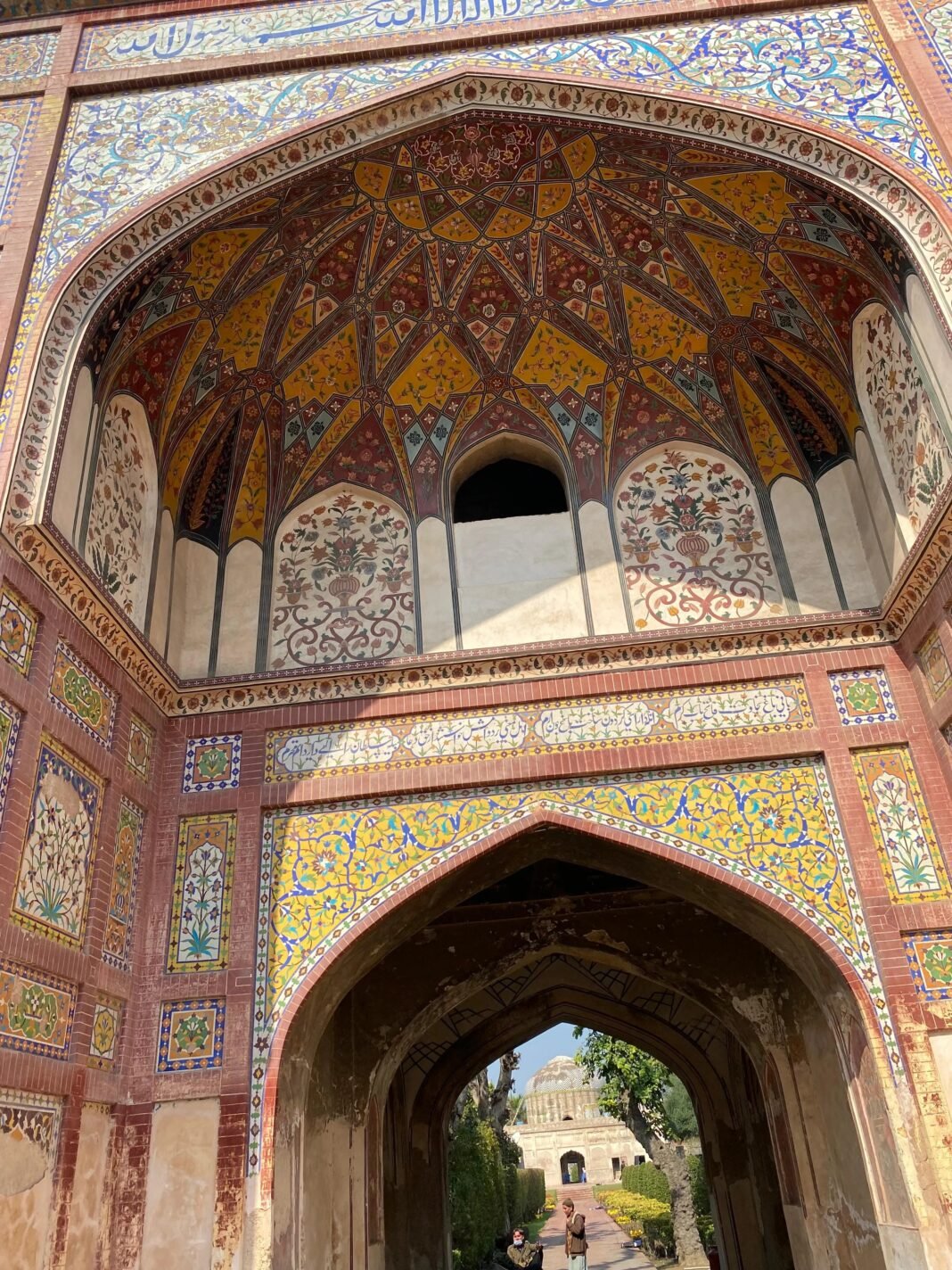
There is a special pleasure in finding beauty where you did not expect it. The Gulabi Bagh Gateway stands on a busy Lahore road, traffic streaming past, and yet the moment you look up at its façade — the intricate mosaic tiling in blue, yellow and green across brick, the calligraphic panels, the perfect Mughal proportions — the noise falls away. This is the tile work of the great Mughal age at its most vivid, and almost nobody comes to see it.
The gateway is also a masterclass in how Lahore’s history layers itself. It was built in 1655–56 as the entrance to a square pleasure garden 250 Mughal yards on each side — a garden for delight, laid out by a Persian admiral of Shah Jahan’s fleet. Sixteen years later, the garden was converted into the tomb complex of Dai Anga, the emperor’s wet nurse, whose mausoleum still stands a short distance to the north. One building, two lives: a pleasure garden and a memorial, separated by a single generation.
For photographers, the gateway is a gift. The V&A Museum in London holds a 19th-century albumen photograph of it by James Craddock and a c.1880 architectural drawing by Muhammad Din of the Mayo School — proof that artists have been drawn to this façade for 150 years. You can stand in the same spot, frame the same arches, and take home a shot most Lahore visitors never knew existed.
And it fits beautifully into a heritage day. The gateway sits on the historic route between Lahore and Delhi, close to the Shalimar Gardens, so you can pair it with the great Mughal garden, the Dai Anga tomb and the old GT Road monuments in a single relaxed outing.
History of Gulabi Bagh Gateway
The gateway dates to 1655–56 CE (1066 AH), the high noon of Shah Jahan’s reign. It was commissioned by Mirza Sultan Baig (also spelled Beg), a Persian noble who served as Amir-ul-Bahr — admiral of the Mughal fleet — and was related by marriage to the imperial family (sources describe him as connected to Shah Jahan through the emperor’s daughter’s family). As the entrance to his pleasure garden, the gateway was meant to impress from the first glance, and it still does.
The garden it opened onto was a classic Mughal square, measuring 250 Mughal yards (gaz) on each side — slightly smaller than Asaf Khan’s tomb-garden at Shahdara, but larger than the gardens of the great nobles Ali Mardan Khan and Mahabat Khan further along the same road. In the mid-17th century, this whole stretch of the realigned Grand Trunk Road was filling with the residences, villages, shrines and tomb-gardens of the Mughal elite — Begumpura (“Woman’s Town”), Kot Khwaja Saeed, Bhogiwal — and the Gulabi Bagh was among the finest of them.
Then, in 1671, the garden’s purpose changed forever. Dai Anga — the wet nurse of Shah Jahan and wife of Murad Khan, the magistrate of Bikaner under Jahangir — died, and the pleasure garden was repurposed as her tomb complex. A new mausoleum was raised at the centre of the square, and over the centuries the surrounding garden was swallowed by encroaching structures until only a narrow strip remained between the tomb and the gateway. The gateway thus predates the famous tomb it now serves by sixteen years — a rare case where the entrance is older than the monument.
The name itself carries a small mystery. “Gulabi” is usually read as “rosy” or “of roses” (the Rose Garden), and the words also serve as a chronogram: their numerical value gives the construction date of 1066 AH / 1655 AD, a fact noted by the 19th-century historian Syed Muhammad Latif in his 1892 survey of Lahore’s monuments. But researchers have proposed that “Gulabi” may derive from the Persian word qalabi (pear), inscribed in a geometrical panel on the façade, which was popularly reinterpreted over time. Latif himself described the gateway as standing on the Shalimar road, “rather more than half way on the left,” its splendid arched entrance of glazed tiles still standing while the garden had vanished.
The craftsmanship is kashi kari — Kashan-style mosaic tile work whose origins lie in 14th-century Iran and which became a signature of later Mughal architecture. The gateway is now protected under Pakistan’s Antiquities Act of 1975. Like many of Lahore’s smaller monuments, it faces pressures from encroachment and weathering, which makes visiting — and valuing — it all the more worthwhile.
Top Things to Do in Gulabi Bagh Gateway
Study the kashi-kari tile façade
Give the gateway a full, slow ten minutes. The mosaic tiling across the brick façade — geometric panels, floral sprays, calligraphic bands — repays close looking. The tile work originated in Iran in the mid-14th century and reached its Mughal flowering in buildings like this one. Morning light rakes across the façade and makes the glazing glow; bring a zoom lens for the upper panels.
Decode the chronogram
Look for the inscription panels and remember Latif’s observation: the very name “Gulabi Bagh” encodes the building’s date (1066 AH). Whether you read it as “Rose Garden” or the debated “pear” (qalabi) theory, standing before the words and knowing they carry a hidden date is one of those small thrills that makes heritage travel addictive.
Walk to the Tomb of Dai Anga
A short distance north of the gateway stands the 1671 mausoleum of Dai Anga, Shah Jahan’s wet nurse — the reason the pleasure garden became a tomb complex. The tomb’s dome still carries traces of Mughal-era frescoes, and its façade retains kashi-kari tile work that echoes the gateway. Visiting both together tells the full story. (See also our Dai Anga’s Mosque travel guide for another monument to this remarkable woman.)
Photograph the 19th-century views
James Craddock photographed this gateway in the 1860s–70s (his print is in the V&A), and Muhammad Din drew it around 1880. Try to find their vantage point — the frontal view down the old road alignment — and take the same shot 150 years later. It is a wonderful way to feel the continuity of the place.
Famous Places In and Around Gulabi Bagh Gateway
- Tomb of Dai Anga: 1671 Mughal mausoleum, a short walk north; shares the gateway’s tile-work tradition.
- Shalimar Gardens: Further along the same historic road — the great Mughal garden, a UNESCO World Heritage Site.
- Tomb of Hazrat Ishaan: 17th-century shrine close by on the old Lahore–Delhi route.
- Cypress Tomb: An 18th-century tomb in the same neighbourhood, worth a look for architecture fans.
- Badshahi Mosque and Lahore Fort: The city’s headline Mughal monuments — read our Badshahi Mosque travel guide and combine both in one heritage day.
How to Reach Gulabi Bagh Gateway
The gateway stands in Begumpura on the Grand Trunk Road, on the route from central Lahore toward the Shalimar Gardens — well inside the city. From anywhere in Lahore, a ride-hailing car (Careem, Uber, inDrive) or auto-rickshaw will get you there in 15–30 minutes depending on traffic. If you are coming from the Walled City or Badshahi Mosque area, head east on the GT Road toward Shalimar; the gateway is on the roadside and your driver will know Begumpura.
From Islamabad: M-2 motorway to Lahore (about 380 km, 4.5–5 hours), then city roads east to Begumpura. From Karachi: Fly to Allama Iqbal International Airport (1.5 hours), then a 30–45 minute drive. Nearest airport: Allama Iqbal International Airport, Lahore, roughly 12–15 km from Begumpura.
Road conditions are ordinary city roads — no special vehicle needed. There is no formal visitor infrastructure: no ticket office, no guided tours. The gateway is best appreciated as part of a self-guided heritage drive. Combine it with Shalimar Gardens (about 10–15 minutes further east) and the Dai Anga tomb for a half-day Mughal trail.
Route Details
- From central Lahore, take the Grand Trunk Road east toward Shalimar Gardens.
- Pass through the Begumpura neighbourhood; watch the left (north) side of the road for the tiled gateway façade.
- Park safely on a side street — do not block the GT Road — and approach on foot.
- Spend 20–30 minutes at the gateway, then continue north a short distance to the Tomb of Dai Anga.
- Finish at the Shalimar Gardens, 10–15 minutes further east, for the full Mughal garden experience.
Where to Stay in Gulabi Bagh Gateway
The gateway is a roadside stop, not an overnight destination — you stay in Lahore. Luxury travellers should consider the five-star hotels on Mall Road and Upper Mall, a 20–30 minute drive from Begumpura. Mid-range business hotels in Gulberg and around the airport road offer comfortable rooms with breakfast at moderate rates, roughly 25–35 minutes away.
Budget travellers will find guesthouses and budget hotels near the Railway Station and Lower Mall, 15–20 minutes from the gateway. For a heritage-focused trip, staying near Mall Road or the old city keeps you within easy reach of the gateway, Shalimar Gardens, the Fort and the Badshahi Mosque. Book ahead in the wedding season (December–February) and around national holidays.
Where to Eat: Local Foods of Gulabi Bagh Gateway
Begumpura and the GT Road corridor are lined with the dhabas and eateries that feed working Lahore: fresh tandoori roti, dal fry, chicken karahi, kebabs and doodh patti, all at budget-friendly prices. For the full Lahori experience, drive 20 minutes west to Fort Road Food Street near the Badshahi Mosque — lahori chargha, tandoori platters and kebabs served with the illuminated fort behind you.
Do not leave Lahore without trying its signatures: paye and nihari for breakfast, dahi bhalla and golgappe from old-city vendors, and falooda or kulfi for dessert. Street food around Begumpura is cheap and delicious; choose busy stalls with high turnover and drink bottled water.
Weather in Gulabi Bagh Gateway
The gateway shares Lahore’s climate: fiercely hot summers, mild winters, and two glorious shoulder seasons. Since the monument is fully outdoors with no shade, timing matters.
| Season | Temperature Range | Conditions |
|---|---|---|
| Winter (Dec–Feb) | 7–22°C | Mild and clear; the best light for tile-work photography |
| Spring (Mar–Apr) | 18–32°C | Warm and pleasant; ideal for a heritage drive |
| Summer (May–Jul) | 35–45°C, can touch 48°C | Extreme heat; visit early morning only |
| Monsoon (Jul–Sep) | 30–38°C | Humid with heavy showers; slippery roads, dramatic skies |
| Autumn (Oct–Nov) | 20–32°C | Clear and cooling; excellent for combining with Shalimar Gardens |
Language and Culture of Gulabi Bagh Gateway
Urdu is the working language, with Punjabi in its warm Lahori accent spoken everywhere around you. English is widely understood by drivers and in hotels. As a 370-year-old protected monument, the gateway deserves the standard respect: do not deface the tile work, do not climb the structure, and keep the surroundings clean.
Begumpura is a lived-in, working-class Mughal-era neighbourhood, not a tourist zone — which is part of its charm. Dress modestly, greet shopkeepers, and ask before photographing people. If you visit the nearby shrines and tombs, remove shoes where custom requires and keep your voice low. A small tip to a caretaker who shows you around is customary and appreciated.
Shopping in Gulabi Bagh Gateway
There are no souvenir shops at the gateway itself, but the GT Road corridor is one of Lahore’s great commercial arteries. The nearby Shahdara and Begumpura markets sell everyday goods, fabrics and dry fruits at local prices. For Mughal-themed keepsakes — miniature paintings, calligraphy prints, blue pottery inspired by kashi-kari — head to the shops around the Fort and in Anarkali Bazaar. Liberty Market in Gulberg covers everything from lawn suits to electronics if you need a modern mall.
Travel Tips for Gulabi Bagh Gateway
Packing Essentials
Sun protection (cap, sunglasses, sunscreen), comfortable walking shoes, a water bottle and a camera with zoom for the upper tile panels. A copy of Latif’s description or a printout of Craddock’s photograph makes a wonderful companion for the visit.
Safety Tips
The GT Road is busy and chaotic — cross carefully and park off the main carriageway. The area is a normal working neighbourhood; standard city awareness is enough. Visit in daylight; the tile work also photographs best in daylight.
Money & Connectivity
Carry cash for rickshaws, snacks and small purchases — small vendors rarely take cards. ATMs are plentiful along the GT Road and in Gulberg. All major networks (Jazz, Telenor, Zong, Ufone) have strong 4G coverage in the area.
Best Time to Visit Gulabi Bagh Gateway
Winter (November–February): Best
Cool, clear days and low-angled sunlight make the tile work glow. Combine with Shalimar Gardens and the old city in perfect comfort.
Spring and Autumn (March–April, October): Excellent
Warm but pleasant — ideal for the full Mughal heritage drive along the GT Road.
Summer and Monsoon (May–September): Early Mornings Only
The heat is punishing and there is no shade at the monument. If this is your only window, arrive just after sunrise.
Final Thoughts
The Gulabi Bagh Gateway is proof that Lahore’s greatest pleasures are not always the famous ones. In half an hour — reading the chronogram in its name, tracing the kashi-kari panels with your eyes, walking on to Dai Anga’s tomb — you will have touched the Mughal age more intimately than most visitors ever do. Add the Shalimar Gardens down the road, and you have a heritage half-day that belongs in every Lahore itinerary.
For more of Pakistan’s historic places, from famous forts to forgotten gateways, explore our Explore Pakistan collection — or head north to the mountains with our Malam Jabba guide.
FAQs
1. Where is the Gulabi Bagh Gateway located?
In Begumpura, Lahore, on the Grand Trunk Road toward the Shalimar Gardens — inside the city, 15–30 minutes from central Lahore by car or rickshaw.
2. When was the Gulabi Bagh Gateway built?
In 1655–56 CE (1066 AH) by the Persian noble Mirza Sultan Baig, admiral of Shah Jahan’s fleet, as the entrance to his pleasure garden. The garden later became the tomb complex of Dai Anga in 1671.
3. What is the best time to visit?
Winter (November–February) and the spring/autumn shoulder seasons. Avoid midday in summer, when Lahore’s heat is extreme and the monument has no shade.
4. How do I reach it?
Take the GT Road east from central Lahore toward Shalimar Gardens; the gateway stands roadside in Begumpura. Any ride-hailing car or rickshaw driver will know the area.
5. Is there an entry ticket?
There is no formal ticket office; it is a roadside protected monument. Visit respectfully and do not climb on or deface the structure.
6. What is kashi-kari?
Kashan-style mosaic tile work, originating in 14th-century Iran, that became a signature of later Mughal architecture — the glowing tiled façade is the gateway’s main attraction.
7. What local food should I try nearby?
The GT Road dhabas serve chicken karahi, kebabs and fresh roti at budget prices; for a feast, drive to Fort Road Food Street for lahori chargha and tandoori platters.
8. What else is nearby?
The Tomb of Dai Anga (a short walk north), the Shalimar Gardens (10–15 minutes east), the tomb of Hazrat Ishaan and the Cypress Tomb — plus our Badshahi Mosque guide for the city’s headline monument.