Quick Facts
- Location: Gunyar (also called Gul-e-Anaar, “Flower of Pomegranate”) village, near Thana, Malakand District, Khyber Pakhtunkhwa, Pakistan
- Altitude: Malakand’s valley floor (lowland — exact figure for the village not published)
- Famous For: An ancient Buddhist stupa and monastery remains from the Gandhara era, set in a historic village on the old Buddhist pilgrimage route
- Nearest City: Thana, then Batkhela (the district headquarters) and Dargai
- Accessibility: Good paved roads all the way from Islamabad via the Swat Expressway; the last stretch is a village road. No visitor facilities at the site itself — visit in daylight with a local guide
- Known Landmarks: The Gunyar stupa remains, the nearby Shingardar Stupa at Barikot, Malakand Fort, the Shahkot Pass and the ancient Hathilar (elephant) caravan route
- Best For: History lovers, Buddhist heritage travelers, photographers, and anyone exploring the Gandhara trail beyond the crowded spots
Why Visit Gunyar Stupa, Malakand
Some places reward you with views. Others reward you with stories. Gunyar Stupa, Malakand does both, but it is the stories that stay with you. Tucked beside a village whose name means “Flower of Pomegranate,” this quiet Buddhist stupa belongs to the same Gandhara civilization that gave the world Taxila and Takht-i-Bahi. The difference is that here you will likely have the stones entirely to yourself. No ticket counters, no crowds, no selfie queues — just a 2,000-year-old monument, the murmur of the village, and the hills of Malakand watching over it all.
If you are the kind of traveler who reads the small print on museum plaques, who gets a thrill from standing where Chinese pilgrims walked fifteen centuries ago, Gunyar is your place. The stupa sits in a landscape that has seen Alexander the Great’s armies, Mauryan administrators, Kushan patrons of Buddhism, and the Yousafzai tribes who still farm these fields. Few destinations in Pakistan compress that much history into one village walk. It is a perfect half-day stop on a Swat or Malakand itinerary, and it pairs beautifully with the grander Gandhara sites nearby.
There is also something moving about the village itself. The people of Gunyar are mostly Madey-Khel Miagaan, descendants of the saints Madey Baba and Serai Baba, and their community has kept the place alive through schools, a health unit, and a women’s handicraft center built by their own youth welfare association. Visiting Gunyar is not just a history trip; it is a meeting with a living community that happens to farm around ancient ruins. Come with respect, ask before photographing people, and you will leave with more than pictures.
This gunyar stupa malakand travel guide will help you plan the visit properly: what the site is, how the region’s history unfolded, how to reach it from Islamabad, Lahore, or Karachi, what the weather is like through the year, and how to combine it with the wider Gandhara trail of Khyber Pakhtunkhwa. For more destination ideas across the country, browse our Explore Pakistan collection.
History of Gunyar Stupa, Malakand
The story of Gunyar begins long before the stupa was built, in the lands of ancient Gandhara. This region sat at the crossroads of empires for two thousand years. When Alexander the Great pushed through the area in 327 BC, the capital of the local Swati tribes was at Odigram near Barikot, only about 25 kilometers northeast of Gunyar. Alexander’s campaign shook the region but could not hold it, and by 305 BC the Mauryan Empire had stepped in — the same Mauryas whose emperor Ashoka would make Buddhism a state religion and cover the subcontinent with stupas and edicts.
Buddhism flourished here most brilliantly under the Kushan dynasty, when Gandhara became one of the great centers of Buddhist art and learning in the ancient world. The Gunyar stupa belongs to this broad Gandhara world of monasteries and shrines. A modern survey by Pakistan’s Directorate of Archaeology and Museums recorded the wider Malakand region as astonishingly rich — more than a thousand archaeological sites across a district of just 952 square kilometers — and its teams documented 92 previously unrecorded sites in villages including Gunyar, Thana, Landakay, and Haibatgram. The finds included Gandhara grave-culture burials, Buddhist monasteries, stupas, rock paintings, and Hindu Shahi remains, built in the region’s characteristic diaper and ashlar stone masonry that continued from Kushan times into the Hindu Shahi period.
One of the most evocative details of Gunyar’s history is the old caravan road hewn through the Shahkot mountains, known as Hathilar — the “elephant route.” Scholars believe this road was built under royal patronage both for trade and for the convenience of Buddhist pilgrims traveling to the monasteries of Loriyan Tangai, Kafir-Kot, and Gunyar, and onward to the great Buddhist centers of Swat, Dir, Buner, and Bajaur. The remains of a Buddhist shrine on the summit of the Shahkot pass, known locally as the Takht or “throne,” suggest the pass itself was a pilgrimage station. Standing at Gunyar today, you are on a road that monks and merchants walked for a thousand years.
The medieval and early modern chapters of the village’s story are just as real. The Muslim period in this part of Swat and Malakand opened with Mahmud of Ghazni’s campaigns around 1001 AD, remembered in local tradition by the Shaheedan shrines at the entrance routes. Centuries later, in 1519, the saint Madhay Baba arrived with the forces of the Mughal emperor Babur to support the Yousafzai tribe in their conquest of Swat — an event the people of Gunyar still count as part of their own ancestry, since most villagers trace their descent to Madey-Khel Miagaan, the kin of Madey Baba and Serai Baba. In the modern era, the Gunyar Youth Welfare Association, founded in 1984, has led the village’s development: building and upgrading schools, establishing a health unit, creating a women’s handicraft center, and planting a community forest with an irrigation system to support farming.
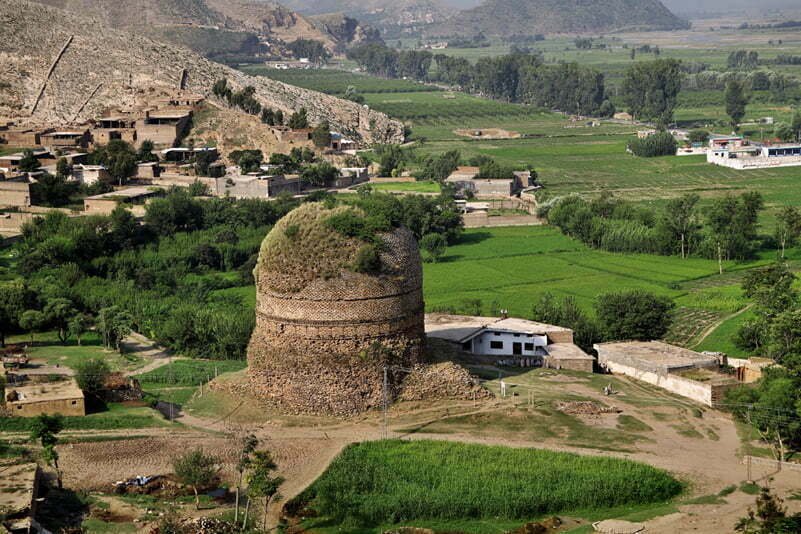
Today the stupa itself survives in a fragile state, like so many of Malakand’s Buddhist monuments. Archaeologists have warned that most of the district’s ancient sites are in poor condition, with some converted to farmland or absorbed by modern villages, and have called for urgent conservation — and for sites like Gunyar to be promoted for religious and heritage tourism. Visiting respectfully, and hiring a local guide, is a small way of showing that this heritage matters.
Top Things to Do in Gunyar Stupa, Malakand
Stand Before the Stupa Itself
The heart of the visit is the stupa mound and its associated remains. Take your time walking around it slowly, the way pilgrims once did. Look closely at the stonework — the diaper masonry pattern of the Gandhara builders is still readable in places. Because there are no signs and no guides on duty, bring what you have read with you, or better, bring a local elder or a guide from Thana who can point out which scatter of stones was a wall and which was a shrine. Early morning or late afternoon light is kindest for photographs.
Walk the Village of Gul-e-Anaar
Gunyar’s nickname, “Flower of Pomegranate,” is a promise the orchards still keep. A slow walk through the village lanes — past the fields, the irrigation channels, and the community forest planted by the youth welfare association — shows you the living side of this heritage landscape. The nearby villages of Thana, Chapai, Maizara, Aladhand Dherai, and Nalu make for a pleasant extended wander if you have the legs for it. Always greet people, ask before taking portraits, and accept the inevitable cup of tea.
Trace the Hathilar Elephant Route at Shahkot Pass
If you have a full day, drive up toward the Shahkot pass and look for the ancient carved road known as Hathilar, where elephants and caravans once climbed the mountain. The Buddhist shrine remains at the summit, called the Takht, make a fine viewpoint and a historian’s picnic spot. The pass road is rough in places, so go with a local driver who knows it.
Visit the Shingardar Stupa at Barikot
About 25 kilometers northeast, near Barikot, stands the Shingardar Stupa — locally called the Gunbad — at the foothill of the Kumbazara forest. It is one of the best-preserved stupas of the Hindu Shahi period in the region and makes the perfect companion visit to Gunyar: two stupas, two eras, one afternoon. Barikot itself was ancient Bazira, the city Alexander besieged, so the whole drive is a history lesson.
Explore the Malakand Pass and Fort Area
The Malakand Pass, gateway between the Peshawar valley and Swat, is one of the most storied mountain passes in South Asia — the Malakand Field Force campaigned here in the 1890s, and the young Winston Churchill rode with it. The fort and the pass viewpoints are a short drive from Gunyar and give you the strategic-military layer of the region’s history to set beside the Buddhist layer.
Famous Places In and Around Gunyar Stupa, Malakand
- Shingardar Stupa (Barikot): Well-preserved Hindu Shahi-era stupa near the ancient city of Bazira.
- Malakand Fort and Pass: Historic British-era fort and the famous pass into Swat.
- Chakdara Museum: Gandhara sculptures and artifacts from the Dir and Swat valleys, a short drive away.
- Shahkot Pass and Hathilar route: Ancient carved caravan road with a Buddhist shrine at the summit.
- Butkara and Saidu Sharif (Swat): The great Buddhist complex of Butkara and the Swat Museum, for the full Gandhara day.
- Thana Bazaar: The nearest market town for tea, snacks, and supplies.
How to Reach Gunyar Stupa, Malakand
Gunyar is one of the more accessible Gandhara sites in Khyber Pakhtunkhwa. The village sits just off the road network near Thana in Malakand District, and the Swat Expressway has cut journey times dramatically. Roads are paved to Thana; the final approach into the village is a narrower village road, easily managed by car in dry weather.
From Islamabad (about 200 km, 4–5 hours): Take the M-1 motorway toward Peshawar, exit onto the Swat Expressway, and continue to the Dargai/Batkhela/Thana exits. From Thana it is a short drive to Gunyar village. This is the easiest and most popular route.
From Lahore (about 460 km, 6–7 hours): Take the M-2 to the M-1 interchange, then follow the Islamabad route above via the Swat Expressway. Leave early to reach the site in daylight.
From Karachi: Fly to Islamabad or Peshawar and continue by road. Bacha Khan International Airport in Peshawar is the closest major airport to Malakand (roughly 100 km), with Islamabad International Airport the main international gateway. There is no railway station at Gunyar; the nearest railheads are at Peshawar and Rawalpindi.
Public transport options include the comfortable coach services that run from Islamabad and Peshawar to Batkhela, Dargai, and Thana, from where a local taxi or rickshaw can take you to the village. For the most relaxed trip, hire a car with a driver who knows the Malakand back roads, or join a heritage tour heading for the Swat valley — many pass within minutes of Gunyar. If you loved the mountain roads on the way here, you will feel at home on the route to Malam Jabba further up the valley.
Route Details
- Islamabad → M-1 motorway → Swat Expressway (follow signs for Swat/Chakdara).
- Exit the expressway toward Dargai/Thana/Batkhela.
- Drive to Thana town; ask locally for the Gunyar (Gul-e-Anaar) village road.
- Park at the village edge and walk to the stupa remains with a local guide — the site has no visitor facilities, so go in daylight and carry water.
Where to Stay in Gunyar Stupa, Malakand
Gunyar village itself has no hotels, which is part of its charm — but you will not be short of beds nearby. The practical base is Batkhela, the district headquarters, where mid-range hotels and guesthouses cluster along the main road. These are simple, clean, family-run places with hot water and home-style food; expect budget-friendly tariffs rather than luxury.
Dargai and Thana offer smaller guesthouses and rest houses suited to an overnight stop. If you prefer more comfort, base yourself in Saidu Sharif or Mingora in Swat (about an hour’s drive) where you will find proper mid-range and a few upper-mid-range hotels, then do Gunyar as a day trip combined with Barikot and Chakdara. For the adventurous, farmhouse stays and village guest rooms can sometimes be arranged through local contacts in Thana — ask at the bazaar and always agree on the arrangement in advance. Camping at the stupa site itself is not appropriate; it is an archaeological site in a lived-in village.
Where to Eat: Local Foods of Gunyar Stupa, Malakand
You are in Yousafzai Pashtun country, and the food shows it. The dhabas and small hotels of Thana and Batkhela serve the classics: chapli kebab (the spiced minced-meat patties this region is famous for), lamb karahi, daal with fresh tandoori roti, and hearty pulao. Meals are generous, freshly cooked, and very budget-friendly — a full dhaba lunch for two typically costs no more than a few hundred rupees each in general terms.
Do not miss the fruit. Malakand’s orchards produce excellent pomegranates — fitting for a village called Flower of Pomegranate — along with persimmons, plums, and citrus in season. Buy from roadside sellers rather than town shops for the freshest pick and the best price. For breakfast, try the local paratha with chai at any Thana dhaba, and if you are offered kawa (green tea) in a village home, accept — refusing hospitality is the only real faux pas here. Carry drinking water and snacks for the stupa visit itself, since there are no shops at the site.
Weather in Gunyar Stupa, Malakand
Gunyar sits on Malakand’s valley floor, so it follows the classic lowland Khyber Pakhtunkhwa pattern: genuinely hot summers, cool pleasant winters, and two rainy spells — spring showers and the summer monsoon. There is no snow here, which makes it a comfortable winter heritage destination when the northern valleys are frozen. The table below uses long-term averages for Malakand town, which closely match conditions at Gunyar.
| Season | Temperature Range | Conditions |
|---|---|---|
| Winter (Dec–Feb) | 2°C to 17°C | Cool, dry, and sunny; crisp mornings, ideal for walking the site. Carry a warm jacket. |
| Spring (Mar–May) | 8°C to 33°C | Green and flowering; March–April bring spring rains. Arguably the prettiest season. |
| Summer (Jun–Aug) | 23°C to 38°C | Hot, especially June; monsoon showers in July–August. Visit the stupa early morning or late afternoon. |
| Autumn (Sep–Nov) | 7°C to 33°C | Warm days cooling fast; October is the driest month. Excellent for photography and village walks. |
Language and Culture of Gunyar Stupa, Malakand
The language of Gunyar is Pashto, spoken in the Yousafzai dialect of the valley, and the villagers belong to the Yousafzai Pashtun tribe with the Madey-Khel Miagaan lineage at the village’s core. Urdu is widely understood, especially by younger people and shopkeepers in Thana and Batkhela, and a little English goes a long way with students.
Culturally, this is a conservative, hospitable Pakhtun community. Dress modestly — long trousers and covered shoulders for everyone; women travelers will be more comfortable in a shalwar kameez with a dupatta. Always ask before photographing people, particularly women. If you are invited into a home, remove your shoes where others do, accept tea, and keep small talk warm and unhurried. The village’s own development story — schools, a health unit, and a women’s handicraft center built by the community — is a point of pride; showing genuine interest is the fastest way to be welcomed.
Shopping in Gunyar Stupa, Malakand
There are no souvenir shops at the stupa, so do your shopping in the bazaars of Thana and Batkhela. Look for hand-embroidered items from the village women’s handicraft center — ask locally whether pieces are available for sale, as buying directly supports the community. The region’s dry fruits, especially walnuts and dried apricots, and fresh seasonal fruit (pomegranates in autumn are the signature buy) make good edible souvenirs. Batkhela’s bazaar also stocks everyday Pakhtun textiles, shawls, and caps. There are no shopping malls here, and that is exactly the point — haggle gently, smile often, and carry cash.
Travel Tips for Gunyar Stupa, Malakand
Packing Essentials
Sun protection (cap, sunscreen, sunglasses) for the open site; sturdy walking shoes for uneven ground and village lanes; a light fleece even in spring and autumn for cool mornings; drinking water and snacks since there are no shops at the stupa; and a power bank — you will take more photos than you expect.
Safety Tips
Malakand District is a settled, regularly visited area, but standard travel sense applies: visit the stupa in daylight, go with a local guide, and keep valuables out of sight. Check the weather before driving the pass roads in the rainy season, when landslides can briefly block routes. Share your plans with your hotel, and keep your phone charged.
Money & Connectivity
Bring cash — ATMs are available in Batkhela and Thana but not in the village, and small vendors do not take cards. Mobile signals from all major networks (Jazz, Telenor, Zong, Ufone) work in Thana and Batkhela and are generally usable at Gunyar, though data speeds dip inside the village. Download offline maps before you leave the highway.
Best Time to Visit Gunyar Stupa, Malakand
Spring (March to May) — The Sweet Spot
Green fields, flowering orchards, and comfortable temperatures make spring the loveliest time for Gunyar. April and May are specifically recommended by local travel guides. Expect some spring rain in March and April, which only freshens the landscape.
Autumn (September to November) — The Photographer’s Season
Clear skies, golden light, and the driest weather of the year — October is the single best month for crisp photographs of the stupa and for long village walks without heat or rain.
Winter (December to February) — Quiet and Mild
Cool but rarely harsh, winter is a fine time for history travelers who prefer empty sites and low-season calm. Mornings are chilly, so layer up and plan the stupa walk for midday.
Summer (June to August) — Go Early or Late
June can be fiercely hot on the valley floor, with monsoon humidity in July and August. If summer is your only window, visit the stupa at sunrise or after 4 pm and spend midday in the bazaars or at your hotel.
Final Thoughts
Gunyar Stupa will never be Taxila, and that is precisely its gift. It is a place where the grand story of Gandhara — Alexander, Ashoka’s missionaries, Kushan patrons, pilgrim roads — survives not behind glass but in open fields, beside a village that still calls itself the Flower of Pomegranate. You will not find crowds, cafes, or curated experiences here. You will find stones that have watched two thousand years of history, and people who are proud to show them to you.
If your Pakistan itinerary has room for one quiet, meaningful detour between the motorway and the mountains, make it this one. Pair it with Barikot’s Shingardar Stupa and the Chakdara Museum, hire a local guide in Thana, and give the village the unhurried half-day it deserves. For more journeys like this across the country, keep exploring our Explore Pakistan guides — and if the mountains are calling next, our Hunza Valley guide is waiting.
FAQs
Where is Gunyar Stupa located?
Gunyar Stupa is in Gunyar village (also called Gul-e-Anaar), near Thana in Malakand District, Khyber Pakhtunkhwa, Pakistan — on the valley floor a short drive from Batkhela and Dargai.
What is the best time to visit Gunyar Stupa?
April–May and September–November offer the best weather. October is the driest month and ideal for photography; winter is mild and crowd-free.
How do I reach Gunyar Stupa from Islamabad?
Drive the M-1 to the Swat Expressway, exit toward Thana/Batkhela, and follow the village road to Gunyar — about 200 km and 4–5 hours in total.
Is Gunyar Stupa safe for tourists?
Yes. It is a settled village area visited in daylight with a local guide. Standard precautions apply: go in daytime, keep valuables discreet, and check road conditions in the rainy season.
Is Gunyar Stupa suitable for families?
Yes, for families with older children interested in history. The walk is easy, but there are no facilities, shade, or food at the site, so bring water and snacks.
Where can I stay near Gunyar Stupa?
Batkhela and Dargai have mid-range hotels and guesthouses; Thana has smaller guesthouses. For more comfort, stay in Saidu Sharif/Mingora in Swat and visit as a day trip.
What food is available near Gunyar Stupa?
Pashtun dhaba food in Thana and Batkhela — chapli kebab, lamb karahi, daal, fresh roti — plus superb seasonal fruit, especially pomegranates.
What makes Gunyar Stupa historically important?
It is a Buddhist stupa from the Gandhara era on the ancient Hathilar pilgrim and caravan route, in a region with over a thousand recorded archaeological sites spanning Alexander’s campaign, the Mauryas, the Kushans, and the Hindu Shahis.