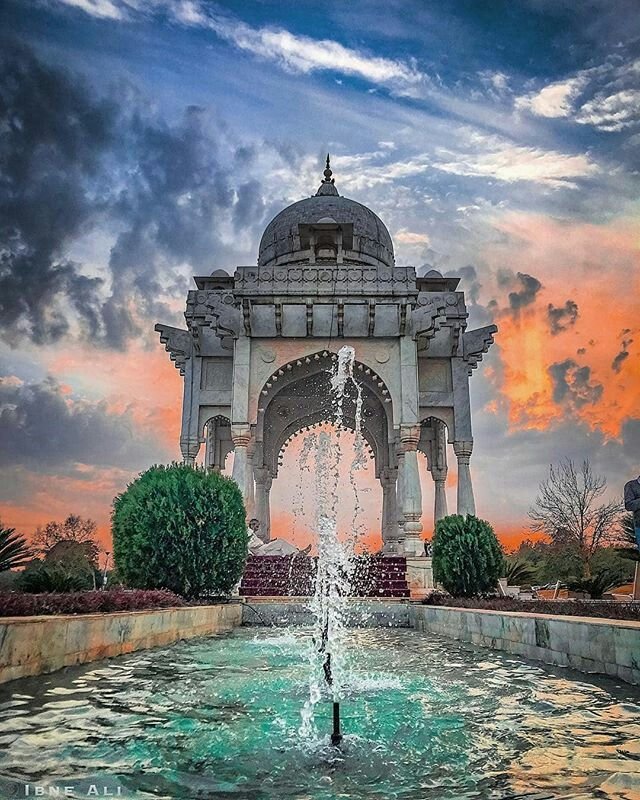
Every old city has a landmark that locals use the way sailors use a lighthouse — not to admire, exactly, but to navigate by. In Faisalabad, that landmark is the Gumti: a domed water fountain from the British Raj era, standing on a busy roundabout on Railway Road, facing the Qaiseri Gate. It has sixteen pillars, a gracefully curved roof, and a fountain that still runs at its center. It was a meeting place when Lyallpur was a new colonial town, it survived decades of neglect, and it has now been restored to something close to its old dignity. This Gumti Fountain Faisalabad travel guide will tell you why this small monument is worth a stop, what it says about the city’s history, and how to fold it into a day exploring one of Pakistan’s most characterful old downtowns.
Quick Facts
- Location: Railway Road, facing Qaiseri Gate, outside Rail Bazar, downtown Faisalabad, Punjab
- Built: 1890s (British Raj era; academic sources date it to 1897)
- Famous For: A colonial-era domed water fountain on sixteen pillars — once the city’s meeting place, now a working roundabout fountain
- Nearest City: Faisalabad city center — the Gumti is in the old downtown, minutes from Ghanta Ghar
- Accessibility: On a public chowk (roundabout); viewable from the roadside at any time, best in daylight or early morning
- Known Landmarks: The sixteen-pillar domed pavilion, the central fountain, Qaiseri Gate across the road, the Ghanta Ghar clock tower nearby
- Best For: Heritage lovers, photographers of colonial architecture, travelers exploring old Lyallpur, quick cultural stops
Why Visit Gumti Fountain, Faisalabad
Faisalabad is Pakistan’s textile capital, an industrial powerhouse that most travelers pass through without stopping. That is their loss — and the Gumti is the perfect reason to stop. In a single small monument it tells you the whole origin story of the city: a planned colonial town called Lyallpur, built from scratch in the 1890s, where the British laid out eight bazaars around a clock tower and where the townspeople built their own monuments to mark their place in the new order. The Gumti is one of the oldest of those monuments, and standing beside it puts you at the very beginning of Faisalabad’s story.
There is also the simple pleasure of the thing itself. The Gumti is a handsome piece of colonial-era design — sixteen pillars carrying a curved roof over a raised platform, with the fountain playing at its center. After its restoration, it photographs beautifully, especially in the soft light of early morning before the traffic builds. Heritage photographers and architecture students will find it a rewarding subject; casual visitors will find it a memorable five-minute stop that anchors the whole old-city walk.
Finally, the Gumti is a doorway. It stands at a chowk from which four routes emerge — toward the railway station, toward Aminpur Bazaar via Katchery Chowk, toward Chiniot, and toward the Factory Area — which means it is the natural starting point for exploring downtown Faisalabad on foot. See the Gumti, cross to the Qaiseri Gate, walk into the bazaars around Ghanta Ghar, and you will have spent a morning inside a living 19th-century city plan. Few travelers do this. You should.
History of Gumti Fountain, Faisalabad
The Gumti belongs to the founding decade of the city itself. Faisalabad began life as Lyallpur, named after Sir James Broadwood Lyall, the British lieutenant governor of Punjab; it was declared a municipality of the Lower Chenab region in 1898, and the colonial administration set about building a planned city on the Sandal Bar. The great projects of those years are well documented: the clock tower in 1903, the railway station in 1896, the Chenab Club in 1910 — and, dated by heritage researchers to 1897, the Gumti water fountain.
The Gumti’s origin story is a small political drama. The Gumti and the Qaisari Gate were the first two monuments built by the local townspeople to honor Queen Victoria on her birthday. But the Muslim community protested — they felt they had no monument of their own honoring the Queen — and so the British administration, together with Muslims and other religious minorities, built a second clock tower: the present-day Ghanta Ghar, which carries inscriptions in four languages representing the Muslim, Sikh, Hindu and Christian communities. The Gumti thus stands at the start of a conversation about representation that shaped the city’s most famous landmark.
During the colonial days the Gumti served as a general meeting place — the town’s folk gathered here for local meetings, and it became one of Lyallpur’s defining landmarks. After Partition, when Lyallpur was renamed Faisalabad in 1973 for King Faisal bin Abdulaziz Al Saud of Saudi Arabia, the Gumti remained what it had always been: a chowk, a reference point, a piece of street furniture with a century of memory in it. The twelve stairs of its platform grew shorter over the years as road levels rose around it, and long neglect dulled its beauty.
Restoration came in two waves. In 2014, the Gumti was renovated and its fountain repaired under the Sohna Lyallpur project by the Lyallpur Heritage Foundation — a body formed by the District Coordination Officer to care for the city’s historical buildings — and citizens celebrated the return of its old grandeur. Then, in December 2023, the Walled City Authority of Lahore began a larger rehabilitation program for five pre-partition Faisalabad buildings — the Allama Iqbal Library, the District Council building, the Ghumti, the Qaisari Gate and the Gora Graveyard — backed by Rs279 million from the Punjab government under the “Attractive Faisalabad” initiative, with completion targeted for mid-2024. The little fountain on Railway Road, in other words, is now officially recognized as heritage worth protecting.
Top Things to Do in Gumti Fountain, Faisalabad
Admire the Pavilion Architecture
Take a slow walk around the roundabout’s edge and study the structure: sixteen pillars supporting a beautifully curved roof over a raised platform, with the water fountain playing at the center. The proportions are elegant, the masonry work repays close looking, and the whole composition — dome, pillars, water — is a classic of the colonial public-works style. Early morning, before the traffic peaks, is the best time for unhurried looking and photography.
Stand at the Four-Way Chowk
The Gumti sits in the middle of a chowk from which four routes emerge: one to the railway station, one to Aminpur Bazaar via Katchery Chowk, one toward Chiniot, and one to the Factory Area. Stand on the pavement and orient yourself — this junction has organized movement through downtown Faisalabad for over a century. It is a small, vivid lesson in how the colonial city plan still governs daily life.
Walk to Qaiseri Gate and the Eight Bazaars
The Qaiseri Gate faces the Gumti across the road, and beyond it lies the great set-piece of old Lyallpur: the Ghanta Ghar clock tower with eight bazaars radiating from it like the Union Jack. Walk from the Gumti into this quarter — Rail Bazaar is the closest — and you are inside one of the subcontinent’s most distinctive Victorian city plans, still functioning as the commercial heart of the city.
Visit the Ghanta Ghar (Clock Tower)
A short walk from the Gumti brings you to Faisalabad’s most iconic landmark: the clock tower built in the early 1900s with inscriptions for four communities, standing at the center of the eight bazaars. The Gumti and the Ghanta Ghar belong to the same founding story — see them together and the history clicks into place. Our separate Ghanta Ghar guide covers it in full.
Photograph Colonial Faisalabad
The Gumti–Qaiseri Gate–Ghanta Ghar triangle is the richest few blocks in the city for heritage photography: domes, gates, bazaar facades, and the clock tower. Morning light is kindest; the bazaars are most alive mid-morning. Respect shopkeepers’ space, ask before close-up portraits, and keep to the pavements — the traffic around the Gumti roundabout is genuinely busy.
Famous Places In and Around Gumti Fountain, Faisalabad
- Ghanta Ghar (Clock Tower) — the city’s iconic landmark at the center of the eight bazaars, minutes from the Gumti.
- Qaiseri Gate — the colonial gate facing the Gumti across Railway Road, part of the same founding-era building wave.
- The Eight Bazaars — Rail Bazaar, Aminpur Bazaar, Katchery Bazaar, Chiniot Bazaar and four more, radiating from the clock tower.
- Faisalabad Railway Station — the 1896 colonial station, one of the routes leading from the Gumti chowk.
- Chenab Club — the 1910 colonial club, a landmark of old Lyallpur’s social life.
- Company Bagh (Jinnah Garden) — the old city’s public garden, a green pause after the bazaars.
- Allama Iqbal Library — the former Coronation Library, one of the five pre-partition buildings under restoration.
How to Reach Gumti Fountain, Faisalabad
The Gumti is in downtown Faisalabad on Railway Road, facing the Qaiseri Gate and just outside Rail Bazar — one of the easiest heritage landmarks in the city to find. Any rickshaw or taxi driver in Faisalabad knows “Gumti Chowk.” Because it sits on a working roundabout, you view it from the pavement; do not attempt to cross the traffic to reach the platform itself.
From Lahore: About 180 km via the M-2 motorway, roughly 2.5 hours. Take the Faisalabad exit and follow signs toward Ghanta Ghar / Railway Road in the old city.
From Islamabad: About 330 km via the M-2, roughly 4–4.5 hours. Exit for Faisalabad and head for the city center.
From Karachi: Around 1,280 km by road — fly instead. Faisalabad International Airport (Lyallpur Airport) has commercial flights, and the downtown is roughly a 30–40 minute drive from the airport depending on traffic.
Transport options: Within Faisalabad, auto-rickshaws and ride-hailing cars are the practical choices for the old city — the bazaar quarter’s streets are narrow and congested, and parking near the Gumti is essentially nonexistent. Daewoo and other coach services connect Lahore and Islamabad with Faisalabad frequently through the day.
Route Details
Lahore → M-2 motorway west → Faisalabad interchange → Canal Road or Satyana Road into the city → toward the old downtown and Ghanta Ghar → Railway Road → Gumti Chowk, facing Qaiseri Gate. From the airport: Airport Road → Jhang Road or Canal Road → city center → Railway Road. If you are combining the Gumti with the clock tower, park (or get dropped) near Ghanta Ghar and walk the bazaar quarter — the Gumti is a short stroll down Railway Road.
Where to Stay in Gumti Fountain, Faisalabad
The Gumti is a short visit — an hour at most — so choose your hotel for the city, not the monument. Faisalabad has a solid range of business hotels.
Luxury: The Serena Faisalabad, on Club Road near the city center, is the city’s established upscale address — comfortable, well-run, and a convenient base for both the old downtown and the newer commercial districts.
Mid-range: The Canal Road and Satyana Road corridors have a good stock of mid-range hotels aimed at business travelers, most with restaurants and parking. Hotel One’s Faisalabad properties sit in this bracket and are reliably consistent.
Budget and guesthouses: The areas around the railway station and the old bazaars have budget hotels and guesthouses — basic but perfectly located if your interest is the heritage quarter itself. Expect noise and bustle; that is the price of being in the middle of it.
For heritage travelers, staying near the old city (or anywhere along Canal Road with easy rickshaw access downtown) keeps the Gumti, Ghanta Ghar and bazaars within a short ride.
Where to Eat: Local Foods of Gumti Fountain, Faisalabad
You are in Punjab’s dhaba belt, and the food around the Gumti is gloriously unpretentious. The old-city breakfast is the main event: paye and nihari with fresh naan, halwa puri with lassi on weekend mornings, daal and saag at the lunch dhabas, samosas and jalebi frying all afternoon near the bazaar entrances. Aminpur Bazaar and the lanes around Ghanta Ghar are lined with eateries where a full, filling meal costs a few hundred rupees.
Faisalabad’s food culture leans desi and hearty — tandoori everything, desi-ghee sweets, thick lassi in steel glasses, and the winter specialty of saag with makai di roti when the season is right. For a sit-down meal, the restaurants along Canal Road and in People’s Colony (D Ground) offer everything from barbecue to fast food. Eat breakfast near the Gumti, lunch in the bazaars, and you will have tasted the city properly.
Weather in Gumti Fountain, Faisalabad
Faisalabad shares the Punjab plains climate: a short, foggy winter, a brief glorious spring, and a long, punishing summer. The Gumti is an outdoor roadside stop, so summer midday visits are uncomfortable — plan heritage walks for mornings or the cooler months.
| Season | Temperature Range | Conditions |
|---|---|---|
| Winter (Dec–Feb) | 9–23°C | Cool and often foggy, especially mornings. Pleasant for walking the old city once the fog lifts. |
| Spring (Mar–Apr) | 16–33°C | Warm and bright; the most comfortable season for sightseeing. |
| Summer (May–Jul) | 30–43°C | Intensely hot. Visit the Gumti at dawn or not at all; carry water. |
| Monsoon/Autumn (Aug–Nov) | 18–39°C | Humid monsoon showers, then clear autumn days. October–November is excellent. |
Language and Culture of Gumti Fountain, Faisalabad
Faisalabad speaks Punjabi first and Urdu second, with the brisk, businesslike cadence of a trading city. The old downtown around the Gumti is conservative and working-class — dress modestly, greet shopkeepers with salaam, and you will be met with the straightforward courtesy the city is known for.
A few practical notes: the Gumti is on a live roundabout, so treat it as a look-don’t-touch monument — admire from the pavement, photograph from the pavement. The bazaar quarter is crowded and male-dominated; women travelers will be more comfortable with a companion in the densest lanes. Bargaining is expected in the bazaars but not at food stalls. And if someone offers you directions, take them — Faisalabadis are proud of their city and generous with strangers who show interest in it.
Shopping in Gumti Fountain, Faisalabad
The eight bazaars around Ghanta Ghar are the shopping — each traditionally specialized, together selling everything from cloth to crockery. Faisalabad is Pakistan’s textile capital, so fabric is the headline: unstitched suits, bed linen and towels at factory-town prices, especially in the cloth markets. Rail Bazaar and Aminpur Bazaar, the two closest to the Gumti, are good starting points for a browsing walk.
For modern mall shopping, Lyallpur Galleria on East Canal Road is the city’s established mall — brands, a food court and cinema under one roof, a useful contrast to the bazaar quarter. Between the 1890s bazaars and the 21st-century mall, you can shop two centuries of Faisalabad in a single day.
Local Events and Festivals
Faisalabad’s old center runs on the religious calendar, and the city’s biggest annual gatherings happen around the landmarks near the Gumti. The Eid Milad-un-Nabi procession — marking the Prophet’s birthday on 12 Rabi-ul-Awwal — passes through the downtown in a major rally, and the Muharram processions are among the largest in Punjab, with the clock-tower area at their heart. These are solemn religious observances rather than tourist festivals, but witnessing the scale of the city’s devotion is a powerful experience.
On the civic calendar, Independence Day (14 August) turns the bazaars and chowks — including the Gumti roundabout — green and white with flags and lights. If your visit coincides with either the religious processions or the national celebrations, expect road closures around the old city and plan your heritage walk accordingly.
Travel Tips for Gumti Fountain, Faisalabad
Packing Essentials
Sun protection for most of the year — cap, sunglasses, sunscreen. Comfortable closed walking shoes for the bazaar lanes. A water bottle, especially in summer. A light shawl or jacket for winter mornings, when fog can make 9°C feel colder. Keep a small daypack; leave valuables at the hotel.
Safety Tips
The area around the Gumti is busy and generally safe in daylight, but it is a working commercial quarter, not a tourist zone — stay alert in crowds, keep phones and wallets secure, and avoid the roundabout’s traffic flow entirely. Visit in the morning or afternoon; the old city quiets down after the bazaars close. As always in Pakistan, cooperate politely with any security checks.
Money & Connectivity
The bazaars run on cash — carry small notes for food stalls and rickshaws. ATMs are plentiful on Railway Road, in the bazaar quarter’s banks, and along Canal Road. Jazz, Telenor, Zong and Ufone all have strong 4G coverage in Faisalabad, so maps and ride-hailing work smoothly.
Best Time to Visit Gumti Fountain, Faisalabad
Winter (December–February) — the walking season
Cool air and low sun flatter the old buildings, and the bazaars are at their bustling best. Mornings can be foggy — start after 10 a.m. once it lifts.
Spring (March–April) — the easy season
Warm days, clear skies, comfortable evenings. The most forgiving window for a full old-city day on foot.
Autumn (October–November) — the golden season
Post-monsoon clarity, pleasant temperatures, festive mood building toward winter weddings. An excellent time for photography.
Summer (May–September) — the dawn-only season
Brutal heat and humidity. See the Gumti at sunrise, retreat indoors by 10 a.m., and save the bazaars for a winter trip.
Final Thoughts
The Gumti Fountain will not take more than a few minutes of your time, and that is exactly why travelers skip it — which is exactly why you should not. In those few minutes, standing on the pavement with the fountain playing behind the traffic, you are looking at the seed from which Faisalabad grew: a colonial meeting place, a townspeople’s monument, a survivor of neglect and a beneficiary of restoration.
Pair it with the Ghanta Ghar, walk the eight bazaars, eat breakfast in Aminpur Bazaar, and Faisalabad will stop being a city you pass through and become a city you have actually visited. For a textile capital with a Victorian heart, that is no small thing. Find more journeys across the country in our Explore Pakistan collection.
FAQs
Where is Gumti Fountain located?
On Railway Road in downtown Faisalabad, on a roundabout facing the Qaiseri Gate, just outside Rail Bazar — minutes from the Ghanta Ghar clock tower.
What is the best time to visit Gumti Fountain?
October to March, when the weather suits walking the old city. In summer, visit at dawn. Early morning is also best for photography and lighter traffic.
How do I reach Gumti Fountain from Lahore or Islamabad?
From Lahore about 180 km via the M-2 (2.5 hours); from Islamabad about 330 km via the M-2 (4–4.5 hours). From Karachi, fly to Faisalabad International Airport and drive 30–40 minutes downtown. Any local rickshaw or taxi knows “Gumti Chowk.”
Is Gumti Fountain safe to visit?
Yes, in daylight — it is a busy public chowk. View and photograph it from the pavement; do not try to cross the roundabout traffic to reach the platform.
Is Gumti Fountain suitable for families?
As a short stop, yes — children enjoy the fountain and the bustle. It is a roadside monument rather than a park, so plan it as part of a wider old-city outing rather than a destination in itself.
Where can I stay near Gumti Fountain?
Faisalabad’s hotels cluster along Canal Road and near the city center — from the Serena Faisalabad to mid-range business hotels and budget guesthouses near the station and bazaars.
What food can I try near Gumti Fountain?
Old-city Punjabi fare: paye and nihari for breakfast, halwa puri with lassi, daal and saag at lunch dhabas, samosas and jalebi in the bazaars — typically a few hundred rupees for a full meal.
What is the history of Gumti Fountain?
Built in the 1890s (dated 1897) when the city was the colonial planned town of Lyallpur, it was among the first monuments the townspeople raised — to honor Queen Victoria — and served as the city’s meeting place. Restored in 2014 and again under a 2023 heritage program, its sixteen-pillar pavilion and working fountain survive on their original roundabout.