


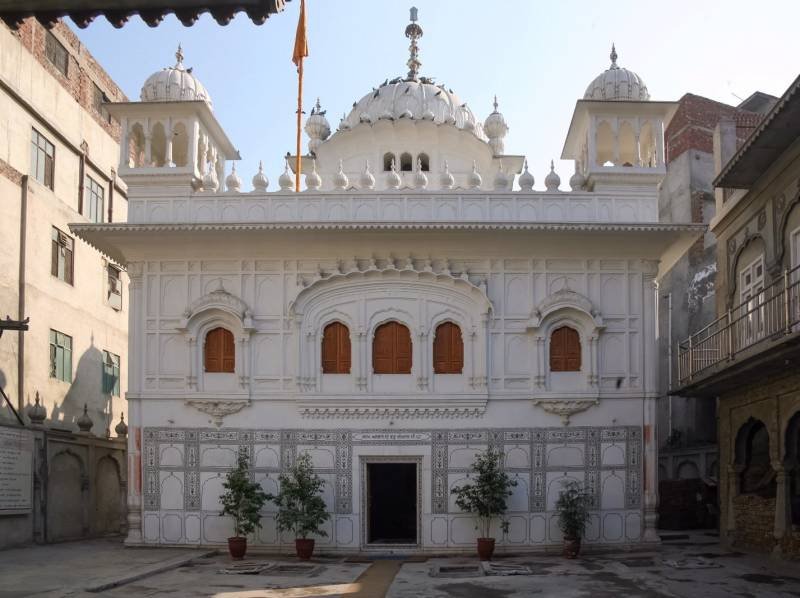
This Gurdwara Guru Mangat (site), Gulberg travel guide tells the story of a shrine that no longer stands — and explains why the site still matters. On Guru Mangat Road in Lahore’s Gulberg once stood Gurdwara Patshahi VI, the domed shrine with the gilded pinnacle where Guru Hargobind stayed after leaving Mozang, where the Sikh community dug a sarovar and uncovered an ancient stepwell, and which came under the Shiromani Gurdwara Parbandhak Committee in 1927. Damaged in the violence of 1947 and a ruin for years, the site is now occupied by the Shan-e-Islam mosque. Inside you will find the full history of the Guru’s visit, how to reach the site from anywhere in Lahore and from Islamabad and Karachi, the best time to explore Lahore’s Sikh heritage trail, where to stay and eat in Gulberg, and how to pair this quiet site with the city’s great living shrines.
Quick Facts
- Location: Guru Mangat Road, Gulberg, Lahore, Punjab, Pakistan — near the Lahore Cantonment railway station area
- Altitude: Around 217 metres above sea level (Lahore plain)
- Famous For: The site of Gurdwara Patshahi VI, where Guru Hargobind stayed after leaving Mozang; its domed building with a gilded pinnacle; the ancient stepwell uncovered while digging its sarovar; SGPC management from 1927 until Partition
- Nearest City: Lahore itself — the site is in central Lahore’s Gulberg district
- Accessibility: On Guru Mangat Road in Gulberg; minutes from Main Boulevard Gulberg; Lahore Cantt and Walton are the nearest railway stations
- Known Landmarks: The Shan-e-Islam mosque now standing on the site, with its Quran school and dispensary; the vanished gurdwara’s remembered position about 400 metres southwest of the old Guru Mangat village
- Best For: Sikh pilgrims completing Lahore’s heritage circuit, students of Partition history, travellers interested in how sacred sites change across time, anyone exploring Gulberg and Lahore Cantt
Why Visit Gurdwara Guru Mangat (site), Gulberg
Let us be honest from the start, because this guide is written for travellers, not tourists: there is no gurdwara to visit at Guru Mangat anymore. The domed building with the gilded pinnacle is gone. What stands on the site today is the Shan-e-Islam mosque, with its Quran school and its dispensary serving the neighbourhood. If you come expecting marble and domes, you will be disappointed — and this guide would be failing you if it pretended otherwise.
But if you come for the story — and for what the story says about Lahore, about Partition, and about how sacred ground outlives the buildings on it — then Guru Mangat is worth your time. This was Gurdwara Patshahi VI: the shrine of the Sixth Master. Guru Hargobind, the warrior-saint who transformed the Sikh faith, stayed here after leaving Mozang during his time in Lahore. The shrine that grew on the site of his sojourn was, by all accounts, beautifully built — a domed building with a gilded pinnacle standing about 400 metres southwest of the old village, important enough to come under the management of the Shiromani Gurdwara Parbandhak Committee in 1927. And it held a small archaeological wonder: when the community dug a sarovar behind the new building, they uncovered an old open well with steps descending to the water — an ancient baoli — which was lovingly renovated.
Then came 1947. The shrine suffered vast damage in the communal violence of Partition, stood as a ruin for years, and was eventually replaced — the mosque raised, as the old accounts put it, “in order to preserve the sanctity of this sacred place.” That phrase is worth sitting with. Whatever one’s view of what happened here, the impulse it describes is universal: this ground was holy, and the neighbourhood could not bear to see it lie waste. A dispensary now treats the sick where pilgrims once bathed; children learn the Quran where the Guru once rested. Sacred ground, serving the people around it, in a new idiom.
So why visit? Because Lahore’s Sikh heritage is not only in its great surviving monuments — the Samadhi of Maharaja Ranjit Singh, Gurdwara Dera Sahib, the Shahid Ganj debate still echoing in the history books. It is also in its absences, its palimpsests, its stories of what stood where. Guru Mangat belongs on every serious Sikh heritage itinerary of Lahore precisely because it asks the deeper questions: what do we owe to sacred sites that did not survive? How do cities remember? Come quietly, pay your respects at the site, and then walk on to the living shrines — you will appreciate them all the more.
History of Gurdwara Guru Mangat (site), Gulberg
The story begins with Guru Hargobind’s presence in Lahore. The sixth Sikh Guru spent significant time in the Lahore region — the Sikh encyclopaedic tradition records his stay at Muzarig (Mozang), the old quarter of Lahore, and it was after leaving Mozang that he came to the village then called Guru Mangat, close to what is now the Lahore Cantonment. The spot where he sojourned became sacred, and in time a gurdwara rose there: Gurdwara Patshahi VI, the shrine of the Sixth Patshahi.
The shrine that developed was a handsome one. Descriptions record a domed building with a gilded pinnacle, standing about 400 metres southwest of the village — the kind of building that announced, across the flat Punjab plain, that holy ground lay here. In 1927, as the Gurdwara Reform Movement brought Sikh shrines under democratic community control, Gurdwara Patshahi VI came under the management of the Shiromani Gurdwara Parbandhak Committee. The community invested in the site: a new building went up, and when a sarovar — a sacred bathing tank — was dug behind it, the diggers made a remarkable discovery: an old open well, a baoli, with steps descending to the water level. It was renovated and incorporated into the shrine complex, a whisper of an even older sacred history beneath the Sikh one.
For two decades the shrine thrived under SGPC management. Then Partition tore the Punjab apart. In the communal violence of 1947, Gurdwara Patshahi VI suffered vast damage. The Sikh community of the area migrated to India, and the shrine — like so many across West Punjab — was abandoned. It stood as a ruin for many years, its dome and pinnacle crumbling, its sarovar filling with dust.
What followed is recorded with unusual candour in the old shrine surveys: in order to preserve the sanctity of the place, a splendid mosque — the Shan-e-Islam, “glory of Islam” — was built on the site. A school was attached to the mosque where the Quran is taught, and a dispensary was set up for the welfare of the people. The area, once under the Mozang police station, came under the new Gulberg police station as modern Lahore grew around it; the locality of Gulberg — with its boulevards, markets and garden suburbs — developed over what had been village and cantonment-edge land, and the shrine’s memory survived mainly in the road name: Guru Mangat Road.
One clarification matters for heritage travellers. There is another, quite separate shrine associated with the name Mangat: the Gurdwara of Bhai Bannu at Mangat village in Mandi Bahauddin district — the famous shrine of the first copy of the Adi Granth, which still stands and can be visited. That is a different place, a different story, a different district. Guru Mangat of Gulberg is the vanished Patshahi VI shrine of Guru Hargobind. Do not confuse the two — though visiting both, the vanished and the surviving, makes a remarkable two-day meditation on what Partition preserved and what it took.
Top Things to Do in Gurdwara Guru Mangat (site), Gulberg
Pay Quiet Respects at the Site
The essential act at Guru Mangat is simple and private: stand on Guru Mangat Road, acknowledge the ground, and remember what stood here. The Shan-e-Islam mosque now occupies the site; visitors of any faith are welcome to view it respectfully from outside, but remember it is a working mosque and a school — not a tourist attraction. A few minutes of quiet reflection, perhaps with the story of the Guru’s sojourn and the uncovered stepwell in mind, is the right observance. This is a pilgrimage of memory, not of sightseeing.
Walk Guru Mangat Road and Old Gulberg
The road itself is the memorial. Walk Guru Mangat Road and the surrounding blocks of old Gulberg, where the cantonment-edge Lahore of the early 20th century — the Lahore the shrine knew — still shows through the modern suburb in places: old bungalows, railway-colony streets, the broad cantonment roads. Lahore Cantt railway station and Walton station, which once served the shrine’s pilgrims, are both nearby and worth a look for railway romantics.
Build a Lahore Sikh-Heritage Day Around It
Guru Mangat makes most sense as one stop on a full-day Sikh heritage circuit of Lahore. Pair the quiet site with the great living monuments: the Samadhi of Maharaja Ranjit Singh and Gurdwara Dera Sahib beside the Lahore Fort, Gurdwara Janam Asthan Guru Ram Das in the old city, and the Shahid Ganj site with its complex history. Start at Guru Mangat in the morning — the absence — and end at Dera Sahib in the evening — the presence. Few heritage days in Pakistan are as thought-provoking.
Explore Gulberg’s Markets and Food Streets
Gulberg is one of Lahore’s most pleasant districts for a wander: Main Boulevard’s shops, Liberty Market’s fabrics and boutiques, and the food streets that come alive in the evening. After the reflective morning at the site, let Lahore do what Lahore does best — feed you. The area around Gulberg and nearby Model Town holds some of the city’s best-loved restaurants, from traditional desi to modern cafes.
Visit the Lahore Fort and Badshahi Mosque Quarter
No Lahore heritage day is complete without the fort quarter: the Lahore Fort’s Sheesh Mahal and Alamgiri Gate, the vast courtyard of the Badshahi Mosque, the Samadhi of Ranjit Singh at the edge of the Hazuri Bagh. This is the Lahore of emperors and maharajas — the city Guru Hargobind knew — and it puts the small vanished shrine of Guru Mangat in its full historical context.
Famous Places In and Around Gurdwara Guru Mangat (site), Gulberg
Lahore Fort and Sheesh Mahal — the Mughal fort complex, a UNESCO World Heritage site. Badshahi Mosque — the great imperial mosque of Aurangzeb. Samadhi of Maharaja Ranjit Singh and Gurdwara Dera Sahib — the Sikh royal memorial and living gurdwara beside the fort. Liberty Market, Gulberg — Lahore’s beloved shopping district, minutes from the site. Lahore Museum — superb Gandharan and Sikh-period collections. Gurdwara Bhai Bannu, Mangat — the separate, surviving shrine at Mangat village (Mandi Bahauddin district), for travellers who want to see what a preserved shrine of the era looks like.
How to Reach Gurdwara Guru Mangat (site), Gulberg
The site is in central Lahore, on Guru Mangat Road in Gulberg — one of the easiest heritage stops in Pakistan to reach. Any Lahore taxi or ride-hailing driver knows Gulberg; ask for Guru Mangat Road, near the cantonment side. Lahore’s traffic is legendary, so allow generous time, especially in the evening.
From Islamabad: Around 380 kilometres via the M-2 motorway, roughly 4 to 4.5 hours by car — the standard route. Daewoo and other coach services run constantly between the two cities; from Lahore’s terminals, take a taxi or ride-hailing car to Gulberg (30–45 minutes depending on traffic).
From Lahore (within the city): Gulberg is central — 15–25 minutes from most city hotels, about 30 minutes from Allama Iqbal International Airport in normal traffic. The nearest railway stations are Lahore Cantt and Walton.
From Karachi: Around 1,200 kilometres by road — fly. Lahore’s Allama Iqbal International Airport has frequent connections from Karachi (about 1 hour 45 minutes); Gulberg is roughly 30 minutes from the airport.
Nearest airport: Allama Iqbal International Airport, Lahore. Rail: Lahore Junction (the main station) connects to the whole country; Lahore Cantt and Walton stations are closest to the site. Road conditions: Gulberg’s roads are excellent; Lahore’s traffic is the main variable — avoid rush hours (8–10 AM, 5–8 PM) for cross-city trips.
Route Details
Step 1: Reach Lahore by motorway, rail or air. Step 2: Base yourself in or near Gulberg — the district has the city’s best concentration of mid-range and upscale hotels. Step 3: Take a taxi or ride-hailing car to Guru Mangat Road; the Shan-e-Islam mosque marks the shrine’s site. Step 4: Pay quiet respects, walk the surrounding blocks, then continue to Liberty Market or the fort quarter. Step 5: Build the rest of your day around Lahore’s living Sikh shrines — Dera Sahib and the Samadhi of Ranjit Singh.
Where to Stay in Gurdwara Guru Mangat (site), Gulberg
Gulberg is Lahore’s most convenient base for this itinerary, and it happens to be one of the city’s best hotel districts. Main Boulevard Gulberg and its side streets hold a dense cluster of mid-range and upscale hotels — business hotels with restaurants, Wi-Fi, hot water and room service — plus serviced apartments for longer stays. Staying in Gulberg puts the Guru Mangat site minutes away and the fort quarter 20–30 minutes away, with Liberty Market’s shopping and the area’s restaurants on your doorstep.
Budget travellers will find guesthouses and budget hotels in the streets behind Main Boulevard at genuinely reasonable rates; standards vary, so inspect the room first. Luxury seekers can choose from Lahore’s five-star properties, most a short drive from Gulberg. For Sikh pilgrim groups, Lahore’s larger hotels are well accustomed to hosting yatras and can arrange coaches for the full heritage circuit. Book ahead on weekends and public holidays, when Lahore fills with domestic visitors.
Where to Eat: Local Foods of Gurdwara Guru Mangat (site), Gulberg
You are in Lahore — the food capital of Pakistan — and Gulberg sits in the middle of it. Eat like a Lahori. Start with the classics: nihari (the slow-cooked beef stew that is Lahore’s breakfast of champions), halwa puri with cholay, murgh cholay (chicken and chickpeas), and the great chargha — Lahore’s famous whole fried chicken, crisp and spiced. The Fort Road Food Street, with the Badshahi Mosque lit up behind it, is the essential evening experience: rows of stalls serving kebabs, tikkas, karahi and falooda for dessert.
Gulberg itself has excellent options: the restaurants along Main Boulevard and in Liberty Market serve everything from traditional desi (try the mutton karahi and seekh kebabs) to modern cafes. For the sweet course, Lahore’s jalebi, barfi and kulfi are justly famous. A full Lahori dinner at a good desi restaurant is hearty and reasonable; the Fort Road stalls are cheaper still. Drink bottled water, eat where the crowds are, and pace yourself — Lahore does not let you leave hungry.
Weather in Gurdwara Guru Mangat (site), Gulberg
Lahore’s climate is the Punjab plain at its most dramatic: a short, foggy winter, a brief spring, and a long, blazing summer broken by the monsoon. For heritage walking — the fort quarter, the old city, the Guru Mangat site — the cool months from November to March are ideal. Summer afternoons in Lahore are genuinely punishing; plan indoor museums for midday if you must travel then.
| Season | Temperature Range | Conditions |
|---|---|---|
| Winter (Dec–Feb) | 6–21°C | Cool days, cold nights; dense fog common Dec–Jan |
| Spring (Mar–Apr) | 16–34°C | Brief and beautiful; Basant season in spirit if not in kites |
| Summer (May–Aug) | 27–41°C | Very hot; monsoon humidity and storms Jul–Aug |
| Autumn (Sep–Nov) | 18–34°C | Cooling down; clear skies return; excellent for sightseeing |
Language and Culture of Gurdwara Guru Mangat (site), Gulberg
Lahore speaks Punjabi in its homes and bazaars and Urdu in its offices and drawing rooms, with English widely understood in Gulberg’s hotels, restaurants and shops. The culture is famously warm, witty and food-obsessed — Lahoris pride themselves on hospitality, and the phrase “Lahore Lahore ae” (Lahore is Lahore) is less a boast than a philosophy.
At the Guru Mangat site itself, remember you are visiting a working mosque and school: dress modestly, keep your voice low, remove your shoes if you enter any prayer space, and ask before photographing people. Friday midday is the main congregational prayer — avoid visiting then. If you are a Sikh pilgrim paying respects at the site of the Guru’s sojourn, a quiet moment at the roadside is entirely appropriate; the neighbourhood is accustomed to visitors interested in the area’s history. The broader etiquette of Lahore’s Sikh heritage circuit applies: cover your head and remove shoes at the living gurdwaras (Dera Sahib and others), and accept the karah prasad offered with both hands.
Shopping in Gurdwara Guru Mangat (site), Gulberg
You could hardly be better placed for shopping: Liberty Market, minutes from the site, is Lahore’s most beloved bazaar — fabrics, ready-made clothes, shoes, jewellery and household goods at bargain prices, with enthusiastic bargaining expected. Ichhra Bazaar, a short drive away, is the old city’s great people’s market: everything, cheap. Anarkali, in the old city, is the historic bazaar for traditional crafts, books and street food combined.
For handicrafts with a heritage connection, look for phulkari embroidery, khussa shoes (Punjab’s embroidered slippers — a cousin of the Peshawari chappal), brassware and blue Multani pottery in the old-city shops. Gulberg also has modern malls along Main Boulevard for fixed-price shopping. Whatever your style, set aside an afternoon — Lahore’s shopping is a contact sport, and immensely fun.
Travel Tips for Gurdwara Guru Mangat (site), Gulberg
Packing Essentials
Comfortable walking shoes for the fort quarter’s stone floors and Gulberg’s markets, a headscarf or cap (for mosques and gurdwaras alike), sunscreen and water in warm months, a warm jacket for December–January evenings. Lahore’s winter fog can be spectacular — and spectacularly cold in the early morning.
Safety Tips
Lahore is Pakistan’s most tourist-friendly big city, and Gulberg is one of its safest districts — but normal big-city sense applies: keep valuables discreet in crowded bazaars, use registered taxis or ride-hailing apps, and avoid poorly lit streets late at night. At the site itself, be a respectful guest of a working religious and educational institution.
Money & Connectivity
ATMs are everywhere in Gulberg, and cards are accepted at larger restaurants and malls — but the bazaars (Liberty, Ichhra, Anarkali) are cash territory, so carry rupees in small notes. All mobile networks have excellent 4G in Lahore. Hotel Wi-Fi is standard; many cafes offer it too.
Best Time to Visit Gurdwara Guru Mangat (site), Gulberg
November to March — The Ideal Season
Lahore at its best: crisp mornings, sunny afternoons, cool evenings made for food streets. The fort quarter glows in the winter light, the Guru Mangat site is a pleasant stop on a Gulberg walk, and the city’s social life moves outdoors. This is when to come.
April and October — The Shoulder Months
Warm but workable, with fewer crowds than winter. April brings the last of spring; October brings the first relief after the monsoon. Start heritage walks early in the day and retreat to air-conditioning by afternoon.
May to September — The Hot Season
Lahore’s summer is among the hottest urban experiences in South Asia. If you travel then, do the outdoor sites — including Guru Mangat — at dawn, spend midday in the Lahore Museum’s cool galleries, and emerge for the food streets after sunset. The monsoon (July–August) brings dramatic storms and waterlogged streets.
Final Thoughts
Gurdwara Guru Mangat (site) is not a destination for collecting photographs — it is a destination for collecting understanding. The shrine is gone; the ground remembers. In its place stands a mosque and a school and a dispensary, serving the living neighbourhood — which is, when you think about it, exactly what a dharamsala was always meant to do. Come quietly, learn the story of the Guru’s sojourn and the stepwell found beneath the sarovar, and let the site ask you its questions about memory, loss and continuity.
Then let Lahore console you the way only Lahore can: with the fort at sunset, the Badshahi Mosque floodlit, Dera Sahib’s evening kirtan, and a table groaning under chargha and falooda on Fort Road. The vanished shrine and the living city belong to the same day — and the same story. For more journeys through Pakistan’s heritage, explore our Explore Pakistan collection, from the calm of Malam Jabba to the valleys of Hunza.
FAQs
Where is the Gurdwara Guru Mangat site?
On Guru Mangat Road in Gulberg, Lahore — near the Lahore Cantonment railway station area. The Shan-e-Islam mosque now stands on the site.
Does the gurdwara still exist?
No. Gurdwara Patshahi VI was badly damaged in the 1947 violence, stood as a ruin for years, and no longer exists. The site is occupied by a mosque with a Quran school and dispensary.
Which Guru is associated with Guru Mangat?
Guru Hargobind, the sixth Sikh Guru, who stayed here after leaving Mozang during his time in the Lahore region.
What is the best time to visit Lahore for heritage sightseeing?
November to March — cool, sunny and ideal for walking the fort quarter, the old city and Gulberg.
How do I reach the site from Islamabad?
About 380 km via the M-2 motorway (4–4.5 hours) to Lahore, then 15–25 minutes by taxi to Gulberg and Guru Mangat Road.
Is it appropriate for Sikh pilgrims to visit?
Yes — many pilgrims include the site in Lahore’s heritage circuit as a place of memory. Be respectful: it is now a working mosque and school.
Where should I stay?
Gulberg itself — Main Boulevard has the city’s best cluster of mid-range and upscale hotels, minutes from the site.
Is this the same as Gurdwara Bhai Bannu at Mangat?
No — that is a separate, surviving shrine at Mangat village in Mandi Bahauddin district (famous for the first copy of the Adi Granth). Guru Mangat of Gulberg is the vanished Patshahi VI shrine of Guru Hargobind in Lahore.
, Gulberg, Pakistan? Discover why it deserves your visit, the best time to go and top things to do.)