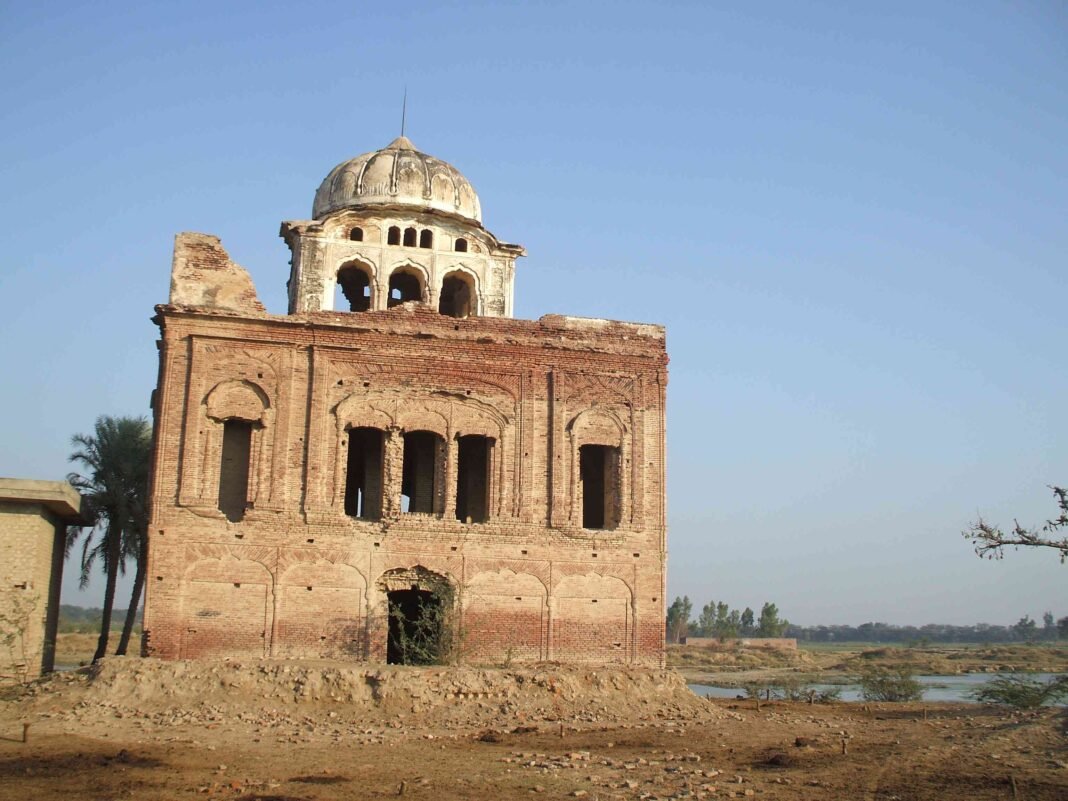
About 25 kilometres from Lahore, near one of the most sensitive borders in the world, a ruined shrine keeps watch over five centuries of history. Gurdwara Rori Sahib at Jahman (also spelt Jhaman) is not like the other gurdwaras in this series. It is abandoned, partly collapsed, and hauntingly beautiful — a two-storey red-brick darbar on an archaeological mound where Guru Nanak and his companion Bhai Mardana are believed to have sat singing, where the “rori” in its name means shards of ancient pottery rather than pebbles, and where the dome once held frescoes of the Sikh Gurus that survived Partition, neglect and vandalism. If you are compiling a Gurdwara Rori Sahib, Jahman travel guide, know this: you do not come here for a polished pilgrimage. You come to witness history in its rawest form — and to understand why preserving it matters.
This article is written for the thoughtful traveller: the heritage enthusiast who has seen the grand shrines and now wants the deeper story, the photographer drawn to beautiful decay, the student of Sikh history tracing Guru Nanak’s footsteps through the villages around his maternal home of Dera Chahal. Jahman will move you, and it will unsettle you. The gurdwara partially collapsed in the monsoon of 2023, and what stands today is fragile. Visit with respect, keep a safe distance from unstable walls, and come away with a story that few travellers can tell — of the shrine on the mound, the frescoes under the dome, and the border shimmering a few kilometres away.
Quick Facts
- Location: Just outside the village of Jahman (Jhaman), near Lahore, Punjab, Pakistan — a few kilometres from the international border
- Famous for: The mound where Guru Nanak and Bhai Mardana are believed to have sat and sung; rare surviving Sikh frescoes under its dome
- The name: “Rori” here means shards of pottery found in abundance on the archaeological mound — not pebbles
- The village: Jahman came into existence in the 13th century, according to British land survey reports
- Altitude: The flat Punjab plains; the gurdwara stands atop a small archaeological mound
- Nearest city: Lahore, about 25 km away
- Accessibility: By road from Lahore; village tracks for the last stretch — visit in daylight with a local guide
- Condition: Abandoned since 1947; partially collapsed in July 2023 after heavy monsoon rains — view from a safe distance
- Best for: Serious heritage travellers, Sikh history students, photographers, researchers
Why Visit Gurdwara Rori Sahib, Jahman
Let us be direct about what Jahman is and is not. It is not a functioning shrine with a granthi, langar and festival crowds. It is a ruin — and ruins tell truths that restored monuments sometimes cannot. The Gurdwara Rori Sahib at Jahman is one of the very few Sikh shrines in Pakistan that was never “renovated” into unrecognisability. Its red Nanakshahi brick, its frescoed dome, its pond now gone to murk — these are the authentic architectural traditions of Sikh Punjab, preserved precisely because nobody modernised them. For anyone who cares about heritage as it really was, that makes Jahman priceless.
The story embedded in the mound is extraordinary. This is believed to be where Guru Nanak, visiting the area around his maternal village of Dera Chahal, would sit with his Muslim companion Bhai Mardana — the Guru singing, Mardana playing the rabab — on a mound littered with pottery shards from civilisations long gone. The great Sikh scholar Kahan Singh Nabha recorded in his encyclopedia, the Mahan Kosh, that Guru Nanak held spiritual discourses here with the local Bhabhra Jain community, some of whom became his disciples. Think about that layering: an archaeological mound possibly dating back to the 6th century CE, a 16th-century Guru singing on it, Jain merchants debating philosophy with him. Few places on earth compress that much human story into one small hill.
Then there are the frescoes. Under the dome of the upper floor, fragments survive of paintings depicting Guru Nanak, Guru Harkrishan, Guru Ram Das, Guru Arjan, and Guru Gobind Singh in battle — plus Guru Gobind Singh with his young sons, Jujhar Singh and Fateh Singh. That faces were later chiselled off and the walls graffitied only sharpens the poignancy: this is what the Partition era did to shared heritage, and the surviving fragments are all the more precious for it. Photographers and art historians will find here a fading masterclass in Sikh fresco tradition.
Finally, visit Jahman because places like this disappear. The shrine partially collapsed in July 2023; heritage bodies including India’s INTACH have appealed for its preservation, but no conservation work has yet begun. Every year of monsoon takes a little more. Going now — respectfully, carefully — is a way of bearing witness while witness is still possible, and of adding your voice to the quiet chorus saying this matters. Pair it with nearby Dera Chahal and Ghavindi for a full day tracing Guru Nanak’s youth in this borderland, and read our Explore Pakistan heritage guides to place it in the wider story of Punjab’s shrines.
History of Gurdwara Rori Sahib, Jahman
The deepest history here is not Sikh at all — it is the mound itself. Archaeological survey reports suggest the mound at Jahman may date back as far as the 6th century CE, and the “rori” of the shrine’s name — the pottery shards scattered across it — are the physical evidence of the settlements buried beneath. Villages in this belt grew, were abandoned, and grew again over a thousand years before any Guru walked here. The village of Jahman itself came into existence in the 13th century, according to British land survey reports.
Guru Nanak’s connection to this area runs through family. His maternal grandparents lived at Dera Chahal, not far from Jahman, and the young Nanak is believed to have visited the village often, usually in the company of Bhai Mardana, his Muslim rabab-player companion. The two would sit on the mound outside the village, singing the hymns that would become the foundation of Sikh scripture. The Mahan Kosh of Kahan Singh Nabha records that at Jahman, Guru Nanak engaged in spiritual discourse with members of the Bhabhra Jain community — and that, captivated by his philosophy, some became his disciples. From Jahman, tradition holds, Nanak travelled on to Sultanpur Lodhi, where his spiritual awakening deepened.
The gurdwara itself was raised to commemorate those visits: a two-storey structure of red Nanakshahi brick, crowned with a large golden dome, with a sacred pool (sarovar) constructed in front. According to Sikh historian Amardeep Singh’s documentary research on Guru Nanak’s travels, the shrine was built by Bhai Wadhwa Singh. In its flourishing years it was a proper village shrine: festivals were held here on Vaisakhi and on the 20th day of the month of Jeth, the Guru Granth Sahib was placed and recited on its Thara Sahib, and the dome’s frescoes depicted the Gurus in vivid colour.
Partition ended that life. The Sikh-majority village’s congregation left in 1947, and the shrine was abandoned. In the decades that followed, the building suffered every indignity of neglect: treasure-hunters dug up the ground where the Thara Sahib had stood, the sarovar dried and fouled, and evangelists’ graffiti — religious slogans painted over the walls — tried to overwrite its Sikh identity. Some 100 bighas (around 500 kanals) of the gurdwara’s endowed land were illegally occupied. Yet the frescoes endured, damaged but legible, into the 21st century — until the monsoon of July 2023, when heavy rains brought parts of the weakened structure down. Reporting on the collapse, historians called it a failure of preservation on both sides of the border; INTACH appealed to Sikh and government bodies in both countries to save what remains. As of now, the shrine awaits rescue — which is exactly why this guide exists.
Top Things to Do in Gurdwara Rori Sahib, Jahman
Study the frescoes under the dome
If the structure allows safe access to the upper floor, the fresco fragments are the single most important thing to see: Guru Nanak, Guru Harkrishan, Guru Ram Das, Guru Arjan, Guru Gobind Singh in battle scenes, and the Guru with his sons Jujhar and Fateh Singh. Bring a good zoom lens rather than climbing anything unstable. Even in their damaged state — faces chiselled away, plaster flaking — these paintings are among the last in-situ examples of the Sikh fresco tradition in Pakistani Punjab. Look, do not touch; every flake lost is irreplaceable.
Walk the archaeological mound
Circle the mound the gurdwara stands on and look down: pottery shards — the “rori” that named the shrine — still surface after rains. You are walking on layered settlements over a thousand years old. It is a strange and wonderful feeling to hold a potsherd and realise you are holding the reason a Guru’s shrine bears its name. Do not collect artefacts; photograph them where they lie.
Visit Dera Chahal, the Guru’s maternal village
A short distance away lies Dera Chahal, where Guru Nanak’s maternal grandparents lived and where the young Nanak spent time. The shrine of Bebe Nanaki there is part of the same youthful geography as Jahman. Plan it with our Gurdwara Janam Asthan Bebe Nanaki, Dera Chahal travel guide — together the two sites tell the story of Nanak before he became the Guru.
Continue to Ghavindi (Lahura Sahib)
A short distance along the border belt lies Ghavindi, another village Guru Nanak and Bhai Mardana are believed to have frequented on their journeys between Dera Chahal and Sultanpur Lodhi. Its modest shrine under the lahura trees makes a contemplative companion stop — see our Gurdwara Lahura Sahib, Ghavindi guide.
Photograph the borderland
From the roof of the gurdwara (only if structurally safe — ask your guide), the international border is just a few kilometres away; on a clear day you can see structures on the Indian side. Writers who have stood here describe hearing fighter jets overhead and feeling history press in from all sides. It is a powerful, sobering panorama — photograph it thoughtfully.
Famous Places In and Around Gurdwara Rori Sahib, Jahman
Dera Chahal — Guru Nanak’s maternal village and its shrines. Ghavindi — the Lahura Sahib shrine under desert-teak trees. Kartarpur (Gurdwara Darbar Sahib) — the Guru’s final resting place, further along the border belt in Narowal district. Lahore — 25 km away; the walled city, Lahore Fort and Badshahi Mosque for a full heritage day. Wagah border — the flag-lowering ceremony, a natural evening extension for border-belt travellers.
How to Reach Gurdwara Rori Sahib, Jahman
Jahman lies about 25 km from Lahore, but this is not a casual self-drive excursion — the village sits in the border belt, the last stretch is village track, and the shrine itself is a fragile ruin. Go with a local guide who knows the area, travel in daylight, and carry identification.
From Lahore (about 25 km, 45–75 minutes): Head east/northeast from Lahore toward the border belt villages (the exact route depends on current road conditions — your guide will know the best approach; routes run via the Bedian Road / border-area road network). The final approach to the mound is on unpaved village tracks; a normal car can manage in dry weather, but after rain the tracks turn to mud. From Islamabad (about 300 km, 4.5–5.5 hours): M-2 to Lahore, then as above — realistically an overnight trip with a Lahore base. From Karachi: fly to Lahore and arrange the village visit from there.
Nearest airport: Allama Iqbal International Airport, Lahore. Rail: Lahore Junction is the railhead; no railway serves the village itself. Local transport: hire a private car with driver from Lahore for the day — do not rely on finding rickshaws or vans at the village. A guide is strongly recommended, both for navigation and for context.
Route Details
Step by step: (1) Base yourself in Lahore. (2) Engage a local guide/driver familiar with the border-belt villages — heritage tour operators in Lahore know Jahman. (3) Drive out via the eastern road network toward the village (your guide will choose the current best track). (4) Park at the village edge and walk the last stretch to the mound. (5) View the shrine from safe ground; do not enter unstable sections. Road conditions by season: Oct–Mar is ideal — dry tracks, clear air. In monsoon (Jul–Sep), tracks can be impassable and the ruin itself is at its most dangerous; avoid. In Dec–Jan fog, start after 10 am.
Where to Stay in Gurdwara Rori Sahib, Jahman
There is no accommodation at Jahman — this is strictly a day visit from Lahore, and that is the right way to do it. Lahore offers the full spectrum: luxury five-star hotels on the Mall and in Gulberg/DHA, characterful boutique and heritage guesthouses in the old city and Cantonment, and budget hotels around the railway station and Bhatti Chowk. Heritage travellers doing the border-belt circuit (Jahman, Dera Chahal, Ghavindi, Kartarpur) typically base in Lahore for 2–3 nights. Book a driver for the whole circuit rather than piecemeal — it is cheaper and your driver learns your pace. There is nothing to buy or book at the shrine itself; carry everything you need from Lahore.
Where to Eat: Local Foods of Gurdwara Rori Sahib, Jahman
Eat in Lahore before and after — the village has only the most basic shops. For the day trip, pack water, fruit and snacks from the city. Back in Lahore, reward yourself properly: the walled city’s food streets (Fort Road Food Street near Badshahi Mosque) serve mutton karahi, chargha, BBQ platters, hareesa and falooda; Lakshmi Chowk is famous for desi ghee halwa puri breakfasts; and Anarkali offers everything from nihari to gol gappay. A full food-street dinner is moderately priced — budget a comfortable few hundred to a thousand rupees per person depending on how deep into the menu you go. Winter visitors should try sarson da saag with makki di roti and gajar ka halwa — Lahore does both superbly.
Weather in Gurdwara Rori Sahib, Jahman
Same Punjab plains climate as Lahore, with one critical difference: you will be on exposed tracks and a mound with no shelter, so weather discipline matters more here than at a city shrine. Approximate ranges:
| Season | Temperature Range | Conditions |
|---|---|---|
| Winter (Dec–Feb) | 5–20°C | Best for the visit — crisp and clear; but Dec–Jan morning fog can hide the mound until late morning |
| Spring (Mar–Apr) | 15–33°C | Excellent; green fields, mild air — the finest photography light of the year |
| Summer (May–Jul) | 30–45°C | Brutal on an exposed mound; go only at dawn and carry ample water |
| Autumn (Aug–Nov) | 25–38°C | Avoid the monsoon months (ruin at its most unstable); October–November is superb |
Language and Culture of Gurdwara Rori Sahib, Jahman
The village speaks Punjabi; Urdu will carry you through every interaction. Jahman’s culture is that of the border belt: close-knit, watchful, and deeply hospitable once trust is established. Villagers are generally aware of the gurdwara’s history and some remember the pre-collapse shrine; a respectful conversation (through your guide) can surface remarkable local memory.
Visiting etiquette for a ruined shrine: this is still a sacred site — cover your head, remove shoes if you step onto the shrine platform, keep voices low, and do not climb on walls or the dome. Do not remove pottery shards, bricks or plaster fragments as souvenirs. Ask villagers before photographing people or homes. Given the border proximity, carry ID, cooperate politely with any security checks, and do not photograph military installations, checkpoints or fencing — shrine photography is fine, security photography is not.
Shopping in Gurdwara Rori Sahib, Jahman
There is nothing to buy at Jahman, and that is as it should be — do not create a souvenir economy around a fragile ruin. Your meaningful “souvenir” is documentation: photographs, notes, and the story you carry home. For actual shopping, Lahore’s Anarkali, Ichhra and Liberty markets offer Punjabi juttis, phulkari textiles, blue Multani pottery and books on Sikh heritage (Urdu Bazaar near the old city is excellent for the last). No malls exist anywhere near the village; Lahore has them in abundance if needed.
Local Events and Festivals
No festivals are held at Jahman today — the shrine has been abandoned since 1947 and is partially collapsed. Historically, the sangat gathered here on Vaisakhi and on the 20th of Jeth, and those melas were the high points of the village’s sacred year. If you visit during Vaisakhi (mid-April), you can honour that memory in your own quiet way — and then join the living celebrations at functioning shrines like Eminabad’s Rori Sahib or Kartarpur, where the tradition continues.
Travel Tips for Gurdwara Rori Sahib, Jahman
Packing Essentials
Sturdy closed shoes (the mound is uneven and strewn with brick and shards), a headscarf, sun protection, at least 2 litres of water per person, basic first aid, and a fully charged phone — there are no facilities at the site. A zoom lens or binoculars lets you study the frescoes and upper brickwork without approaching unstable walls.
Safety Tips
The ruin is the main hazard: do not enter the collapsed sections, do not climb walls or the dome, and keep children close. The July 2023 collapse is a reminder that old brick fails without warning, especially after rain. Second, the border belt: stay on village tracks, follow your guide’s instructions, carry ID, and never photograph checkpoints, fencing or military movement. Travel in daylight only and let someone in Lahore know your plan and expected return.
Money & Connectivity
Bring all cash you need from Lahore — there are no ATMs at the village. Mobile signals are generally present (the border belt is covered by the major networks) but can be patchy; download offline maps before leaving Lahore. There is no entry fee; consider a contribution to a heritage preservation cause instead of leaving money at the ruin.
Best Time to Visit Gurdwara Rori Sahib, Jahman
October to March — the only sensible window
Dry tracks, stable ruin (relatively), clear air for photography, and comfortable temperatures. November and February are the sweet spots: golden light, green or golden fields, and the mound at its most photogenic.
March–April — spring light
Beautiful light and mild weather, and Vaisakhi (mid-April) adds poignancy — you can stand where the mela used to gather and then celebrate at a living shrine the same week.
May to September — avoid
Extreme heat, monsoon mud, and the ruin at its most dangerous. The 2023 collapse happened in monsoon season. If you must travel in summer, restrict yourself to a dawn visit from Lahore and be off the mound before 9 am.
Final Thoughts
Gurdwara Rori Sahib at Jahman is not an easy visit, and it is not supposed to be. It is a place that asks something of you: attention, care, and the willingness to see beauty in brokenness. You will stand on a mound of ancient pottery where a young Guru sang with his friend, look up at frescoes of the Gurus fading under a damaged dome, and hear the border humming a few kilometres away. It is one of the most historically dense square kilometres in Punjab — and one of the most endangered.
Go while it stands. Go gently. Tell the story when you return — of the rori that named a shrine, the Jain merchants who debated with Nanak, the frescoes that survived everything but time. And add your voice, however small, to the call to preserve it. For more of Punjab’s hidden heritage, follow our Explore Pakistan series — from the living shrines of Eminabad to the peaks of Malam Jabba.
FAQs
Where is Gurdwara Rori Sahib, Jahman located?
Just outside Jahman (Jhaman) village, about 25 km from Lahore in Punjab, Pakistan — a few kilometres from the international border.
Why is it called Rori Sahib if there are no pebbles?
Here “rori” means the shards of ancient pottery scattered across the archaeological mound the shrine stands on — evidence of settlements buried beneath it.
What is the condition of the gurdwara?
Abandoned since 1947 and partially collapsed in the July 2023 monsoon. View it from a safe distance; do not enter unstable sections.
Which Guru is associated with Jahman?
Guru Nanak Dev Ji, who is believed to have visited often with Bhai Mardana when coming to his maternal village of Dera Chahal nearby.
What is the best time to visit?
October to March — dry tracks, safer ruin, best light. Avoid the monsoon months entirely.
How do I reach Jahman from Lahore?
By private car with a local guide who knows the border-belt tracks (about 25 km, 45–75 minutes). Go in daylight and carry ID.
Is it safe to visit?
Yes with precautions: stay clear of the unstable ruin, follow your guide, carry ID for the border belt, and never photograph military installations or checkpoints.
Are there other historical sites nearby?
Yes — Dera Chahal (Guru Nanak’s maternal village), Ghavindi’s Lahura Sahib shrine, and Gurdwara Darbar Sahib Kartarpur further along the border belt.