Every great life has a moment when character is revealed — and at Gurdwara Tambu Sahib, Nankana Sahib, you stand at the scene of young Guru Nanak’s most famous one. This is where the eighteen-year-old Nanak, sent to town with twenty rupees to do business, spent it all feeding hungry holy men instead — the “True Bargain,” or Sacha Sauda — and then hid under a tree shaped like a tent to escape his father’s scolding. If Nankana Sahib is the city of Guru Nanak’s birth, Tambu Sahib is the shrine of his youth, his conscience, and his compassion. No pilgrimage to the Guru’s birthplace is complete without it.
Quick Facts
- Location: On the right side of the road from Nankana Sahib railway station toward Gurdwara Janam Asthan, just before the Janam Asthan, Nankana Sahib, Punjab, Pakistan
- Altitude: Lowland Punjab plains (exact figure not published for the site)
- Famous For: The van (jal) tree, spread like a tent (tambu), under which the young Guru Nanak sheltered after performing the Sacha Sauda (True Bargain)
- Nearest City: Nankana Sahib itself; Lahore roughly 75 km to the east
- Accessibility: Easy road access; Nankana Sahib has its own railway station; nearest airport is Allama Iqbal International Airport, Lahore
- Known Landmarks: The double-storey domed sanctum in a square hall; the tent-like tree; the neighbouring Nihang Singh Chaoni
- Best For: Sikh pilgrims, spiritual travellers, history enthusiasts, families visiting Nankana Sahib, and photographers of sacred architecture
Why Visit Gurdwara Tambu Sahib, Nankana Sahib
Nankana Sahib draws pilgrims from around the world to Gurdwara Janam Asthan, the shrine of Guru Nanak’s birth — but the travellers who stop at Tambu Sahib on the way discover something rarer: a story, not just a site. This is the shrine of the Sacha Sauda, the “True Bargain,” the episode Sikh children learn before almost any other. A father gives his teenage son twenty rupees and sends him to the market town of Chuharkana to learn business. The boy meets hungry sadhus on the road, spends every rupee feeding them, and returns home empty-handed but full-hearted. When you stand under the tent-shaped tree where he hid from his father’s anger, the story stops being a lesson and becomes a place.
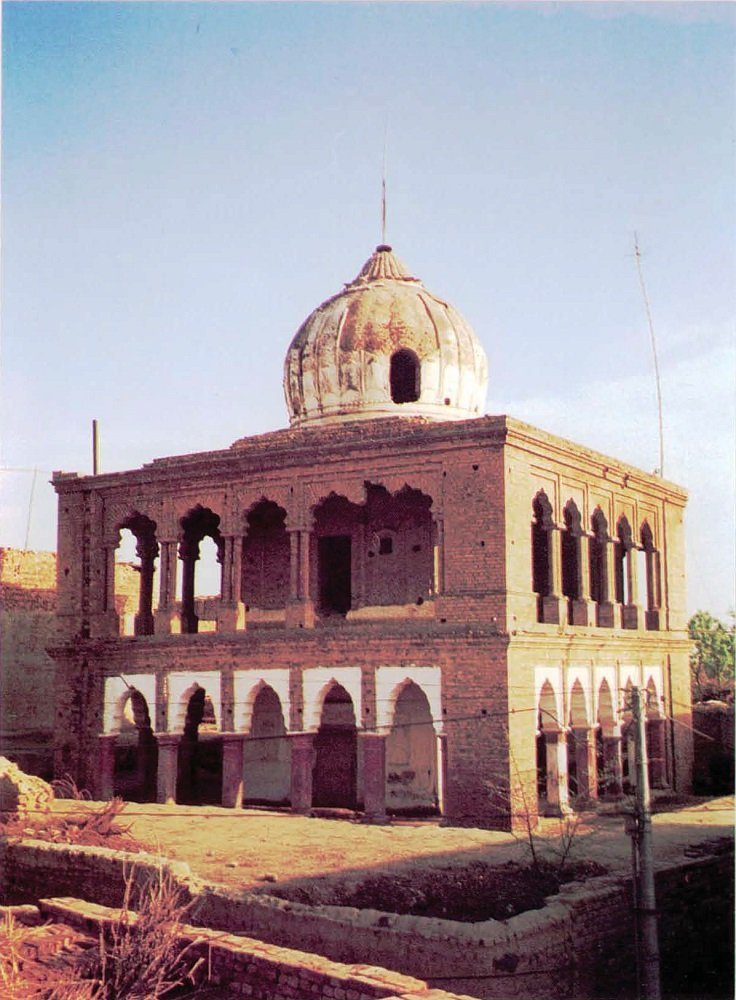
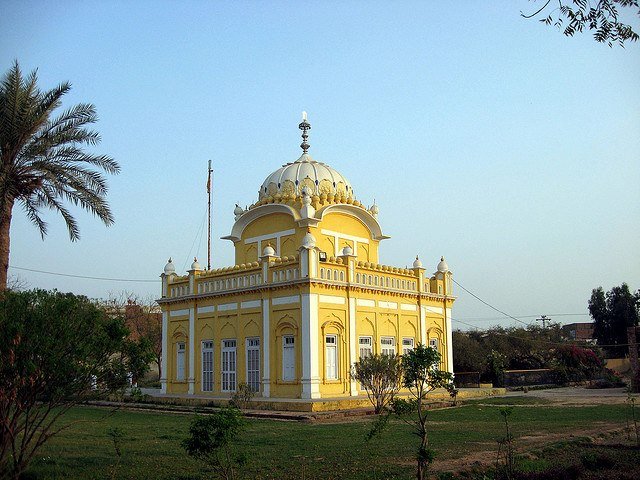
The shrine itself rewards the visit. A high-domed, double-storey sanctum rises from the middle of a square hall, its architecture echoing the nearby Gurdwara Mal Ji Sahib — this is the Sikh-empire style of sacred building at its most graceful. The great van tree still spreads its branches to the ground like a tent, exactly as the old accounts describe. Pilgrims consider it their good fortune simply to bow here, and you will feel why: the atmosphere is gentle, green, and steeped in one of the kindest stories in religious history.
Tambu Sahib is also the perfect companion stop on a Nankana Sahib day. It sits right on the road from the railway station to the Janam Asthan, so there is no detour, no extra planning — just a pause that deepens everything else you see that day. Come in November for Guru Nanak Gurpurab, when the whole city glows and the air hums with kirtan, and this quiet shrine becomes part of the grandest Sikh celebration on earth.
Whether you come as a pilgrim, a student of history, or simply a traveller who loves places with soul, Tambu Sahib gives you what the best destinations give: a story you will retell for years.
History of Gurdwara Tambu Sahib, Nankana Sahib
The history of Tambu Sahib is the history of Guru Nanak’s youth at Talwandi — the village renamed Nankana Sahib in his honour after his birth here in 1469. When Nanak was about eighteen, his father Mehta Kalu gave him twenty rupees and sent him to Chuharkana (the market town now called Farooqabad) to do business and learn the ways of trade. On the way, the young Nanak came upon hungry sadhus and villagers. Moved by compassion, he spent the entire sum feeding them — and returned home declaring he had struck a Sacha Sauda, a True Bargain: wealth spent in service of the hungry.
Only as he neared Talwandi did the boy realise his father’s fury awaited him. Unwilling to face Mehta Kalu’s rebuke, Guru Nanak — accompanied by his lifelong companion Bhai Mardana — took shelter under a large van tree (also called jal or mal, a shady tree of the Punjab plains) whose branches swept down to touch the ground, spreading like a tambu, a tent. Bhai Mardana carried the news home; Mehta Kalu hurried to the spot, and Nanak’s elder sister Bibi Nanaki followed, pleading with her father not to scold the boy. The village chief Rai Bular — already a devotee who had recognised the divine light in Nanak — intervened on the boy’s behalf. The family returned home together, and the tree kept its name: Tambu Sahib, the tent.
A gurdwara was established near the tree, about a furlong east of the Janam Asthan, during the Sikh rule in Punjab. Its present building is a handsome double-storey domed sanctum set in the middle of a square hall, with architectural embellishments similar to those of Gurdwara Mal Ji Sahib. In later years the shrine came under the control of Nihang Sikhs; historical accounts note that Mahant Bhai Sharam Singh took up the service of the Guru Granth Sahib at the behest of the Gurdwara Parbandhak Committee, while Nihang Ujagar Singh established a separate prakashasthan nearby — the Nihang Singh Chaoni (camp), which still stands beside the gurdwara today. No land endowment stands in the shrine’s name, and the prakash (ceremonial installation of the scripture) is no longer held at either spot — but the buildings stand, the tree still spreads like a tent, and pilgrims continue to bow here in large numbers.
Nankana Sahib itself carries the weight of Sikh history: the town grew around the Janam Asthan, was the scene of the tragic Saka of February 20, 1921 — when some 150 unarmed Sikh reformers were massacred by the shrine’s corrupt custodian, an event that shook the Sikh world and led to the shrine’s liberation — and became a district in its own right in May 2005. Tambu Sahib is one jewel in this extraordinary crown of sacred sites.
Top Things to Do in Gurdwara Tambu Sahib, Nankana Sahib
Bow beneath the tent-tree
The living heart of the shrine is the great van tree whose low-sweeping branches form a natural tent — the very shelter of the young Guru Nanak. Walk around it slowly, touch its bark if you like, and picture the eighteen-year-old hiding here with Bhai Mardana while his father’s footsteps approached. Pilgrims count it a blessing to prostrate at this spot; even non-Sikh visitors find it unexpectedly moving.
Admire the domed sanctum
Step into the square hall and look up at the double-storey domed sanctum rising from its centre. Built in the Sikh-empire style with decorative flourishes reminiscent of Mal Ji Sahib, it is one of the most photogenic small shrines in Nankana Sahib. Visit in the soft light of morning for the best photographs, and remember to cover your head and remove your shoes before entering.
Walk the sacred road to the Janam Asthan
Tambu Sahib sits on the right of the road from Nankana Sahib railway station to Gurdwara Janam Asthan — so make it the first stop of a walking pilgrimage that continues to the Guru’s birthplace. The road itself is lined with Sikh history, and the short walk lets the story of the Sacha Sauda settle in before you reach the grand shrine.
Visit the neighbouring shrines
Within a short distance stand several more sacred sites: Gurdwara Mal Ji Sahib, with its own tree-shade miracle and cobra-tile legend; Gurdwara Bal Lila Sahib, marking the Guru’s childhood playground; and Gurdwara Patti Sahib and Kiara Sahib, marking his school and the miraculously undamaged field. Together they form Nankana Sahib’s celebrated circuit of Guru Nanak’s early life.
Experience Gurpurab in the Guru’s city
If your dates align with Guru Nanak Gurpurab in November, stay for the celebrations: three days of Akhand Path (continuous scripture reading), nagar kirtan processions, illuminated gurdwaras, and langar served to thousands. Tambu Sahib glows along with the rest of the city, and the atmosphere is unforgettable.
Famous Places In and Around Gurdwara Tambu Sahib, Nankana Sahib
- Gurdwara Janam Asthan — the great shrine of Guru Nanak’s birth, a few minutes from Tambu Sahib.
- Gurdwara Mal Ji Sahib — the shrine of the shade-giving tree and the cobra legend.
- Gurdwara Bal Lila Sahib — where the child Nanak played.
- Gurdwara Sacha Sauda, Farooqabad — the shrine at the site of the True Bargain itself, near the old market town of Chuharkana.
- Nankana Sahib railway station — the historic station from which the pilgrim road begins.
How to Reach Gurdwara Tambu Sahib, Nankana Sahib
Getting to Tambu Sahib is straightforward — it lies on the main pilgrim road of Nankana Sahib, on the right side as you travel from the railway station toward the Janam Asthan, just before the great shrine itself.
From Lahore: roughly 75 km west via Sheikhupura (about 1.5 hours by car). Take the Lahore–Sheikhupura road onward to Nankana Sahib; the shrine is signposted on the station-to-Janam-Asthan road.
From Islamabad: roughly 340 km via the M-2 motorway to Lahore, then onward to Nankana Sahib — about 4.5 to 5 hours by car in total.
From Karachi: fly to Lahore (Allama Iqbal International Airport), then drive the 1.5 hours to Nankana Sahib. Pakistan Railways also connects Karachi and Lahore with Nankana Sahib station.
Nearest airport: Allama Iqbal International Airport, Lahore, about 85–90 km away.
Nearest railway station: Nankana Sahib railway station — the shrine road begins here, and the gurdwara is a short drive or walk along it.
Road conditions: Excellent — the Lahore–Nankana Sahib road is a well-maintained highway, good in all seasons. The final approach is on town roads.
Transport options: Private car or hired van is most convenient; Daewoo and other coaches run Lahore–Nankana Sahib; local rickshaws and Qingqis cover the town itself. During Gurpurab, the Evacuee Trust Property Board and tour operators run special pilgrim transport.
Route Details
From Lahore, drive west through Sheikhupura to Nankana Sahib (follow signs for the Gurdwara Janam Asthan). At the Nankana Sahib railway station, take the road toward the Janam Asthan; Gurdwara Tambu Sahib with its high dome stands on your right hand before you reach the main shrine. Park at the shrine forecourt and continue on foot to the Janam Asthan afterward. From Islamabad, take the M-2 to Lahore and follow the same route.
Where to Stay in Gurdwara Tambu Sahib, Nankana Sahib
Nankana Sahib is a major pilgrimage town, so it is well set up for visitors. The gurdwara sarais (pilgrim inns) near the Janam Asthan offer simple, clean, very affordable accommodation — the traditional choice for Sikh yatris and the most atmospheric option during Gurpurab. Mid-range hotels and guesthouses in the town provide air-conditioned rooms with attached baths for families wanting more comfort. Budget lodges near the bus stand and station serve the passing trade. Many visitors also day-trip from Lahore, where the full range of luxury and business hotels awaits — the 1.5-hour drive each way makes this entirely practical. During Guru Nanak Gurpurab in November, book well ahead: the town fills with pilgrims from across Pakistan and abroad.
Where to Eat: Local Foods of Gurdwara Tambu Sahib, Nankana Sahib
Nankana Sahib eats like the Punjabi heartland it is. The town’s dhabas serve daal, sabzi and tandoori rotis, chanay, halwa puri breakfasts and tall glasses of lassi — hearty, honest and budget-friendly. Around Gurpurab, the great langar halls of the Janam Asthan serve free vegetarian meals to thousands around the clock; visitors of all faiths are welcome to sit, eat and experience this 500-year-old tradition of equality — just cover your head, sit on the floor with everyone else, and accept what is served with gratitude. In the bazaar you will find samosas, pakoras, jalebi and fresh sugarcane juice in season. A dhaba meal costs very little; even a comfortable restaurant dinner in town stays firmly budget-friendly by city standards.
Weather in Gurdwara Tambu Sahib, Nankana Sahib
Nankana Sahib shares the classic central-Punjab climate: mild, pleasant winters that draw the pilgrim crowds; a short, flowery spring; scorching early summer; and a humid monsoon. November — Gurpurab month — is climatically perfect.
| Season | Temperature Range | Conditions |
|---|---|---|
| Winter (Dec–Feb) | Around 4–20°C | Cool days, chilly foggy mornings; peak pilgrim season |
| Spring (Mar–Apr) | Around 14–32°C | Pleasant and green; ideal for sightseeing |
| Summer (May–Jun) | Around 28–41°C | Intensely hot; visit shrines early morning or evening |
| Monsoon/Autumn (Jul–Nov) | Around 20–35°C | Humid rains July–September; glorious clear weather by October–November |
Language and Culture of Gurdwara Tambu Sahib, Nankana Sahib
Punjabi is the language of the town — the very soil of the Guru’s mother tongue — with Urdu universally understood. Nankana Sahib’s culture is shaped by five centuries of Sikh heritage layered over Punjabi Muslim rural life; the result is a town unusually accustomed to pilgrims and visitors of all backgrounds. At the gurdwaras, observe the courtesies: cover your head (scarves are often available at entrances), remove shoes, dress modestly, do not smoke or carry tobacco on shrine premises, and accept langar with both hands. Photography is generally fine in courtyards but ask before photographing worshippers. The town is conservative but famously hospitable — a greeting and a smile go a very long way here.
Shopping in Gurdwara Tambu Sahib, Nankana Sahib
The bazaars around the Janam Asthan cater to pilgrims: religious souvenirs — framed images of the Gurus, khanda emblems, kara bracelets, rumallas (cloths for the scripture) — alongside Punjabi handicrafts, phulkari embroidery and everyday khussay. Bookstalls sell janamsakhis (traditional life-stories of Guru Nanak) in Urdu, Punjabi and English — the perfect take-home from the city of his birth. For everyday shopping, Nankana’s main bazaar has the usual Punjabi market mix of cloth, sweets and household goods at small-town prices. There are no shopping malls here; the charm is in the pilgrim bazaar itself. Bargain politely and you will be treated fairly.
Local Events and Festivals
Nankana Sahib’s calendar is anchored by two great Sikh observances, and Tambu Sahib shares in both. Guru Nanak Gurpurab — the Guru’s birth anniversary, celebrated on the full moon of Kartik (in November; the 557th anniversary fell on November 24, 2026) — is the biggest event of the year: three days of Akhand Path, nagar kirtan processions through streets lined with devotees, gurdwaras bathed in lights, and langar for tens of thousands, with the main celebrations at the Janam Asthan and pilgrim jathas arriving from India and the diaspora. Saka Nankana Sahib (February 20–21) solemnly marks the 1921 massacre of some 150 unarmed Sikh reformers at the Janam Asthan — a day of remembrance with kirtan and speeches that draws the devout from across Punjab. Visiting during either occasion lets you see Tambu Sahib at its most alive.
Travel Tips for Gurdwara Tambu Sahib, Nankana Sahib
Packing Essentials
A headscarf or cap (essential for gurdwara visits), modest clothing covering shoulders and knees, comfortable slip-on shoes (you will remove them often), socks for hot/cold shrine floors, sunscreen and a hat for summer, a warm layer for winter mornings, and a water bottle. A small bag for carrying your shoes at busy shrines is handy during Gurpurab.
Safety Tips
Nankana Sahib is a well-trodden pilgrim town and welcoming to visitors. Keep valuables secure in crowds during festivals, drink bottled water, and eat at busy langar halls and dhabas. Women travellers will find the town conservative but safe; dressing modestly earns respect everywhere.
Money & Connectivity
ATMs and banks operate in Nankana Sahib town — carry cash for the bazaar and small dhabas. All major mobile networks (Jazz, Telenor, Zong, Ufone) have good coverage, and most mid-range hotels offer Wi-Fi. During Gurpurab, networks can slow under the load; download maps offline in advance.
Best Time to Visit Gurdwara Tambu Sahib, Nankana Sahib
Winter (November–February) — the best season
Cool, clear, festive. November brings Guru Nanak Gurpurab — the single best time to experience Nankana Sahib, with the city at its most beautiful and welcoming. December–February stay pleasant for sightseeing, with foggy mornings giving way to sunny afternoons.
Spring (March–April) — lovely and quiet
Green fields, mild temperatures, fewer crowds. An excellent time for photographers and those who prefer their shrines contemplative.
Summer (May–June) — for the determined
Temperatures cross 40°C. Visit at dawn, rest through midday, and return to the shrines in the cooler evening.
Monsoon and Autumn (July–October) — humid, then golden
July–September are hot and humid with monsoon showers. October turns clear and pleasant — a fine shoulder season before the Gurpurab crowds arrive.
Final Thoughts
Gurdwara Tambu Sahib is proof that the greatest travel stories are not always about the grandest buildings. A boy, twenty rupees, a tent of leaves — and a bargain struck not for profit but for compassion. Standing under that tree, you understand Guru Nanak a little better than any book could teach you.
Pair it with the Janam Asthan, Mal Ji Sahib and Bal Lila Sahib, and you will have walked through the childhood of one of history’s great spiritual teachers in a single day. That is a journey worth making — and a story worth carrying home. For more heritage journeys across the country, explore our Explore Pakistan collection, or wander north to the mountains with our Malam Jabba and Hunza Valley guides.
FAQs
Where is Gurdwara Tambu Sahib, Nankana Sahib?
On the right side of the road from Nankana Sahib railway station toward Gurdwara Janam Asthan, just before the Janam Asthan, in Nankana Sahib, Punjab, Pakistan.
Why is it called Tambu Sahib?
The young Guru Nanak sheltered under a van tree whose branches touched the ground and spread like a tambu (tent) after performing the Sacha Sauda. The shrine is named for that tent-like tree, which still stands.
What was the Sacha Sauda (True Bargain)?
At about eighteen, Guru Nanak was given twenty rupees by his father Mehta Kalu to do business in Chuharkana. Instead he spent it all feeding hungry sadhus and villagers — declaring compassion the truest bargain of all.
What is the best time to visit?
November to February. November brings Guru Nanak Gurpurab, the year’s grandest celebration; the weather is cool and pleasant throughout winter.
How do I reach Tambu Sahib?
Drive about 1.5 hours west from Lahore via Sheikhupura to Nankana Sahib, or take the train to Nankana Sahib station. The shrine is on the station-to-Janam-Asthan road, on the right just before the main shrine.
Is it suitable for families?
Absolutely — it is one of the most family-friendly pilgrim stops in Punjab: easy access, a beautiful tree-shaded courtyard, and a story children love.
Where can I stay?
In Nankana Sahib’s gurdwara sarais, mid-range hotels and guesthouses — or day-trip from Lahore’s full range of hotels, just 1.5 hours away.
What else should I see nearby?
Gurdwara Janam Asthan (the Guru’s birthplace), Mal Ji Sahib, Bal Lila Sahib, Patti Sahib, Kiara Sahib — and Gurdwara Sacha Sauda at Farooqabad, the site of the True Bargain itself.