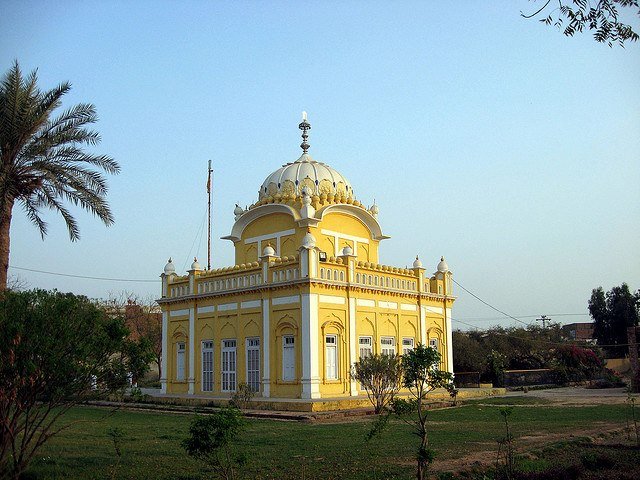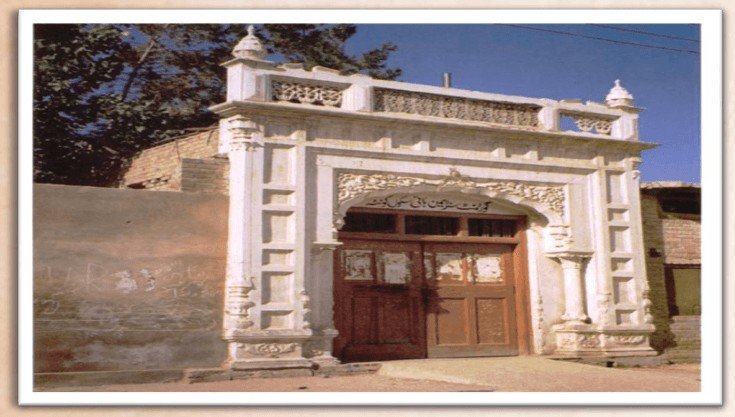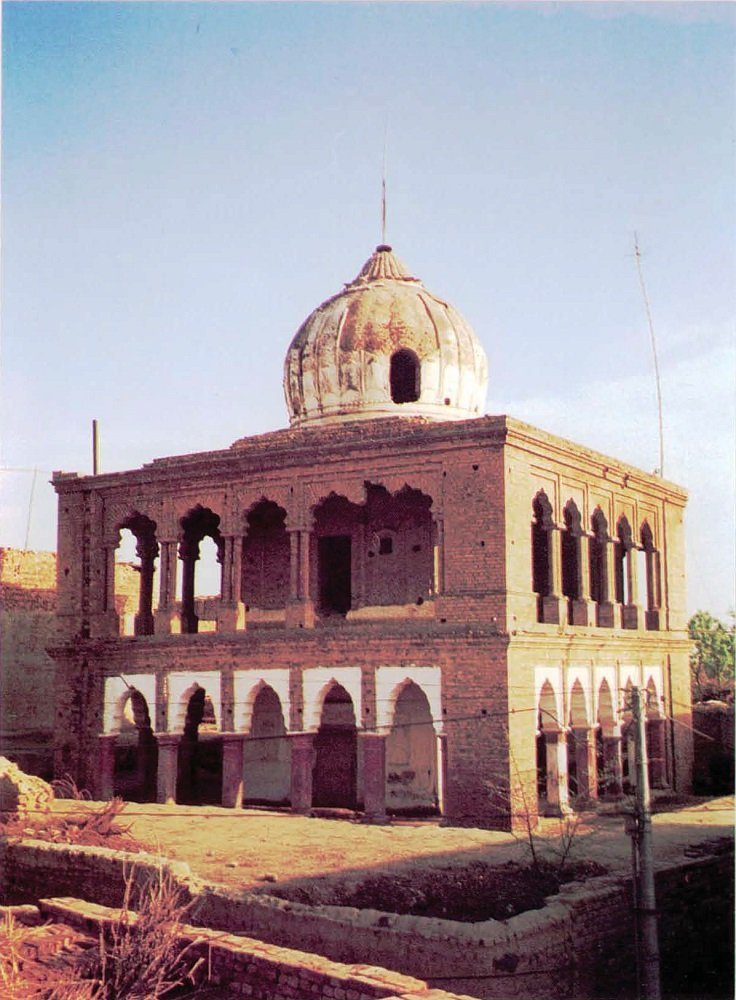
Just off the old Lahore–Multan road, past Bhai Pheru where the highway bends toward the famous Chhanga Manga forest, stands a tall, graceful shrine with a story four centuries old. Gurdwara Tham Sahib, Jamber Kalan marks the spot where Guru Arjan — the fifth Sikh Guru, compiler of the Adi Granth — stopped on his travels and brought five local men into the Sikh faith. It is not the most famous gurdwara in Pakistan, and that is exactly its appeal: a beautiful, spacious, history-soaked shrine in the Punjabi countryside, wrapped in 150 acres of quiet land, waiting for travellers who like their heritage unhurried and real.
Quick Facts
- Location: Jamber Kalan village, just past Bhai Pheru at the Chhanga Manga turning on the Lahore–Multan road (N-5), district Kasur, Punjab, Pakistan
- Altitude: Lowland Punjab plains (exact figure not published for the village)
- Famous For: The visit of Guru Arjan Ji, who came here from Beherwal; the conversion of five men — Kedara, Samdhu, Makhanda, Tulsa and Lalu — to Sikhism
- Nearest City: Pattoki and Phoolnagar (Bhai Pheru); Lahore roughly 70 km to the northeast
- Accessibility: Directly off the N-5 national highway; nearest airport is Allama Iqbal International Airport, Lahore
- Known Landmarks: The tall, spacious gurdwara building itself, set in 150 acres of attached land; the Chhanga Manga forest nearby
- Best For: Sikh heritage pilgrims, road-trippers on the N-5, history lovers, and travellers combining shrines with the Chhanga Manga forest
Why Visit Gurdwara Tham Sahib, Jamber Kalan
Some shrines impress with gold and marble. Tham Sahib impresses with presence. The building is described by every account as tall, beautiful and spacious — a landmark you can spot from the road — standing in the middle of its own 150 acres in the flat green of Kasur district. There is something deeply peaceful about a sacred place with that much sky around it, and visitors consistently describe the atmosphere as calm and contemplative.
The story here belongs to Guru Arjan, the fifth Guru — the scholar-saint who compiled the Adi Granth, built the Golden Temple’s spiritual foundations, and gave Sikhism its first martyrdom. Travelling from Beherwal, he stopped at Jamber, and here five local men — Kedara, Samdhu, Makhanda, Tulsa and Lalu — were brought into the Sikh faith. Five conversions may sound modest, but in the early 1600s each new Sikh was a seed, and Jamber became one of the many quiet villages where the young faith took root in the Punjab soil.
For the modern traveller, Tham Sahib is wonderfully easy to fold into a bigger day. It sits right by the Chhanga Manga turning — and Chhanga Manga, one of the largest man-made forests on earth, is one of Punjab’s great family outings, with its forest railway, lakes and wildlife. A morning at the gurdwara and an afternoon under the forest canopy makes for one of the finest low-cost day trips out of Lahore. Add the twin-village charm of Jamber Kalan and Jamber Khurd — two settlements that have grown together into one — and you have rural Punjab at its most authentic.
There is also a poignancy to Tham Sahib that thoughtful travellers will feel. The building was undergoing construction at the time of Partition in 1947; the work stopped, and the structure has stood in a state of disrepair ever since. Visiting is, in a small way, an act of remembrance — for the shrine, for the history it holds, and for the heritage that deserves care.
History of Gurdwara Tham Sahib, Jamber Kalan
The history of Tham Sahib belongs to the era of Guru Arjan (1563–1606), the fifth Sikh Guru. Jamber — a village of district Kasur lying just past Bhai Pheru at the Chhanga Manga turning on the Lahore–Multan road — was one of the Guru’s halts during his travels through this region. Guru Arjan arrived here from Beherwal, a nearby settlement, and it was at Jamber that five men of the area — remembered by name in Sikh tradition as Kedara, Samdhu, Makhanda, Tulsa and Lalu — were converted to Sikhism by the Guru himself.
The name of the shrine comes from the tham — the pillar or post — marking the sacred spot, a naming tradition found at several Sikh shrines where a physical marker of the Guru’s presence became the heart of the memorial. The present building grew into a tall, beautiful and spacious gurdwara, and a remarkable 150 acres of land came to be attached to it — an endowment that speaks to the reverence in which the site was held by the Sikh community of the region.
Jamber itself is actually two villages — Jamber Kalan (the greater) and Jamber Khurd (the lesser) — twin settlements that over the generations have grown and overlapped into one continuous habitation. The shrine stands in Jamber Kalan.
The shrine’s modern history carries the shadow of 1947. The gurdwara building was undergoing construction at the time of Partition, and after the upheaval no further work was completed — the structure has remained in a sorry state of disrepair since. Like many Sikh shrines in Pakistani Punjab, it stands as both a monument and a reminder: of a shared heritage, and of how much of it still waits for restoration. Visitors today find a place of great dignity and quiet, its tall form still commanding the village skyline.
Top Things to Do in Gurdwara Tham Sahib, Jamber Kalan
Take in the tall, spacious shrine
Let the building itself be your first experience. Tham Sahib’s height and proportions make it visible from a distance across the flat fields, and up close its spacious design gives the complex an airy, unhurried feel. Walk the grounds slowly — with 150 acres attached, there is room to breathe here that few shrines can match. Remember this is a sacred site in disrepair: tread gently, do not climb on old masonry, and treat the place with the care its history deserves.
Reflect on the five who became Sikhs
At the heart of the shrine’s story are five names: Kedara, Samdhu, Makhanda, Tulsa and Lalu — the men Guru Arjan brought into the faith at this spot. Take a quiet moment to consider what it meant, four centuries ago, to take that step in a small Punjabi village. For Sikh visitors this is a moment of genuine connection; for others, a window into how faiths grow one person at a time.
Combine it with Chhanga Manga Forest
The shrine sits at the Chhanga Manga turning — and the forest is one of Punjab’s great day-out destinations. Planted in the 1860s under British rule, Chhanga Manga is among the largest artificial forests in the world, with shady avenues, a small forest railway, lakes for boating, and a wildlife park that children love. A morning of heritage at Tham Sahib followed by an afternoon in the forest is the perfect pairing.
Walk the twin villages
Jamber Kalan and Jamber Khurd have merged into one rambling settlement, and a stroll through the lanes shows you rural Kasur district at its most genuine — brick homes, buffaloes, wheat and mustard fields, and villagers who will happily point you toward the shrine. It is an easy, flat walk and a lovely way to see Punjabi village life.
Stop at Bhai Pheru on the way
The town of Bhai Pheru (Phoolnagar), just before the Jamber turn, holds its own historic shrine — Gurdwara Bhai Pheru — making the N-5 corridor here a natural two-shrine heritage drive from Lahore.
Famous Places In and Around Gurdwara Tham Sahib, Jamber Kalan
- Chhanga Manga Forest — one of the world’s largest planted forests; forest railway, lakes, wildlife park.
- Gurdwara Bhai Pheru, Phoolnagar — historic shrine in the nearby town on the N-5.
- Gurdwara Panjvin Patshahi, Sheikham — another Guru Arjan shrine, about 3 km from Pattoki on the Pattoki–Halla road.
- Head Balloki — the barrage on the Ravi near Pattoki, a popular local outing spot.
How to Reach Gurdwara Tham Sahib, Jamber Kalan
Reaching Tham Sahib could hardly be simpler: it stands in Jamber Kalan, just past Bhai Pheru at the Chhanga Manga turning on the Lahore–Multan road (N-5) in Kasur district. If you can drive the N-5, you can find the shrine.
From Lahore: roughly 70 km southwest via Multan Road (N-5) through Phoolnagar (Bhai Pheru) — about 1.5 hours by car. Watch for the Chhanga Manga turning; Jamber Kalan is right there.
From Islamabad: roughly 370 km via the M-2 to Lahore, then the N-5 southwest — about 5 to 5.5 hours by car.
From Karachi: fly to Lahore, then drive the N-5. There is no practical rail link to the village itself; Pattoki station on the main line is the nearest railhead.
Nearest airport: Allama Iqbal International Airport, Lahore, roughly 80 km away.
Road conditions: The N-5 is a major national highway in good condition year-round. Village approach roads are paved but narrow; monsoon months (July–August) can leave them muddy.
Transport options: Private car or hired van is ideal. Buses and wagons ply the Lahore–Multan corridor constantly and can drop you at Bhai Pheru or the Chhanga Manga turning, from where a rickshaw covers the last stretch.
Route Details
From Lahore, take Multan Road (N-5) southwest through Manga Mandi to Phoolnagar (Bhai Pheru). Continue a short distance to the Chhanga Manga turning — signposted for the forest. Jamber Kalan village begins here; ask for “Tham Sahib” or “Gurdwara” and the tall building is unmistakable. From Islamabad, take the M-2 motorway to Lahore, exit onto Multan Road, and follow the same route.
Where to Stay in Gurdwara Tham Sahib, Jamber Kalan
Jamber Kalan is a village, so visitors stay in the nearby towns or in Lahore. Pattoki, a short drive away, has budget hotels and guesthouses serving highway travellers — simple, clean and very affordable. Phoolnagar (Bhai Pheru) offers similar roadside lodges. Most visitors, though, treat Tham Sahib as a day trip from Lahore — just 1.5 hours each way — where the full spectrum from luxury hotels to budget guesthouses awaits. If you are combining the shrine with a full day at Chhanga Manga forest, the rest houses and basic accommodation near the forest (booked through the forest department) are an option for the adventurous. For Gurpurab-season visits, Lahore hotels fill fast — book ahead.
Where to Eat: Local Foods of Gurdwara Tham Sahib, Jamber Kalan
This is the Kasur countryside, and the food is pure Punjabi comfort. The dhabas along the N-5 are legendary among road-trippers: daal fry with tandoori roti, chicken karahi, saag and makki di roti in winter, lassi in tall steel glasses, and doodh patti chai that tastes better at a highway dhaba than anywhere else. Kasur district is famous for Kasuri methi (dried fenugreek leaves) — you will taste it in local cooking and can buy packets in town markets. In the village, expect seasonal farm food at its freshest. A dhaba meal is very budget-friendly; even the better highway restaurants stay modestly priced. In winter, look for fresh sugarcane juice stalls and roasted peanuts sold by the roadside.
Weather in Gurdwara Tham Sahib, Jamber Kalan
Kasur district has the classic plains-Punjab climate: winters are mild and delightful, May and June are furnace-hot, and the monsoon brings real downpours. November to March is the prime visiting window.
| Season | Temperature Range | Conditions |
|---|---|---|
| Winter (Dec–Feb) | Around 5–20°C | Cool, sunny days; occasional morning fog; best season for the shrine and forest |
| Spring (Mar–Apr) | Around 15–33°C | Pleasant; wheat harvest colours the fields gold |
| Summer (May–Jun) | Around 28–41°C | Extremely hot and dry; plan shrine visits at dawn |
| Monsoon/Autumn (Jul–Nov) | Around 20–36°C | Heavy rain July–August; fresh and green by October–November |
Language and Culture of Gurdwara Tham Sahib, Jamber Kalan
Punjabi is the everyday language of Jamber, in the warm central-Punjab dialect; Urdu is understood everywhere. The culture is that of the Punjabi farming belt — hospitable, straightforward, and conservative. Dress modestly, cover your head at the shrine, remove shoes before entering sacred areas, and ask before photographing villagers. The gurdwara building is in disrepair, so be especially careful where you walk and do not lean on or climb old walls. A greeting of “Sat Sri Akal” at the shrine or “Assalam-o-Alaikum” in the village will be returned with genuine warmth. If you meet Sikh pilgrims here, you will find them happy to share the shrine’s story.
Shopping in Gurdwara Tham Sahib, Jamber Kalan
There is no souvenir trade at the shrine — come for the history, not the shopping. In nearby Pattoki and Phoolnagar markets you can buy Kasuri methi, the district’s famous dried fenugreek, along with fresh seasonal produce and everyday Punjabi goods at small-town prices. Pattoki is also known regionally for its nurseries and flowers — the town sits in a belt of plant nurseries, and potted plants and saplings make unusual, living souvenirs. The N-5 dhabas sell desi ghee and honey from local producers. For serious shopping, Lahore’s bazaars are 1.5 hours away.
Travel Tips for Gurdwara Tham Sahib, Jamber Kalan
Packing Essentials
Light clothes for most of the year, a jacket for winter mornings, sturdy walking shoes (village lanes and old shrine grounds are uneven), a headscarf or cap, sunscreen, insect repellent if combining with the forest, and a water bottle. Carry socks for barefoot shrine floors.
Safety Tips
The N-5 corridor is busy and well-travelled. In the village, the main caution is the shrine’s state of disrepair — watch your step and keep children close to you on old masonry. Drink bottled water and eat at busy dhabas.
Money & Connectivity
Carry cash — the village has no ATMs; Pattoki and Bhai Pheru have banks and ATMs. Mobile coverage from Jazz, Telenor, Zong and Ufone is generally good along the highway and in the village. Fuel up in Lahore or Pattoki before the village stretch.
Best Time to Visit Gurdwara Tham Sahib, Jamber Kalan
Winter (November–March) — the best season
Mild days, clear skies, green fields — perfect for the shrine, the village walk and Chhanga Manga forest together. This is when the region is at its most inviting.
Spring (March–April) — short and sweet
Warm but still pleasant; the harvest landscape is beautiful. Go early in the season before the heat builds.
Summer (May–June) — only for early birds
Daytime temperatures approach 40°C. Visit the shrine at sunrise, then retreat to the shade of Chhanga Manga — the forest is noticeably cooler than the open road.
Monsoon and Autumn (July–October) — wet, then wonderful
July–August rains can muddy village tracks. October and November are superb: washed-clean air, green countryside, comfortable temperatures.
Final Thoughts
Gurdwara Tham Sahib, Jamber Kalan is not a shrine that shouts — it is one that stays with you quietly. Five men became Sikhs here four hundred years ago. A tall, beautiful building rose to remember it. Time and Partition left their marks, but the dignity of the place endures, set in its 150 acres under the wide Punjab sky.
Come for the history of Guru Arjan’s travels, stay for the forest at Chhanga Manga, and leave with a fuller picture of the Sikh heritage woven into Pakistan’s soil. It is an easy drive from Lahore, an honest village welcome, and a story worth knowing. For more heritage road trips, browse our Explore Pakistan collection — or head for the hills with our Hunza Valley and Malam Jabba guides.
FAQs
Where is Gurdwara Tham Sahib, Jamber Kalan?
In Jamber Kalan village, just past Bhai Pheru (Phoolnagar) at the Chhanga Manga turning on the Lahore–Multan road (N-5), district Kasur, Punjab, Pakistan.
Which Guru is associated with Tham Sahib?
Guru Arjan, the fifth Sikh Guru, who came here from Beherwal. Five local men — Kedara, Samdhu, Makhanda, Tulsa and Lalu — became Sikhs at this spot.
Why is it called Tham Sahib?
Tham means pillar or post in Punjabi — the shrine is named for the marker of the Guru’s presence at this place.
What is the best time to visit?
November to March, when the weather is mild. It pairs perfectly with a visit to nearby Chhanga Manga Forest.
How do I reach it from Lahore?
Drive about 1.5 hours southwest on Multan Road (N-5) through Bhai Pheru to the Chhanga Manga turning; the tall gurdwara in Jamber Kalan is unmistakable.
Is the shrine in good condition?
Honestly, no — construction was interrupted at Partition in 1947 and the building has been in disrepair since. Visit with care, watch your step, and treat the heritage gently.
Where can I stay nearby?
Budget hotels in Pattoki or Phoolnagar, or — easiest — day-trip from Lahore, only 1.5 hours away.
What else can I see nearby?
Chhanga Manga Forest (forest railway, lakes, wildlife park), Gurdwara Bhai Pheru, Gurdwara Panjvin Patshahi at Sheikham, and Head Balloki on the Ravi.