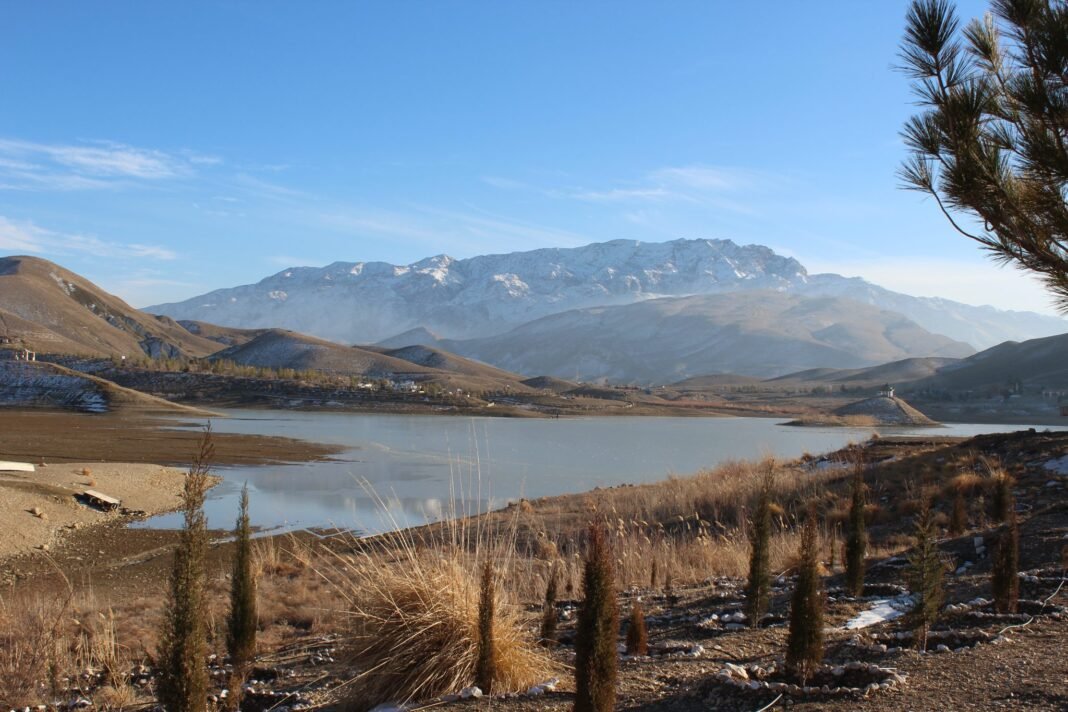
Every city has its escape valve — the place locals flee to when they need air, water and quiet. For Quetta, that place is Hanna Lake. Tucked into the hills where the Urak Valley begins, just 10 to 17 kilometres east of the city, this historic reservoir has been Quetta’s favourite outing for over a century: pine-shaded picnic spots, a lakeside restaurant, golden fish swimming up to the water’s edge, and the striking old British bridge-wall rising between two mountains like the battlements of a fort.
This Hanna Lake travel guide will help you plan your visit — the lake’s remarkable colonial history, the best seasons, water sports at the Hayat Durrani Water Sports Academy, how to reach it from Quetta and beyond, where to stay, what to eat, and practical tips. For more of Pakistan’s waters and valleys, see our Attabad Lake guide, the Explore Pakistan collection, and the Archaeological Museum of Balochistan for Quetta’s deeper history.
Quick Facts
- Location: Urak Valley, Zarghoon Range — 10–17 km east of Quetta city, Balochistan
- Altitude: Hillside setting at the mouth of the Urak Valley, above Quetta city (which sits at around 1,680 metres)
- Famous For: The 1894 British-era reservoir and bridge-wall; picnic and boating spot; Hayat Durrani Water Sports Academy (rowing, kayaking, sailing)
- Nearest City: Quetta — the lake is essentially the city’s lakeside resort, minutes from town
- Accessibility: Very easy — paved road from Quetta, any car, ideal half-day or full-day trip
- Known Landmarks: The historic bridge-wall (Surrpull/Red Bridge), Hayat Durrani Water Sports Academy, pine-shaded picnic area, nearby Urak Valley
- Best For: Families, picnickers, boaters, water-sports enthusiasts and anyone visiting Quetta
Why Visit Hanna Lake
The first reason is proximity with payoff. Few cities in Pakistan have a mountain lake this close and this storied. You can finish breakfast in Quetta and be gliding across Hanna Lake in a boat within the hour, pine trees overhead, the Zarghoon mountains ringing the horizon. For travellers passing through Quetta — on the way to Ziarat, to the Bolan Pass, or simply exploring Balochistan’s capital — Hanna Lake is the essential half-day that turns a stopover into a memory.
The second reason is the history you can touch. The lake’s great bridge-wall — built by the British in 1894 between two mountains to store water — still stands, and kayakers paddle in its shadow. This is not a roped-off monument; it is a working piece of 19th-century engineering that has shaped the valley for 130 years. The story of the lake — its construction on local tribesmen’s land, its floods and dryings, its revivals — is the story of Quetta’s fragile relationship with water, written in stone and shoreline.
The third reason is the life of the place. Hanna Lake is where Quetta comes to celebrate: families spreading picnic cloths under the pines, children feeding the golden fish that swim right up to the lake’s edge, rowers from the Hayat Durrani Water Sports Academy — Balochistan’s only rowing, canoeing, kayaking and sailing training centre — cutting across the water. In the years when the lake is full, water-sports competitions return and the whole shoreline hums. Even on a quiet weekday, the combination of mountain air, still water and pine shade is deeply restorative.
Who is it perfect for? Quetta visitors of every kind — families wanting a safe, easy outing; couples looking for a scenic escape; photographers chasing mountain-light on water; and sports-minded travellers who want to try kayaking or rowing in an extraordinary setting. When to go? Spring (March–May) and autumn (September–November) are ideal — pleasant temperatures, good light, comfortable boating. Summer is warm but workable; winter brings real cold and occasional snow. Details below.
History of Hanna Lake
Hanna Lake is a reservoir with a colonial birth certificate. In 1894, during the British colonial era, the administration constructed the lake on the land of local tribesmen at the point where the Urak Valley begins, about 10–17 km east of Quetta. The centrepiece was a small dam and bridge-wall — known as Surrpull, the “Red Bridge” — built on the main Urak road to catch the streams, snowmelt and rain running down from the Zarghoon and Murdar (Koh-i-Murdar) mountains and divert them into the lake through a canal system.
The purpose was practical: Quetta, a growing garrison town in an arid valley, needed water — for drinking, for agriculture, and for recharging the karezes, the ancient underground irrigation channels that had watered the region for centuries. In its prime, the lake was an impressive body of water: historical accounts describe it spreading over some 818 acres with a holding capacity of over 220 million gallons and a depth of around 49 feet (15 metres).
The lake’s history since has been a cycle of flood and drought. A heavy flood in the 1970s destroyed the Murdar mountains’ recharge canal near Spin Karez — a channel that was never rebuilt, meaning snowmelt and rainwater that once filled the lake now largely runs to waste. The lake dried up completely from 1999 to January 2005, a shocking sight for Quetta residents, and has fluctuated since, reviving with good rains (notably in 2018) and shrinking in dry years. The Hanna Lake Development Authority (HLDA) is the custodian charged with maintaining the lake and its feeder channels, and the lake’s water level remains a barometer of both rainfall and management.
Alongside the engineering story runs a sporting one. Water sports — rafting, kayaking, canoeing, rowing and boating — became a regular feature at Hanna Lake from 1989, with annual competitions held from March to November, and the Hayat Durrani Water Sports Academy (HDWSA) established on the lake’s eastern side as Balochistan’s first and only rowing, canoeing, kayaking and sailing training and championship centre. When the lake dried, the competitions stopped; when the rains returned, the boats went back on the water. Hanna Lake’s history is, in the end, a very Baloch story: water as precious, precarious, and worth celebrating.
Top Things to Do in Hanna Lake
Boating on the lake
The classic Hanna Lake experience. Rowboats and paddle boats take you out onto the water, with the mountains rising on all sides and the old bridge-wall looming at one end. Early morning is the most beautiful time — the water glassy, the light soft on the Zarghoon peaks. Boating is a gentle, all-ages activity, and an hour on the water is usually enough to fall for the place.
Kayaking and rowing at HDWSA
On the eastern side of the lake stands the Hayat Durrani Water Sports Academy, the only rowing, canoeing, kayaking and sailing training centre in Balochistan. Kayaking in front of the historic 1894 bridge-wall is a signature experience — paddling in the shadow of Victorian engineering with mountains all around. The academy has trained Balochistan’s water-sports athletes and organised championships; visitors can enquire about introductory sessions and equipment when the lake has water and the academy is active.
Picnic under the pines
The lakeside picnic area, with tables shaded by pine trees, is where Quetta families have gathered for generations. Bring food from the city (or buy from the small shops and the lakeside restaurant), spread out, and settle in for a long, lazy afternoon. The golden fish that swim right up to the lake’s edge are a particular delight for children — bring a little bread and watch them swarm.
Photography: the bridge-wall and mountain light
The old bridge-wall rising from the water “like the battlements of a fort” is one of Balochistan’s most photogenic structures, especially at golden hour when the low sun rakes across its stonework. The surrounding Zarghoon mountains give dramatic backdrops in every direction, and winter snow on the peaks adds a whole new palette. Sunrise and sunset both reward the early or late visitor.
Walk the shoreline
A gentle walk along the lake’s edge — out toward the dam wall at one end, along the reed beds at the other — is the best way to absorb the place. Birdlife visits the lake, the mountain air is crisp, and the views shift constantly as you move. It is an easy, flat walk suitable for all ages.
Eat at the lakeside restaurant
The lakeside restaurant, set among the pines at the end of the lake, is part of the Hanna Lake ritual: a meal with a water view, mountain air, and the unhurried pace of a Quetta afternoon. Simple Pakistani and local dishes, tea, and the pleasure of eating outdoors.
Famous Places In and Around Hanna Lake
- Urak Valley: The valley beyond the lake — orchards, villages and mountain scenery stretching into the Zarghoon range.
- Quetta city: The provincial capital, minutes away — its bazaars, the Archaeological Museum of Balochistan, and Hanna-Urak roadside eateries.
- Hazarganji Chiltan National Park: Southwest of Quetta — home to the rare Chiltan markhor, juniper forest and dramatic desert-mountain landscapes.
- Ziarat: About 130 km from Quetta — the famous juniper forests (some of the oldest living trees on earth) and the Quaid-e-Azam Residency.
- Sandeman Tangi and the Bolan Pass: Historic gorge and pass routes south of Quetta, layered with railway and colonial history.
How to Reach Hanna Lake
Hanna Lake is one of Pakistan’s easiest lake destinations to reach — it is effectively a suburb of Quetta, on the road toward the Urak Valley. From Quetta city centre, drive east on the Hanna-Urak road for 10–17 km (about 20–30 minutes). The road is paved and any car can make it; rickshaws and taxis from Quetta will also take you there and wait.
Route Details
- From Quetta city: Drive east on the Hanna-Urak road, 10–17 km, 20–30 minutes. Taxis and ride-hailing are readily available; agree on a wait-and-return fare.
- From Islamabad: Fly to Quetta (about 1.5 hours; several daily flights), then drive to the lake as above. By road, the journey via Dera Ghazi Khan and the Bolan Pass is long (14+ hours) — flying is strongly recommended.
- From Lahore: Fly to Quetta via Karachi or Islamabad (no direct flights), then drive to the lake. By road it is a very long journey — plan it as part of a wider Balochistan trip.
- From Karachi: Fly to Quetta (about 1.5 hours) or drive the N-25 via Khuzdar (roughly 10–12 hours through dramatic mountain country). Then the short drive to the lake.
Nearest airport: Quetta International Airport — about 25–30 km from the lake, 30–45 minutes by road. Road conditions: The Hanna-Urak road is paved and fine year-round; winter snow is possible but the road is usually cleared quickly given its importance. Transport options: Private car, taxi, or hotel-arranged transport. Public vans run toward Urak but a taxi is far more convenient for a lake visit.
Where to Stay in Hanna Lake
There is no reason to stay at the lake itself — Quetta, minutes away, has the full range of accommodation, and the lake is a half-day trip.
Luxury: Quetta’s top hotels (including the Serena Quetta on Shahrah-e-Zarghun) offer comfortable, secure stays with restaurants and heating — important in winter. Mid-range: A solid selection of mid-range hotels along Zarghun Road and Jinnah Road cater to business and leisure travellers. Budget: Numerous budget hotels and guesthouses around the city centre offer clean, basic rooms at very reasonable rates. Camping: Not established at Hanna Lake; the lake is a day-visit destination. Wherever you stay in Quetta, confirm heating in winter — nights get properly cold — and book ahead during peak domestic travel periods.
Where to Eat: Local Foods of Hanna Lake
The lakeside restaurant serves the standard outing menu — Pakistani staples, barbecue, tea — with a view. But the real eating happens in Quetta, and Quetta’s food is a destination in itself. Do not leave without trying sajji (whole lamb or chicken slow-roasted over coals — the signature dish of Balochistan), kaak (stone-baked bread), rosh (slow-cooked meat), and landhi in winter. Quetta’s famous chai culture — doodh patti served in the city’s countless tea houses — is an institution. The city’s bakeries (a legacy of its diverse communities) are excellent for rusks, cakes and biscuits to take to the lake. Dry fruits — almonds, pistachios, pine nuts — are sold everywhere in Quetta’s bazaars and make perfect picnic supplies. A full meal at a Quetta dhaba or restaurant is very budget-friendly; the lakeside restaurant charges a modest premium for the view, which is fair enough.
Weather in Hanna Lake
Quetta’s climate is famously extreme for a Pakistani city: cold, sometimes snowy winters and warm, dry summers, all at around 1,900 metres altitude. Hanna Lake, up in the hills, runs a touch cooler than the city. Spring and autumn are the sweet spots — mild days, crisp air, comfortable boating. Summer afternoons can be hot but mornings and evenings are pleasant. Winter is genuinely cold, with the lake sometimes edged in ice and snow on the surrounding peaks — beautiful, but dress for it.
| Season | Temperature Range | Conditions |
|---|---|---|
| Winter (Dec–Feb) | -4°C to 12°C | Cold, occasional snow; dramatic scenery, few visitors |
| Spring (Mar–May) | 8°C to 28°C | Ideal — mild, fresh, best for boating and picnics |
| Summer (Jun–Aug) | 18°C to 36°C | Warm days, cool evenings; go early or late in the day |
| Autumn (Sep–Nov) | 5°C to 28°C | Excellent — clear skies, crisp air, golden light |
Language and Culture of Hanna Lake
Quetta is one of Pakistan’s most diverse cities, and that diversity reaches the lakeshore. Pashto is the most widely spoken language, with Balochi (Baluchi), Brahui, Hazaragi and Urdu all widely heard; Urdu works everywhere for visitors. The culture blends Pashtun, Baloch, Hazara and Brahui traditions — famous hospitality, strong community bonds, and a deep pride in the land.
For visitors: dress modestly, as Quetta is conservative — women should keep shoulders and knees covered and carry a scarf. Greet people warmly; a handshake and a smile open doors. Ask before photographing people. The Hazara community’s presence gives parts of Quetta a distinct character, including excellent bakeries and restaurants worth seeking out. As everywhere in Balochistan, check current travel advisories and travel with local guidance — Quetta is welcoming, but it pays to be informed and to move with a local driver or guide who knows the city.
Shopping in Hanna Lake
There is little shopping at the lake — a few small shops selling snacks, drinks and picnic supplies. Save your shopping for Quetta, where the bazaars are a highlight: dry fruits (Quetta is famous for them — almonds, pistachios, chilghoza pine nuts), Balochi embroidery and mirror-work textiles, traditional Balochi caps and shawls, carpets and rugs, and local handicrafts. Liaquat Bazaar and the streets around it are the main shopping areas. Prices are reasonable and the dry-fruit quality is among the best in Pakistan — stock up for the journey home. Quetta has modern shopping areas too, but the traditional bazaars are the real experience.
Local Events and Festivals
Hanna Lake’s own “festival” is sporting. From 1989 until the lake’s drying, annual water-sports competitions — rowing, kayaking, canoeing and sailing — were held at the lake every year from March to November, organised around the Hayat Durrani Water Sports Academy, drawing athletes from across Balochistan. When water levels allow, these events return and are worth timing a visit around — check locally before you travel. In Quetta city, cultural life follows the seasons: Sibi Mela (held each February in nearby Sibi, one of Pakistan’s great traditional festivals, with livestock, crafts and folk music) is the region’s flagship event and combines well with a Quetta–Hanna Lake trip. Religious festivals — Eid-ul-Fitr, Eid-ul-Adha and Nauroz (celebrated by the Hazara and Baloch communities) — fill the city’s bazaars and restaurants with special energy.
Travel Tips for Hanna Lake
Packing Essentials
Sun protection (the mountain sun is strong even when the air is cool), a warm layer for mornings and evenings in spring and autumn, and a proper jacket in winter. Comfortable walking shoes for the shoreline. Swimwear only if you plan to use academy facilities — the lake is not a swimming spot for casual visitors. A camera, drinking water, and picnic supplies from Quetta.
Safety Tips
Hanna Lake itself is a relaxed, family-friendly outing. The main cautions are general to the region: check current travel advisories for Balochistan before your trip, travel with a local driver or guide, and keep to well-visited areas. On the water, wear a life jacket when boating and supervise children closely. Do not swim in the lake outside organised academy activities. Keep valuables minimal and your phone charged.
Money & Connectivity
Bring cash for the lake — boat rides, snacks and the restaurant are cash businesses. ATMs are plentiful in Quetta city. All major mobile networks work in Quetta and at the lake, with reasonable data coverage. Fuel up in Quetta; there is nothing beyond basic shops at the lake.
Best Time to Visit Hanna Lake
Spring (March to May) — the best all-rounder
Mild temperatures, fresh mountain air, good water levels after winter rains, and comfortable boating. This is the prime season — and historically the start of the water-sports calendar.
Autumn (September to November) — the photographer’s season
Clear skies, crisp light, golden hillsides, and thinning crowds. Arguably the most beautiful time at the lake, especially October.
Summer (June to August) — warm but workable
Quetta’s summer is milder than the plains, but midday at the lake can be hot. Go early in the morning or late in the afternoon, and enjoy Quetta’s famously cool summer evenings back in the city.
Winter (December to February) — stark and beautiful
Real cold, possible snow, few visitors — and a stark, dramatic beauty as the peaks whiten and the air turns crystal clear. Dress warmly and check the lake’s condition before going.
Final Thoughts
Hanna Lake is not Pakistan’s most dramatic lake or its most pristine. It is something better: a lake with a lived-in soul. A Victorian bridge-wall, a water-sports academy, generations of Quetta families, golden fish at the water’s edge, and mountains standing guard — all of it twenty minutes from a great city. It is the kind of place that reminds you that the best travel experiences are often not the most extreme ones, but the most human.
If Quetta is on your route — and it should be, at least once — give Hanna Lake half a day. Go in spring for the easy perfection, or in autumn for the light. Take the boat, walk to the old wall, eat under the pines, and watch the city you came from glitter in the distance. Quetta’s lake will do the rest.
FAQs
Where is Hanna Lake located?
Hanna Lake is in the Urak Valley, about 10–17 km east of Quetta city in Balochistan, Pakistan, at the point where the valley begins in the Zarghoon Range.
What is the best time to visit Hanna Lake?
March to May and September to November offer the most pleasant weather for boating and picnics. Summer is warm but workable; winter is cold with possible snow.
How do I reach Hanna Lake from Quetta?
Drive east on the Hanna-Urak road for 10–17 km (20–30 minutes). Taxis from Quetta will take you there and wait. The road is paved and suitable for any car.
Is Hanna Lake safe for families?
Yes — it is Quetta’s classic family outing, with picnic areas, a restaurant and gentle boating. Supervise children near the water and wear life jackets on boats.
What is the history of Hanna Lake?
The reservoir was built by the British in 1894, with the Surrpull (Red Bridge) dam-wall diverting Zarghoon and Murdar mountain streams into the lake. It has cycled through floods and droughts, drying completely from 1999 to 2005.
Can I do water sports at Hanna Lake?
Yes — the Hayat Durrani Water Sports Academy on the lake’s eastern side is Balochistan’s only rowing, canoeing, kayaking and sailing training centre. Enquire locally about sessions; activity depends on water levels.
Where can I stay near Hanna Lake?
Stay in Quetta (20–30 minutes away), which has the full range from luxury hotels like Serena Quetta to mid-range and budget options. The lake itself is a day-visit destination.
What food should I try near Hanna Lake?
In Quetta, try sajji (slow-roasted lamb/chicken), kaak bread, rosh, and the city’s famous doodh patti chai. Stock up on Quetta’s renowned dry fruits in the bazaars for your lakeside picnic.