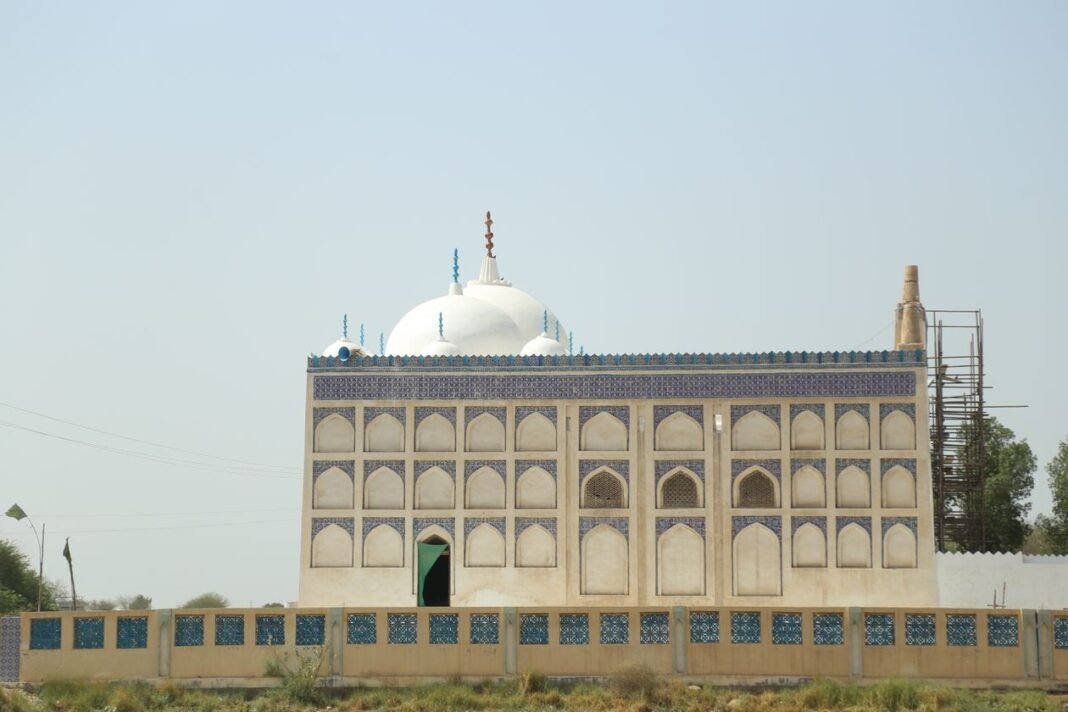
Most travellers who chase Sindh’s great tiled mosques go to Thatta — and they should. But the connoisseurs keep driving north, to a quiet village ten kilometres south of Dadu, where the finest surviving building of the early Kalhora period stands wrapped in enamelled Sindhi tilework. The Jamia Masjid of Khudabad — often called the Badshahi Mosque — was the congregational mosque of a lost capital, built by the founder of the Kalhora dynasty three centuries ago. A British archaeologist once called its tilework a world-class masterpiece. This Jamia Masjid, Dadu, Khudabad travel guide gives you the real history, why this forgotten capital deserves your detour, the best time to go, and exactly how to reach it.
Quick Facts
- Location: Khudabad village, about 10–13 kilometres south of Dadu town, Dadu District, Sindh, Pakistan
- Famous For: The finest surviving building of the early Kalhora period; superb Sindhi enamelled (Kashi) tilework; the mosque of the first Kalhora capital
- Nearest City: Dadu, 10–13 km to the north; Larkana and Mohenjo-daro lie further north along the Indus
- Accessibility: Reached by road off the N-55 (Indus Highway); Dadu and Larkana are both on the highway network
- Known Landmarks: The tomb of Mian Yar Muhammad Kalhoro (who built the mosque), the necropolis of Mian Nasir Muhammad Kalhoro at Garhi, the ruins of old Khudabad
- Best For: Architecture lovers, Islamic art enthusiasts, history travellers, photographers and off-the-beaten-path explorers
Why Visit Jamia Masjid, Dadu, Khudabad
If you love Islamic architecture, you already know the Shah Jahan Mosque of Thatta with its ninety-three domes. Here is what the guidebooks rarely tell you: historians have called the Jamia Masjid of Khudabad “perhaps the most beautiful and imposing structure throughout Sindh” after Thatta — and it stands almost entirely alone, visited by a fraction of Thatta’s crowds. The mosque’s walls are faced in local Sindhi enamelled tile — the Kashi work of Hala — arranged in floral panels of extraordinary grace. The British archaeologist Henry Cousins, writing in his book on Sindh tiles, praised this tilework as a world-class masterpiece. You can stand in front of it, at arm’s length, with nobody else there.
The setting is part of the magic. Khudabad was the first capital of the Kalhora state — the dynasty that ruled Sindh through the 18th century before the Talpurs — and the mosque is the most substantial building to survive from that abandoned city. Around it lie the ruins of the old capital and the great tomb of the ruler who built both. Visiting here is not just seeing a mosque; it is walking through the remains of a royal city the Indus itself eventually swallowed.
For the thoughtful traveller, Khudabad also tells a more complicated story. The mosque has endured decades of troubled restoration — substandard materials, fallen tiles, wide cracks reported by heritage experts — and seeing it is a reminder that Pakistan’s heritage needs its visitors as much as its visitors need it. Coming here, writing about it, photographing it respectfully: all of that helps keep places like this on the map.
And practically, it is an easy add-on. Dadu sits on the Indus Highway between Karachi and the great northern sites of Larkana and Mohenjo-daro. If you are driving the Indus corridor — and every serious Sindh itinerary does — Khudabad costs you a half-day detour and pays you back with one of the finest tiled facades in the country.
History of Jamia Masjid, Dadu, Khudabad
The mosque was built during the reign of Mian Yar Muhammad Kalhoro, between 1700 and 1718. The Mughal emperor Aurangzeb had made Yar Muhammad the governor of the Derajat in 1701 and conferred on him the title of Khudayar Khan — and from that title came the name of the new capital he founded: Khudabad. The foundation of the Jamia Masjid was laid at the same time as the city itself, making the mosque and the capital twins of the Kalhora state’s founding moment.
Yar Muhammad Kalhoro, who ruled from 1701 to 1718, is remembered as the true founder of the Kalhora dynasty in Sindh — a benevolent and capable ruler of upper Sindh who was also a genuine enthusiast of architecture. Beyond the mosque, he built his own tomb at Khudabad during his lifetime — a landmark that still dominates the landscape and is visible from a distance — and commissioned tombs across Dadu and Larkana districts, including the necropolis of Mian Nasir Muhammad Kalhoro at Garhi.
Khudabad remained the Kalhora capital through the first half of the 18th century, until the dynasty’s centre of gravity shifted and Hyderabad was founded in 1768. The Talpurs defeated the last Kalhora ruler in 1783 and kept Khudabad as their capital until 1789, when the Indus inundated the city — a catastrophe that finally moved the seat of power to Hyderabad and began Khudabad’s long decline into the quiet village of ruins you see today.
The mosque itself served not only as a house of prayer but also as a school and for military training, reflecting its central role in the life of the capital. Its architecture — the open eastern hall, the domed western chamber carried on massive piers in three aisles, the floral tile panels flanking the entrance — represents the high point of 18th-century Sindhi tilework. In recent decades the building has suffered from well-documented restoration problems: heritage experts have reported cracked facades, fallen tiles and the use of counterfeit tiles and cement instead of traditional materials, with repair work stretching from 2009 onward at costs reported in the tens of millions of rupees. The mosque endures — but it deserves better, and informed visitors are part of the answer.
Top Things to Do in Jamia Masjid, Dadu, Khudabad
Study the Kashi Tilework
This is the main event. Walk the facade slowly and look at the enamelled tile panels: the floral patterning is arranged around a tall, graceful plant of the lily order, its leaves, flowers and buds sprouting from a central stem and falling left and right in easy natural curves. The colour palette — the deep blues and turquoises of Sindhi Kashi work — glows in morning light. Bring a zoom lens; the detail rewards close looking.
Walk the Two Prayer Chambers
The prayer chamber divides into two equal compartments: an open eastern hall and a domed western hall split into three aisles by massive piers carrying elegant arches, the central aisle wider than the flanking ones. An arched mihrab is sunk into the western wall of each bay. Standing in the central aisle under the dome, you feel the scale the Kalhora builders were aiming for.
Visit the Tomb of Yar Muhammad Kalhoro
A short walk from the mosque stands the tomb of the man who built it — constructed during his own lifetime, still conspicuous across the flat landscape of Khudabad. Seeing the patron’s tomb and his mosque together completes the story of the founder of the Kalhora state.
Explore the Ruins of Old Khudabad
The abandoned capital spreads around the mosque in low mounds and ruined walls. Local lore says old coins still surface among the ruins — in 1908 a charcoal seller famously unearthed a hoard of silver coins here. Walk respectfully, take nothing, and imagine the city that stood here for most of the 18th century.
Day-Trip to the Kalhora Necropolis at Garhi
The necropolis of Mian Nasir Muhammad Kalhoro at Garhi, with its cluster of historic tombs built under Yar Muhammad’s patronage, makes a natural extension of the Khudabad visit for travellers with a full day.
Famous Places In and Around Jamia Masjid, Dadu, Khudabad
- Tomb of Mian Yar Muhammad Kalhoro — the founder’s own mausoleum, a short walk from the mosque, dominating the Khudabad skyline.
- Kalhora necropolis at Garhi — the tomb cluster of Mian Nasir Muhammad Kalhoro and others, in Dadu district.
- Dadu town — the district centre, 10–13 km north, with bazaars and basic services.
- Mohenjo-daro — the great Indus Valley city, reachable via Larkana to the north; the essential pairing for an Indus-corridor trip.
- Hala — the town famous for the Kashi tilework you see on the mosque; its workshops still make the traditional enamelled tiles.
How to Reach Jamia Masjid, Dadu, Khudabad
Khudabad village lies just off the N-55 (Indus Highway), 10–13 km south of Dadu town in upper Sindh. Dadu and nearby Larkana are both on the highway network, making this one of the more accessible heritage sites in interior Sindh.
- From Karachi: About 300 km via the M-9 Motorway and then the N-55 Indus Highway — roughly 4 to 5 hours by car. This is the most common approach.
- From Hyderabad: About 230 km north via the Indus Highway — roughly 3.5 to 4 hours.
- From Lahore: About 800 km via the motorway network to the Indus Highway — a full day’s drive; most travellers break the journey.
- From Islamabad: About 1,000 km south — fly to Karachi and drive, or make it part of a longer Indus-corridor road trip.
- Nearest airports: Jinnah International Airport, Karachi (the main gateway); Sukkur Airport is a closer regional option, roughly 110 km north of Dadu.
- Local transport: From Dadu town, hire a car or rickshaw for the short run south to Khudabad village; the mosque is well known locally — ask for the Badshahi Masjid.
Route Details
- From Karachi, take the M-9 Motorway north, then join the N-55 (Indus Highway) toward Hyderabad and onward to Dadu.
- At Dadu town, continue south on the local road toward Khudabad village (10–13 km).
- Ask for the Jamia Masjid or Badshahi Masjid — every local knows it; the tomb of Yar Muhammad Kalhoro is the landmark on the skyline.
- Allow one to two hours at the site, and combine it with the founder’s tomb on foot.
Where to Stay in Jamia Masjid, Dadu, Khudabad
Khudabad is a village — stay in Dadu town or plan it as a day trip from a larger base. Dadu town has budget hotels and guesthouses sufficient for an overnight stop; they are simple but serviceable. Mid-range hotels are found in Hyderabad (3.5–4 hours south) and Sukkur/Larkana to the north — the usual bases for travellers working the Indus corridor. Luxury accommodation in this part of Sindh means the better hotels of Hyderabad or Karachi. Most visitors do Khudabad as a half-day detour from Dadu or as a stop between Karachi and Mohenjo-daro, which avoids the need to overnight in the village at all.
Where to Eat: Local Foods of Jamia Masjid, Dadu, Khudabad
Upper Sindh’s cuisine is the draw here. Sindhi biryani — tangier and more potato-laden than its Karachi cousin — is the everyday staple, alongside sai bhaji (the slow-cooked spinach-and-lentil dish that is Sindh’s signature), dal pakwan for breakfast, and kebabs and karahi from roadside grills along the Indus Highway. The Indus gives the region its palla fish, the celebrated hilsa of Sindh, prized in season. Wash it down with lassi or sattu sharbat. Eat in Dadu town before or after the mosque visit — dhaba meals are hearty and budget-friendly, typically a few hundred rupees per person. Carry drinking water for the site itself.
Weather in Jamia Masjid, Dadu, Khudabad
Dadu sits in one of the hottest parts of Pakistan. Summers are punishing — plan around them — while winters are mild and genuinely pleasant. The site is fully exposed, so winter and early spring are the only comfortable seasons for lingering over the tilework.
| Season | Temperature Range | Conditions |
|---|---|---|
| Winter (Nov–Feb) | 8°C – 25°C | Mild, dry and sunny; the ideal season — plan your trip for these months |
| Spring (Mar–Apr) | 20°C – 35°C | Warming fast; mornings still workable for sightseeing |
| Summer (May–Aug) | 35°C – 48°C | Extremely hot; avoid midday exposure; the site offers no shade |
| Autumn (Sep–Oct) | 28°C – 40°C | Cooling slowly; late October becomes comfortable again |
Language and Culture of Jamia Masjid, Dadu, Khudabad
Sindhi is the language of the Dadu region, spoken with the warmth and pride of one of the world’s oldest literary cultures; Urdu is widely understood. The culture is deeply Sindhi — Sufi-influenced, hospitable, and centred on community. The mosque is an active place of worship: dress modestly, remove shoes in the prayer areas, and visit outside prayer times unless joining the congregation. Always ask the caretaker before photographing interiors. In the village, greet elders with respect, accept offered tea graciously, and do not remove stones or tiles from the ruins — the site’s losses to neglect and theft are already well documented.
Shopping in Jamia Masjid, Dadu, Khudabad
Dadu’s bazaars are the place to shop on this trip. Look for Sindhi ajrak — the block-printed shawl that is the region’s cultural emblem — ralli quilts with their intricate patchwork, Sindhi topi caps and khussa footwear. Dates and dry fruits from the Indus belt make good-value gifts. If your route takes you through Hala, its workshops still produce the Kashi enamelled tiles you admired on the mosque — small decorative pieces are the perfect souvenir of this trip.
Travel Tips for Jamia Masjid, Dadu, Khudabad
Packing Essentials
A hat, sunscreen and at least two litres of drinking water per person — the site has no shade and no shops. Comfortable walking shoes for uneven ground around the ruins, a camera with zoom for the tilework, and modest clothing for the mosque.
Safety Tips
The area is safe for visitors, including families, but travel in daylight and keep to the village paths around the monuments. The old structures are fragile — do not climb on walls or domes. Keep valuables out of sight in the vehicle.
Money & Connectivity
Carry cash: Dadu town has ATMs, but the village has none and vendors deal in cash only. Mobile coverage from the major networks works in Dadu and along the highway; signals in the village can be weaker.
Best Time to Visit Jamia Masjid, Dadu, Khudabad
November to February — the ideal season
Mild, dry and sunny — the only season when you can comfortably spend hours studying the tilework and walking the ruins. This is when heritage travellers should come, and when the light is best for photography.
March to October — the hot season
Spring warms rapidly and summer is punishing, with temperatures reaching the high 40s. If you must travel then, visit at sunrise, carry ample water, and keep the visit short.
Final Thoughts
The Jamia Masjid of Khudabad is a masterpiece hiding in a village — the congregational mosque of a drowned capital, wrapped in tilework a British archaeologist called world-class, standing within sight of the tomb of the king who built it. That combination of art, history and solitude is rare anywhere in the world, and it is sitting on the Indus Highway waiting for travellers who look beyond Thatta.
Come in winter, come in the morning, and give the tiles the slow attention they deserve. Then drive north to Mohenjo-daro or south to Hala, and you will have traced a line through five thousand years of the Indus valley in a single trip. Khudabad’s lost capital may be quiet now — but its mosque is still speaking, for anyone willing to listen.
FAQs
Where is Jamia Masjid Khudabad located?
In Khudabad village, 10–13 kilometres south of Dadu town in Dadu District, Sindh — just off the N-55 Indus Highway. Locals also call it the Badshahi Masjid.
What is the best time to visit the mosque?
November to February, when the weather is mild and dry. Summer temperatures in Dadu can reach 48°C, so avoid the hot months.
How do I reach Khudabad from Karachi?
Drive about 300 km via the M-9 Motorway and N-55 Indus Highway (4–5 hours) to Dadu town, then 10–13 km south to Khudabad village. Hire a local car or rickshaw from Dadu.
Who built the Jamia Masjid of Khudabad?
Mian Yar Muhammad Kalhoro, the founder of the Kalhora dynasty, between 1700 and 1718 — at the same time he founded Khudabad as his capital.
What is special about the mosque’s architecture?
Its Sindhi enamelled Kashi tilework — floral panels arranged around a lily-order plant motif — considered the high point of 18th-century Sindhi tilework, plus a domed western prayer hall divided into three aisles by massive piers.
Is the mosque safe to visit?
Yes — it is safe for families and visitors in daylight. The structures are old and fragile in places, so do not climb on the walls or domes and stick to the paths.
Where should I stay?
Dadu town has budget hotels and guesthouses for an overnight stop; most visitors do Khudabad as a half-day detour from Dadu or as a stop between Karachi and Mohenjo-daro.
What else can I see nearby?
The tomb of Yar Muhammad Kalhoro (a short walk), the Kalhora necropolis at Garhi, Dadu’s bazaars, Hala’s Kashi tile workshops, and — further north via Larkana — Mohenjo-daro.
Continue your Sindh heritage journey with the City Museum (Tajjar Building), Larkana travel guide and the Bhit Khori travel guide — or browse the full Explore Pakistan collection.