Quick Facts
- Location: Choa Saidanshah, Chakwal District, Punjab, in the Salt Range hills
- Altitude: Around 610 metres (2,000 feet) above sea level
- Famous For: A sacred pond believed to have formed from the tears of Lord Shiva, and a cluster of Hindu temples dating from the 6th century CE onwards
- Nearest City: Chakwal, roughly 40 km away; Kallar Kahar is the nearest well-known town
- Accessibility: Easy day trip by road from Islamabad or Lahore via the M2 motorway; the final stretch winds through the Salt Range
- Known Landmarks: The sacred pond, the Shiva temple, Ramachandra and Hanuman temples, the Satghara group of temples, a Buddhist stupa, and the haveli of Hari Singh Nalwa
- Best For: History lovers, pilgrims, photographers, and families looking for a meaningful day trip
Why Visit Katas Raj Temples
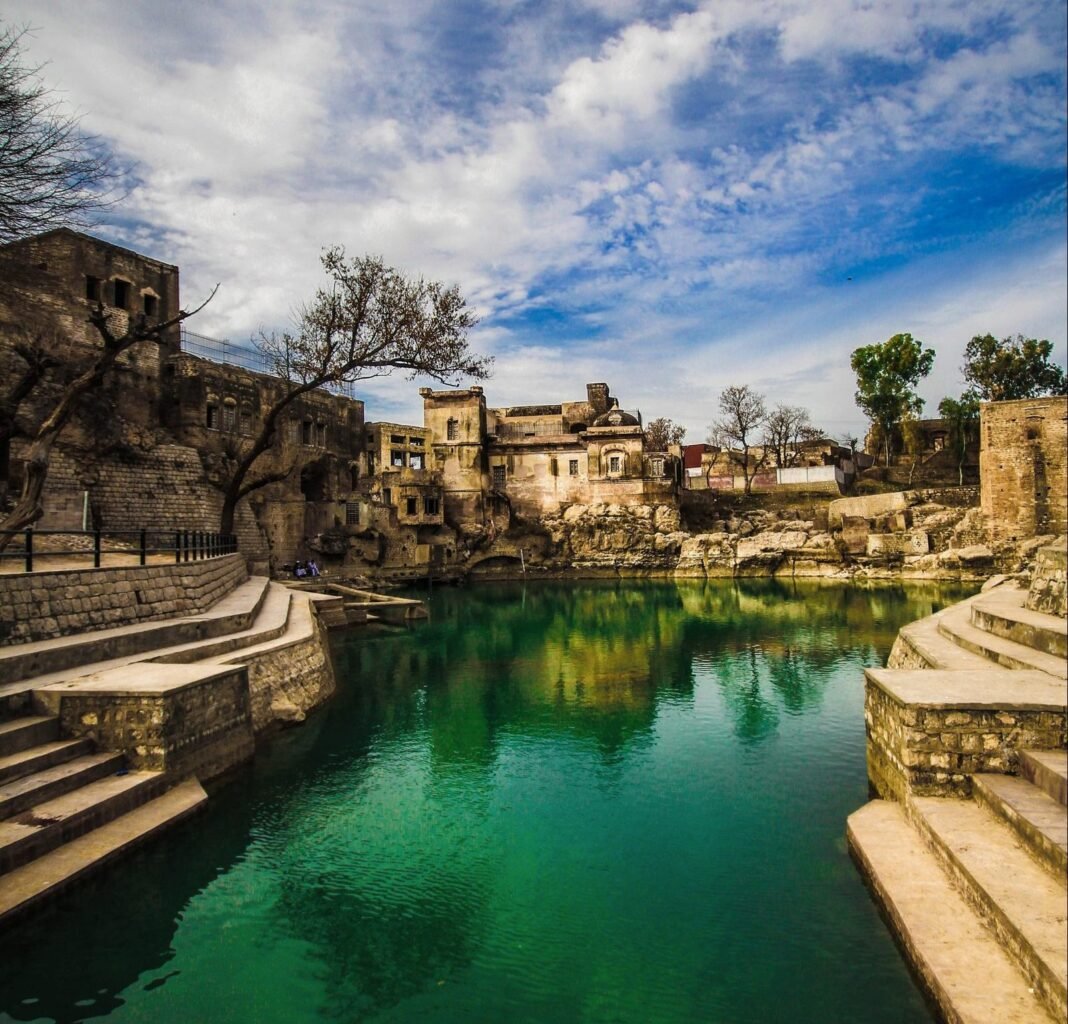
There are places you visit for scenery, and places you visit for the weight of time they carry. Katas Raj is the second kind. Set in a fold of the Salt Range in Punjab, this cluster of ancient temples gathers around a still, green-blue pond that Hindu tradition says was born from the tears of Lord Shiva as he mourned his wife Sati. Stand on its banks at sunrise, when the mist lifts off the water and the old stone temples turn gold, and you understand why pilgrims have come here for more than a thousand years.
What makes Katas Raj special is that it is not a single monument but a whole layered history in one place. Buddhist stupas, Hindu temples from the Hindu Shahi era, a Sikh-period haveli, and even British-era buildings stand within walking distance of each other. Nowhere else in Pakistan tells the story of the region’s layered past so compactly. For a traveler interested in heritage, this is one of the most rewarding half-day explorations in the country.
This katas raj temples travel guide is for the curious: the history enthusiast who wants dates and dynasties, the photographer chasing reflections in the sacred pond, and the family looking for a day trip from Islamabad or Lahore that is genuinely different from the usual hill-station run. October to March is the sweet spot, when the Salt Range air is crisp and the light is kind.
You do not need to be Hindu to feel what this place is about. You only need to walk the old pathways between the temples, look at carvings that have survived fifteen centuries of sun and rain, and let the quiet of the pond do the rest. Katas Raj rewards slow looking, and this guide will help you plan exactly that kind of visit.
History of Katas Raj Temples
The story of Katas Raj begins in legend and continues in stone. According to Hindu mythology, the sacred pond formed from the tears of Lord Shiva after the death of his consort Sati. The name itself comes from the Sanskrit word kataksha, meaning “tearful eyes.” Tradition holds that the two teardrops of Shiva created two ponds: one at Katas and another at Pushkar in Ajmer, India. The Mahabharata connects the site with the Pandava brothers, who are believed to have spent part of their exile in this region, and the complex is also associated with stories from the Puranas.
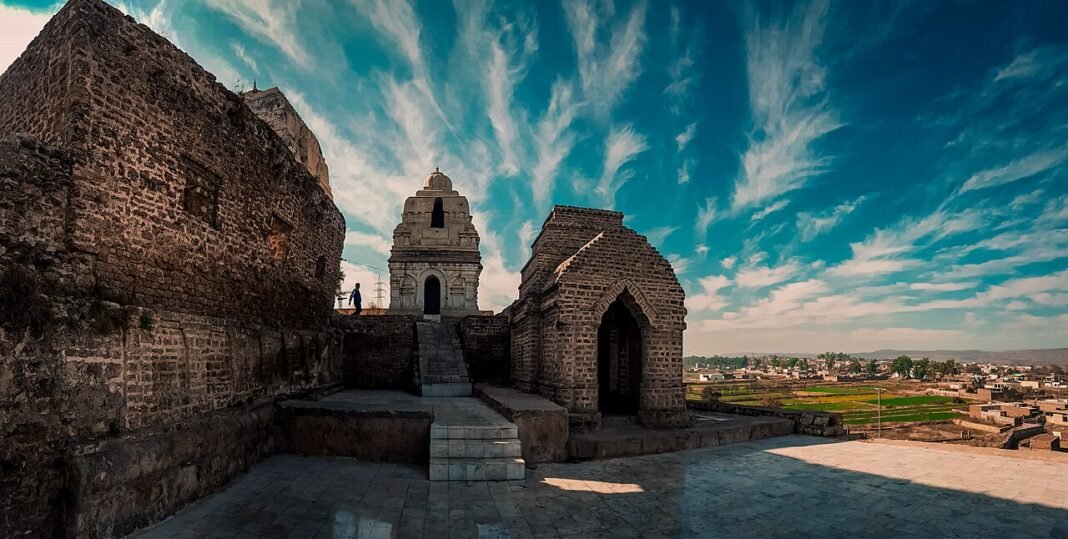
The built history starts in the 6th century CE, which is the date of the oldest surviving temple at the site. The main group of temples belongs to the Hindu Shahi period, roughly 615 to 950 CE, when Hindu Shahi kings ruled the region between the Indus and the Kabul valley. The architecture shows the evolution of temple design in the northwestern subcontinent, with elements drawn from Gandharan, Gupta, and early medieval North Indian styles. The Satghara group of temples, standing a little apart from the main pond complex, shows Kashmiri architectural influence and is traditionally linked to the Pandavas’ stay.
The site’s significance did not end with the Hindu Shahis. The region later passed through the hands of the Ghaznavids, the Ghurids, the Delhi Sultanate, the Mughals, and the Sikh Empire. Maharaja Ranjit Singh is said to have held the site in reverence, and the haveli of his famous general Hari Singh Nalwa still stands within the complex. The 19th century brought British archaeologists, including Sir Alexander Cunningham, who documented the temples and traced the name Katas back to the Sanskrit kataksha.
After the partition of the subcontinent in 1947, Katas Raj fell quiet, and Hindu pilgrims from India were only permitted to visit from 1982 onward, in small organized groups. A major restoration program between 2006 and 2017, overseen by the Evacuee Trust Property Board and Pakistan’s archaeology authorities, stabilized the structures and restored the sacred pond. The site has been reported as placed on UNESCO’s tentative list for World Heritage status. Today it receives both pilgrims, especially around Maha Shivaratri, and a growing number of Pakistani heritage travelers.
Top Things to Do in Katas Raj Temples
The Sacred Pond
The pond is the spiritual heart of the complex and the first thing you should walk to. It is a natural spring-fed pool, and local belief holds that bathing in it washes away sins. Even if you do not bathe, sitting on its steps and watching the temples reflected in the water is the defining Katas Raj experience. Visit early in the morning for the calmest water and the best photographs.
The Main Shiva Temple
The principal temple, dedicated to Lord Shiva, rises on a quadrangular platform with the distinctive corbelled dome and carved stonework of the Hindu Shahi style. Look closely at the lintels and pillar rows for carved scenes and geometric patterns that have survived more than a millennium. The elevation of the sub-shrines forms a stepped series of cornices that is characteristic of the site.
Ramachandra and Hanuman Temples
Alongside the Shiva shrine, the complex includes temples dedicated to Ramachandra and Hanuman, reflecting the site’s long association with the epics of the Ramayana and Mahabharata. These smaller shrines reward close looking: the stonework and proportions show how temple architecture developed across the centuries of the complex’s active life.
The Satghara Group
A short distance from the main pond stands the Satghara group, seven temples in the Kashmiri style traditionally associated with the Pandava brothers’ exile. The setting is quieter than the main complex, and the walk there passes through the scrub and rock of the Salt Range, giving you a sense of the landscape that shaped this sacred geography.
The Buddhist Stupa and Ancient Layers
Do not miss the remains of the Buddhist-era stupa within the complex. Katas Raj preserves an unbroken line of building from the Buddhist period through the British era, and the stupa is your reminder that this hill was sacred long before the Hindu Shahi temples rose. It is a rare place where you can read fifteen centuries of religious history in a single afternoon.
Hari Singh Nalwa’s Haveli and Later Buildings
The mansion of Hari Singh Nalwa, the Sikh Empire’s celebrated general, stands as a reminder of the site’s 19th-century chapter. Nearby are later structures including an old library building and a British-period police post. Together they complete the picture of Katas Raj as a place that every era of Punjab’s history touched in some way.
Photography and Quiet Corners
The complex is a photographer’s delight: temple reflections in the pond, carved doorways, the contrast of red sandstone against the pale Salt Range hills. The best light is within an hour of sunrise or before sunset. Beyond the main path, the caves traditionally used by sadhus and the old tunnel passages offer quieter corners for those who like to explore slowly.
Famous Places In and Around Katas Raj Temples
- Kallar Kahar — the nearest town, famous for its salt-water lake and peacock sanctuary, an easy combined stop. (Kallar Kahar Lake travel guide)
- Tilla Jogian — the historic hill complex associated with Guru Nanak, roughly 100 km by road from Katas Raj, another major pilgrimage landscape. (Tilla Jogian travel guide)
- Choa Saidanshah — the small Salt Range town that is the gateway to the temples, with local bazaars and eateries.
- Nandana Fort and Malot Fort — historic Salt Range forts within reach for travelers combining heritage stops.
How to Reach Katas Raj Temples
Reaching Katas Raj is straightforward and makes for one of the easiest heritage day trips in Punjab. The temples sit just off the M2 Lahore–Islamabad motorway, reached via the Kallar Kahar interchange, after which a district road climbs into the Salt Range toward Choa Saidanshah.
From Islamabad: approximately 140–160 km by road, about 2.5 to 3.5 hours. Take the M2 toward Lahore, exit at the Kallar Kahar interchange, and follow the road to Choa Saidanshah; the complex is signposted from the town.
From Lahore: approximately 250–260 km, about 5 to 6 hours. Take the M2 toward Islamabad and exit at Kallar Kahar, then follow the same Salt Range road.
From Karachi: the practical route is to fly to Islamabad and drive from there. The road journey from Karachi is well over 1,400 km and not sensible for a weekend trip.
Nearest airport: Islamabad International Airport, from where the temples are a half-day drive. Public transport options are limited for the final stretch, so most visitors come in a private car, a hired car with driver, or with an organized tour. The Salt Range roads are paved but narrow in places, so plan to travel in daylight.
Route Details
- From Islamabad or Lahore, join the M2 motorway and drive to the Kallar Kahar interchange.
- Exit the motorway and take the road toward Choa Saidanshah; the route climbs through the Salt Range with views over the hills.
- Follow signboards for Katas Raj from Choa Saidanshah; the temple complex has a designated parking area near the entrance.
- Allow 2–3 hours on site to see the pond, the main temples, the Satghara group, and the later-period buildings at a comfortable pace.
Where to Stay in Katas Raj Temples
Most visitors see Katas Raj as a day trip and sleep in Islamabad or Lahore, but if you want to linger, the area around Kallar Kahar has the nearest cluster of hotels, motels, and rest houses, ranging from comfortable mid-range options to simpler roadside lodgings. Chakwal city, about 40 km away, has additional budget hotels and guesthouses.
For a heritage-focused trip, staying overnight at Kallar Kahar works well: you can visit Katas Raj in the soft morning light, return for the lake and peacock sanctuary in the afternoon, and be back on the motorway the next day. Book ahead on winter weekends and public holidays, when the Salt Range towns fill with day-trippers. Camping is not established at the temple site itself, which is a protected heritage complex, so plan on proper accommodation nearby.
Where to Eat: Local Foods of Katas Raj Temples
The food around Katas Raj is hearty Punjabi fare, and the dhabas along the Salt Range roads do it well. Expect saag with makai di roti in winter, daal fry, chicken karahi, and fresh tandoori rotis, with desi ghee featuring generously in the local cooking. The eateries at Kallar Kahar and Choa Saidanshah serve simple, budget-friendly meals that suit a day trip perfectly.
Chakwal district is famous for its peanuts, and roadside vendors sell roasted mong phali through the winter months, a classic Salt Range snack for the drive. Carry water and snacks for the temple visit itself, as there are limited food options inside the complex. A typical dhaba meal in the area is easy on the wallet, and the motorway rest areas on the M2 offer familiar fast-food alternatives on the way back.
Weather in Katas Raj Temples
The Salt Range climate shapes the visit: summers are hot and dry, winters are cool and clear, and the shoulder months are pleasant. The best time to visit Katas Raj is from October to March, when walking between the temples is comfortable and the light is at its best.
| Season | Temperature Range | Conditions |
|---|---|---|
| Winter (Dec–Feb) | Approximately 5–18°C | Cool, clear days; cold mornings and evenings; best walking weather |
| Spring (Mar–Apr) | Approximately 15–28°C | Pleasant and green after winter rains; good for photography |
| Summer (May–Aug) | Approximately 30–42°C | Hot and dry; visit very early morning if you must come in summer |
| Autumn (Sep–Nov) | Approximately 18–32°C | Cooling down; October onward is ideal for exploring |
Language and Culture of Katas Raj Temples
Punjabi, in its Pothohari dialect, is the language of the surrounding villages, while Urdu is understood everywhere and English works at hotels and with guides. The local culture is that of rural Punjab: conservative, hospitable, and deeply respectful of guests.
Because Katas Raj is an active religious site, dress and behave modestly. Cover your shoulders and knees, remove your shoes where required before entering shrines, and ask before photographing pilgrims or worshippers. During Maha Shivaratri and other pilgrimage days, the complex belongs first to the devotees; visitors are welcome but should keep a respectful distance from rituals. A quiet, unhurried manner is the right way to experience this place.
Shopping in Katas Raj Temples
There is no dedicated souvenir market at the temples, but the Salt Range towns offer honest local shopping. Chakwal city’s bazaars sell everyday Punjabi goods, and in winter the roasted peanuts of the district make a perfect edible souvenir. You will also find salt-lamp and rock-salt handicrafts in the Salt Range towns, a nod to the region’s famous salt deposits.
For a wider selection, the motorway service areas and the shops at Kallar Kahar stock snacks, dry fruits, and basic travel supplies. Do not expect malls or branded outlets here; the shopping is small-town and authentic, which suits the spirit of the trip.
Local Events and Festivals
The most significant event at Katas Raj is Maha Shivaratri, the great night of Lord Shiva, which falls in February or March each year. On this occasion the complex comes alive with Hindu pilgrims, special prayers, and ceremonies at the sacred pond, and it is the single best time to witness the site’s living religious tradition.
In addition, organized Hindu pilgrim groups visit at other times of the year, and these visits sometimes coincide with other Hindu festivals. If you plan to come during Maha Shivaratri, expect larger crowds and plan your transport and timing accordingly; the atmosphere is unforgettable, but it is a pilgrimage first and a sightseeing trip second.
Travel Tips for Katas Raj Temples
Packing Essentials
Bring comfortable walking shoes with good grip, since the pathways and old stone steps can be uneven. A hat, sunscreen, and water are essential outside the winter months. Carry a light jacket from November to February for the cool Salt Range mornings and evenings, and keep a power bank handy if you plan to photograph extensively.
Safety Tips
Katas Raj is a well-visited, managed heritage site and is safe for families and solo travelers alike. Stick to the marked pathways, supervise children near the pond, and avoid climbing on old structures. Travel the Salt Range roads in daylight, as the final stretches are narrow with limited lighting after dark.
Money & Connectivity
Carry cash for entry arrangements, parking, and small purchases; there are no card machines at the site itself. ATMs are available in Chakwal city and at motorway service areas. Mobile signals from the major networks generally work in the area, though coverage can dip in the deeper folds of the Salt Range.
Best Time to Visit Katas Raj Temples
October to March: The Ideal Season
This is the window most travelers should aim for. Days are mild, the air is clear, and walking the full complex, including the Satghara group, is genuinely pleasant. Maha Shivaratri in February or March adds a powerful cultural dimension if you do not mind crowds.
April and May: Warm but Workable
Spring brings green hillsides after the winter rains and good photographic light. By late May the heat builds, so start your visit early in the morning and plan to leave by midday.
June to September: The Hot Months
Summer in the Salt Range is harsh, and midday temple-hopping is uncomfortable. If this is your only option, arrive at opening time, carry plenty of water, and combine the visit with the cooler hours of the day.
Final Thoughts
Katas Raj is one of those rare places where myth, history, and landscape meet without any of them feeling staged. The pond that legend says holds Shiva’s tears, the temples that have watched fifteen centuries pass, the quiet of the Satghara hills — together they make an experience that stays with you long after the drive home.
For anyone exploring Pakistan’s heritage beyond the usual northern valleys, this is an essential stop. Come in the cool months, give it a slow morning, and let one of the oldest sacred landscapes in the country tell you its story. You will leave understanding why pilgrims have never stopped coming.
FAQs
Where is Katas Raj located?
Katas Raj is in Choa Saidanshah, Chakwal District, Punjab, in the Salt Range hills, reached via the Kallar Kahar interchange of the M2 motorway.
What is the best time to visit Katas Raj?
October to March offers the most comfortable weather. Maha Shivaratri, in February or March, is the most significant pilgrimage occasion.
How do I reach Katas Raj from Islamabad?
Drive the M2 toward Lahore, exit at Kallar Kahar, and follow the road to Choa Saidanshah. The trip is roughly 140–160 km and takes about 2.5 to 3.5 hours.
Is Katas Raj safe for families?
Yes. It is a managed heritage site visited by families, school groups, and pilgrims throughout the year.
How old are the Katas Raj temples?
The oldest structures date to the 6th century CE, with the main group built during the Hindu Shahi period (roughly 615–950 CE).
What is the story of the sacred pond?
Hindu tradition holds that the pond formed from the tears of Lord Shiva mourning his wife Sati; the name Katas derives from the Sanskrit kataksha, meaning “tearful eyes.”
Where can I stay near Katas Raj?
The nearest hotels and rest houses are around Kallar Kahar, with more options in Chakwal city about 40 km away. Most visitors come as a day trip from Islamabad or Lahore.
What local food should I try?
Hearty Punjabi dhaba food — saag with makai di roti in winter, daal, and karahi — plus Chakwal’s famous roasted peanuts from roadside vendors.
Explore more heritage destinations in our Explore Pakistan series, and pair this trip with the classic Malam Jabba travel guide for a contrasting mountain escape.