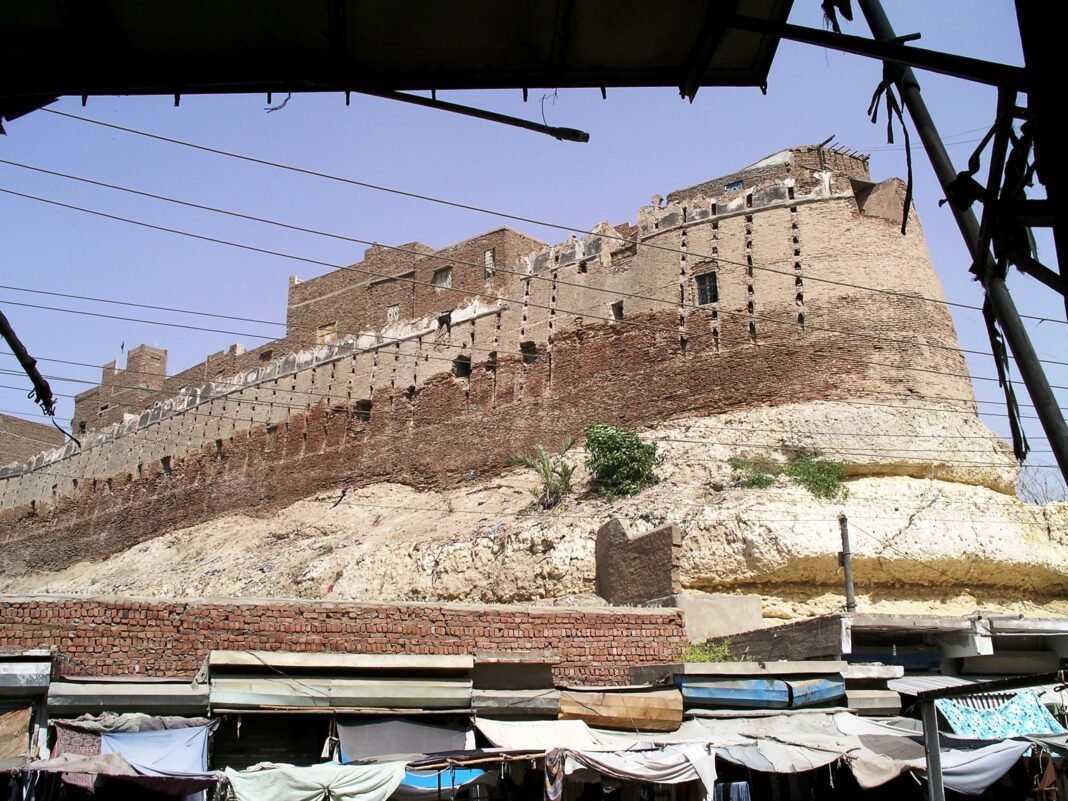
In the middle of Hyderabad, Sindh, a great red wall rises out of the bazaars and traffic — the boundary wall of the Pucca Fort (Pacco Qillo, the “Strong Fort”). Built in 1768 by Mian Ghulam Shah Kalhoro when he founded the city, the wall runs for over 2.25 kilometres around the old fortress, climbing 12 to 15 metres high in places. It is one of the most imposing pieces of 18th-century military architecture in Pakistan — and one of the most troubled, lived-in, and hauntingly alive heritage sites in the country. Thousands of people live inside the fort today, shops press against the wall outside, and the red brickwork carries the marks of Kalhoro kings, Talpur mirs, British cannon and Partition refugees. This boundary wall of pucca fort travel guide gives you the real history, how to see the wall, when to go, where to eat and stay in Hyderabad, and the honest practical advice this particular site demands.
Quick Facts
- Location: Hyderabad, Sindh — the wall rings the Pucca Qila on the Ganjo Takkar hillock, beginning close to the railway station and enclosing parts of the old city centre.
- Altitude: Hyderabad is a low-lying plains city on the east bank of the Indus; the fort stands on a low rocky plateau a few metres above the surrounding city.
- Famous For: The massive 18th-century burnt-brick boundary wall (over 2.25 km around, 12–15 m high); the best surviving monument of the Kalhoro dynasty; a living fort inhabited since Partition.
- Nearest City: Hyderabad itself; Karachi is about 165 km to the south-west.
- Accessibility: Easy to reach by road and rail — Hyderabad is on the main Karachi–Peshawar railway line and the M-9 motorway; the wall is visible from the station area.
- Known Landmarks: The fort’s gates (the main gate collapsed in September 2021), the Qila grounds, the nearby Shahi Bazaar, the tombs of the Talpur Mirs.
- Best For: Heritage travellers, photographers, and visitors interested in Sindh’s Kalhoro and Talpur history — with realistic expectations about the site’s condition.
Why Visit Boundary Wall of Pucca Fort
You should visit the boundary wall of Pucca Fort for one reason above all: scale. Stand on the street near the railway station and look up at 12 to 15 metres of 18th-century burnt brick running away in both directions, and you understand instantly why the Kalhoros chose this hillock for their capital. Few city walls in Pakistan survive at this height and length, and the Pucca Fort’s red wall is the single most dramatic thing the Kalhoro dynasty left behind.
The second reason is the story. This wall has lived through every chapter of modern Sindh: the Kalhoro kings who built it, the Talpur mirs who made it their court, the British who stormed Sindh in 1843 and later razed much of the fort, and the Partition refugees who moved into its cellars and courtyards in 1947 and never left. Walking its perimeter is a walk through 250 years of the province’s history, compressed into a couple of kilometres.
The third reason is the old city it encloses. The wall wraps around a slice of Hyderabad’s historic centre — the Naya Pul area, Qadam Gah, the Nau-Gaz Qabar and the shrine of Sakhi Wahab Shah — and just outside it lie the Shahi Bazaar and some of the oldest market streets in Sindh. A visit to the wall naturally becomes a walking tour of old Hyderabad: bangle sellers, ajrak shops, food stalls and shrines.
Honesty matters here more than at most heritage sites. The Pucca Fort is in poor condition. Its walls are crumbling in places, the main gate collapsed during botched restoration work in September 2021, and the interior is a dense residential neighbourhood, not a manicured monument. Come expecting a living, complicated place rather than a polished tourist attraction, go in daylight with a local guide, and you will see something few polished forts can offer: history that people still live inside. For more Sindh heritage ideas, browse our Explore Pakistan collection.
History of Boundary Wall of Pucca Fort
The story begins with the Kalhoros. The Kalhoro tribe had ruled parts of Sindh from their capital at Khudabad, but Mian Ghulam Shah Kalhoro decided to abandon Khudabad — possibly because the Indus was shifting away from it — and build a new capital. He chose a rocky plateau at a place called Ganjo Takkar (also called Ganji), overlooking the Indus, and there around 1768 he ordered the construction of a new fort of burnt brick — a pucca qila, a “strong fort” — and named the new city Hyderabad, after Hazrat Ali, the fourth caliph, who is also called Hyder.
The fort was designed as both residence and power centre: the ruler could watch his city from the hilltop, and the massive outer wall — ranging from over 12 to 15 metres high with a circumference of more than 2.25 kilometres, pierced by two gates on the north — made it one of the most formidable strongholds in Sindh. The wall’s strength was multiplied by the site itself: it stands on the southern end of a plateau some 3.25 kilometres long, its outer face reinforced by the perpendicular drop of the rock.
Kalhoro rule did not last long. In 1783 the Talpurs overthrew the Kalhoros, and in 1789 Mir Fateh Ali Khan moved the Talpur capital from Khudabad to Hyderabad. He made the Pucca Fort his residence and the seat of his court, adding a harem and other buildings for the ruling family and commissioning mosques so the residents could fulfil their religious obligations. Under the Talpurs the fort was the political heart of Sindh, surrounded by the working-class homes of the city.
The British chapter began with conquest. After defeating the Talpur mirs at the Battle of Miani in 1843, Charles Napier’s forces occupied the fort. Blasts set off in the fort destroyed much of its architecture and the surrounding houses, and in 1857 the British razed what remained of the edifice to make room for military installations and stores. The great boundary wall survived — too massive to be worth demolishing — and became the fort’s defining relic.
Partition gave the fort its strangest chapter. In 1947, refugees arriving from India were housed temporarily in the fort’s open spaces and courtyards. The temporary arrangement became permanent: with nowhere else to go, families moved into the cellars of the fort walls and built homes inside the fortress. Decades later, thousands of people still live within the walls, and their houses, shops, kitchens and workshops are now woven into the historic fabric — the main reason the monument is both alive and crumbling.
Conservation has been a long failure. Survey after survey has found houses and structures inside the fort dangerous; monsoon rains damage the wall every year; and in September 2021 the fort’s main gate collapsed during restoration work that the district administration later condemned as unprofessional — carried out by untrained labourers, without archaeologists on site. The wall still stands, but heritage experts warn that portions collapse regularly. Visit it with respect, and from a safe distance where the masonry looks unstable.
Top Things to Do in Boundary Wall of Pucca Fort
Walk the Outer Perimeter
The essential experience is the circuit of the great red wall. Begin near the railway station, where the wall first catches the eye, and follow it around the old city centre. The full circumference is over 2.25 km — a walk of 30–45 minutes at an easy pace, not counting stops. Look for the changes in the brickwork that mark repairs, collapses and rebuilding across two and a half centuries. Go in the morning, when the light is soft and the bazaars are opening.
See the Fort Gates
The fort historically had two gates on its northern side. The main gate — which collapsed in September 2021 during the failed restoration — remains a sobering sight and a talking point about heritage management in Pakistan. View the gate area from the street; do not climb on damaged masonry.
Visit the Qila Grounds
Inside the walls, the open Qila grounds have been a place of political significance for generations — public meetings and rallies have been held here to this day, addressed over the decades by national political figures. The grounds give you a sense of the fort as a living civic space rather than a dead monument.
Explore Shahi Bazaar and Faqeer Ka Pir
Just outside the wall lie some of Hyderabad’s oldest markets. The Shahi Bazaar and the Faqeer Ka Pir area are where the city has shopped for centuries — bangles, ajrak, spices and everyday goods spilling across narrow lanes. Combine the wall walk with an hour in these bazaars for the full old-Hyderabad experience.
Visit the Tombs of the Talpur Mirs
A short ride from the fort, the mausoleums of the Talpur rulers — who made this fort their court after 1789 — complete the story the wall begins. The tiled tombs are among the finest funerary architecture in Sindh and pair naturally with a Pucca Fort visit.
Famous Places In and Around Boundary Wall of Pucca Fort
The Pucca Qila gates and Qila grounds; Shahi Bazaar and Resham Gali; the tombs of the Talpur Mirs; Mukhi House museum; Rani Bagh; the shrine of Sakhi Wahab Shah; Qadam Gah and Nau-Gaz Qabar; Neroon Kot (old Hyderabad); the Kotri barrage and the Indus riverbank.
How to Reach Boundary Wall of Pucca Fort
Hyderabad is one of the best-connected cities in Sindh, sitting on the main north–south corridor. The fort wall begins close to the railway station, so rail travellers practically arrive at it.
- From Karachi: Around 165 km, roughly 2.5–3 hours by car via the M-9 motorway (Superhighway). Buses, vans and coasters run constantly between the two cities, and trains on the main line stop at Hyderabad.
- From Lahore: Around 1,050 km — a long day’s drive via the motorway network through Multan and Sukkur, or a short flight to Karachi or Hyderabad’s nearest airports followed by road. Most travellers break the journey or fly.
- From Islamabad: Around 1,200 km by road; flying to Karachi and driving up to Hyderabad (2.5–3 hours) is the practical option.
- Nearest airport: Karachi’s Jinnah International Airport (about 165 km); Hyderabad’s own airport has limited operations, so Karachi is the reliable gateway.
- Road conditions: The M-9 to Hyderabad is a good motorway all year. City streets around the fort and station are congested — take a rickshaw for the last stretch.
- Transport options: Trains (Hyderabad is a major station on the Karachi–Peshawar main line); Daewoo and other intercity buses; Careem/inDrive and auto-rickshaws within the city. Any driver will know “Pucca Qila” or “Pacco Qillo”.
Route Details
Arriving by train, you step out of Hyderabad station almost in the shadow of the wall — walk out of the station area towards the old city and the red brickwork appears within minutes. By road from Karachi, take the M-9 to Hyderabad, enter the city and head for the station/old-city area; ask for Pucca Qila. The best approach is on foot: park or get dropped near the station, walk the wall’s outer perimeter through the bazaar streets, then cut into the Shahi Bazaar. Allow half a day for the wall, the bazaars and the Talpur tombs. Hire a local guide at the site if you want to enter the fort’s inner areas — the interior is a residential neighbourhood, and a guide keeps you on the right paths and out of private homes.
Where to Stay in Boundary Wall of Pucca Fort
There is no accommodation inside the fort — and you would not want any; it is a dense residential area, not a hotel zone. Hyderabad’s hotels cluster in the city centre, near the railway station, and along the main roads of the newer city. Mid-range hotels with air conditioning, Wi-Fi and restaurants are the comfortable choice for most visitors; budget guesthouses near the station are cheaper and put you within walking distance of the wall.
For a heritage trip, staying near the station or in the city centre works best — the wall, the bazaars and the Talpur tombs are all within a short rickshaw ride. Hyderabad is also an easy day trip from Karachi (2.5–3 hours each way), so some travellers base themselves in Karachi and visit the fort as a day excursion. Book ahead during wedding season and public holidays.
Where to Eat: Local Foods of Boundary Wall of Pucca Fort
Hyderabad’s food is classic Sindhi, and the streets around the fort are a good place to eat it. The city’s most famous dish is pallo machhi — the hilsa fish of the Indus, rich, bony and beloved, best in the monsoon season when the fish run. Grilled and fried fish shops around the city do it justice. For sweets, Hyderabad is known for its rabri — thickened, caramelised milk served chilled — sold in the old bazaars.
Everyday Sindhi food is hearty: Sindhi biryani with its sharp masala and potatoes, sai bhaji (a slow-cooked mix of spinach, lentils and vegetables), dal pakwan for breakfast, and fresh tandoori naan from the clay ovens on every street. The food streets near the station and in the old city serve all of this at budget-friendly prices; a full local meal costs little by big-city standards. Drink bottled water, eat at busy stalls, and finish with rabri — it is the taste Hyderabad is proudest of.
Weather in Boundary Wall of Pucca Fort
Hyderabad is hot for most of the year, with a long summer and a short, mild winter. The monsoon reaches Sindh in July and August, bringing humid heat and the heavy downpours that damage the fort’s walls a little more each year. Winter is the comfortable season and the right time for walking the wall’s 2.25 km perimeter.
| Season | Temperature Range | Conditions |
|---|---|---|
| Winter (Dec–Feb) | Around 8°C to 25°C | Mild, dry and sunny. The best season for the wall walk and the bazaars; a light jacket for evenings. |
| Spring (Mar–Apr) | Around 18°C to 38°C | Heating up fast; March is still workable, April turns hot. |
| Summer (May–Jul) | Around 28°C to 42°C | Intensely hot; sightseeing on foot is punishing at midday. Pallo fish season begins with the monsoon. |
| Autumn (Sep–Nov) | Around 18°C to 38°C | Cooling through October; November is pleasant — a good second window for heritage visits. |
Language and Culture of Boundary Wall of Pucca Fort
Sindhi is the language of Hyderabad’s old city — you will hear it in the bazaars, at the shrines and in every shop around the fort. Urdu is universally understood, and English works in hotels and with educated guides. Learning a greeting or two in Sindhi earns immediate warmth.
The culture around the fort is Sindhi and Sufi to the core: the ajrak (the block-printed shawl) and the embroidered Sindhi topi are worn with pride, Sufi shrines anchor neighbourhood life, and hospitality to guests is a point of honour. The fort’s own community — the families who have lived inside since Partition — have their own distinct neighbourhood culture layered over the monument. Visitors should dress modestly, ask before photographing residents (this is people’s home, not a museum), remove shoes at shrines, and accept tea when offered. If you hire a local guide, you will also get the oral history of the fort — stories no plaque will ever tell you.
Shopping in Boundary Wall of Pucca Fort
The bazaars around the fort are among the best places in Sindh to buy traditional crafts. Shahi Bazaar and Resham Gali are the famous market streets — start here. Hyderabad is renowned across Pakistan for its glass bangles; the choori (bangle) sellers of the old city offer dazzling variety at very reasonable prices. Ajrak shawls in deep indigo and crimson, Sindhi embroidered caps, and rilli patchwork quilts are the classic Sindhi textiles to take home.
Spice shops, dried fruit sellers and sweet shops (stock up on rabri and local mithai) fill the lanes near the station. Bargaining is expected — offer below the asking price and negotiate with a smile. Check bangles and textiles for quality before paying, and keep the shopping to daylight hours when the bazaars are at their liveliest. There are modern markets and shopping areas in the newer parts of Hyderabad for everyday goods, but for authentic Sindhi crafts, the old city around the wall is unmatched.
Travel Tips for Boundary Wall of Pucca Fort
Packing Essentials
Light cotton clothes for most of the year; a light jacket for December–January evenings. Comfortable closed walking shoes — the streets around the fort are uneven and dusty. Sunscreen, sunglasses and a cap; the Sindh sun is strong even in winter. A scarf is useful for shrine visits and for dust.
Safety Tips
Visit in daylight and preferably with a local guide — the fort interior is a residential area, and a guide helps you navigate respectfully. Do not climb on or lean against damaged sections of the wall; portions have collapsed in the past, and the masonry is fragile. Keep valuables discreet in the crowded bazaars, agree rickshaw fares in advance or use a ride-hailing app, and drink bottled water. Women travellers should dress modestly; the old city is conservative but welcoming.
Money & Connectivity
Cash in rupees is essential — the bazaars, rickshaws and food stalls around the fort are cash-only. ATMs are plentiful near the station and in the commercial areas; withdraw before your walk. All major networks (Jazz, Zong, Telenor, Ufone) cover Hyderabad well with 4G; hotels and cafes offer Wi-Fi.
Best Time to Visit Boundary Wall of Pucca Fort
Winter (December to February) — Best
Mild, dry and sunny — ideal for the 2.25 km wall walk, the bazaars and the Talpur tombs. This is the season to plan your trip around.
Spring (March) — Good
Still pleasant in March before the heat builds. A fine shoulder season with fewer visitors.
Summer (April to August) — Avoid
Hyderabad’s summer is brutal, and walking the exposed wall perimeter at midday is miserable. If you come, go at dawn and retreat to air conditioning by late morning.
Autumn (October to November) — Good
The heat fades and November turns genuinely pleasant — a strong second choice for the heritage circuit.
Final Thoughts
The boundary wall of Pucca Fort is not a monument you admire from behind a rope. It is a wall that a city grew into — that kings built, armies broke, refugees moved into, and shopkeepers lean their stalls against. Its red bricks hold the whole compressed history of Hyderabad: Kalhoro ambition in 1768, Talpur courts, British conquest, Partition’s upheaval, and the slow, sad story of heritage neglected. No restored fort in Pakistan will teach you as much about how history actually survives.
Come in winter, walk the full perimeter in the morning light, eat pallo and rabri in the old city, and finish at the Talpur tombs. Go with a guide, keep your expectations honest, and treat the residents with the respect owed to people who live inside history. For the rest of Sindh’s stories, our places to visit in Islamabad guide shows a different side of the country — but Hyderabad’s red wall will stay with you longer than most polished attractions manage.
FAQs
Where is the boundary wall of Pucca Fort?
In Hyderabad, Sindh — the great red wall rings the Pucca Qila (Pacco Qillo) on the Ganjo Takkar hillock, beginning close to the railway station and enclosing part of the old city centre. The wall runs for over 2.25 km.
Who built the Pucca Fort and when?
Mian Ghulam Shah Kalhoro built it around 1768, when he founded Hyderabad as his new capital after abandoning Khudabad. The Talpur mirs later made it their court (1789), and the British occupied it after the Battle of Miani in 1843.
What is the best time to visit?
December to February — mild, dry and sunny, perfect for walking the wall’s perimeter. Avoid the extreme heat of April to August.
How do I reach the Pucca Fort?
Hyderabad is about 165 km (2.5–3 hours) from Karachi via the M-9 motorway, and a major station on the Karachi–Peshawar railway line — the wall begins near the station. From Lahore it is around 1,050 km; most visitors fly to Karachi and drive up.
Is it safe to visit?
Yes, in daylight and preferably with a local guide. The fort interior is a residential neighbourhood — be respectful, don’t climb damaged masonry (sections have collapsed), and keep valuables discreet in the bazaars.
Can you go inside the fort?
The interior is inhabited by thousands of residents, not set up as a tourist site. Go with a local guide who knows the neighbourhood; stick to the outer wall walk and the Qila grounds unless guided.
What food should I try in Hyderabad?
Pallo machhi (Indus hilsa fish, best in monsoon season), rabri, Sindhi biryani, sai bhaji, and breakfast dal pakwan in the old-city food streets.
What can I buy near the fort?
Hyderabad’s famous glass bangles, ajrak shawls, Sindhi embroidered caps, rilli quilts, spices and sweets in Shahi Bazaar and Resham Gali — all within walking distance of the wall.