



New Desert Lizard Found in Chagai Sands
Researchers have identified a previously unknown desert lizard in western Pakistan, and the find gives Balochistan a new species named after its home district. The Chagai desert lizard, named Eremias chagaiensis, was documented on low sand dunes in Chagai District, near the borders with Afghanistan and Iran.
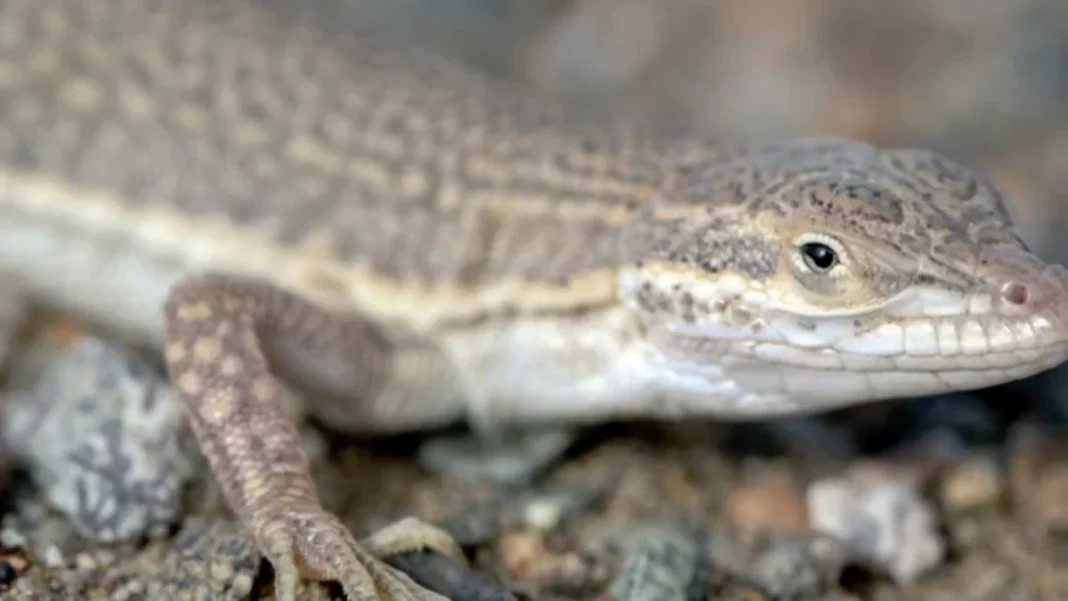
The species is a racerunner, a fast-moving desert lizard. Its most striking feature is a network of winding brown markings across its back. The pattern looks like a maze, and it sets the animal apart from related racerunners, which usually carry lengthwise stripes.
What researchers found
Field surveys between 2022 and 2025 recorded the new lizard at four localities. Its body reaches 5.7 centimetres in length, excluding a tail that can be more than twice as long. The maze-like pattern appears in both juveniles and adults, so it is not a trait that fades with age.
The research team was led by Rafaqat Masroor of the Pakistan Museum of Natural History. Daniel Jablonski of Comenius University in Bratislava and the Natural History Museum Vienna also took part in the study.
“Balochistan’s deserts are among the least explored places in South Asia. Finding a new lizard here tells us how much is still undocumented,” Masroor said.
How the Chagai desert lizard was identified
Looks alone did not settle the question. The new species closely resembles Eremias graphica, a species described from Iran in 2023. The team therefore tested two mitochondrial genes and one nuclear gene, and it compared body proportions and scale characters.
Those tests supported the lizard as a distinct evolutionary lineage. In the mitochondrial analyses, Eremias fasciata, a striped species from the same wider area, emerged as its closest relative. The two species differ by about 10.6 per cent in the mitochondrial genes examined.
“At first glance this lizard looked like a species from Iran described in 2023,” Jablonski said. “Appearances can be deceptive. The sand doesn’t stop at the border. Surveys in Afghanistan are needed to learn how far this species really lives.”
The study also delivered a second result. It provides the first modern specimen- and DNA-based confirmation of Eremias fasciata in Pakistan, more than a century after its first alleged historical report. That finding closes a long gap in the record for the striped species.
Where the lizard lives
The new lizard was observed on loose sand, particularly low dunes and sandy patches near desert shrubs. It excavates burrows in that ground. It was not recorded on the neighbouring gravel plains, and those plains were occupied by Eremias fasciata instead.
That split in habitat matters for fieldwork. Two closely related species can live side by side yet use different ground, and the contrast helped confirm that they are distinct neighbours rather than one variable population.
Why the find matters for Pakistan
Balochistan has a long but uneven history of reptile research. Recent work in the north-west of the province has already revealed Eremias kakari and two further racerunners, Eremias rafiqi and Eremias killasaifullahi, found by Masroor and Jablonski over almost a decade of collaboration. The new species builds on that record, and it shows that the province’s deserts still hold undocumented life.
A named species also creates a baseline for conservation. Once a species has a known range and a described habitat, researchers can track whether that range shrinks or shifts.
Pakistan’s wildlife record has grown in other areas too. More than 500 dolphins were spotted off Gwadar in a single pod, as reported in 500-Plus Gwadar Dolphins Pod Spotted Off Coast. Snow leopards in Gilgit-Baltistan face a different set of pressures, covered in Snow Leopards Face Growing Threats in Gilgit-Baltistan. New species descriptions sit beside such sightings, and together they build a fuller picture of the country’s wildlife. The discovery of a tiger-sized new dinosaur from a century-old fossil, reported in Invictibellatrix Amberina: Tiger-Sized New Dinosaur Identified From 100-Year-Old Fossil, shows how old and new evidence both extend what science knows.
What happens next
The researchers say surveys in Afghanistan are needed to learn how far the species really lives, since the sand country crosses the border. Further fieldwork in Balochistan could also add localities and clarify the size of the population.
For now, the Chagai desert lizard stands as a reminder that Pakistan’s least explored ground can still produce firsts. A small lizard on a low dune has added a new name to the scientific record, and it has put Chagai District on the map.
Frequently asked questions
What is the new lizard called?
The species is named Eremias chagaiensis, after Chagai District in Balochistan, where it was documented.
What does the Chagai desert lizard look like?
It is a racerunner with a network of winding brown markings across its back, a maze-like pattern present in both juveniles and adults.
How big is the new species?
Its body reaches 5.7 centimetres in length, excluding a tail that can be more than twice as long.
How was it confirmed as a new species?
Researchers analysed two mitochondrial genes and one nuclear gene, and they compared body proportions and scale characters, after noting its close resemblance to Eremias graphica from Iran.
Where does the lizard live?
It lives on loose sand, low dunes and sandy patches near desert shrubs in Chagai District, where it excavates burrows, and it was not found on neighbouring gravel plains.