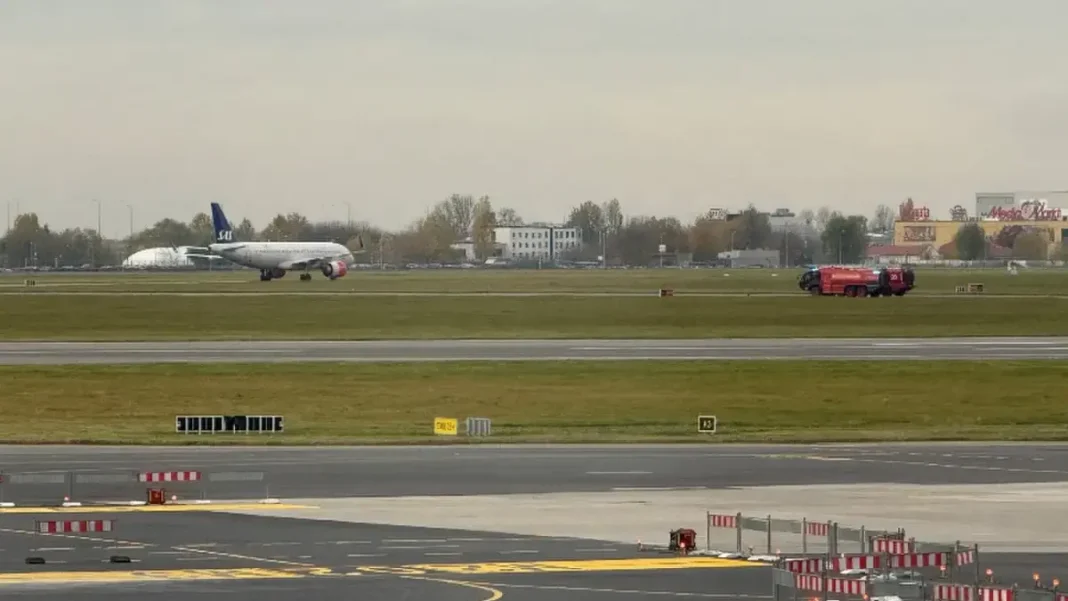
Hoax Bomb Threats Disrupt Four Europe Flights
Hoax bomb threats disrupted four Europe flights on Tuesday, forcing the temporary closure of one Warsaw airport and the diversion of another plane, but all four aircraft landed safely and no explosives were found. The incidents stretched from Copenhagen to Murcia, and they followed a similar scare the day before.
Two of the warnings targeted flights heading to the Polish capital, Warsaw. A third hit a flight to Spain, and a fourth led to checks on a plane after it landed in Bulgaria. In every case, the response was the same: full security checks, passengers moved off the plane, and a careful search before normal service resumed.
Two Warsaw-bound flights targeted
Scandinavian Airlines confirmed that a threat had been made against flight SK751, travelling from Copenhagen to Warsaw. The airline said the aircraft landed normally at Warsaw’s Chopin airport, and the passengers disembarked. One runway at Chopin was closed while the plane underwent a security inspection, but no explosives were found.
The second Warsaw-bound flight was operated by Polish airline LOT, travelling from London’s Heathrow airport. That plane was diverted to Warsaw Modlin, the capital’s other airport. Authorities then closed Modlin airport following the alert, but the Boeing 737 MAX also landed safely.
Modlin airport spokesman Adam Szablowski said the passengers were evacuated and the plane underwent security checks. He added that nothing was found, and the airport was reopened and operating normally. The diversion meant that two Warsaw airports were disrupted on the same day, by two separate threats, against two separate airlines.
Ryanair and Wizz Air flights also checked
In Spain, the airport operator Aena confirmed that an emergency protocol was activated because of a bomb alert on a Ryanair flight from Manchester, in north-west England, to Murcia in south-eastern Spain. The flight landed without incident in Murcia, and the emergency plan was deactivated after checks by Spain’s Civil Guard.
A Wizz Air flight from Bergamo, in Italy, was inspected after landing at 0910 GMT in Sofia, the capital of Bulgaria. A Bulgarian interior ministry spokesperson confirmed the inspection. No explosives were reported in either the Spanish or the Bulgarian case.
The four incidents shared a pattern. Each threat was treated as real until checks proved otherwise. Each plane was searched. Each airport involved accepted delays and disruption rather than taking a chance on a warning that later proved false.
Hoax bomb threats follow a second day of scares
Tuesday’s hoax bomb threats did not come out of nowhere. On Monday, fighter jets were scrambled when a Wizz Air flight from London’s Luton airport to Sofia was diverted following a bomb threat, and forced to make an emergency stop in Budapest.
Hungary’s defence minister, Romulusz Ruszin-Szendi, said on Facebook that NATO’s air defence alert service had issued an alert for that Monday flight. The involvement of fighter jets shows how far the response can go, even when the threat turns out to be false.
Taken together, the two days cover five flights, four airlines, and airports in Poland, Spain, Bulgaria, Hungary and Britain. A single hoax threat disrupts one flight. A run of threats across several countries in two days forces airlines, airports and air forces to respond again and again.
Why hoax threats still force a full response
Aviation security works on a simple rule: a threat cannot be dismissed as a hoax until it has been checked. That rule explains why a warning with no explosive behind it still closes a runway, evacuates a plane and scrambles jets. For passengers, the result is delay and worry, even when the outcome is safe. For airlines, it means diverted planes and schedules that take hours to repair.
Direct air links matter for Pakistani travellers too, and new routes are still being added, as reported in Pakistan, Spain Agree Direct Flights. Aviation safety incidents elsewhere also draw close attention, including the recent crash covered in Florida Learjet Crash Kills Six. The European scares are a reminder that security checks apply to every flight, on every route.
What happens next
No arrests or claims of responsibility were reported in the day’s coverage, and no explosives were found in any of the four Tuesday cases. Investigators in the countries involved will now try to trace where the threats came from, and whether the incidents across the two days are linked.
Airlines and airports are likely to keep the same full-response approach for any further warnings. Until the source of the threats is found, passengers on European routes should expect that a warning, even one that proves false, will still mean delays, diversions and checks.
Frequently asked questions
How many flights were hit by hoax bomb threats?
Four flights were targeted on Tuesday: two heading to Warsaw, one from Manchester to Murcia, and one from Bergamo to Sofia. A fifth flight, from Luton to Sofia, was diverted on Monday after a similar threat.
Did any plane find explosives on board?
No. In every case reported, security checks found nothing. All four Tuesday flights landed safely, and the Monday flight also landed safely after its diversion to Budapest.
Which airlines were involved?
Scandinavian Airlines, LOT, Ryanair and Wizz Air were involved across the Tuesday incidents. Wizz Air was also involved in the Monday diversion from Luton to Sofia.
Why was a Warsaw airport closed?
Warsaw Modlin airport was closed after the LOT flight from Heathrow was diverted there following a threat. The closure allowed security checks to take place. The airport reopened once nothing was found, and it is operating normally.
Were fighter jets involved?
Yes, on Monday. Fighter jets were scrambled when the Wizz Air flight from Luton to Sofia was diverted to Budapest. NATO’s air defence alert service had issued an alert for that flight, according to Hungary’s defence minister.