Some viewpoints show you a place. Chunda Valley shows you a whole city, two rivers, and the Karakoram all in one sweeping glance. Perched on a hillside roughly 500 metres above Skardu town in Gilgit-Baltistan, this quiet valley is the closest thing Skardu has to a balcony — a raised green terrace of orchards, stone-and-wood Balti houses, and meadows that looks straight down on the Indus and Shigar rivers meeting below. This Chunda Valley travel guide will help you decide if it deserves a place on your Skardu itinerary, and show you exactly how to reach it, when to go, and what to do once the road ends.
## Quick Facts
– **Location:** Skardu District, Gilgit-Baltistan, Pakistan — a hillside village above Skardu town, near the confluence of the Indus and Shigar rivers
– **Altitude:** around 2,500 metres (about 8,200 feet) above sea level, roughly 500 metres above Skardu city
– **Famous For:** spring blossom season (cherry and apricot orchards in full bloom), and panoramic aerial views of Skardu city, the airport runway, and surrounding Karakoram peaks
– **Nearest City:** Skardu — roughly 10 to 20 kilometres away depending on the route, about a 30 to 60 minute jeep ride
– **Accessibility:** rough, steep, mostly unpaved mountain track; a 4×4 jeep is strongly recommended; the last stretch to the viewpoint is often covered on foot
– **Known Landmarks:** Chunda village itself, the Chunda viewpoint (sometimes called the “Roof of Skardu”), terraced orchards and meadows
– **Best For:** photographers, couples, nature lovers, families on a Skardu trip, and anyone who wants big mountain views with a short travel time
## Why Visit Chunda Valley
Ask any Skardu regular for a short trip that punches far above its weight, and Chunda Valley comes up again and again. The reason is simple: in under an hour from Skardu’s main bazaar, you trade the dust and traffic of the town for cool air, green terraces, and a view that makes the whole Skardu valley lie at your feet like a map. The Indus snakes in from one side, the Shigar from the other, and the little planes landing at Skardu airport look like toys on a model runway. It is the kind of view you normally have to trek for days to earn — here you get it before lunch.
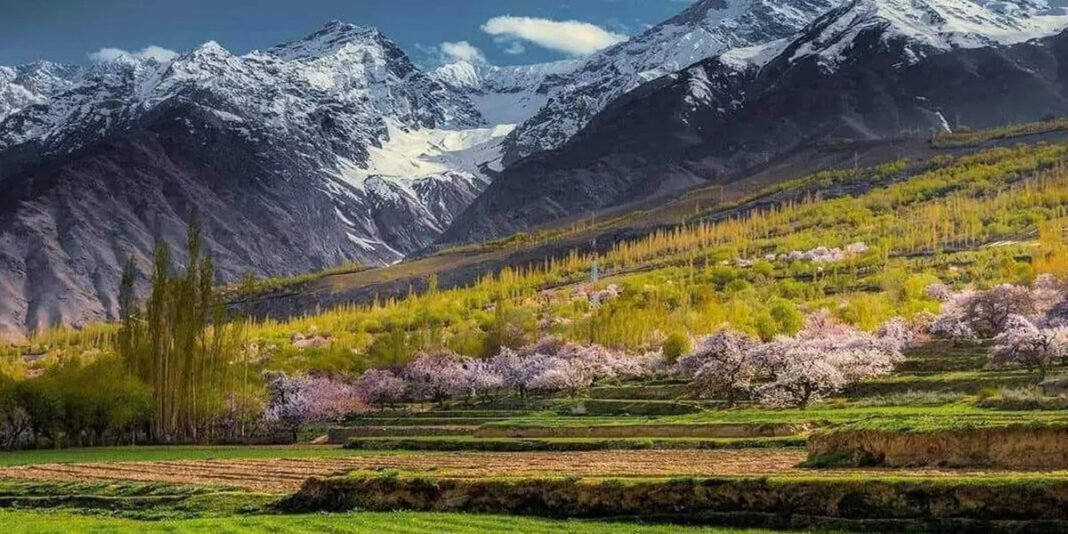
Chunda is also, quietly, one of the loveliest blossom spots in Baltistan. When late February turns into March and April, the valley’s apricot, cherry, apple, almond, and pear orchards burst into white and pink flower, and the whole hillside glows against the still-snowy Karakoram. Photographers plan entire Skardu trips around these few weeks, and Chunda rewards them with blossom foregrounds and mountain backdrops in every direction. If you have ever wanted to see a real cherry blossom season without leaving Pakistan, this is one of the best places to do it.
Then there is the valley’s gentler side. Unlike the big-ticket attractions around Skardu, Chunda is not commercial. There are no ticket counters, no rows of stalls, no crowds jostling for the same selfie. You walk through a working Balti village where life continues around you — women tending orchards, children on the lanes, old stone houses with timber frames — and you feel like a guest rather than a customer. That authenticity is getting harder to find in the north, and it is worth protecting with quiet, respectful visits.
Chunda Valley is perfect for travelers who have two or three days in Skardu and want one outing that is easy, beautiful, and different from the lake-and-fort circuit. It suits couples looking for a peaceful picnic spot, families who want mountain air without a hard trek, and photographers chasing blossom or golden-hour light. If your idea of a good trip includes sitting on a meadow edge with the whole valley below you, put Chunda on the list.
## History of Chunda Valley
Chunda Valley itself has no palace, no inscription, and no recorded founding date — its story is the story of the Balti villages that have clung to these hillsides for centuries, growing apricots and barley on terraces watered by glacial streams. The wider history around it, though, is deep. Skardu, the town below, was the seat of the Maqpon rulers of Baltistan, a small Himalayan kingdom that reached its height in the late 16th century under Ali Sher Khan Anchan, the ruler whose name still echoes through Baltistan’s forts and legends. The Balti people, of Tibetan descent, embraced Islam from the 15th and 16th centuries onward, and their villages — Chunda among them — became the quiet agricultural backbone of the kingdom: orchards, terraced fields, and stone houses built to survive harsh winters.
In 1840 the Dogras conquered Baltistan, folding it into the princely state of Jammu and Kashmir, and Skardu became a frontier garrison town. After 1947, the Gilgit Scouts’ liberation of the region brought Baltistan into Pakistan, and Skardu slowly grew from a remote garrison into the tourism hub it is today. For most of that time, Chunda remained what it had always been — a hillside farming village above the town, known mainly to locals.
Its discovery by travelers is recent. As Skardu’s tourism boomed in the 2010s and 4×4 jeeps became widely available for hire, local drivers and guides began taking visitors up the rough track to Chunda for the view, and the blossom photographs that followed did the rest. Travel writers started calling it the “Mini Switzerland of Skardu” and the “Roof of Skardu” — nicknames that are marketing, but not entirely unfair when the orchards are in flower. What matters more than the nicknames is that Chunda’s rise has been gentle: it is still a living village first and a viewpoint second, and visiting it respectfully helps keep it that way.
## Top Things to Do in Chunda Valley
### Soak in the Panoramic Viewpoint
The Chunda viewpoint is the headline act, and it earns it. From the edge of the raised valley you look down over the whole of Skardu — the bazaar, the airport runway with planes coming in low over the river, the Indus and Shigar rivers braiding silver through the valley floor, and the Karakoram wall rising beyond. Come in the late afternoon, when the light turns the city golden and the mountains go pink, and you will understand why photographers guard this spot. Bring a wide-angle lens if you have one; the panorama is too wide for a phone to do justice, though phones still capture the scale surprisingly well.
### Walk Through the Blossom Orchards
In blossom season (roughly late February to April, peaking around March), the orchards of Chunda are the main event. Cherry, apricot, almond, apple, and pear trees flower in waves of white and blush pink, each species with its own colour and scent. Walk the narrow lanes between the terraces slowly — the farmers are used to visitors in season, but ask before entering anyone’s orchard, and never pick fruit or break branches. A local guide from Skardu can point you to the densest groves and the best angles with the peaks behind.
### Explore Chunda Village on Foot
Leave the jeep at the village and wander. Chunda is a classic Balti settlement — stone-and-timber houses, flat roofs stacked with winter firewood, irrigation channels gurgling past doorways, and children who will wave before they ask your name. The walk from the village up to the main viewpoint takes about 30 minutes to an hour on foot and is part of the pleasure: every turn opens a new angle on the valley below. Comfortable shoes with grip matter, because the lanes are uneven and the climb is steady.
### Picnic and Camp in the Meadows
Above the village, open meadows make a fine picnic ground with a view that no restaurant in Skardu can match. Bring your own food and water from town — there are no shops or dhabas up here — and carry every wrapper back down with you. Overnight camping is possible in the summer months if you bring full gear; the nights are cold even in July, and you will want a warm sleeping bag. If you camp, keep noise down and fires minimal: this is someone’s pasture and watershed, not a campsite.
### Photograph Sunrise and Sunset
Chunda’s east-west orientation makes it a double show. At sunrise the first light catches the high peaks while Skardu still sleeps in blue shadow; at sunset the whole valley floor glows and the airport’s evening flights make lovely long-exposure subjects. If you are staying in Skardu for a few days, consider visiting twice — once in blossom-season morning light and once for an evening panorama. The two visits feel like different places.
### Famous Places In and Around Chunda Valley
– **Skardu city and bazaar** — the town below the viewpoint, worth an evening stroll for dry fruits and Balti handicrafts.
– **Shangrila (Lower Kachura) Lake** — the famous heart-shaped lake resort, an easy pairing with a Chunda morning.
– **Shigar Valley and Shigar Fort** — the old royal fort-palace turned heritage hotel, about an hour’s drive from Skardu.
– **Kharpocho Fort** — the ruined hilltop fort overlooking Skardu town, for history and sunset views.
– **Satpara Lake** — the turquoise reservoir south of Skardu, popular for boating and trout.
– **Deosai National Park** — the high plateau of wildflowers and brown bears, a full-day jeep trip from Skardu in summer.
– **Basho Valley** — another green Skardu-side valley; see our Basho Valley travel guide if you want a second valley day.
## How to Reach Chunda Valley
Reaching Chunda Valley is straightforward but not effortless, which is exactly why it stays peaceful. You first get to Skardu, then hire a 4×4 jeep in town for the climb. The track leaves the Gilgit-Skardu road near the town, winds up past Chonda village, and grows rougher and steeper as it climbs — this is not a road for low-clearance cars or nervous drivers. The drive from central Skardu takes roughly 30 to 60 minutes depending on the route and road condition, covering about 10 to 20 kilometres. From the road’s end near the village, the final stretch to the best viewpoints is a gentle walk of 20 to 40 minutes.
From Islamabad, most travelers either fly or drive to Skardu. Skardu International Airport has regular flights from Islamabad (about an hour in the air, though mountain weather causes delays and cancellations, so keep a buffer day). By road, the classic route is the Karakoram Highway to Jaglot and then the Jaglot-Skardu road — a spectacular but long drive of roughly 14 to 18 hours from Islamabad, usually split with an overnight stop. From Lahore, add the motorway run to Islamabad first (4 to 5 hours), then follow the same route north. From Karachi, the sensible option is to fly to Islamabad and continue from there; driving the whole way is a multi-day expedition. In Skardu, jeeps are hired from the main bazaar area — negotiate the fare before leaving, confirm whether waiting time is included, and try to leave early in the day so you are not descending the rough track after dark.
The nearest airport is Skardu International Airport, right below the valley — you can literally watch planes land from the viewpoint. There is no public transport to Chunda; options are a hired 4×4 jeep, a motorbike (only for confident riders), or trekking up on foot from Skardu (a 3 to 4 hour climb for fit walkers). Tour vans and coasters cannot handle the track. In winter, from roughly November to March, snow and ice can make the road impassable — confirm conditions in Skardu before setting out.
### Route Details
1. **Arrive in Skardu** — by air from Islamabad, or by road via the Karakoram Highway and Jaglot-Skardu road.
2. **Hire a 4×4 jeep** in Skardu’s main bazaar; agree on the fare, waiting time, and pickup point. Carry drinking water and snacks — there is nothing to buy in Chunda.
3. **Drive toward Chonda village** — take the Gilgit-Skardu road out of town and turn onto the uphill track signposted toward Chonda/Chunda. The road is steep, rocky, and largely unpaved.
4. **Climb to Chunda village** — about 30 to 60 minutes of winding ascent with increasingly spectacular views behind you.
5. **Walk to the viewpoint** — park at the village and follow the lanes uphill for 20 to 40 minutes to the main panoramic points above the orchards.
6. **Descend before dark** — the track is challenging enough in daylight; plan to be back in Skardu by evening.
## Where to Stay in Chunda Valley
Be honest with yourself about this one: Chunda Valley is a village, not a resort, and there are no hotels, guesthouses, or restaurants up here that we can verify. That is part of its charm, and it means the right strategy is to base yourself in Skardu and visit Chunda as a half-day or full-day trip.
Skardu town has accommodation for every budget, clustered around the main bazaar and along the Kachura and Shigar roads. Mid-range hotels and family-run guesthouses are the most common option and usually include breakfast and help arranging jeeps; a smaller number of upper-end hotels cater to travelers who want more comfort after a day on mountain tracks. Book ahead in blossom season (March-April) and in the summer peak (June-August), when Skardu fills up. If you are traveling on a tight budget, Skardu has basic hostels and dormitory-style stays near the bazaar.
For the adventurous, camping in Chunda’s meadows is possible in the summer months — bring everything you need, including a warm sleeping bag, because nights at 2,500 metres stay cold even in July, and there are no facilities, shops, or prepared campsites. If you would rather keep things simple, do what most visitors do: breakfast in Skardu, jeep up to Chunda, picnic with a view, and back down for dinner. If you are building a wider northern areas itinerary, our Hunza Valley travel guide pairs beautifully with a Skardu leg.
## Where to Eat: Local Foods of Chunda Valley
There are no restaurants in Chunda, so plan your food around Skardu — and that is good news, because Baltistan has one of Pakistan’s most distinctive mountain cuisines. The signature dishes to look for in Skardu’s bazaar and hotel kitchens include **mamtu**, steamed dumplings filled with minced meat and served with a tangy chutney; **khambir**, a thick wholewheat bread baked in a clay oven and eaten with salty butter tea; and **churo**, a hearty buckwheat pancake. **Namkeen chai** — salty butter tea — is the drink of the mountains here, warming and slightly addictive, and you will be offered it everywhere. Apricots are the valley’s pride: fresh in summer, dried in winter, pressed into oil, and simmered into sweet apricot desserts. Trout from the cold streams appears on some menus when in season.
For your Chunda trip itself, pack a picnic in Skardu: fresh khambir or naan, kebabs or tikkas from a bazaar grill, dried apricots and almonds, and plenty of water. A packed lunch eaten on a meadow edge above Skardu beats most restaurant meals. Back in town for dinner, the bazaar area has everything from budget dhabas to hotel restaurants; a filling meal at a local eatery is generally budget-friendly, while hotel dining costs more. If you want to eat well across the region, browse more ideas in our Explore Pakistan collection.
## Weather in Chunda Valley
Chunda sits about 500 metres above Skardu town, so expect it to be a few degrees cooler than the town below, with sharper wind on the exposed viewpoints. Summers are mild and pleasant — this is high-mountain weather at its friendliest — while winters are harsh, with sub-zero nights and a real chance the access track is snowed shut. Spring is the dramatic season: cold mornings, warm afternoons, and the famous blossom. Autumn brings crisp air and golden poplar and orchard colours. Rain is light through the year, but weather in the Karakoram changes fast, so always carry a layer more than you think you need.
| Season | Temperature Range | Conditions |
|—|—|—|
| Winter (Dec-Feb) | -8 to 3°C | Cold and often snowy; nights well below freezing; the access road may be impassable |
| Spring (Mar-Apr) | 2 to 16°C | Blossom season; chilly mornings, mild afternoons; the valley’s most beautiful weeks |
| Summer (May-Sep) | 12 to 27°C | Pleasant and sunny; cool nights; best for camping, trekking, and long viewpoints sessions |
| Autumn (Oct-Nov) | 3 to 15°C | Crisp air, golden orchards; days shorten quickly; first snows possible by November |
## Language and Culture of Chunda Valley
The people of Chunda are **Balti** — an ethnic group of Tibetan descent whose language, **Balti**, belongs to the Tibetic family and is still the everyday tongue of the valley, alongside Urdu, which everyone uses with visitors. Baltistan’s villages converted to Islam centuries ago, and the religious life here is devout and community-minded; you will hear the call to prayer drift across the orchards at dusk.
Balti culture is famous for hospitality, and Chunda is no exception — a lost-looking traveler will be pointed the right way within minutes. Return the courtesy with a few simple habits: dress modestly (cover shoulders and knees, and women may want a light headscarf for village lanes), ask before photographing people, especially women, and never walk through standing crops or orchards without permission. If you are offered namkeen chai in a village home, accept — refusing hospitality here is a small social misstep, and the tea is genuinely good. Bargaining in Skardu’s bazaar is normal and friendly; in the village itself, pay fair prices without haggling hard.
## Shopping in Chunda Valley
Chunda has no shops, so shopping happens back in **Skardu’s bazaar** — and it is worth saving time for. The classic buys are dried apricots (the valley’s most famous product, sold in grades from everyday to premium), apricot oil, dried mulberries, and almonds. Balti handicrafts include hand-woven woolen shawls and caps, woodcarving, and traditional jewelry; look for pieces made locally rather than imported imitations. Pashmina-style shawls are widely sold — check quality carefully, because grades and prices vary enormously.
A word of caution that applies across the north: there are no verifiable large shopping malls in Skardu aimed at tourists, and anyone promising a “mall” is describing a regular market building. The bazaar is the real shopping experience — wander it in the evening when it is liveliest. Carry cash; card acceptance is patchy even in town.
## Travel Tips for Chunda Valley
### Packing Essentials
Layers are everything. Even in summer, bring a warm fleece or jacket for the windy viewpoint and the cold descent, plus sun protection — at 2,500 metres the UV is strong and the sunburn sneaks up on you. Sturdy walking shoes with grip handle the village lanes and the viewpoint path; add a hat, sunglasses, sunscreen, a reusable water bottle, and snacks. In blossom season (March-April), mornings are near freezing, so pack gloves and a warm cap. If you are camping, bring a four-season-capable setup: nights stay cold through summer. A power bank is wise — there is nowhere to charge in the valley.
### Safety Tips
Chunda is a safe, peaceful village, and the main risks are environmental, not criminal. The jeep track is the biggest hazard: hire an experienced local driver, wear your seatbelt where fitted, and do not pressure anyone to drive after dark. At the viewpoint edges, the drops are real — keep children close and do not step backward for photographs. Altitude here is moderate, but if you have just flown in from the plains, take it easy on the uphill walk and drink water. There are no medical facilities in the valley; Skardu has hospitals and pharmacies, so handle anything serious in town. Travel insurance that covers mountain areas is a sensible precaution for any northern trip.
### Money & Connectivity
Bring all the cash you will need from Skardu — there are no ATMs, banks, or card machines in Chunda, and even in Skardu, ATMs can run dry in peak season. In Gilgit-Baltistan, **SCOM** is the network with the most reliable coverage; other Pakistani networks work in Skardu town but fade quickly as you climb. Expect little to no signal at the viewpoint itself — download offline maps before you leave town, and tell someone your plan. For wider trip planning across the mountains, our Malam Jabba travel guide covers another high-altitude destination with similar practicalities.
## Best Time to Visit Chunda Valley
### Spring (Late February to April) — Blossom Season
This is the famous window. Cherry and apricot blossom sweeps through the valley, usually peaking in March, and the contrast of pink-white flower against snow peaks is the single most beautiful thing Chunda does. Mornings are cold and the weather can be unsettled, but photographers and romantics will not care. Book Skardu accommodation early — blossom season is increasingly popular.
### Summer (May to September) — Green and Easy
The orchards are green, the meadows are lush, streams are full, and daytime temperatures are made for walking. This is the easiest season: the track is at its best, camping is comfortable (with warm gear), and long daylight hours let you combine Chunda with Shigar or Kachura in one day. Late June to August is peak domestic tourism in Skardu, so expect company on the road.
### Autumn (October to November) — Golden and Quiet
The crowds thin, the orchards turn gold and amber, and the air goes crystal clear. It is a lovely, contemplative time to visit if you do not mind cold nights and shorter days. By late November, winter starts closing in.
### Winter (December to February) — Only for the Hardy
Chunda under snow is beautiful and almost empty — but the access track is frequently impassable, temperatures sit below freezing, and there are no facilities. Only consider it with a local driver who knows the current road condition, full winter gear, and flexible plans.
## Final Thoughts
Chunda Valley is proof that you do not need a week-long expedition to find the north’s magic. In a single morning you can stand in a blossom-filled Balti village, watch your shadow stretch across terraced orchards, and look down on two great rivers joining beneath the Karakoram — then be back in Skardu for dinner. It is the kind of place that rewards the traveler who looks slightly beyond the famous-name checklist, and it asks for little in return: a hired jeep, a packed lunch, and the courtesy to treat a living village as a home rather than a backdrop.
If you are planning a Skardu trip, give Chunda half a day — a full day if the blossom is on. Go in the morning light, walk the village lanes, sit a while at the viewpoint, and let the valley do the talking. Some places you visit; Chunda is one you stand above, quietly, and remember.
## FAQs
**Where is Chunda Valley?**
Chunda Valley is a hillside village in Skardu District, Gilgit-Baltistan, Pakistan, perched about 500 metres above Skardu town near the confluence of the Indus and Shigar rivers. It sits at an altitude of around 2,500 metres and is roughly 10 to 20 kilometres from central Skardu.
**What is the best time to visit Chunda Valley?**
Late February to April for the cherry and apricot blossom season, or May to September for green, mild trekking and camping weather. October brings golden autumn colours. Winter (December to February) is harsh and the access road may be closed by snow.
**How do I reach Chunda Valley from Skardu?**
Hire a 4×4 jeep in Skardu’s main bazaar; the rough uphill track via Chonda village takes about 30 to 60 minutes, followed by a 20 to 40 minute walk to the main viewpoints. Low-clearance cars are not suitable, and there is no public transport.
**Is Chunda Valley safe for families?**
Yes — it is a peaceful village and the trip is a straightforward day outing. Keep children away from viewpoint edges, hire an experienced driver, and carry water, snacks, and warm layers. There are no medical facilities in the valley itself.
**Can I stay overnight in Chunda Valley?**
There are no hotels or guesthouses in the valley. Most visitors base themselves in Skardu, which has options for every budget, and visit Chunda as a day trip. Summer camping in the meadows is possible if you bring full gear.
**What is Chunda Valley famous for?**
Its spring blossom (cherry, apricot, almond, apple, and pear orchards in flower) and its panoramic viewpoint over Skardu city, the airport, the Indus and Shigar rivers, and the surrounding Karakoram peaks — sometimes called the “Roof of Skardu.”
**What should I wear and pack for Chunda Valley?**
Layers, sturdy walking shoes, sun protection, and a warm jacket even in summer — the viewpoint is windy and nights are cold at 2,500 metres. In blossom season, add gloves and a warm cap for freezing mornings. Carry drinking water and snacks; there are no shops in the valley.
**What local food should I try around Chunda Valley?**
In Skardu, try mamtu (steamed dumplings), khambir bread with namkeen chai (salty butter tea), buckwheat churo pancakes, and anything made with local apricots. Pack a picnic from the bazaar for your Chunda day trip.