Every great city has a balcony — a place where you climb a little higher, look back down, and finally understand the city whole. For Islamabad, that balcony is Daman-e-Koh. The name is Persian for “foothills” or “skirt of the hill,” and it describes the place perfectly: a terraced garden viewpoint tucked into the Margalla Hills, about 2,400 feet above sea level, where the entire planned geometry of Pakistan’s capital spreads out beneath you like a living map. Whether you are a first-time visitor to Islamabad or a resident who has driven past the turnoff a hundred times, this Daman-e-Koh travel guide will convince you to go — and show you the best time, the best light, and the best way to experience it.
Quick Facts
- Location: Pir Sohawa Road, Margalla Hills, north of Islamabad (in the Margalla Hills National Park)
- Altitude: Around 2,400 feet (730 meters) above sea level — about 500 feet above the city below
- Famous For: The classic panoramic viewpoint over Islamabad — Faisal Mosque, Seventh Avenue, Rawal Lake, and the city grid in one sweeping view
- Nearest City: Islamabad itself — roughly 6 km from the Faisal Mosque area
- Accessibility: Easy by car, taxi, or ride-hailing via Daman-e-Koh Road (E-7); also reachable on foot via Trail 2 for hikers
- Known Landmarks: The north and south viewing terraces, the big Islamabad map signboard, viewing telescopes, the resident monkey troops, Pir Sohawa further up the road
- Best For: Families, photographers, couples at sunset, first-time Islamabad visitors, picnickers, and hiking enthusiasts
Why Visit Daman-e-Koh
Here is the thing about Islamabad: from street level it is all leafy avenues and roundabouts, pleasant but hard to read. From Daman-e-Koh, it suddenly makes sense. The city’s famous grid unfolds beneath you, the white marble sails of Faisal Mosque catch the light, Rawal Lake glints to the south, and the Margalla ridge rises behind you. It is the single best orientation any visitor to the capital can get — one long look from this terrace and you will navigate the city like a local for the rest of your trip.
But Daman-e-Koh is more than a viewpoint; it is a mood. The air is a few degrees cooler than the city, scented with pine and wild olive. Terraced lawns and flowering beds cascade down the hillside. Troops of monkeys — the hills’ most famous and most mischievous residents — patrol the railings, ready to inspect any unattended bag of chips. At sunset, the whole terrace glows gold, the city’s lights flicker on one by one below, and for a little while the noise of the world feels very far away. Couples come for the romance, families come for the picnic lawns, photographers come for the blue-hour skyline, and everyone leaves with the same photo — and completely different memories.
It is also the perfect “choose your own adventure” stop. Want it easy? Drive up, park, walk fifty steps to the railing, and you are done — the great view requires zero effort. Want it earned? Hike up Trail 2 through the national park forest and arrive at the terrace with your heart pounding and your camera ready. Want dinner with a view? The restaurants near the top serve food against that same panorama. Few places in Pakistan pack this much payoff into such an easy trip.
And there is a quieter layer, too. The hillside near here is where Airblue Flight 202 went down on 28 July 2010, a tragedy etched into the nation’s memory. Visiting Daman-e-Koh with that knowledge gives the place a gentle gravity — a reminder to stand still for a moment, breathe the mountain air, and be grateful for ordinary beautiful evenings. That is what this place does best: it gives you perspective, in every sense of the word.
History of Daman-e-Koh
Unlike the ancient stupas and forts scattered across Pakistan, Daman-e-Koh’s story is a modern one — it is inseparable from the story of Islamabad itself. When Pakistan’s new capital was being planned and built in the 1960s on the Potohar Plateau, the Margalla Hills formed its dramatic northern backdrop. As the city grew, the hillside terraces above sectors E-7 and F-6 naturally became the place where residents drove up to look back at what they were building. The Capital Development Authority (CDA) developed the spot into a proper public garden and viewpoint, with terraces, railings, lawns, and signage.
The name itself is older than the viewpoint. “Daman-e-Koh” fuses two Persian words — daman (skirt or foothills) and koh (hill) — a poetic way of saying “the foothills.” Persian naming runs deep in this region’s history, a legacy of centuries when Persian was the language of administration and poetry across the subcontinent.
Over the decades, Daman-e-Koh has grown from a simple lookout into a full-fledged public park. The CDA has added landscaped gardens, an expanded parking area, electric-powered visitor vehicles, viewing telescopes, and the large signboard displaying an authentic map of Islamabad that helps visitors pick out landmarks. A chairlift once connected Daman-e-Koh to Pir Sohawa higher up the hill, but it was suspended over environmental concerns — the hills here are a national park, and their ecology comes first.
Today the viewpoint sits within the Margalla Hills National Park, one of Pakistan’s most accessible protected areas, home to leopards (which occasionally descend from the higher Murree hills in winter), barking deer, monkeys, and hundreds of bird species. What began as a scenic pull-off has become the gateway between the capital and its wild northern edge — the place where Islamabad ends and the Himalayan foothills begin.
Top Things to Do in Daman-e-Koh
Take In the Panoramic City View
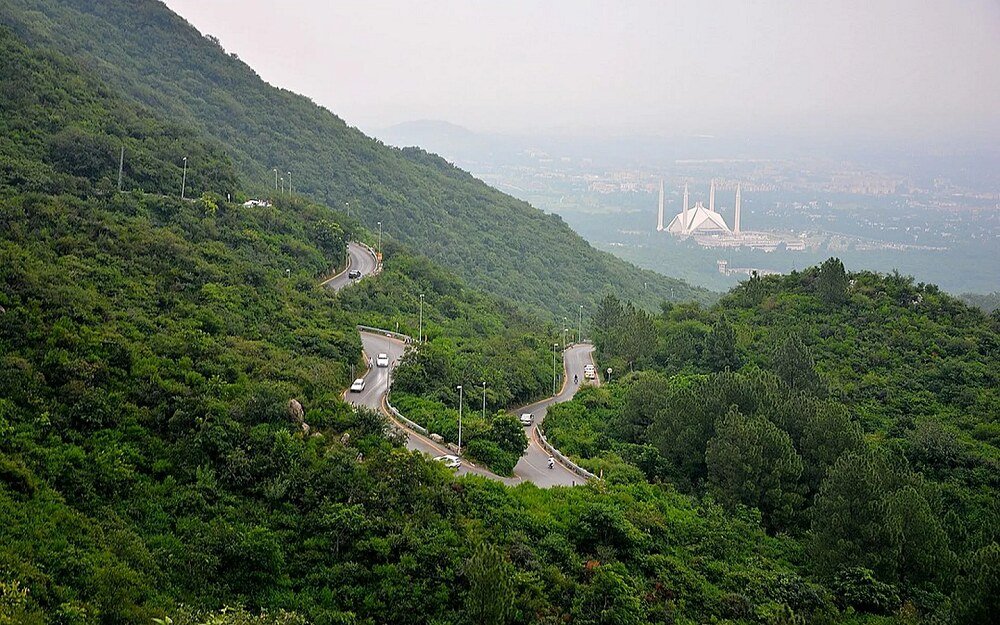
Head first for the southern terrace — this is the money view. From here you look straight down over Islamabad: Faisal Mosque’s unmistakable white minarets, the sweep of Seventh Avenue, the grid of sectors, and Rawal Lake shimmering in the distance. On a clear day after rain, you can see for miles; on a hazy summer afternoon, the city softens into a beautiful blur. Give yourself at least twenty unhurried minutes at the railing.
Watch Sunset (or Sunrise) from the Terrace
Ask any Islamabad local and they will tell you: Daman-e-Koh at sunset is a rite of passage. Arrive an hour before sundown, claim a spot at the railing, and watch the light turn the Margallas gold while the city below switches on its lights. Sunrise is the connoisseur’s choice — thinner crowds, cooler air, and the sharpest views of the day.
Peer Through the Viewing Telescopes
The coin-operated-style telescopes installed at the viewpoint let you zoom in on the city’s landmarks — pick out Faisal Mosque’s courtyard, trace the avenues, spot Rawal Lake. Kids love them, and they turn a pretty view into a fun game of “find the landmark.”
Study the Big Islamabad Map Signboard
Near the terraces stands a large signboard with an authentic map of Islamabad. Use it to orient yourself: find your hotel’s sector, trace tomorrow’s route, point out the landmarks you will visit. It is genuinely useful trip planning disguised as a photo backdrop.
Hike Trail 2 to the Top
For the active, Margalla Trail 2 climbs from the city up to Daman-e-Koh through national park forest. The hike takes roughly 1 to 1.5 hours each way — a proper half-day outing with birdsong, shade, and the chance of spotting monkeys (and, very rarely, signs of bigger wildlife). Start early, carry water, and wear proper shoes. Reaching the terrace on foot makes the view taste sweeter.
Meet the Monkeys (Carefully)
Daman-e-Koh’s rhesus monkeys are famous — and famously bold. They are endlessly entertaining to watch as they groom, squabble, and perform acrobatics along the railings. Enjoy them, photograph them, but keep food and shiny objects secured and never try to feed or touch them. They are wild animals, however photogenic.
Picnic on the Terraced Lawns
The landscaped gardens and lawns are made for unhurried afternoons: spread a sheet, unpack samosas and pakoras from the stalls near the entrance, and let the kids run. On weekends and public holidays the lawns fill with families — come on a weekday morning if you prefer quiet.
Dine with a View
Small eateries and cafes cluster around the viewpoint, and dining on the hillside with the city glittering below is one of Islamabad’s simple great pleasures. The well-known Dome restaurant is a popular pick for a meal with a panorama. Even just chai and pakoras at sunset counts as a memorable dinner here.
Continue Up to Pir Sohawa
Daman-e-Koh sits on the road to Pir Sohawa, about 3,600 feet up, where the famous Monal restaurant and other eateries offer dinner above the clouds. Many visitors pair the two: sunset at Daman-e-Koh, dinner at Pir Sohawa. The winding road between them is half the fun.
Famous Places In and Around Daman-e-Koh
- Pir Sohawa — higher viewpoint and restaurant strip, further up the same winding road.
- Margalla Hills National Park & Trails — Trail 2 (to Daman-e-Koh), plus Trails 3, 4, 5, and 6 for more hiking.
- Saidpur Village — the charming heritage village at the foot of the hills, with restaurants, galleries, and old stone lanes (about a 10-minute drive).
- Faisal Mosque — Pakistan’s iconic national mosque, at the foot of the Margallas, stunning when viewed from above.
- Rawal Lake — visible from the terrace; visit its promenade and Lake View Park at water level.
- Kohsar Market — upscale cafes and dining a short drive away in the E-7/F-6 area.
- Shah Allah Ditta Caves — ancient Buddhist-era caves on the far side of the Margallas for history lovers.
How to Reach Daman-e-Koh
Getting to Daman-e-Koh is refreshingly simple — it is one of the easiest “mountain” experiences in Pakistan. The viewpoint sits on Pir Sohawa Road, reached via Daman-e-Koh Road through sector E-7 in Islamabad. From central Islamabad or the Faisal Mosque area, the drive is only about 6 km, climbing steadily into the Margalla Hills on a narrow, winding road. Budget 20–30 minutes for the drive, more on weekend evenings when half of Islamabad seems to have the same sunset idea.
From Islamabad (city center): Head to E-7 / Faisal Mosque, then follow the signs for Daman-e-Koh / Pir Sohawa Road up into the hills. Any taxi or ride-hailing app (Careem, Uber, inDrive all operate in Islamabad) will know the way — just say “Daman-e-Koh” and settle in for the pretty climb.
From Lahore: About 375 km via the M-2 Motorway, roughly 4.5–5 hours to Islamabad, then 25 minutes up the hill. Most Lahore visitors fold Daman-e-Koh into a 2–3 day Islamabad trip.
From Karachi: Fly to Islamabad International Airport (about 2 hours), then drive 45–60 minutes into the city and up to the viewpoint. Same-day arrival-to-sunset is entirely doable if your flight lands by mid-afternoon.
Nearest airport: Islamabad International Airport, about 45–60 minutes by road from the viewpoint.
Road conditions: The road is paved but narrow and winding, with sharp bends — drive slowly, especially after dark or in monsoon rain. Parking areas exist at both the north and south viewpoints, but they fill up on weekends; arrive early or visit on a weekday for easy parking. Note that the old chairlift to Pir Sohawa is suspended, so the road (or your feet, via Trail 2) is the way up.
Public transport: The CDA lists bus route ST-01 from PIMS toward Daman-e-Koh, but schedules can be unreliable — check on the day if you are depending on it. For most visitors, a ride-hailing car split among friends is the sweet spot of convenience and cost.
Route Details
- City → E-7: From any central sector (F-6, F-7, Blue Area), drive toward Faisal Mosque / E-7. Follow Margalla Road or Seventh Avenue north to the E-7 sector.
- E-7 → Daman-e-Koh Road: Turn onto Daman-e-Koh Road (well signposted). The road begins climbing immediately — pine forest closes in, the city noise drops away.
- Climb to the terraces: About 6 km of winding ascent brings you to the parking areas. The south viewpoint (the classic panorama) is the main stop; the north terrace offers a different angle. Park, walk to the railings, and breathe.
- On foot via Trail 2: For hikers, Trail 2 starts from the city side and climbs through the national park to the viewpoint — 1 to 1.5 hours up. Start early morning, carry at least a liter of water, and descend before dark.
Where to Stay in Daman-e-Koh
There is no need to stay on the hill itself — Daman-e-Koh is a viewpoint you visit, and Islamabad’s excellent hotels are all within 20–30 minutes. Base yourself in the city and drive up for sunset.
Luxury: Islamabad’s five-star hotels (in the Blue Area, F-6, and Club Road areas) offer the full luxury experience — and several have rooms with Margalla views that echo the Daman-e-Koh panorama from your window.
Mid-range: Sectors F-6, F-7, and E-7 are packed with comfortable mid-range hotels and serviced apartments, many just 10–15 minutes from the Daman-e-Koh Road turnoff. This is the ideal base: quiet, green, and close to both the hills and the city’s restaurants.
Budget: Guesthouses and budget hotels cluster around Aabpara, G-6, and the Blue Area — clean, affordable, and well-connected by ride-hailing to the viewpoint.
Camping: Not at the viewpoint itself, but the Margalla Hills offer designated camping and the hills around Khanpur and beyond for those who want nights under the stars. For a Daman-e-Koh trip, though, a city hotel plus a sunset drive is the classic formula.
Where to Eat: Local Foods of Daman-e-Koh
The food scene around Daman-e-Koh is really the food scene of Islamabad’s hillside — and it is delightful.
At the viewpoint: Stalls near the entrance sell the holy trinity of Pakistani hill-station snacking: hot samosas, crispy pakoras, and bhutta (roasted corn) in season, plus chai, soft drinks, and ice cream. Horse-ride operators and souvenir sellers add to the festive roadside atmosphere. Prices are modest — classic street-food territory.
Saidpur Village (10 minutes away): This restored heritage village at the foot of the Margallas is the area’s food heart — atmospheric restaurants in old stone buildings serve Pakistani, desi, and continental food. It is the perfect dinner stop after sunset at the viewpoint.
Kohsar Market & F-6/F-7: A short drive back into the city brings you to Islamabad’s cafe belt — upscale casual dining, coffee houses, and dessert spots for every taste and budget.
Pir Sohawa: Continue up the road for hilltop restaurants with sweeping views — dinner above the city lights is a beloved Islamabad tradition.
What it costs: Street snacks at the viewpoint cost very little; a full meal at Saidpur or Kohsar Market runs from budget-friendly local rates to upscale prices depending on the venue. As a rule of thumb, eating around the hills costs about the same as eating in Islamabad’s nicer sectors — plan accordingly and carry a card plus some cash.
Weather in Daman-e-Koh
At 2,400 feet, Daman-e-Koh runs a couple of degrees cooler than the city below — a small difference you will feel gratefully on a summer evening. The viewpoint follows Islamabad’s four-season rhythm, with the added drama of mountain weather: sudden clouds, mist rolling over the ridge, and spectacular post-rain clarity.
| Season | Temperature Range | Conditions |
|---|---|---|
| Winter (Dec–Feb) | 3–15°C | Crisp, clear, often the sharpest views of the year. Mornings can be frosty; the city below sometimes fills with fog while the terrace sits above it in sunshine — magical. Bring a jacket. |
| Spring (Mar–Apr) | 15–28°C | Arguably the loveliest season: wildflowers on the hillsides, fresh green terraces, comfortable temperatures, and clear air. Peak picnic season. |
| Summer (May–Jul) | 22–35°C | Warm but noticeably cooler and breezier than the plains cities. Evenings are pleasant; afternoons can be hazy, which softens the view. The monsoon usually arrives in July. |
| Autumn (Sep–Nov) | 15–30°C | Post-monsoon clarity gives brilliant views; golden light, comfortable days, and thinning crowds. A photographer’s favourite, rivalling spring. |
Monsoon note (July–August): The Margallas get heavy rain — the hills turn intensely green and waterfalls appear, but the road gets slippery, clouds can hide the view entirely, and leeches appear on the hiking trails. If you go, go between showers and drive carefully.
Language and Culture of Daman-e-Koh
Languages: You will hear Urdu everywhere — it is the lingua franca of the capital’s visitors. Punjabi and Potohari are widely spoken by locals, Pashto and other languages by the city’s diverse residents, and English works fine at restaurants and hotels.
Culture: Daman-e-Koh is Islamabad’s shared living room. On any given evening the terraces hold a cross-section of the capital: families with picnic baskets, young couples watching the sunset, groups of friends with cameras, foreign visitors with guidebooks. The vibe is relaxed and family-friendly. Modest dress is the norm (this is a family public park), littering is frowned upon — the CDA works to keep the national park clean, so use the bins — and a little courtesy goes a long way on the narrow viewing terraces at busy times.
A note on wildlife etiquette: The monkeys are wild. Do not feed them (it makes them aggressive and unhealthy), keep children close when monkeys are near, and secure your food and bags. If you hike the trails, stay on marked paths — this is leopard country, however rarely they are seen, and the park rules protect both you and them.
Shopping in Daman-e-Koh
Shopping here is souvenir-scale, not mall-scale — and that is exactly right for a viewpoint.
At the viewpoint: Stalls near the entrance sell classic tourist souvenirs: keychains, magnets, and trinkets with Islamabad and Pakistan motifs, plus snacks and cold drinks. Bargain cheerfully; prices start hopeful.
Saidpur Village: The village’s small galleries and craft shops sell pottery, paintings, textiles, and handicrafts in a far more atmospheric setting — better quality and better stories than the viewpoint stalls.
For serious shopping: Head back down to the city — Centaurus Mall (Jinnah Avenue), Kohsar Market’s boutiques, and the Jinnah Super and F-6 markets cover everything from high-street brands to traditional crafts. No big malls exist up on the hill itself, nor should they — the Margallas are for views, not food courts.
Travel Tips for Daman-e-Koh
Packing Essentials
A light jacket (even in summer, the hilltop breeze surprises), comfortable walking shoes, sunglasses, sunscreen, water, and your camera with a charged battery — you will take more photos than you plan. If hiking Trail 2: proper hiking shoes, at least a liter of water, a hat, and a small first-aid kit.
Safety Tips
Daman-e-Koh is one of the safest tourist spots in Pakistan — busy, family-filled, and well-patrolled. Standard sense applies: keep valuables secure (the monkeys have excellent taste in sunglasses and snack bags), stay behind railings at viewpoints, drive slowly on the winding road, and descend before dark if hiking. Avoid the trails during heavy monsoon rain.
Money & Connectivity
Entry to the viewpoint area is free; parking carries a nominal fee. Carry cash for stalls, telescopes, and small eateries — cards work at the bigger restaurants. ATMs are everywhere in the city below. Mobile signals (Jazz, Telenor, Zong, Ufone) are strong at the viewpoint, so live-sharing that sunset is easy.
Best Time to Visit Daman-e-Koh
Spring (March–April) — The Peak
Wildflowers, green terraces, clear air, perfect temperatures. This is Daman-e-Koh at its most beautiful, and the picnic lawns are at their liveliest. Come on a weekday morning for the calmest version.
Autumn (October–November) — The Photographer’s Pick
Post-monsoon skies are at their clearest, the light turns golden, and crowds thin out. For the sharpest, most dramatic city panoramas, this is the season.
Winter (December–February) — Crisp and Quiet
Cold, clear days with the best long-distance visibility of the year — sometimes you will stand in sunshine above a sea of fog filling the city below. Bundle up and go; just check the road if there has been unusual weather.
Summer Evenings (May–July) — The Escape
Midday is warm and often hazy, but summer evenings are why locals love this place: the breeze picks up, the heat of the city falls away below you, and sunset draws the crowds. Arrive late afternoon, stay for the lights coming on.
Final Thoughts
Daman-e-Koh is not the most adventurous place in Pakistan, nor the most remote, nor the most dramatic — and it does not need to be. It is the capital’s balcony, and what it offers is something rarer than adrenaline: perspective. One long look from that terrace reorders your mental map of Islamabad, slows your breathing, and reminds you why people fall for this planned, pine-scented city in the first place.
So go for sunset. Take the winding road up, stand at the railing while the light does its work, eat something hot from a hillside stall, and drive back down through the darkened forest with the city’s lights behind you. It is the simplest great evening in Islamabad — and once you have seen the city from Daman-e-Koh, you will never quite see it the same way again. For more capital-area inspiration, see our places to visit in Islamabad roundup and the full Explore Pakistan collection.
FAQs
Where is Daman-e-Koh located?
Daman-e-Koh is a hilltop garden and viewpoint in the Margalla Hills, north of Islamabad on Pir Sohawa Road — about 6 km from the Faisal Mosque area, at roughly 2,400 feet above sea level.
What is the best time to visit Daman-e-Koh?
March–April (spring) for flowers and perfect weather, and October–November for the clearest views. For the classic experience, come an hour before sunset on a clear day. Winter mornings offer stunning above-the-fog views.
How do I reach Daman-e-Koh from Islamabad?
Drive, taxi, or ride-hail via Daman-e-Koh Road (E-7) up Pir Sohawa Road — about 20–30 minutes from central Islamabad. Hikers can climb Trail 2 through the national park (1–1.5 hours each way).
Is there an entry fee for Daman-e-Koh?
Entry to the viewpoint and gardens is free; parking near the terraces carries a nominal fee. Stalls, telescopes, eateries, and horse rides cost extra.
Is Daman-e-Koh safe for families?
Yes — it is one of Pakistan’s most family-friendly viewpoints: busy, well-maintained, with lawns, railings, eateries, and easy road access. Keep children supervised near monkeys and railings.
What can you see from Daman-e-Koh?
The full panorama of Islamabad — Faisal Mosque, Seventh Avenue, the sector grid, and Rawal Lake — with the Margalla Hills rising behind you. Viewing telescopes help pick out individual landmarks.
Where can I eat near Daman-e-Koh?
Snack stalls at the viewpoint (samosas, pakoras, chai), the Dome restaurant with a view, Saidpur Village’s atmospheric restaurants 10 minutes away, Kohsar Market’s cafes, and hilltop restaurants further up at Pir Sohawa.
Can you hike to Daman-e-Koh?
Yes — Margalla Trail 2 leads from the city up to the viewpoint through the national park, taking about 1 to 1.5 hours each way. Start early, carry water, wear proper shoes, and stick to the marked trail.