Quick Facts
- Location: Sector F-9, Islamabad — the park occupies the entire sector
- Altitude: around 540 metres above sea level
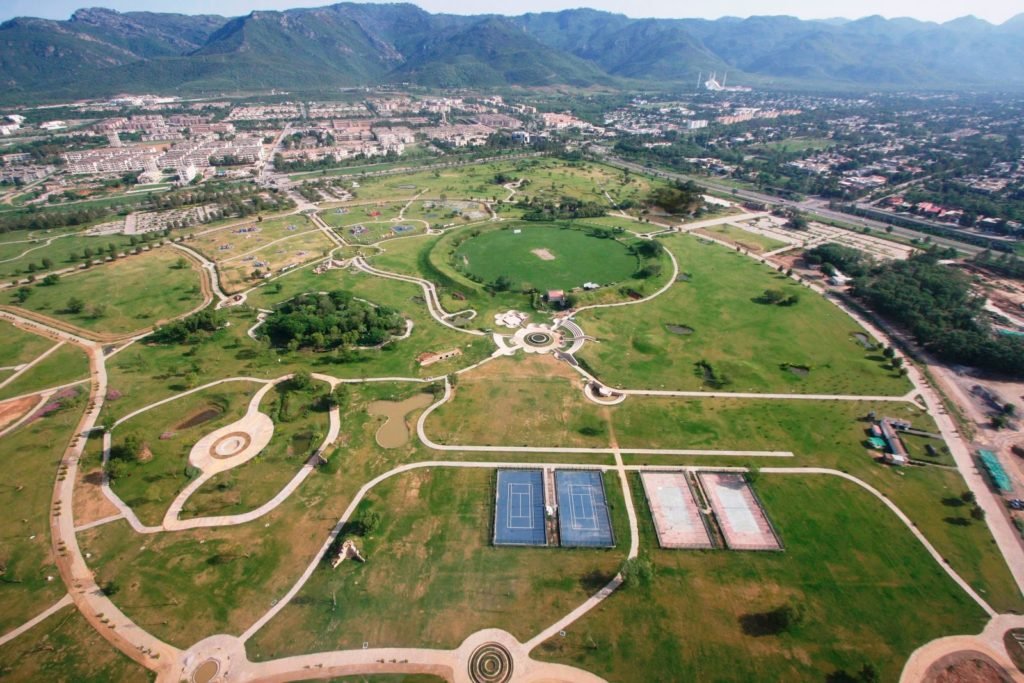
- Famous For: 304 hectares (750 acres) of green space — just smaller than New York’s Central Park — known as the “lungs of Islamabad”; jogging tracks, a lake with fountains, and an amphitheatre
- Nearest City: it is inside Islamabad itself, minutes from the Blue Area and Jinnah Super Market
- Accessibility: extremely easy — multiple gates on all four sides, reachable by car, taxi or ride-hailing from anywhere in the capital
- Known Landmarks: the central lake with fountains, the amphitheatre, the Citizen Club, the children’s play areas, and the five named gates (Mehran, Bolan, Khyber, Ravi)
- Best For: morning walkers and joggers, families with children, picnickers, fitness enthusiasts, cyclists, and anyone needing a green escape in the capital
Why Visit Fatima Jinnah Park
Every great capital needs a great park, and Islamabad has one of the finest in South Asia. Fatima Jinnah Park — known to everyone in the city as F-9 Park — swallows an entire sector of the capital: 750 acres of lawns, woodland, jogging tracks and ponds, sitting just below the Margalla Hills. Stand at its centre and the city falls away; you hear birds instead of traffic, and for a city park, that is a small miracle.
This Fatima Jinnah Park travel guide is for the traveller who wants to see the real Islamabad — not just the monuments, but the daily life of the capital. Come at dawn and you will share the tracks with hundreds of walkers, joggers and yoga groups, the city’s famous health-conscious crowd doing its morning ritual. Come on a winter Sunday afternoon and you will find extended families spread across the lawns with picnic baskets, children racing to the play areas, and kites — always kites — stuttering against the sky.
Who is it perfect for? If you are a fitness traveller, this is your headquarters: kilometres of dedicated jogging and cycling tracks, sports courts, and open lawns for your own routine. If you are travelling with children, the play areas, mini train rides and sheer safe open space make it the easiest half-day in Islamabad. And if you are simply a city-weary visitor, the park was literally conceived as the “lungs of Islamabad” — a place designed so that anyone, from any walk of life, could walk in and breathe.
When to go: October to March is the golden window, when Islamabad’s weather is at its legendary best — crisp mornings, warm afternoons, and skies so blue they look edited. The park is open all year and free to enter, so the only real decision is morning or evening. Our answer: morning, when the light is soft, the air is cool, and the park belongs to the walkers.
History of Fatima Jinnah Park
Fatima Jinnah Park is named after Madar-e-Millat Fatima Jinnah — the Mother of the Nation — the younger sister of Pakistan’s founder, Quaid-e-Azam Muhammad Ali Jinnah, and a towering figure in the country’s early political life in her own right. Naming the capital’s great park after her was a statement: this would be a people’s park, honouring a woman remembered for her dignity, courage and service.
The park was designed by landscape architect Michael Japero and inaugurated in 1992. Its original master plan was prepared with the assistance of the Japan International Cooperation Agency (JICA) — a mark of the Pakistan-Japan friendship — and was revised in 2005 by the renowned Pakistani architect Nayyar Ali Dada. From the start, the design brief was unusual and admirable: this was to be Islamabad’s first park intentionally open to people from all socioeconomic backgrounds, with roughly 90 percent of its area kept green and private vehicles kept out.
That philosophy is why the park looks the way it does. Rather than a formal garden of flowerbeds, F-9 Park is mostly natural landscape — vast lawns, scattered ponds, tree-lined walks — with only a few built structures dotted through the greenery. Large parts of the interior function almost as an urban wildlife sanctuary, home to birds and small wildlife, ringed by a steel fence with gates at regular intervals.
The park has kept evolving. A dedicated cycling track was added in recent years, responding to Islamabad’s booming cycling culture. In 2024 the Capital Development Authority removed some 5,000 mulberry trees from the park and planted around 10,000 new trees — a major re-greening effort. The CDA has also announced plans for a Festival Square within the park, signalling that F-9’s role as the capital’s communal living room is only growing. Administered by the Environment Wing of the CDA, it remains what it was designed to be: the lungs of Islamabad.
Top Things to Do in Fatima Jinnah Park
Walk or Jog the Track Network
The single most popular activity in the park is also the simplest: walking. A well-laid network of jogging tracks connects the park’s gates, winding through lawns and tree cover with the Margalla Hills as a backdrop. Dawn is the magic hour — the tracks fill with Islamabad’s famous morning-walker community, and there is a genuinely uplifting energy to hundreds of people starting their day together in the green. Evening walkers get the sunset crowd instead. Either way, bring comfortable shoes; a full loop is a proper workout.
Cycle the Dedicated Track
Islamabad’s cycling boom finally got its home ground when a dedicated cycling track was added to F-9 Park. The flat, smooth paths are ideal for everyone from serious road cyclists doing training laps to families wobbling along on rented bikes. Early mornings are best, before the pedestrian crowds build. If you did not bring a bike, ask around the gates — rental options cluster nearby on weekends.
Picnic on the Lawns
This is the great Pakistani weekend ritual, and F-9 Park is one of its finest stages. The vast lawns swallow crowds easily — you can always find a patch of grass with a view of the hills. Families arrive with daigs of biryani, thermoses of chai and boxes of mithai; the park provides the setting, you provide the feast. Winter Sundays are peak picnic season, so arrive before noon for the best spots.
Visit the Lake and Fountains
Near the park’s heart sits a serene lake decorated with fountains and crossed by small bridges — the prettiest built feature in the park. It is a favourite with photographers, courting couples and anyone who wants ten minutes of calm water-watching. The fountains catch the late-afternoon light beautifully, and the surrounding paths make a lovely short stroll.
Bring the Kids to the Play Areas
The children’s play areas, mini train rides and open lawns make F-9 Park arguably the most family-friendly half-day in Islamabad. The play zones are well used and lively on weekends, the train ride is a rite of passage for the city’s kids, and the sheer amount of safe, car-free space means children can run in a way the city rarely allows. Pack snacks, sunscreen and a football.
Catch an Event at the Amphitheatre
The park’s amphitheatre hosts cultural events and musical concerts through the year, from traditional performances to contemporary gigs. Check local listings before your visit — landing in Islamabad on a concert weekend and spending the evening under the stars at F-9 is one of the city’s great free pleasures.
Birdwatch and Slow Down
Because so much of the park is effectively a wildlife sanctuary, patient visitors are rewarded. Early mornings bring out the birdlife — kites circling, parakeets chattering, and seasonal migrants in winter. Bring binoculars if you have them, find a bench away from the tracks, and let the park do what it was designed to do: slow you down.
Famous Places In and Around Fatima Jinnah Park
- Margalla Hills National Park — the forested hills rising directly behind the park; Trail 3 and Trail 5 trailheads are a short drive away
- Shah Faisal Mosque — Pakistan’s iconic national mosque, about 15 minutes by car
- Jinnah Super Market (F-7) — the capital’s beloved old market for books, clothes and cafes, minutes from the park’s eastern gates
- Lok Virsa Heritage Museum — at Shakarparian, for the folk culture fix after your park visit
- The Centaurus Mall — Islamabad’s landmark mall on Jinnah Avenue, for shopping after the greenery (see our places to visit in Islamabad guide for more city ideas)
How to Reach Fatima Jinnah Park
Getting to F-9 Park could hardly be simpler: it sits in the middle of Islamabad, bounded by Jinnah Avenue to the south and the residential sectors F-8, G-9, F-10 and E-9 on the other sides. Enter through any of the gates — Mehran Gate on the southern side (Jinnah Avenue, facing G-9), Bolan Gate on the west (facing F-10), Khyber Gate on the north (facing E-9), or Ravi Gate on the east (facing F-8). Each entrance has parking, a mosque and public toilets.
From within Islamabad: 10 to 25 minutes by car or ride-hailing from anywhere in the city — Blue Area, F-6, F-7, DHA or Bahria Town. Careem, Uber and local taxis all know “F-9 Park” by heart. From Lahore (about 380 km, 4.5 to 5.5 hours): take the M-2 motorway to Islamabad, then follow Jinnah Avenue or the Kashmir Highway to Sector F-9. From Karachi (about 1,420 km): fly to Islamabad (2 hours) and drive 30–40 minutes from the airport to the park.
Nearest airport: Islamabad International Airport, about 30–40 minutes by car. Road conditions: Islamabad’s roads are among the best in Pakistan — wide, signposted and smooth all year. Transport options: your own car, ride-hailing apps, or local taxis; the park’s gates are also served by the city’s public vans on Jinnah Avenue.
Route Details
- From the Blue Area / Jinnah Super side, drive west along Jinnah Avenue.
- Watch for the park’s steel fence on your right (north) — Mehran Gate is the main southern entrance, facing G-9.
- Park in the designated lot at the gate (arrive early on weekends; lots fill by late morning).
- Enter on foot — no private vehicles inside — and pick up the jogging track network or head for the central lake.
- From the airport: take the Kashmir Highway into the city, then Jinnah Avenue east to the park (about 35 minutes off-peak).
Where to Stay in Fatima Jinnah Park
You do not stay in the park — you stay in Islamabad, and the whole city is your base. The park’s central location means almost any good hotel puts you within 15–25 minutes of its gates.
Luxury: Islamabad Serena Hotel (G-5) and Islamabad Marriott Hotel are the capital’s two landmark five-stars, both verified, full-service properties about 15–20 minutes from F-9 Park — the Serena’s gardens and the Marriott’s central location are both excellent bases. Mid-range: the F-6, F-7 and Blue Area corridors are thick with well-reviewed three- and four-star hotels and serviced apartments at moderate prices, many within walking distance of restaurants. Guesthouses: Islamabad’s guesthouse scene — particularly in F-7, F-8 and E-7 — offers clean, comfortable rooms at a fraction of hotel prices, ideal for longer stays. Camping: not applicable here; this is a city park, and the Margalla Hills trails are the place for outdoor overnights. Our advice: stay near Jinnah Super or Blue Area and you will have the park, the restaurants and the shopping all within minutes.
Where to Eat: Local Foods of Fatima Jinnah Park
The park itself keeps food simple — there is a McDonald’s inside for the inevitable kids’ demand, plus small kiosks selling chai, cold drinks, corn and snacks near the gates. But the real eating happens in the neighbourhoods around the park, and Islamabad eats well.
Within minutes of the gates you can find the full spectrum of Pakistani food: Peshawari-style BBQ and chapli kebabs, Lahori chargha and paye, desi breakfasts of halwa puri and lassi, and excellent Afghan-influenced pulao. Jinnah Super Market and the F-7/F-8 markazes are lined with cafes and dhabas; Melody Food Park remains a beloved budget institution. A dhaba meal runs budget-friendly (a full meal for two often lands in the PKR 800–2,000 range), while the markaz restaurants cost more. Picnic strategy: many families simply buy fresh naan, kebabs and drinks from the markaz shops and feast on the lawns — the most Islamabad way to do F-9 Park.
Weather in Fatima Jinnah Park
Islamabad’s climate is one of its great selling points: four genuine seasons, none of them extreme for long. The park is open all year, but October to March is when the city shows off — crisp air, blue skies, and walking weather that makes the tracks irresistible. Summer afternoons are hot, but the park’s tree cover and early-morning hours keep it usable even in June.
| Season | Temperature Range | Conditions |
|---|---|---|
| Winter (Dec–Feb) | around 3–15°C | Crisp and clear; frosty mornings, gloriously sunny afternoons. Peak park season. |
| Spring (Mar–Apr) | around 15–32°C | Mild and fresh; the city’s famous spring, with flowering trees across the park. |
| Summer (May–Jun) | around 28–40°C | Hot afternoons; walk at dawn or after 6 pm. The tree cover helps. |
| Monsoon (Jul–Sep) | around 25–35°C | Heavy showers and high humidity; dramatic skies, lush greenery, muddy patches. |
| Autumn (Oct–Nov) | around 15–32°C | Clear, dry and golden — arguably the finest weeks of the year in the park. |
Language and Culture of Fatima Jinnah Park
Islamabad is Pakistan’s most linguistically mixed city, and the park reflects it: Urdu is the common language, English is widely spoken, and you will hear Punjabi, Pashto, Saraiki and more on the tracks. The park’s founding idea — a green space genuinely open to everyone — still shapes its culture: morning walkers greet strangers, families share picnic space, and the atmosphere is notably relaxed and safe.
Etiquette is straightforward: dress modestly but comfortably (walking gear is the norm on the tracks), keep the lawns clean — the CDA works hard on upkeep, including major tree-planting drives — and respect other visitors’ space, especially during prayer times at the gate mosques. The park is monitored by over 200 CCTV cameras watched by Islamabad Police, which is one reason families feel comfortable here at all hours of the day.
Shopping in Fatima Jinnah Park
There is no shopping inside the park — it is a green refuge, not a bazaar — but you are minutes from some of Islamabad’s best retail. The Centaurus Mall on Jinnah Avenue is the city’s landmark mall, with international and Pakistani brands, a food court and cinema. For a more local flavour, Jinnah Super Market in F-7 is the old Islamabad institution: bookshops, fabric stores, tailors and cafes in a charming low-rise market. Souvenir hunters should look for Pakistani handicrafts — blue pottery, camel-skin lamps, Peshawari chappals and shawls — at the market shops or the Lok Virsa heritage shop at Shakarparian. A park morning followed by a Jinnah Super afternoon is a classic Islamabad day.
Travel Tips for Fatima Jinnah Park
Packing Essentials
Walking or running shoes, a water bottle, sunscreen and a cap for daytime visits, a light jacket for winter mornings, and a picnic blanket if you are doing the full Sunday ritual. Binoculars are a bonus for the birdlife. Everything else — snacks, drinks, fresh naan — can be bought at the markazes around the park.
Safety Tips
F-9 Park is one of the safest public spaces in Pakistan: fenced, gated, and covered by 200+ police-monitored CCTV cameras. Standard sense still applies — stick to the main tracks after dark, keep valuables discreet, and supervise small children near the lake. The park closes its gates at night, so plan evening visits to end before closing.
Money & Connectivity
Entry to the park is free. Carry some cash for kiosks and parking, though cards and mobile payments work at the surrounding restaurants and malls. ATMs are plentiful in the adjacent sectors. Mobile coverage from all major networks (Jazz, Telenor, Zong, Ufone) is excellent across the park.
Best Time to Visit Fatima Jinnah Park
Winter (December to February) — peak season
This is Islamabad at its best and the park at its busiest: crisp mornings made for long walks, sunny afternoons made for picnics, and weekend lawns full of families. If you visit Pakistan in winter, F-9 Park is non-negotiable.
Spring (March to April) — the beautiful season
Mild air, flowering trees, and the city’s famous spring light. The tracks are a pleasure at any hour, and the park’s re-greening — thousands of new trees planted in recent years — shows at its freshest.
Summer (May to June) — mornings only
Afternoons are genuinely hot, but dawn in the park is still lovely — the serious walkers and cyclists own the 5:30–7:30 am window. Plan indoor sightseeing (museums, malls) for midday.
Monsoon and Autumn (July to November) — dramatic then golden
The monsoon brings theatrical skies and deep green lawns, though paths get muddy. October and November are the connoisseur’s choice: dry, clear, golden light, and thinner crowds than winter.
Final Thoughts
Fatima Jinnah Park is not a tourist attraction in the checklist sense — there is no ticket, no queue, no single sight to photograph and leave. It is something better: the living room of the capital, 750 acres where Islamabad comes to walk, play, picnic and breathe. To visit it is to understand the city in a way no monument can teach.
So come at dawn, walk the tracks with the morning crowd, watch the Margalla Hills catch the first light, and then decide for yourself whether any capital in South Asia has a finer park. We think you will be back the next morning too.
FAQs
Where is Fatima Jinnah Park located?
It occupies the entire Sector F-9 of Islamabad, bounded by Jinnah Avenue and the F-8, G-9, F-10 and E-9 sectors.
What is the best time to visit Fatima Jinnah Park?
October to March, when Islamabad’s weather is cool and clear. Mornings (6–9 am) are best for walking; late afternoons for picnics.
Is there an entry fee for Fatima Jinnah Park?
No — entry to the park is free. You only pay for parking and whatever you buy from kiosks.
How do I reach F-9 Park from the Blue Area?
Drive west along Jinnah Avenue for about 10–15 minutes; Mehran Gate (facing G-9) is the main southern entrance. Ride-hailing apps all know it.
Is Fatima Jinnah Park safe for families?
Yes — it is fenced and gated, with 200+ CCTV cameras monitored by Islamabad Police, and is one of the city’s most popular family destinations.
Why is it called Fatima Jinnah Park?
It honours Madar-e-Millat Fatima Jinnah, the younger sister of Pakistan’s founder Muhammad Ali Jinnah. It was designed by Michael Japero and inaugurated in 1992.
Where can I stay near Fatima Jinnah Park?
Anywhere in central Islamabad works — Islamabad Serena Hotel and Islamabad Marriott Hotel are the landmark luxury options, 15–20 minutes away, with many mid-range hotels and guesthouses closer still.
What food is available at the park?
A McDonald’s and snack kiosks inside; the full range of Pakistani, BBQ and cafe food in the surrounding markazes — or buy kebabs and naan and picnic on the lawns.
For more green escapes and city guides, browse our Explore Pakistan collection, or see the wilder side of the north in our Hunza Valley travel guide.