


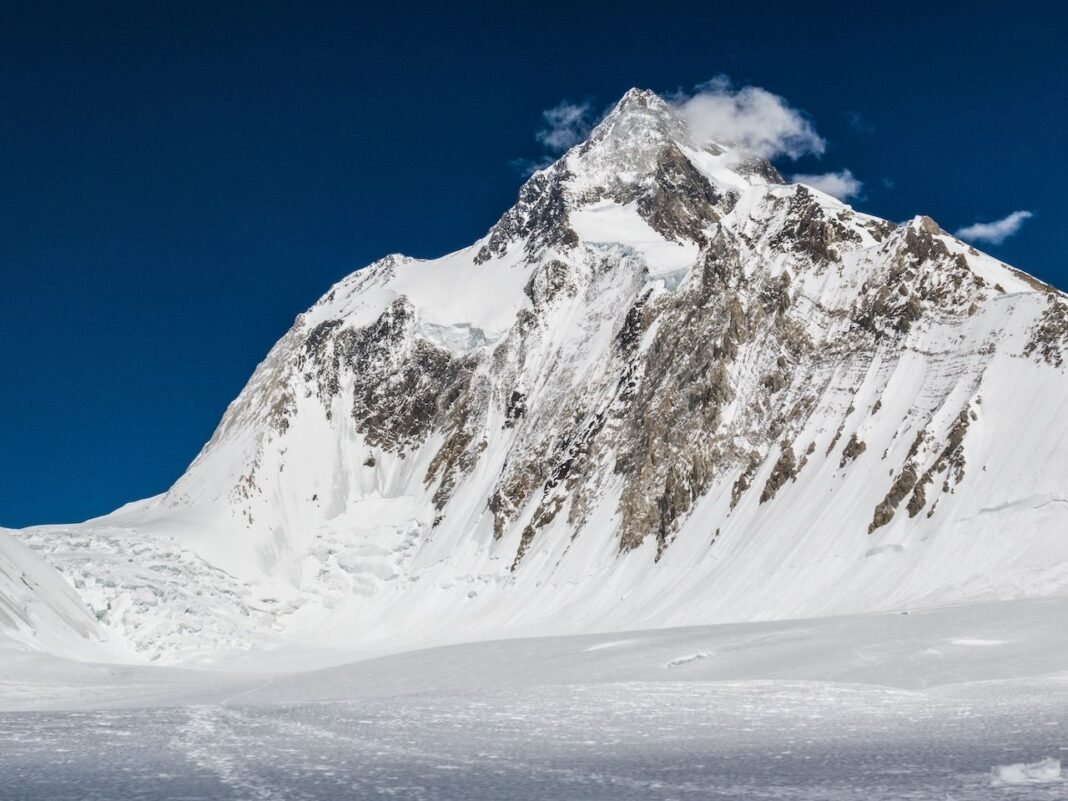
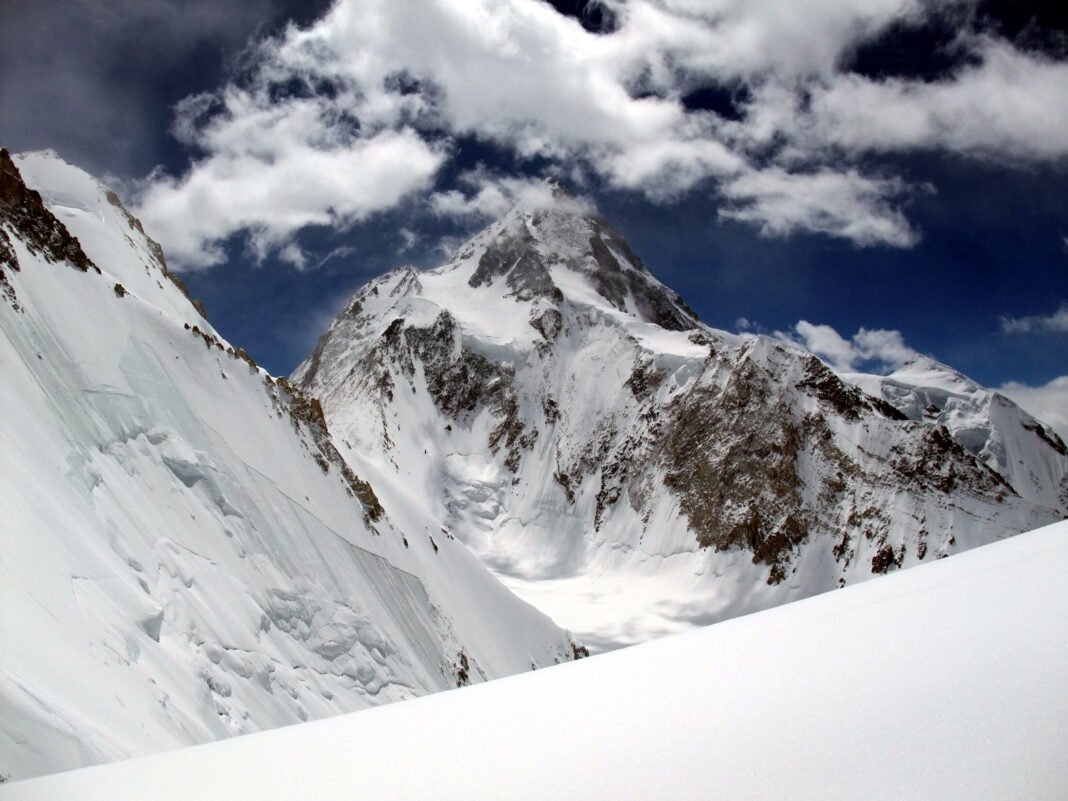
Some mountains you visit. Others you earn. Gasherbrum I — the Hidden Peak — belongs firmly in the second category, and that is exactly why it should be on your list. At 8,080 metres, the 11th highest mountain on Earth, it stands at the far northeastern end of the Baltoro Glacier in Pakistan’s Karakoram, so remote that it stays hidden behind its neighbors for most of the journey in. If you are choosing a great mountain adventure in Pakistan, few choices are more serious, more storied, or more rewarding than the trek to the foot of the Hidden Peak.
This Gasherbrum I (Hidden Peak) travel guide is written for trekkers and dreamers alike: why this peak deserves your journey, its remarkable climbing history, what the trek involves, how to reach the trailhead from Islamabad, Lahore, or Karachi, and when the Karakoram gives you its best weather.
Quick Facts
- Location: Gasherbrum Massif, Karakoram range — on the Pakistan–China border, Shigar District, Gilgit-Baltistan
- Altitude: 8,080 metres (26,510 feet) — the 11th highest mountain in the world
- Famous For: Extreme remoteness (“Hidden Peak”), the 1958 first ascent, the Japanese Couloir route, and its pyramid of ice and rock
- Nearest City: Skardu (trailhead village: Askole)
- Accessibility: Fly or drive to Skardu, jeep to Askole, then a 7–8 day trek via the Baltoro Glacier to Concordia and base camp
- Known Landmarks: Concordia, the Baltoro Glacier, the Abruzzi Glacier, K2 and Broad Peak nearby
- Best For: Serious trekkers, mountaineers, photographers, and mountain-history enthusiasts — not casual sightseeing
Why Visit Gasherbrum I (Hidden Peak)
Here is the honest truth about Gasherbrum I: you do not visit it the way you visit a lake or a fort. There is no viewpoint parking lot, no tea stall at the summit. What you get instead is something rarer — one of the great journeys left on Earth. The trek to Concordia, the glacial junction where the Baltoro Glacier meets its tributaries, is routinely described as the finest mountain walk in the world. From that single campsite you can see four 8,000-metre peaks at once: K2, Broad Peak, Gasherbrum II, and the Hidden Peak itself. No photograph prepares you for the moment the clouds lift and that wall of ice and granite fills the sky.
Gasherbrum I carries a mystique that even its giant neighbors cannot match. It earned its English name because it literally hides — British explorer William Martin Conway called it the Hidden Peak in 1892 after finding that it stays concealed behind the other Gasherbrum summits for most of the approach along the Baltoro. In the local Balti language, the name means “beautiful mountain,” and standing at Concordia at dawn, watching the first light strike its faces, you understand why. This is mountaineering’s deep end: one of the least-climbed of all the 8,000-metre peaks, with only around two hundred summits in history. To walk in the footsteps of the 1958 American expedition, Reinhold Messner, and the great Polish winter climbers is to walk through the living history of Himalayan mountaineering.
For trekkers, the Gasherbrum I journey is the Baltoro trek at its most complete. You pass through Askole, the last village in the valley; cross the Biafo River; camp at legendary stops like Paiju and Urdukas; and spend days walking the great white highway of the Baltoro Glacier itself. It is demanding — a full expedition-style trek of two to three weeks — but for fit, experienced walkers it is the single most spectacular trekking route in Pakistan, and arguably in the world. If your heart is set on the Karakoram, this is the pilgrimage.
History of Gasherbrum I (Hidden Peak)
The mountain first entered recorded history in 1856, when T. G. Montgomerie of the Great Trigonometric Survey of India sighted the great Karakoram peaks from more than 200 kilometres away and designated this one K5 — the fifth peak of the Karakoram. It remained a distant, mysterious triangle on survey maps for decades. In 1892, the British explorer William Martin Conway explored the region and gave the peak its enduring English name, the Hidden Peak, because its extreme remoteness keeps it hidden behind the anterior peaks of the Gasherbrum group for most of the way along the Baltoro Glacier.
The name “Gasherbrum” itself is often said to mean “shining wall,” but it actually comes from the Balti words rgasha (beautiful) and brum (mountain) — “beautiful mountain.” (The “shining wall” description was Conway’s phrase for the great face of neighboring Gasherbrum IV.) Serious attempts on the mountain began in the 1930s, including a 1936 French expedition that reached high on the mountain before weather forced a retreat.
The breakthrough came in 1958, when an eight-man American expedition led by Nicholas Clinch made the first ascent. On July 5, 1958, Pete Schoening and Andy Kauffman stood on the summit, climbing via the Northwest Face and the Gasherbrum Glacier — one of the earliest American successes on an 8,000-metre peak and a landmark in Himalayan climbing history. The peak then waited decades for its next great chapters: in July 1984, Reinhold Messner made the first solo ascent without supplemental oxygen, in pure alpine style — a milestone that redefined what was possible in high-altitude mountaineering. And on March 9, 2012, Polish climbers Adam Bielecki and Janusz Gołąb achieved the first winter ascent of Gasherbrum I, a major triumph in the history of Himalayan winter climbing. Today the standard route, the Japanese Couloir, is the line most expeditions follow, and the mountain remains one of the least-visited of all the eight-thousanders.
Top Things to Do in Gasherbrum I (Hidden Peak)
Trek to Concordia — the Throne Room of the Mountain Gods
The centerpiece of any Gasherbrum I journey is the trek to Concordia (around 4,650 metres), the vast glacial plaza where the Baltoro, Godwin-Austen, and upper Baltoro glaciers converge. Trekkers typically take 7–8 days from Askole, with classic camps at Jhola, Paiju (with its famous rest day beneath the granite towers), Urdukas, and Goro II. Each day the scenery intensifies until Concordia delivers its legendary panorama: K2, Broad Peak, Gasherbrum I, and Gasherbrum II arrayed around you. For most visitors, this is the destination — and it is more than enough.
Continue to Gasherbrum Base Camp
From Concordia, the trail continues up the Abruzzi Glacier to Gasherbrum base camp at roughly 5,100–5,150 metres — about another day of trekking beyond Concordia. Standing at base camp beneath the Hidden Peak’s great faces, watching expedition teams prepare for the Japanese Couloir, is as close as most travelers will ever come to the world of 8,000-metre climbing. The base camp area also gives the finest close-up views of the Gasherbrum group.
Photograph the Great Karakoram Panorama
This is one of the most photographed mountain regions on Earth, and for good reason. Dawn and dusk at Concordia transform the peaks through gold, pink, and violet. The Gasherbrum massif at sunrise, K2’s pyramid catching the last light, the seracs and icefalls of the Baltoro — bring more memory cards than you think you need, and a tripod for the low-light hours.
Walk in Mountaineering History
Few places on Earth are so dense with climbing legend. You will camp where the 1958 Americans, Messner, the Poles, and generations of expeditions camped; cross the same glaciers; and look up at the same faces. Reading up on the first ascent and the 2012 winter ascent before you go transforms the trek from a walk into a pilgrimage.
Combine with K2 Base Camp
Most trekkers visiting the Gasherbrum region combine it with the classic K2 base camp trek, since both share the Baltoro route to Concordia. From Concordia, K2 base camp is a further trek up the Godwin-Austen Glacier. Doing both in one journey is the definitive Karakoram experience.
Famous Places In and Around Gasherbrum I (Hidden Peak)
- Concordia (4,650 m) — the great glacial junction with views of four 8,000-metre peaks
- Baltoro Glacier — one of the world’s longest glaciers outside the poles, the highway of the trek
- Abruzzi Glacier — leads to the Gasherbrum base camps
- K2 (8,611 m) — the world’s second-highest mountain, dominating the Concordia skyline
- Broad Peak (8,051 m) — the massive neighbor of the Gasherbrums
- Gasherbrum II (8,035 m) and Gasherbrum IV (7,925 m) — the Hidden Peak’s celebrated siblings
- Askole — the last village of the Shigar Valley and the trek’s starting point
- Skardu — the gateway city of Baltistan, with its forts and lakes
How to Reach Gasherbrum I (Hidden Peak)
Reaching the Hidden Peak is a multi-stage expedition in itself. Every route funnels through Skardu, then Askole, then the long trek up the Baltoro.
From Islamabad: The fastest option is the roughly one-hour flight to Skardu, which offers staggering views of Nanga Parbat on a clear day — though flights are frequently cancelled in bad weather, so build buffer days. By road, the Karakoram Highway route runs Islamabad → Chilas (about 461 km, 11–12 hours) → Skardu (about 290 km along the Indus, 8–9 hours). From Skardu, a 6–7 hour jeep ride over rough mountain roads reaches Askole, the last village before the glacier.
From Lahore: Travel to Islamabad first (motorway, 4–5 hours), then follow the Islamabad–Skardu options above. Most Lahore-based trekkers fly Lahore–Islamabad–Skardu or join an organized expedition departing from Islamabad.
From Karachi: Fly to Islamabad (about 2 hours) and continue as above. International-style expeditions almost always assemble in Islamabad for briefings, permit formalities with the tourism authorities, and gear checks before heading north.
Nearest airport: Skardu Airport, with daily flights from Islamabad in good weather. There is no air access beyond Skardu — everything after that is jeep and boot leather.
Route Details
- Islamabad → Skardu: by air (~1 hour, weather-dependent) or by road via Chilas on the Karakoram Highway (~20 hours of driving, usually split over two days).
- Skardu → Askole: 6–7 hours by 4×4 jeep through the Shigar Valley to Askole (~3,000 m), the last settlement. Porters are traditionally hired here.
- Askole → Jhola → Paiju: the first trekking days, following the Braldu River; Paiju (3,450 m) is the traditional rest and acclimatization stop.
- Paiju → Urdukas → Goro II → Concordia: onto the Baltoro Glacier proper, with camps at Urdukas (4,050 m) and Goro II (4,380 m) before the great junction at Concordia (4,650 m).
- Concordia → Gasherbrum Base Camp: up the Abruzzi Glacier to base camp at about 5,100–5,150 m. Total trekking distance from Askole is roughly 90–95 km.
- Permits and logistics: climbing permits are issued by Pakistan’s tourism authorities, usually arranged through a licensed tour operator with the Alpine Club of Pakistan; expeditions travel with a liaison officer. Trekkers to Concordia need far simpler paperwork but should still go with a registered operator, certified guide, cook, and porters.
Where to Stay in Gasherbrum I (Hidden Peak)
Let us be honest: there are no hotels at Gasherbrum I. Accommodation on the mountain is expedition camping — high-quality tents at base camp and the successive high camps, with kitchen, dining, and communication tents run by your expedition operator. Trekkers to Concordia sleep in dome tents at the classic campsites along the Baltoro. A good sleeping bag rated well below freezing, an insulated mat, and a tent that can handle Karakoram storms are non-negotiable; reputable operators provide all of this.
Before and after the trek, Skardu is the base. The city has a solid range of options from budget guesthouses to comfortable mid-range and upper-range hotels, many with mountain views and gardens — a welcome soft landing after weeks on the glacier. In Askole, the last village, lodging is limited to very basic guesthouses and camping; most trekkers spend a single night here organizing porters before setting off. Book Skardu accommodation in advance for the June–August season, when the trekking and expedition crowds peak.
Where to Eat: Local Foods of Gasherbrum I (Hidden Peak)
On the trek and at base camp, food is expedition food: your operator’s cooks prepare hearty, high-energy meals — rice, lentils, pasta, soups, eggs, and plenty of tea — designed to keep trekkers fueled at altitude. Fresh supplies are carried from Skardu, supplemented by dried goods; above Concordia, everything is about calories and warmth. If you trek with a good company, you will be surprised how well you eat on a glacier.
In Skardu and the Shigar Valley before the trek, enjoy Balti cuisine — the food of Baltistan. Look for balay, a warming hand-pulled noodle soup; mamtu, steamed dumplings similar to momos; buckwheat and barley preparations; and dishes enriched with local apricot oil. Dried apricots, apricot kernels, and walnuts from Baltistan’s orchards are the classic trail snacks — buy them in Skardu’s bazaar before heading to Askole. In Askole itself, expect simple home-style cooking: chapati, lentils, rice, and endless milk tea. Carry personal snacks and energy bars for the long trekking days.
Weather in Gasherbrum I (Hidden Peak)
The Karakoram makes its own weather, and at 5,000 metres and above, it makes it dramatically. The climbing and trekking season is short — essentially June through August — when the westerly storms ease and temperatures become merely very cold rather than unsurvivable. Outside these months, the region is locked in deep winter. Approximate conditions at base-camp altitude (~5,100 m):
| Season | Temperature Range | Conditions |
|---|---|---|
| Winter (Nov–Mar) | -25°C to -40°C (nights colder) | Extreme cold, deep snow, hurricane winds; only elite winter expeditions attempt the region |
| Spring (Apr–May) | -15°C to -5°C | Still winter-like at altitude; unstable weather; approach trek possible late May for the very prepared |
| Summer (Jun–Aug) | -5°C to 15°C (days) | Climbing season: relatively stable, but storms can strike anytime; nights below freezing even in July |
| Autumn (Sep–Oct) | -15°C to 5°C | Rapidly cooling; short post-monsoon window sometimes usable in early September, then winter closes in |
Language and Culture of Gasherbrum I (Hidden Peak)
The gateway to the Hidden Peak is Baltistan, home of the Balti people, who speak Balti — a Tibetic language reflecting the region’s deep historical ties to Ladakh and Tibet. The Baltis are renowned as some of the finest high-altitude porters in the world; generations of Balti men have carried loads on the Baltoro, and their strength and mountain craft are legendary. Most Baltis are Muslims (with Noorbakhshi, Shia, and Sunni traditions in different valleys), and the culture blends Tibetan heritage with Islamic practice.
Visitors should respect local norms: dress modestly in villages, ask before photographing people, and accept hospitality graciously. The porter culture has its own etiquette — fair treatment, agreed wages through proper channels, and respect for rest days are part of responsible trekking. In Skardu you will also encounter Shina speakers and a mix of mountain cultures. Learning a few words of greeting goes a long way on the trail.
Shopping in Gasherbrum I (Hidden Peak)
There is no shopping on the mountain — your last chance is Skardu’s bazaar, and it is a good one. Stock up on dried apricots, apricot oil, walnuts, and almonds from Baltistan’s orchards; these double as trail food and gifts. The bazaar sells warm woolen caps, gloves, and socks (useful spares), plus Balti handicrafts: hand-woven rugs, woodwork, and traditional knives. There are no shopping malls on the trek route — Skardu has the region’s main markets, so buy everything you need there, from spare batteries to snacks. In Askole’s tiny shops you may find only the basics.
Travel Tips for Gasherbrum I (Hidden Peak)
Packing Essentials
This is a serious high-altitude trek: four-season clothing system, down jacket, expedition-weight sleeping bag, sturdy broken-in boots plus camp footwear, glacier sunglasses and high-SPF sunscreen, headlamp with spare batteries, water purification, personal first-aid and altitude medication (consult your doctor), and trekking poles. Your operator provides tents, ropes, and group gear; confirm the full kit list with them well before departure, and test everything on a shakedown trek at home.
Safety Tips
The Baltoro trek is remote, high, and genuinely hazardous: altitude sickness, crevasses, rockfall, and sudden storms are real risks. Never trek without a certified guide and a registered operator; acclimatize properly with rest days (Paiju is the classic one); stay roped or with your guide on the glacier; and carry a satellite communicator — there is no mobile signal beyond the villages. Helicopter rescue is possible in good weather but never guaranteed, so comprehensive travel insurance with high-altitude evacuation cover is essential. This trek is not suitable for children, and trekkers should have prior multi-day mountain experience.
Money & Connectivity
Carry all cash you will need from Skardu — there are no ATMs or card facilities beyond the city, and porters, tips, and extras are all cash. US dollars or euros are useful for expedition payments; Pakistani rupees cover everything local. Mobile networks work in Skardu and patchily in the Shigar Valley, then vanish — from Askole onward, assume no signal. Satellite phones and communicators are standard expedition equipment.
Best Time to Visit Gasherbrum I (Hidden Peak)
Summer (June to August) — The Climbing Season
This is the only realistic window for the Gasherbrum I trek and any expedition. June brings long days and relatively stable weather; July and August are the peak months, with the warmest temperatures and the classic Concordia experience. Book operators and Skardu hotels months ahead — this is when the Karakoram’s trekking community gathers.
Late May and September — Shoulder Windows
Experienced, well-equipped trekkers sometimes attempt the approach in late May or early September, but conditions are colder and less predictable, and expedition infrastructure may not be in place. Not recommended for first-timers.
Autumn and Winter (October to April) — Closed
Deep winter locks the region in extreme cold and snow. Only elite, specially permitted winter expeditions — like the historic 2012 Polish ascent — operate here, and trekking is effectively impossible for ordinary visitors.
Final Thoughts
Gasherbrum I asks everything of you — fitness, time, money, and nerve — and gives back more than any mountain has a right to. The Hidden Peak stays true to its name until the very end, revealing itself only to those who walk the full length of the Baltoro. If you are choosing one great Karakoram journey for your lifetime, the trek to Concordia and the foot of the Hidden Peak is the one that changes how you see mountains forever.
Go prepared, go with a reputable operator, and go in summer. Pair your planning with our Askole travel guide for the trailhead village, the Baltoro Glacier travel guide for the great ice highway itself, and the Concordia travel guide for the throne room of the mountain gods — or browse the full Explore Pakistan collection for more northern adventures.
FAQs
Where is Gasherbrum I (Hidden Peak) located?
In the Gasherbrum Massif of the Karakoram range, on the Pakistan–China border in Shigar District, Gilgit-Baltistan — at the northeastern end of the Baltoro Glacier, reached via Skardu and Askole.
How high is Gasherbrum I?
8,080 metres (26,510 feet), making it the 11th highest mountain in the world.
Why is it called the Hidden Peak?
British explorer William Martin Conway gave it the name in 1892 because the mountain stays hidden behind the other Gasherbrum peaks for most of the approach along the Baltoro Glacier. In Balti, “Gasherbrum” means “beautiful mountain.”
Who first climbed Gasherbrum I?
Americans Pete Schoening and Andy Kauffman, on July 5, 1958, as part of an eight-man expedition led by Nicholas Clinch. Reinhold Messner later made the first solo ascent without oxygen in 1984, and Poles Adam Bielecki and Janusz Gołąb made the first winter ascent in 2012.
Can a regular trekker visit, or is it only for climbers?
Trekkers can reach Concordia and Gasherbrum base camp on the classic Baltoro trek — no technical climbing needed — but it is a demanding 2–3 week high-altitude trek requiring excellent fitness and a guided, supported expedition setup. The summit itself is for elite mountaineers only.
What is the best time to visit Gasherbrum I?
June to August, the Karakoram’s short summer, when weather is most stable and the trekking route is fully open.
How do I reach Gasherbrum I base camp?
Fly or drive from Islamabad to Skardu, take a 4×4 jeep to Askole, then trek 7–8 days via Jhola, Paiju, Urdukas, and Goro II to Concordia, and onward up the Abruzzi Glacier to base camp at about 5,100 metres.
Is the Gasherbrum I trek safe for families?
No — this is not a family trek. The altitude (above 5,000 m), remoteness, glacier hazards, and lack of medical facilities make it suitable only for fit, experienced adult trekkers with a professional operator.
, Pakistan? Discover why it deserves your visit, the best time to go, top things to do and how to reach.)