


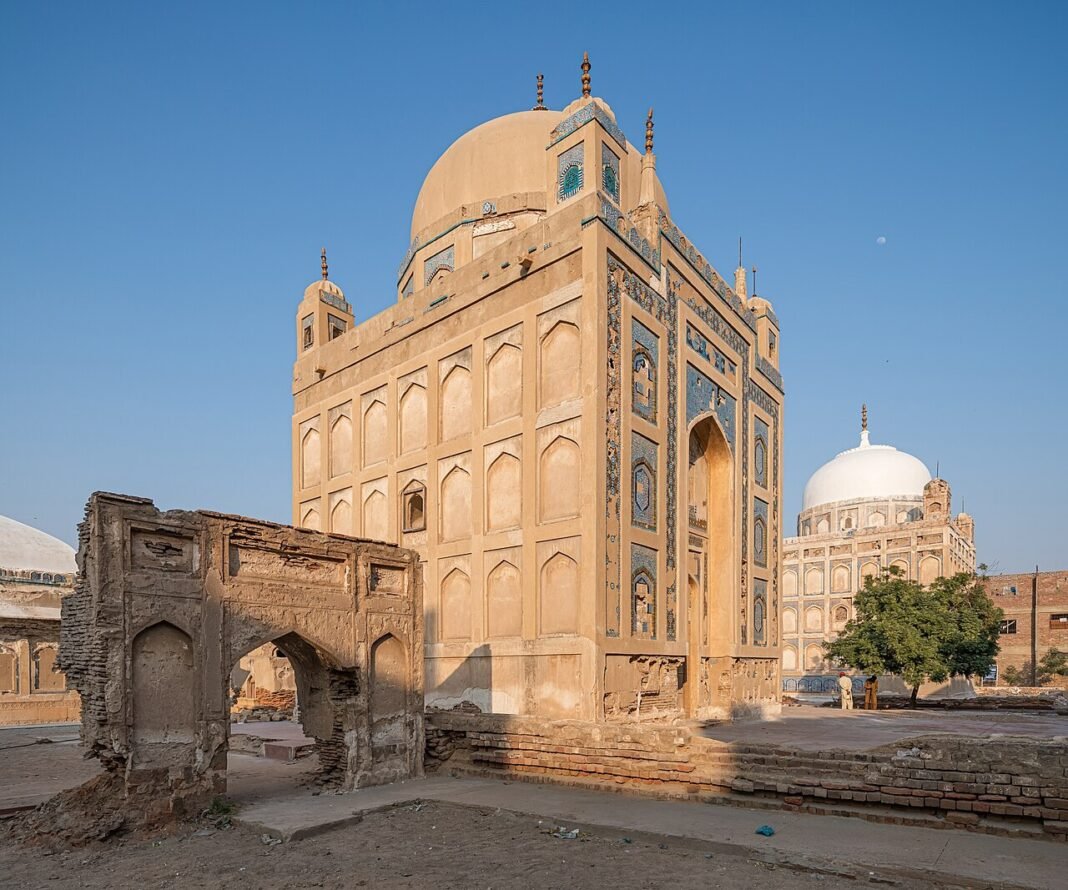
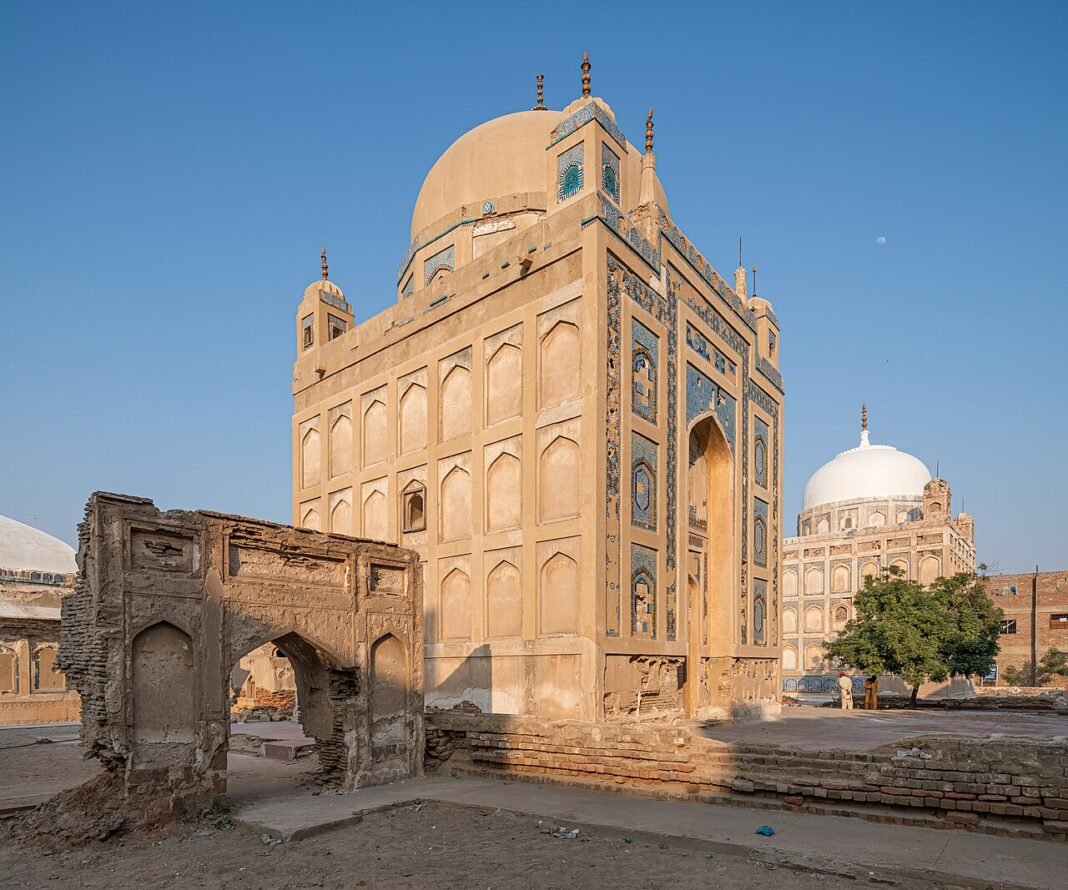
Most travelers racing between Karachi and Hyderabad never notice the turnoff — but a few kilometres off the highway, near the artisan town of Hala, lies one of Sindh’s most evocative royal cemeteries: the tombs of the Talpur Mirs at Khudabad. Also, these are the Cubbas, the great domed mausoleums of the dynasty that ruled Sindh from 1783 to 1843, built of carved sandstone and marble, painted with Quranic calligraphy. In fact, it crowned with domes that catch the desert light. The founder of the Talpur dynasty himself, Mir Fateh Ali Khan, lies here.
And the town beside the tombs — Hala, the centuries-old “city of artisans” famous for its blue kashi pottery — gives you the living craft to go with the dead kings. This Hala Monuments (Mirs Tombs) travel guide is for the traveler who wants Sindh beyond the obvious: real 18th-century royal architecture, one of Pakistan’s great craft towns. The shrines and stories that surround them.
Quick Facts
- Location: Khudabad, near Hala, Matiari district, Sindh, on the left bank of the Indus
- Altitude: Low Indus plain, close to sea level
- Famous For: The domed tombs (Cubbas) of the Talpur Mirs who ruled Sindh 1783–1843; the mausoleum of Mir Fateh Ali Khan; Hala’s blue kashi pottery and handicrafts
- Nearest City: Hyderabad, about 56 km to the south
- Accessibility: Easy road access via Hyderabad; about an hour’s drive north
- Known Landmarks: Mausoleum of Mir Fateh Ali Khan Talpur, the canopied graves of Mir Sobdar Khan and Mir Bahram Khan, the shrine of Makhdoom Nooh in Hala, Bhit Shah
- Best For: Heritage and architecture lovers, craft shoppers, Sufi trail travelers, photographers, day-trippers from Hyderabad or Karachi
Why Visit Hala Monuments (Mirs Tombs)
Sindh’s royal tombs are world-famous at Makli. But the Talpur Mirs, the last native dynasty to rule Sindh, built their own necropolises. Also, the one near Hala is the most atmospheric of them. At Khudabad, the tombs stand in the open Sindhi landscape much as they have for two centuries: square and rectangular mausoleums with ribbed domes, canopies on eight sandstone pillars, graves inscribed with Persian calligraphy giving the names and death dates of the dignitaries below.
The craftsmanship is extraordinary — floral and geometric panels carved from solid stone by the master stonemasons of the Talpur period, marble grave surfaces, and traces of the glazed kashi tiles that once covered the outer walls. It is a quieter, more intimate encounter with royal Sindh than the great crowded necropolises.
Kashi Pottery and the Poet-Saint’s Shrine
Then there is Hala itself, and no heritage trip here is complete without it. This is one of the oldest craft towns in South Asia, a leading centre of the Suhrawardi Sufi tradition since the 16th century and famous across the subcontinent for art, woodwork, cloth printing, and above all kashi. The blue glazed pottery and tiles hand-painted for centuries by the town’s Kashigar artisans in cobalt blue, turquoise, mustard, and white. You can walk into the open pottery yards, watch the clay being wedged, painted. It fired in wood-fuelled kilns, and buy pieces directly from the families who make them.
Tombs in the morning, potters in the afternoon: that is the perfect Hala day.
And the setting keeps giving. Also, five kilometres away at Bhit Shah lies the shrine of Shah Abdul Latif Bhitai, Sindh’s beloved poet-saint, whose annual urs draws hundreds of thousands. The Indus flows nearby, the old town of Hala keeps its three historic entrance gates (nakas). The whole area hums with the Sufi culture that has defined it for centuries. If you want to understand Sindh — its kings, its crafts, its saints — this small corner of Matiari district teaches it all in a single day.
History of Hala Monuments (Mirs Tombs)
The tombs belong to the Talpurs, the Baloch dynasty that ruled Sindh from 1783 to 1843. The Talpurs rose by defeating the Kalhora dynasty at the Battle of Halani, and their rule was formalised when the Mughal emperor Shah Alam II issued a firman in 1783 declaring Mir Fateh Ali Khan Talpur the Nawab of Sindh. For sixty years the Mirs — “Mir” being the title of the Talpur rulers — governed from Hyderabad, building mosques, forts, and, characteristically, magnificent tombs for their dead.
Their reign ended in 1843 when they lost to the British forces of General Charles James Napier at the Battle of Miani (and, in the same campaign, at Dubbo, where Mir Sher Muhammad Khan — the “Lion of Sindh” — led the Talpur army).
Three Royal Cemeteries of the Talpurs
The Talpurs built three great royal cemeteries: the famous complex at Hirabad in Hyderabad, the royal cemetery at Chitori near Mirpurkhas (burial place of the Manikani Talpurs, including Mir Ali Murad Talpur, founder of Mirpurkhas). Also, the complex at New Khudabad near Hala — the Shahdadani Talpurs’ necropolis. The Khudabad complex follows the same architectural language as the Hyderabad tombs: domed mausoleums the Sindhis call Cubbas, built of chiroli, lime, jute, and burnt brick, with marble floors and grave surfaces, Quranic verses in Secco painting on the inner walls, and kashi tiles on the outer faces.
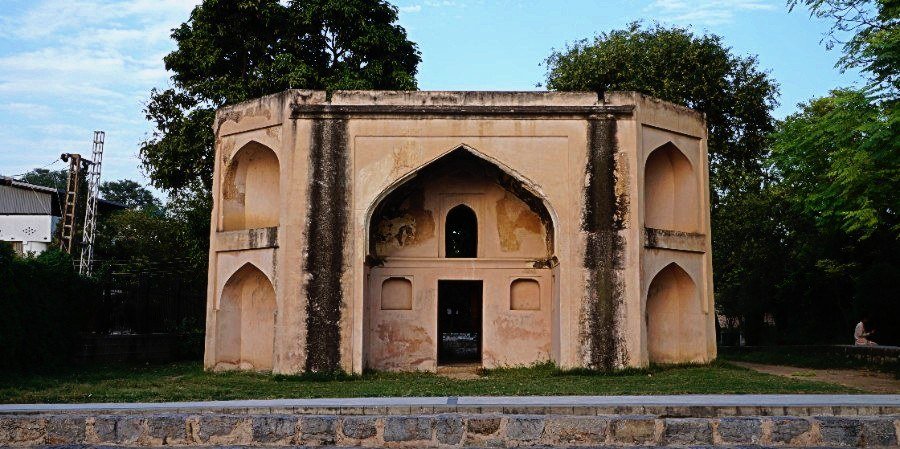
The principal mausoleum at Khudabad is that of Mir Fateh Ali Khan himself, the founder of the dynasty. Around it stand the canopied graves of his kin, their inscriptions still legible: Mir Sobdar Khan Talpur (died 1119 AH), Mir Bahram Khan Talpur (1189 AH). Mir Bijar Khan Talpur (1194 AH), each under an eight-pillared sandstone canopy decorated with floral and geometric motifs, the domes whitewashed and crowned with inverted lotus flowers. It is said the Mirs designed their own burial places while still alive. These are monuments of intention, not accident.
Since 2011 the complex has been in the charge of the Culture Department of the Government of Sindh, and slow, steady restoration work continues.
Hala’s own history runs even deeper. Also, the town, on the left bank of the Indus about 35 miles north of Hyderabad, was given taluka status in 1848 and has been a centre of Sufi learning for centuries, with the shrine of Hazrat Makhdoom Nooh at its heart. Its craft fame — kashi pottery, woodwork, cloth printing, sussi and khaddar weaving — made it known across the subcontinent long before the modern era.
Top Things to Do in Hala Monuments (Mirs Tombs)
Walk the Khudabad tomb complex
Give the necropolis an unhurried hour. Start at the mausoleum of Mir Fateh Ali Khan, the dynasty’s founder, then move among the canopied graves, reading the Persian inscriptions that name each Mir and give his date of death in the Hijri calendar. Look closely at the carved sandstone panels — the floral and geometric designs are the finest work of the Talpur stonemasons — and at the mason’s marks still visible on some slabs. The domes, the quiet, and the open sky make this one of Sindh’s most photogenic heritage sites, best in the soft light of morning or late afternoon.
Visit Hala’s kashi pottery yards
Hala is one of the two great centres of kashi in Sindh (the other being Nasarpur). Also, its pottery yards are working places, not museums. In fact, in the open courtyards you can watch the whole process: clay mixed and wedged, vessels shaped on the wheel, designs painted by hand in the signature cobalt blue and turquoise. In addition, the long firing in wood-fuelled kilns. The artisans — the Kashigars — have passed the craft from father to son for generations. Buy directly from the yards: plates, tiles, vases, and everyday earthenware, each piece unique.
Pay respects at the shrine of Makhdoom Nooh
In the centre of Hala town, reached through the old nakas (entrance gates) and the main shopping street, stands the mausoleum of Hazrat Makhdoom Nooh, the saint at the heart of the town’s spiritual life. Also, visitors come from across the region to pay homage. In fact, dress modestly, remove your shoes, and take in the atmosphere of a living shrine that has anchored this town for centuries.
Make the short trip to Bhit Shah
About five kilometres from Hala lies Bhit Shah, home to the shrine of Shah Abdul Latif Bhitai — Sindh’s greatest poet, whose verses every Sindhi child knows. Also, the shrine, decorated with the blue kashi tiles of Hala’s own artisans, is one of the most beautiful in the province. In fact, time your visit for the evening. The crowds gather and the air fills with the sound of the saint’s poetry.
Explore Hala’s old town and bazaars
Hala keeps its historic structure: three main entrance gates, the shrine at the centre. Also, the main shopping street running through it. The bazaar sells the town’s crafts — pottery, woodwork, printed cloth, sussi — alongside everyday goods. It is also worth simply walking the lanes to see the woodwork on old doorways and balconies, another of Hala’s famous crafts.
Famous Places In and Around Hala Monuments (Mirs Tombs)
- Mausoleum of Mir Fateh Ali Khan — the founder of the Talpur dynasty, centrepiece of the Khudabad complex
- Canopies of Mir Sobdar Khan, Mir Bahram Khan, and Mir Bijar Khan — inscribed 18th-century graves under carved sandstone canopies
- Hala kashi pottery yards — the working workshops of the Kashigar artisans
- Shrine of Hazrat Makhdoom Nooh — Hala town’s central Sufi shrine
- Bhit Shah — shrine of Shah Abdul Latif Bhitai, about 5 km away
- Talpur Tombs, Hyderabad (Hirabad) — the dynasty’s main necropolis, about 56 km south
- Chitori necropolis, Mirpurkhas — the Manikani Talpurs’ royal cemetery
- Nasarpur — the other great kashi pottery town of Sindh
How to Reach Hala Monuments (Mirs Tombs)
Hala sits on the left bank of the Indus in Matiari district, about 35 miles (56 km) north of Hyderabad — roughly an hour’s drive on the N-5 National Highway. Also, From Karachi, it is about 220 km via the M-9 Motorway and N-5, a drive of three and a half to four hours. The Khudabad tomb complex lies just outside Hala town. Ask locally for the Talpur tombs or “Miran ja Quba” and any driver will know the way. From Hyderabad, frequent vans and buses run north to Hala. A rickshaw or taxi covers the last stretch to the tombs.
From Lahore and Islamabad, the journey is long — well over a thousand kilometres — so the sensible plan is to fly to Karachi (or take the train to Hyderabad) and drive north from there. Also, the nearest practical airport is Jinnah International Airport in Karachi. The roads are metalled and in good condition year-round; the N-5 through Matiari district is a busy, well-maintained highway.
Route Details
From Hyderabad: Take the N-5 north toward Hala (about 56 km, one hour). In Hala town, follow the main road and ask for the Khudabad Talpur tombs. From Karachi: M-9 Motorway to Hyderabad, then N-5 north to Hala (about 220 km total, 3.5–4 hours). Suggested day plan: Leave Hyderabad by 8 am, reach the tombs by 9, spend the morning at Khudabad, lunch in Hala, the afternoon in the pottery yards and the Makhdoom Nooh shrine. Bhit Shah at sunset before returning.
Where to Stay in Hala Monuments (Mirs Tombs)
Hala is a small craft town, and most visitors do it as a day trip from Hyderabad — about an hour away — where the full range of hotels, from good mid-range properties to budget guesthouses, is available. Also, Hyderabad makes the ideal base: you can combine the Hala tombs with the city’s own Talpur tombs at Hirabad, the Pacco Qillo. In fact, the riverfront in a two-day heritage circuit. Hala town itself has simple local guesthouses and rest houses for travelers who want an early start at the tombs or a full day in the pottery yards.
An overnight in Hyderabad makes it far more relaxed.. Still, From Karachi, the trip is also very doable in a day (3.5–4 hours each way), There is no formal tourist camping at the tomb complex. The site is a protected heritage area, so plan on proper lodging in Hala or Hyderabad. Book Hyderabad hotels a few days ahead if you are traveling during the Bhit Shah urs. The whole district fills up.
Where to Eat: Local Foods of Hala Monuments (Mirs Tombs)
The food of the Hala region is the food of rural Sindh: hearty, spicy, and built around the Indus plain’s produce. The classic Sindhi dishes are all here — sai bhaji (the slow-cooked spinach, lentil, and vegetable medley that is Sindh’s signature), dal pakwan (crisp flatbread with chana dal, the beloved Sindhi breakfast), and fresh river fish, fried or curried, from the Indus. Also, the dhabas along the N-5 and in Hala’s bazaar serve these at very budget-friendly prices. A full meal for one person costs only a few hundred rupees.
Do not leave without trying the fresh lassi and chaas (buttermilk) sold in the bazaar, and in season the region’s dates and mangoes. Also, Hala’s sweet shops sell the standard Sindhi mithai — try the fresh jalebi in the morning. As everywhere in interior Sindh, carry your own drinking water for the tomb visit, and eat your main meal in town rather than at the site.
Weather in Hala Monuments (Mirs Tombs)
Hala sits on the low Indus plain of interior Sindh, which means a classic hot-arid climate: fierce summers, mild and delightful winters. A short monsoon. The difference between January and June here is one of the starkest in Pakistan, and it dictates your trip entirely. Winter days are made for sightseeing — cool, clear, and golden — while summer afternoons at the exposed tomb complex would be punishing. The monsoon brings some rain in July and August but rarely disrupts travel for long.
| Season | Temperature Range | Conditions |
|---|---|---|
| Winter (Nov–Feb) | 10–26°C | Cool, clear, and perfect for the tombs and town |
| Spring (Mar–Apr) | 18–38°C | Warming fast; visit early in the day |
| Summer (May–Jul) | 30–45°C | Extreme heat; avoid midday outdoor sightseeing |
| Monsoon (Jul–Aug) | 30–40°C | Humid with occasional heavy showers |
| Autumn (Sep–Oct) | 20–38°C | Cooling gradually; pleasant by late October |
Language and Culture of Hala Monuments (Mirs Tombs)
Sindhi is the language of Hala. Also, the town is deep in the Sindhi heartland, and you will hear the saint’s poetry quoted in everyday conversation. Urdu is widely understood, so visitors from elsewhere in Pakistan will manage comfortably. The culture is Sufi to its core: shrines are the centre of social life, hospitality to travelers is a point of pride. The craft traditions are treated as a sacred trust passed down through families.
Etiquette is simple and important: dress modestly, remove shoes at shrines and in the tomb chambers, and ask before photographing artisans at work — most are proud to show you. A greeting first is proper. Women travelers will find the town conservative but welcoming; a headscarf is appreciated at the shrines. If a Kashigar family invites you to watch the firing or try the potter’s wheel, accept. It is the memory you will keep longest.
Shopping in Hala Monuments (Mirs Tombs)
This is one of the best craft-shopping destinations in Sindh. Also, the kashi pottery yards sell plates, tiles, vases, and earthenware in the signature blues and turquoises, painted entirely by hand — each piece is unique, and prices are a fraction of what the same work fetches in Karachi galleries. In fact, buy directly from the makers: you will pay honest workshop prices and the money goes to the artisan family. Hala’s woodwork — carved doors, furniture, and decorative pieces — and its printed cloth and sussi are the other traditional buys.
Bargaining is expected but should stay friendly; these are family workshops, not tourist traps. Wrap pottery carefully for the journey — the yards will pack pieces in straw if you ask. There are no shopping malls in Hala. The bazaar itself, with its craft shops and sweet stalls, is the whole experience.
Local Events and Festivals
The great annual event of the area is the urs of Shah Abdul Latif Bhitai at Bhit Shah, about five kilometres from Hala. Also, held each year on the 14th of Safar in the Islamic lunar calendar, the three-day urs draws hundreds of thousands of devotees from across Sindh and beyond — qawwali and folk music through the night, the saint’s poetry recited for days. The shrine glowing under lights. It is one of the most moving festivals in Pakistan, and accommodation across Matiari district books out, so plan well ahead.
Hala town’s own shrine of Makhdoom Nooh holds its annual urs as well, a smaller but deeply local celebration. Because urs dates follow the lunar calendar, confirm the current year’s dates before traveling. A Hyderabad tour operator or hotel can verify them.
Travel Tips for Hala Monuments (Mirs Tombs)
Packing Essentials
Sun protection year-round: cap, sunglasses, sunscreen — the tomb complex is completely exposed. Also, in winter, a light jacket for cool mornings; in the warmer months, light cotton and extra water. Sturdy walking shoes for the uneven ground of the necropolis. If you are buying pottery, bring bubble wrap or old clothes for padding, though the yards pack well.
Safety Tips
The Hala area is peaceful and accustomed to visitors. The main precautions are environmental: heat in summer. Also, the usual care on the busy N-5 highway. In fact, at the tomb complex, watch your footing on old masonry and do not climb on the structures. They are protected heritage and fragile in places. Keep valuables discreet in crowded bazaar and urs gatherings.
Money & Connectivity
Carry cash in rupees: the pottery yards, bazaar, and dhabas are cash-only, and while Hala town has basic banking, the nearest reliable ATMs are in Hyderabad. All major mobile networks cover the N-5 corridor and Hala town. Download offline maps for Matiari district before you leave Hyderabad, since rural lanes around Khudabad are poorly signposted.
Best Time to Visit Hala Monuments (Mirs Tombs)
Winter (November to February) — the ideal season
Cool, clear days made for walking the necropolis and the pottery yards. Also, the light is beautiful, the crowds are thin, and Hala is at its most pleasant. This is when to come.
Spring (March to April) — good, warming
Still very visitable, especially in March. By April the heat builds — start at the tombs at opening time and spend the midday hours in the shaded pottery yards.
Summer and Monsoon (May to August) — avoid
Interior Sindh’s summer is extreme, and the exposed tomb complex offers no shelter. If you must travel then, restrict sightseeing to dawn and dusk.
Autumn (September to October) — the shoulder sweet spot
Late October brings real relief. Also, pair it with the Bhit Shah urs season (dates vary by the lunar calendar) for the area’s most memorable weeks.
Final Thoughts
The Mirs of Sindh ruled for sixty years, built beautifully, and then vanished into history — and at Khudabad near Hala, their memory is still standing in carved sandstone under the Sindhi sky. Also, combine those silent, gorgeous tombs with the living craft of Hala’s pottery yards and the spiritual pull of Bhit Shah. You have a day that captures the whole soul of Sindh: its kings, its artisans, its saints.
Go in winter. Also, walk the necropolis slowly, buy a blue plate from the hands that painted it, and end your day at Bhit Shah as the sun goes down. Few corners of Pakistan give you this much — history, craft, and devotion — in so small a compass.
FAQs
Where are the Hala Monuments (Mirs Tombs)?
At Khudabad near Hala town, Matiari district, Sindh — about 56 km north of Hyderabad on the left bank of the Indus.
Who were the Talpur Mirs?
The Baloch dynasty that ruled Sindh from 1783 to 1843, after defeating the Kalhoras. Also, Mir Fateh Ali Khan Talpur, buried at Khudabad, was the dynasty’s founder.
What is the best time to visit the Mirs Tombs?
November to February, when interior Sindh is cool and clear. Avoid the extreme heat of May to August.
How do I reach Hala from Hyderabad?
Drive north on the N-5 National Highway — about 56 km, one hour. Also, From Karachi it is about 220 km via the M-9 and N-5, roughly 3.5–4 hours.
Is the site safe for tourists?
Yes. Also, the area is peaceful and used to visitors. Take normal precautions against heat and highway traffic. In fact, it do not climb on the fragile monuments.
Is it suitable for families?
Very — the sites are close together, the walking is easy in winter, and children love the pottery yards. Also, combine with Bhit Shah for a full family day.
What should I buy in Hala?
Hand-painted blue kashi pottery and tiles directly from the artisans’ yards, plus woodwork and printed cloth from the bazaar. Also, prices are honest workshop prices.
Can I combine the tombs with Bhit Shah?
Easily — Bhit Shah, with the shrine of Shah Abdul Latif Bhitai, is only about 5 km from Hala. Also, the tombs in the morning, Hala town at midday, and Bhit Shah at sunset is the classic itinerary.
For more heritage journeys, browse our Explore Pakistan section, or head for the mountains with our Hunza Valley guide and Malam Jabba guide.
? Discover why they deserve your visit, the best time to go, top things to do and how to reach.)