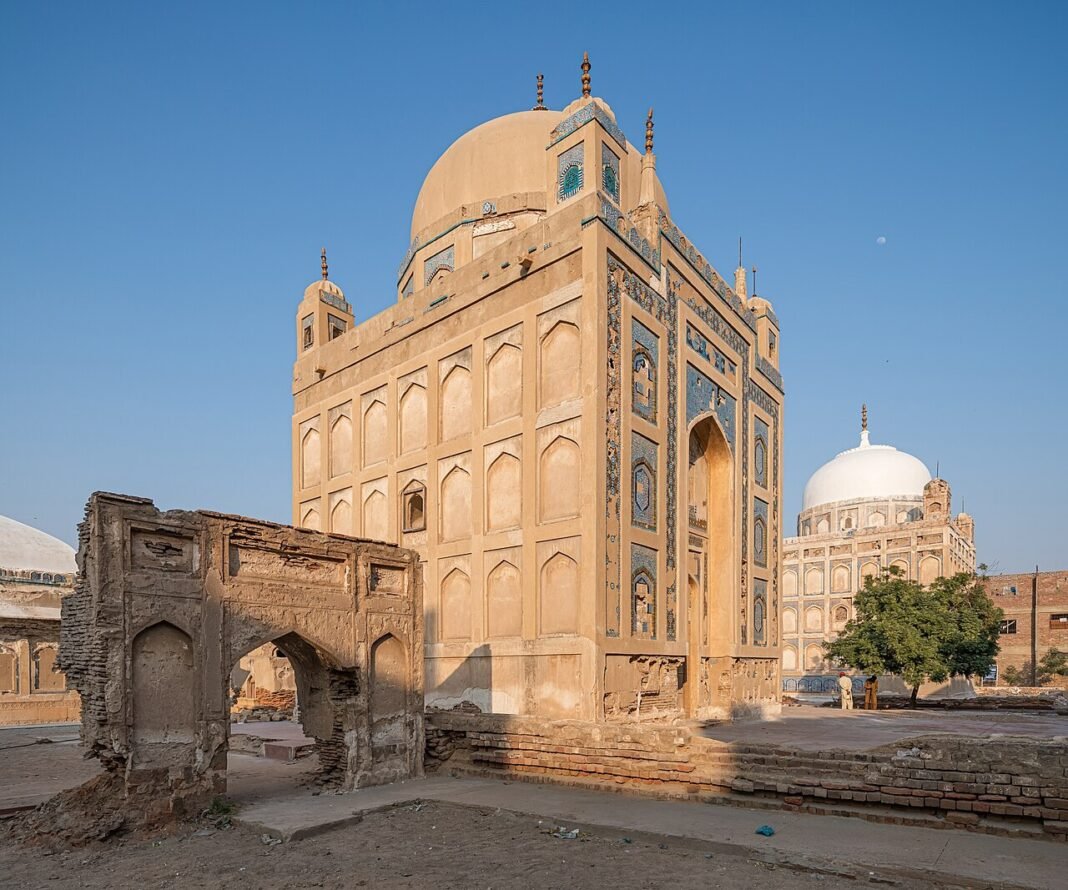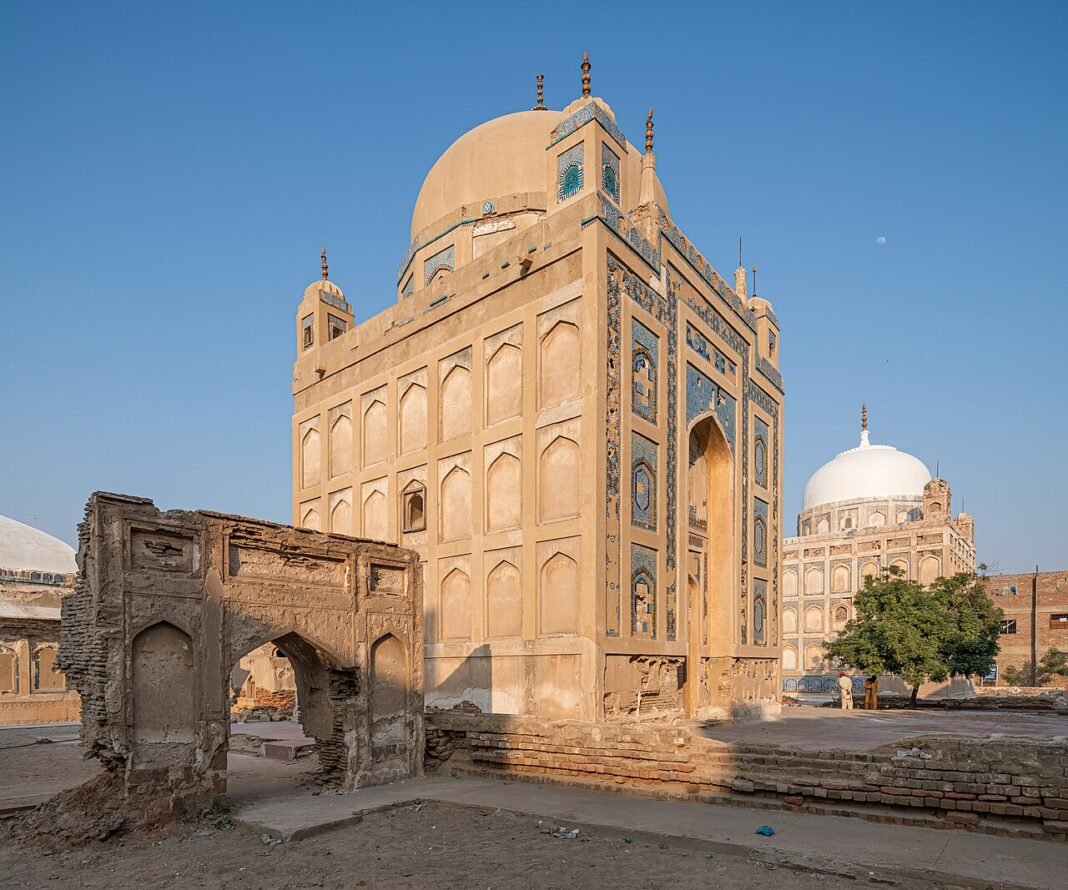
In the old Hirabad quarter of Hyderabad, Sindh, behind high walls and beneath a sky that has watched empires come and go, lies the last resting place of a dynasty. Also, the Haram of Talpur Mirs — better known as the Tombs of the Talpur Mirs, or in Sindhi, Miran Ja Qubba (the Domes of the Mirs) — is a walled necropolis of domed mausoleums where the rulers of Sindh (1784–1843) lie under marble graves inlaid with Quranic verse and glowing with kashi tilework. It is one of the most atmospheric heritage sites in Pakistan, and one of the least visited.
This Haram of Talpur Mirs travel guide will help you decide whether this remarkable complex belongs on your Sindh itinerary — the real history of the Talpur dynasty and its fall to the British in 1843, what to see inside the haram, how to reach Hyderabad from Karachi and beyond, where to stay, what to eat, and practical tips for visiting. For more heritage journeys, browse our Explore Pakistan collection and our Malam Jabba guide for a northern contrast.
Quick Facts
- Location: Hirabad, Hyderabad, Sindh, Pakistan
- Altitude: Low — Hyderabad sits on the east bank of the Indus on a limestone ridge, around 40 metres above sea level
- Famous For: Domed mausoleums (cubbas) of the Talpur Mirs who ruled Sindh 1784–1843; marble graves with Quranic inscriptions; blue-and-white kashi tilework; royal turbans carved on the graves
- Nearest City: Hyderabad itself — the complex is inside the old city; Karachi is about 165 km southwest
- Accessibility: Easy — inside Hyderabad city, reachable by car, rickshaw or taxi; public access is allowed
- Known Landmarks: The great double-grave mausoleum of Mir Karam Ali Khan (d. 1828) and Mir Murad Ali Khan (d. 1833); the northern mausoleum of Mir Nur Muhammad Khan, Mir Nasir Khan, Mir Shahdad Khan and Mir Hussain Ali Khan; nearby Pacco Qillo (Pucca Fort), Rani Bagh
- Best For: History lovers, architecture and photography enthusiasts, students of Sindh’s heritage, and cultural travellers
Why Visit Haram of Talpur Mirs
The first reason is the history you can stand inside. The Talpurs were the last independent rulers of Sindh. Also, a Shia Muslim dynasty that ended centuries of Mughal and Afghan overlordship, ruled through a remarkable system of collective brotherhood, and fell only to the British East India Company in 1843. In fact, their tombs are not just beautiful buildings. They are the full stop at the end of Sindh’s sovereignty, the place where an independent kingdom’s story is literally set in stone.
Walking among the domes, reading the Persian and Arabic inscriptions, you are walking through the final chapter of a history most Pakistanis never learned in school.
Turbaned Tombs in Stone
The second reason is the architecture. Also, the haram’s mausoleums blend Mughal, Rajput and indigenous Sindhi styles into something distinctly Talpur: square and rectangular chambers under swelling domes, walls of marble carved with Quranic verses. In fact, the famous kashi work — glazed tiles in blue floral patterns on white, with accents of green, yellow and brown. In true Talpur fashion, the marble graves carry the rulers’ actual royal turbans, carved in stone on projections at the head of each grave. It is said the Mirs designed their own burial places while still alive — and the care shows.
For photographers, the interplay of dome, tile and harsh Sindhi light is endlessly rewarding.
The third reason is the quiet. Unlike Lahore’s Badshahi Mosque or Thatta’s Shah Jahan Mosque, the Haram of Talpur Mirs receives few visitors. You will likely have the complex largely to yourself, free to wander, photograph and contemplate without crowds or hawkers. In a country where heritage sites are often either mobbed or neglected, the haram offers something rare: a major monument you can experience in something close to the silence its builders intended.
Who is it perfect for? Also, anyone interested in Sindh’s history and the colonial encounter. Architecture students; photographers; and travellers doing a Hyderabad heritage day (the haram pairs perfectly with Pacco Qillo and Rani Bagh). When to go? November to February — Hyderabad’s winter is mild and pleasant, while summer temperatures are brutal. The rest of this guide covers everything you need.
History of Haram of Talpur Mirs
To understand the haram, you must understand the Talpurs. The Talpur Mirs were a Baloch-origin Shia Muslim clan who rose to power in Sindh in the late 18th century, overthrowing the Kalhora dynasty. From 1784 to 1843 they ruled Sindh — first from Khudabad, then, from 1789, from Hyderabad. Also, this mir Fateh Ali Khan made his capital. (Hyderabad itself had been founded in 1768 by the Kalhora ruler Mian Ghulam Shah Kalhoro on the site of the ancient settlement of Nerun Kot.)
The Rule of Four Friends
The Talpur system of rule was unusual: a form of collective kingship. Mir Fateh Ali Khan ruled jointly with his three brothers — a brotherhood remembered in Sindhi tradition as the Char Yari, the “Four Friends” — sharing power and administration rather than concentrating it in one monarch. Despite internal rivalries, the Talpur decades brought relative peace, economic prosperity and a flourishing of Sindhi culture. Hyderabad grew as a political and cultural capital, its court a centre of Persian and Sindhi letters.
The end came with the British. Meanwhile, after the First Anglo-Afghan War, the East India Company turned its attention to Sindh. In fact, treaties were signed and broken. In 1843, Sir Charles Napier’s forces defeated the Talpurs at the Battle of Miani (followed by the Battle of Dubba). Sindh was annexed to British India. The Mirs were deposed and exiled. The tombs in Hirabad thus mark not only individual rulers but the grave of an independent Sindh.
The Haram Complex Itself
The haram complex itself was built across the Talpur period. Also, the Directorate General of Antiquities places the main group of tombs at approximately 1812–1843, with the oldest associated with Mir Karam Ali Khan and Mir Murad Ali Khan. In fact, the largest domed structure holds the graves of Mir Karam Ali Khan (d. In addition, 1828) and Mir Murad Ali Khan (d. 1833); behind it a smaller building holds the graves of Mir Karam’s two wives, the wife of Mir Abdullah Khan, and an infant.
To the north stands the mausoleum containing Mir Nur Muhammad Khan, Mir Nasir Khan, Mir Shahdad Khan and Mir Hussain Ali Khan. Around them are smaller mausoleums for wives, consorts and infant children, and outer graves — many unmarked. The architecture follows the specifications of the earlier mausoleum of Mir Fateh Ali Khan at New Khudabad, the dynasty’s first great tomb.
After 1843 the complex entered a long twilight. Once a magnificent royal burial ground, it suffered decades of neglect and encroachment — a story familiar to heritage sites across South Asia. Following the devolution of government to the provinces, the Culture Department, Government of Sindh, took charge of the monuments on 30 March 2011, and slow, steady restoration work has been underway since. Preservation concerns remain — this is a fragile site — but the haram survives as Sindh’s most eloquent monument to its last kings.
Top Things to Do in Haram of Talpur Mirs
The great double mausoleum
Begin at the complex’s centrepiece: the largest domed structure, containing the graves of Mir Karam Ali Khan (died 1828) and Mir Murad Ali Khan (died 1833). Also, study the marble work. In fact, the Quranic verses inscribed on the graves, the carved royal turbans at the head of each, the proportions of dome to chamber. This is the architectural high point of the haram and the tomb most associated with the dynasty’s mature style.
The northern mausoleum of the four Mirs
To the north stands the mausoleum holding Mir Nur Muhammad Khan, Mir Nasir Khan, Mir Shahdad Khan and Mir Hussain Ali Khan — four rulers under one roof, a fitting monument to the Talpurs’ collective kingship. Also, compare its details with the great double tomb: each mausoleum in the complex is unique in design and decoration, reflecting the personality and status of those buried within.
The smaller mausoleums and outer graves
Do not overlook the smaller structures. The mausoleums of wives, consorts and infant children, and the uncovered, mostly unmarked graves of the outer area. Also, these quieter corners tell the human side of the dynasty: the women and children history books forget. The kashi tilework here, in blue florals on white with green, yellow and brown accents, repays close looking.
Read the inscriptions
The tombs carry inscriptions in Arabic, Persian and Sindhi — Quranic verses on the graves, Persian poetry on some interior walls, genealogical and historical information in Sindhi. Even if you cannot read them, their presence is the point: this was a literate, cosmopolitan court. A local guide or caretaker can often translate key inscriptions and point out details you would otherwise miss — hiring one enriches the visit enormously.
Photography
The haram is a photographer’s delight: domes against the hard blue Sindhi sky, tilework in raking light, long shadows across courtyards, the carved turbans in close-up. Also, morning light is softest; late afternoon gives the domes a warm glow. In fact, be respectful — this is a burial ground. Dress modestly, keep voices low, and remember that the graves are the resting places of real people, revered by many Sindhis.
Famous Places In and Around Haram of Talpur Mirs
- Pacco Qillo (Pucca Fort): Hyderabad’s great baked-brick fort, begun under the Kalhoras and the seat of Talpur power — the essential companion visit to the tombs.
- Rani Bagh: Hyderabad’s historic public garden, a pleasant green pause between heritage stops.
- Tombs of the Kalhora rulers: The Talpurs’ predecessors lie in their own tomb complex in Hyderabad — visiting both tells the full story of 18th-century Sindh.
- Shahi Bazaar and old Hyderabad: The winding old-city bazaars around the fort, full of traditional crafts, bangles and street food.
- Bhit Shah: About 60 km away — the shrine town of Shah Abdul Latif Bhittai, Sindh’s greatest Sufi poet, and the spiritual heart of Sindhi culture.
How to Reach Haram of Talpur Mirs
The haram is in Hirabad, in Hyderabad’s old city — easy to reach once you are in Hyderabad. Also, Hyderabad itself is well connected. In fact, From Karachi it is about 165 km northeast on the M-9 Motorway/N-5, roughly 2 to 2.5 hours by car. Within Hyderabad, take a rickshaw or taxi to Hirabad and ask for the Talpur tombs (Miran Ja Qubba) — every local driver knows them.
Route Details
- From Karachi: Take the M-9 Motorway (or the N-5 National Highway) northeast to Hyderabad — about 165 km, 2 to 2.5 hours. Enter the old city toward Hirabad; the tomb complex is signposted locally. This works as a long day trip from Karachi, though an overnight in Hyderabad lets you see the fort and tombs unhurried.
- From Hyderabad (city): The haram is in the old city — 15–25 minutes by rickshaw or taxi from most central hotels. Combine it with Pacco Qillo (Pucca Fort) and Rani Bagh in a single heritage half-day.
- From Islamabad/Lahore: Fly to Karachi or Hyderabad region, then drive as above. Hyderabad is also on the main railway line — Pakistan Railways runs regular services from Karachi, Lahore, Rawalpindi and Peshawar to Hyderabad Junction.
Nearest airport: Jinnah International Airport, Karachi — about 165 km from Hyderabad. Also, (Hyderabad has an airport with limited services. Karachi is the reliable gateway.) Road conditions: The M-9 Motorway is excellent. Old-city streets around Hirabad are narrow and congested — park outside and walk or take a rickshaw for the last stretch. Transport options: Private car, intercity bus/coach (Karachi–Hyderabad services are frequent and comfortable), train to Hyderabad Junction, then local rickshaw or taxi.
Where to Stay in Haram of Talpur Mirs
Stay in Hyderabad — the haram is a city sight, not a remote destination. Also, the city has options at every level.
Luxury: Hyderabad’s best hotels (including well-known properties on Thandi Sarak and autobahn road) offer comfortable, modern stays with restaurants and reliable air-conditioning — essential in summer. Mid-range: A good selection of mid-range hotels and guesthouses around Latifabad and the city centre cater to business and leisure travellers. Budget: Plenty of budget hotels near Hyderabad Junction railway station and in the old city offer basic, clean rooms at very reasonable rates. Camping: Not applicable — this is an urban heritage visit. Book ahead during wedding season (winter) and public holidays, when Hyderabad’s hotels fill up.
Where to Eat: Local Foods of Haram of Talpur Mirs
Hyderabad is one of Sindh’s great food cities, and a heritage day deserves a proper meal. Also, the city’s signature is Sindhi biryani. In fact, And Hyderabad’s version, fiercely spiced with potatoes and green chillies, is considered the definitive one. In addition, try sai bhaji (spinach-lentil curry), koki (crisp flatbread), busri (sweet stuffed flatbread), and thadal, the cooling almond-cardamom drink. For example, Hyderabad’s Bombay Bakery is legendary across Pakistan for its coffee cake and macaroons — a perfect edible souvenir. The old city’s food streets around Shahi Bazaar serve barbecue, haleem, and fresh sweets at budget-friendly prices.
A full meal at a local restaurant is very affordable; even a generous spread for two rarely strains the wallet. Eat where the locals eat — the busiest dhaba is usually the best one.
Weather in Haram of Talpur Mirs
Hyderabad has a hot desert climate: long, fierce summers and short, mild winters. This matters enormously for sightseeing. Also, the haram is an outdoor site with limited shade. In fact, a summer midday visit is punishing. November to February is the season: mild days, cool evenings, perfect for walking among the tombs. March–April and October are transitional; May to September is genuinely extreme, with temperatures among the highest in Pakistan.
| Season | Temperature Range | Conditions |
|---|---|---|
| Winter (Dec–Feb) | 8°C to 26°C | Ideal — mild, sunny, perfect for heritage sightseeing |
| Spring (Mar–May) | 20°C to 42°C | Heating up fast; visit early morning only by May |
| Summer (Jun–Aug) | 30°C to 45°C | Extreme heat; avoid outdoor sightseeing midday |
| Autumn (Sep–Nov) | 18°C to 38°C | Cooling down; November turns pleasant again |
Language and Culture of Haram of Talpur Mirs
Hyderabad is the beating heart of Sindhi culture. Also, Sindhi is the city’s soul language, heard everywhere from the bazaars to the shrines, with Urdu widely spoken and English understood in hotels and by guides. In fact, the city’s identity is inseparable from Sufism: the shrine of Shah Abdul Latif Bhittai at nearby Bhit Shah draws pilgrims year-round. The values of tolerance, poetry and hospitality associated with Sindh’s Sufi tradition permeate daily life.
For visitors to the haram: this is a burial ground — dress modestly (cover shoulders and knees. Also, women should carry a scarf), speak quietly, and treat the graves with the respect you would show in any cemetery. In fact, do not climb on the tombs or remove anything. Ask the caretakers before photographing people. A small tip for a caretaker or guide who shows you around is customary and appreciated. Beyond the haram, Hyderabad’s old city rewards the respectful traveller: greet shopkeepers, accept offered tea. You will find the city opens up to you.
Shopping in Haram of Talpur Mirs
The haram itself has no shops — but old Hyderabad around it is a shopper’s delight. Shahi Bazaar, one of Pakistan’s oldest markets, sells everything from traditional Sindhi ajrak and rilli to bangles — Hyderabad is famous across Pakistan for its glass bangles. Also, the churi markets are a spectacle in themselves. Look for Sindhi embroidery, block prints, traditional caps. Hala pottery (the blue-glazed ceramics of nearby Hala, sold in Hyderabad’s craft shops). Sweets from the old city’s halwais and the famous Bombay Bakery make excellent take-home gifts.
Bargaining is expected in the bazaars — start at around two-thirds of the asking price and negotiate with good humour. There are modern shopping areas in Latifabad, but the old city’s bazaars are the authentic Hyderabad experience.
Travel Tips for Haram of Talpur Mirs
Packing Essentials
Sun protection is critical — hat, sunglasses, sunscreen — even in winter, the Sindhi sun is strong. Also, comfortable walking shoes (uneven ground, no proper paths in parts). Drinking water — carry your own, as there may be no vendors inside the complex. A camera, modest clothing, and a scarf. A small notebook if you are the historically inclined type — you will want to remember names and dates.
Safety Tips
Hyderabad is generally safe for tourists, and the haram itself is a quiet, low-risk site. Standard precautions apply: keep valuables discreet, use registered transport, and avoid the old city’s most congested lanes after dark unless with a local. Also, the main risk at the haram is structural. It is an old, partly unrestored monument. It do not climb on domes or enter any cordoned-off or visibly unstable areas. Visit in daylight hours.
Money & Connectivity
Bring cash — small notes for rickshaws, tips, snacks and bazaar shopping. Also, ATMs are widely available in Hyderabad city. All mobile networks work well in Hyderabad with good data coverage. The complex has no ticket office formalities reported — but carry ID and a little cash in case of a nominal entry or guide fee.
Best Time to Visit Haram of Talpur Mirs
Winter (November to February) — the season
Mild days, cool evenings, clear skies — perfect for wandering among the tombs, photographing tilework in soft light, and combining the haram with Pacco Qillo and the old city. Also, december and January are the prime months.
Spring (March to April) — the shoulder
Still workable, especially March — go early in the morning before the heat builds. By late April, temperatures start to bite.
Summer (May to September) — avoid
Hyderabad’s summer is among the hottest in Pakistan. Also, outdoor heritage sightseeing is miserable and potentially unsafe at midday. If you must travel then, restrict the haram to a dawn visit.
Autumn (October to November) — the return
Temperatures ease from October; by November the pleasant season is back. A good time for travellers who prefer fewer visitors than the winter peak.
Final Thoughts
The Haram of Talpur Mirs is the kind of place that changes how you see a country. Also, most visitors to Pakistan never hear the Talpurs’ name. In fact, those who walk among their domes in Hirabad come away with a new chapter of history. A dynasty that ruled collectively, built beautifully, resisted an empire, and lost. The carved turbans, the blue kashi tiles, the Persian verses on the walls: all of it speaks of a Sindh that was sovereign, cultured and proud.
Go in winter, go slowly, and go with a guide if you can find one. Stand before the great double tomb of Karam Ali and Murad Ali Khan, and remember that they designed these resting places themselves — men planning, in stone and tile, how they wished to be remembered. Four centuries of visitors have not yet come in the numbers this place deserves. Be among the first.
FAQs
Where is the Haram of Talpur Mirs located?
In Hirabad, in the old city of Hyderabad, Sindh, Pakistan — about 165 km northeast of Karachi.
What is the Haram of Talpur Mirs also known as?
The Tombs of the Talpur Mirs, and in Sindhi, Miran Ja Qubba or Cubbas (the Domes). It is the necropolis of the Talpur Mirs who ruled Sindh from 1784 to 1843.
What is the best time to visit the Haram of Talpur Mirs?
November to February. Also, Hyderabad’s weather is mild and pleasant. In fact, summer (May–September) is extremely hot and best avoided for outdoor sightseeing.
How do I reach the Haram of Talpur Mirs from Karachi?
Drive the M-9 Motorway to Hyderabad (about 165 km, 2–2.5 hours), then take a rickshaw or taxi into the old city to Hirabad. Trains and frequent buses also connect Karachi and Hyderabad.
Stay Safe, Dress Modestly
Is the Haram of Talpur Mirs safe to visit?
Yes. Also, it is a quiet heritage site in Hyderabad’s old city. In fact, visit in daylight, do not climb on the monuments, dress modestly, and use standard city precautions.
Who is buried in the Haram of Talpur Mirs?
The Talpur rulers including Mir Karam Ali Khan (d. Also, 1828) and Mir Murad Ali Khan (d. 1833) in the great double tomb, four Mirs in the northern mausoleum, plus wives, consorts and children in smaller mausoleums.
Where can I stay near the Haram of Talpur Mirs?
In Hyderabad city — options range from the best hotels on Thandi Sarak to mid-range hotels in Latifabad and budget hotels near the railway station and old city.
What else can I see near the Haram of Talpur Mirs?
Pacco Qillo (Pucca Fort), Rani Bagh, the Kalhora tombs, Shahi Bazaar’s craft markets, and — about 60 km away — Bhit Shah, the shrine town of Shah Abdul Latif Bhittai.