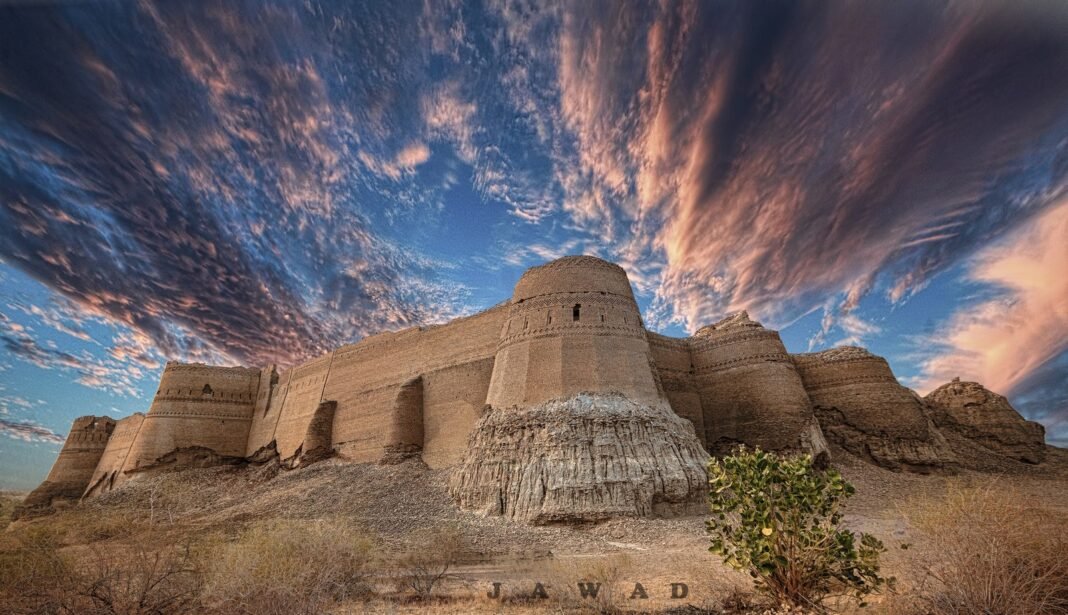
Deep in the Cholistan Desert, a hundred kilometers from the nearest city, the walls of Islamgarh Fort rise out of the sand like a mirage that decided to stay. Built in 1665 by a Rajput king of Jaisalmer, captured and renamed by Muslim rulers, scarred by the 1971 war, this is one of Pakistan’s great forgotten fortresses — and one of its most atmospheric. This Islamgarh Fort travel guide will tell you why the journey into the desert is worth it, and exactly when to go.
Quick Facts
- Location: Khanpur tehsil, Rahim Yar Khan district, Punjab — in the heart of the Cholistan Desert, close to the Indian border
- Built: 1665, by Raja Rawal Siri Bheem Singh of Jaisalmer; originally named Bheem War Fort
- Famous For: Rajput desert architecture, 17th-century history, haunting desert solitude, and proximity to the India–Pakistan border
- Nearest City: Rahim Yar Khan, about 91 km away
- Accessibility: Desert track; a 4×4 vehicle or jeep is essential, ideally with a local guide
- Known Landmarks Nearby: Derawar Fort (about 113 km), Baala Fort (about 46 km), the Cholistan Desert itself
- Best For: History lovers, desert adventurers, photographers, and off-the-beaten-path explorers
A note on the name: the famous Islamgarh Fort — the 17th-century desert fortress described here — stands in the Cholistan Desert of Punjab. There is also a town named Islamgarh in Mirpur, Azad Kashmir. Also, the historic fort of this name is the Cholistan one, listed by the Punjab government’s Cholistan Development Authority.
Why Visit Islamgarh Fort
Some places you visit for what is there. Islamgarh you visit for what it makes you feel. The drive in is a slow dissolve of the modern world: the road narrows, the fields end, the thorn scrub takes over, and then — on a low rise in an ocean of sand — the fort appears. Its massive walls, built of stone hauled on oxen carts from Jaisalmer three and a half centuries ago, have watched empires rise and fall without moving an inch. Standing before them at sunset, with no other soul for kilometers, is one of the most powerful experiences in Pakistani heritage travel.
Islamgarh is also a storyteller’s fort. It began as Bheem War Fort, the stronghold of a Hindu Rajput king. It was captured in 1780 by the Muslim ruler Ikhtiar Khan Sund-i-Elahi. They renamed it Islamgarh and raised a mosque within its walls. It passed to the Nawabs after bloody battle. The Rajar clan lived inside it until the 1971 war, when shelling tore through its glory. Every stone is a chapter, and because the fort has never been restored or commercialized, you read those chapters raw — no ticket counters, no souvenir shops, no crowds.
Derawar’s Wilder, Lonelier Sibling
For the practical traveler, Islamgarh is the perfect companion to the better-known Derawar Fort. Also, Derawar is magnificent and increasingly visited; Islamgarh, about 113 km away across the desert, is Derawar’s wilder, lonelier sibling. In fact, combine the two with the Cholistan Jeep Rally in February and you have the definitive South Punjab desert itinerary — history, adventure, and culture in a single trip.
A word of honest advice: this is not an easy visit. Also, the fort is in a degenerative state — Dawn’s reporting as far back as 2002 warned it could crumble into history without rescue — and there are no facilities at the site. You come for atmosphere and authenticity, not comfort. But if you are the kind of traveler who prefers a ruin with a soul to a monument with a gift shop, Islamgarh will stay with you long after the desert dust washes off.
History of Islamgarh Fort
The documented history of Islamgarh Fort begins in 1665, during the reign of Raja Rawal Siri Bheem Singh, the Hindu Rajput king of Jaisalmer. According to contemporary press accounts drawing on local records, the fort took some twenty years to complete. Also, the stone and building material were brought on oxen carts all the way from the state of Jaisalmer (in present-day India). The bricks were made locally — an extraordinary logistical feat in the waterless desert. The fort was first known as Bheem War Fort, after its royal builder. It anchored this stretch of the desert caravan routes that made Cholistan a medieval trading corridor.
The fort’s Muslim chapter opened in 1780. Also, Ikhtiar Khan Sund-i-Elahi captured it and renamed it Islam Garh — the Fort of Islam. A mosque was constructed inside the fort in the 18th century, and the fort became a Muslim stronghold. A few years later, Nawab Muhammad Mubarak Khan II defeated Ikhtiar Khan in battle and took the fort, and thereafter Muslims and Hindus of the Rajar clan lived within its walls together. The Rajar remained until the 1971 Indo-Pak war. The fort — sitting close to the border — was damaged in shelling. The residents abandoned it.
On Pakistan’s UNESCO Tentative List
Since then, Islamgarh has stood largely alone. Also, a ranger’s post sits nearby. The structures inside are in ruins and the fort has seen little of the restoration lavished on Derawar. The Cholistan Development Authority of the Punjab government lists it among the desert’s heritage forts, and heritage writers have repeatedly called for its rescue. The broader Cholistan fort network — Derawar, Mir Garh, Moj Garh, Marot, Bijnot, Islamgarh and others — is on Pakistan’s Tentative List for UNESCO World Heritage status, a recognition of the desert’s remarkable medieval military architecture. Visiting Islamgarh now is, in a real sense, visiting it before the world arrives.
Top Things to Do in Islamgarh Fort
Islamgarh is a half-day to full-day excursion, best combined with other Cholistan forts. Also, there are no guides on site — bring your own knowledge (this article!) and a local driver who knows the desert.
Walk the Fort’s Outer Walls
The first thing that strikes you is scale: the fort sprawls across its desert rise, its bastions and curtain walls built in classic Rajput military style from stone and brick. Also, walk the perimeter slowly. In fact, the play of light on the weathered masonry — gold at sunrise, ember-red at sunset — is extraordinary. The silence is total. Photographers: the long desert shadows of late afternoon are your moment.
Explore the Ruined Interior
Inside the walls lie the shambles of the fort’s inner structures — collapsed halls, the remains of the 18th-century mosque. The traces of the Rajar settlement that lived here until 1971. Tread carefully: the ruins are unstable and unmaintained. What survives is poignant precisely because it is unrestored. You are seeing the fort as time left it, not as a curator arranged it.
Stand on the Border Frontier
Islamgarh sits very close to the India–Pakistan border — the Indian city of Kishangarh lies on the other side. The desert here was a theater of the 1971 war, and the shell damage on the fort is still visible. Also, it is a sobering, memorable place to reflect on how thin the line between heritage and history can be. A ranger’s post is located near the fort; follow all instructions from security personnel.
Combine with Derawar Fort
No Cholistan itinerary is complete without Derawar Fort, the best-preserved of the desert forts, about 113 km from Islamgarh. Also, its forty massive bastions rising from the sand are one of Pakistan’s great sights. In fact, the contrast with ruined Islamgarh — splendor versus solitude — makes visiting both deeply rewarding. See our Derawar Fort travel guide to plan the combination, and the Abbasi Mosque nearby.
Experience the Desert Around the Fort
The Cholistan around Islamgarh is classic Rohi desert: rolling dunes, thorn forest, and — in a good year — surprising wildlife. Also, the desert is home to migratory houbara bustards in winter, blackbuck in protected areas, and the great Cholistan camel herds. In fact, sunrise over the dunes with the fort silhouetted is worth the early start alone.
Famous Places In and Around Islamgarh Fort
- Derawar Fort — the great forty-bastioned fortress, about 113 km away; our Derawar guide covers it fully
- Baala Fort — another Cholistan fort, about 46 km from Islamgarh
- Abbasi Mosque, Derawar — the exquisite white-marble mosque near Derawar; see our Abbasi Mosque guide
- Bahawalpur — the former princely capital: Noor Mahal, the Bahawalpur Museum (see our Bahawalpur Museum guide), and Fareed Gate (see our Fareed Gate guide)
- Uch Sharif — the ancient shrine city with its stunning blue-tiled Sufi tombs, reachable on a South Punjab circuit
- Lal Suhanra National Park — desert and wetland wildlife near Bahawalpur
How to Reach Islamgarh Fort
Islamgarh Fort is remote by design — it was built to guard the desert, not to welcome tourists. Also, every approach runs through Rahim Yar Khan, the nearest major city, about 91 km from the fort. In fact, From Rahim Yar Khan you need a 4×4 jeep and, strongly recommended, a local driver who knows the desert tracks. The final approach is off-road and unmarked, and getting lost in Cholistan is no joke.
From Lahore: Drive south to Rahim Yar Khan via the motorway network (M-2/M-4/M-5) — a long full-day drive. Alternatively, take the train or a bus/coach to Rahim Yar Khan (overnight options available), then hire a jeep locally for the desert leg. Organized Cholistan tours from Lahore, especially around the February jeep rally season, are the easiest option.
From Islamabad: The capital to Rahim Yar Khan is a very long road journey (the best part of a day via the motorways). Also, most travelers fly to Multan or Bahawalpur and drive onward, or take an overnight train/bus to Rahim Yar Khan. In fact, From Multan, the road south to Rahim Yar Khan is straightforward.
From Karachi: The N-5 highway runs north to Rahim Yar Khan — a full day’s drive. Also, trains on the main line serve Rahim Yar Khan station; from there, arrange desert transport. In fact, Karachi-based travelers often combine Islamgarh with Bahawalpur and Derawar in a single South Punjab loop.
The nearest airport with regular flights is Bahawalpur Airport (with connections from Karachi, Lahore, and Islamabad). Rahim Yar Khan is then a few hours by road. Also, Sheikh Zayed International Airport at Rahim Yar Khan has limited scheduled service — check current schedules.
Route Details
- Reach Rahim Yar Khan: By road (motorway network from Lahore/Islamabad, N-5 from Karachi), by rail (main-line station), or by air via Bahawalpur.
- Rahim Yar Khan to the desert edge: Drive east/northeast toward Khanpur tehsil on local roads; stock up on fuel, water, and food — there is nothing at the fort.
- Desert track to the fort (~91 km from the city): Jeep/4×4 only, with a local driver. The track is unmarked in places; do not attempt it in a regular car or without desert experience.
- At the fort: Park clear of the walls, carry water and sun protection, and keep to stable ground among the ruins. A ranger’s post is nearby — check in and follow instructions.
Where to Stay Near Islamgarh Fort
There is no accommodation at Islamgarh Fort — you sleep in the city and visit on a day trip. Also, you camp in the desert with an organized tour. Rahim Yar Khan has the full range: comfortable mid-range hotels on the main roads, decent budget guesthouses.
A couple of higher-end options. Bahawalpur, the classic base for Cholistan exploration, offers heritage-flavored mid-range hotels and the best tourist infrastructure in South Punjab — many travelers base in Bahawalpur, visit Derawar, and push on to Islamgarh. Desert camping: organized tours (especially around the Cholistan Jeep Rally in February) set up proper desert camps with bedding, meals, and washrooms — the only comfortable way to sleep under Cholistan’s stars. Whatever you choose, book rally-season accommodation well in advance.
Where to Eat: Local Foods of the Region
Pack food for the fort itself — there are no dhabas in the deep desert. Eat like South Punjab royalty before and after. The region’s signature is sohan halwa, the dense, nutty sweet of Multan and Bahawalpur, the perfect desert energy food. Sajji — whole lamb or chicken slow-roasted over coals — is the celebratory dish of the region. Everyday desert food is hearty: daal, sabzi, and tandoori roti at roadside dhabas, lassi in the morning, and camel milk if a herder family offers it (accept graciously).
In Rahim Yar Khan and Bahawalpur, the bazaars serve excellent chargha, kebabs, and pulao. Also, Bahawalpur’s old-city food streets are a destination in themselves. For the desert day trip, carry at least 3–4 liters of water per person, plus dry fruit, biscuits, and fruit. The 91 km each way plus fort exploration is a full day. Dhaba meals on the road are budget-friendly (a filling meal for a few hundred rupees). City restaurants run higher but remain very reasonable by big-city standards.
Weather in the Cholistan Desert
Cholistan is a true hot desert: blazing summers, mild winters, and very little rain. Also, the fort trip is only pleasant in the cool half of the year — summer visits are genuinely punishing and best avoided. Winter mornings can be surprisingly chilly, with fog on the approach roads, but midday is glorious.
| Season | Temperature Range | Conditions |
|---|---|---|
| Winter (Dec–Feb) | Around 5°C to 25°C | Mild, sunny days; cold mornings; the best season — and home to the Cholistan Jeep Rally in February |
| Spring (Mar–Apr) | Around 20°C to 35°C | Warming up; still visitable in March, hot by late April; desert blooms briefly after rare rains |
| Summer (May–Jul) | Around 35°C to 48°C | Extreme heat; dust storms possible; avoid desert travel — the fort trip is miserable and unsafe |
| Monsoon (Jul–Sep) | Around 30°C to 42°C | Hot and humid with occasional downpours; desert tracks can turn to mud; not recommended |
| Autumn (Oct–Nov) | Around 18°C to 35°C | Cooling down; October onward is pleasant again — the second visiting window opens |
Language and Culture of Cholistan
The desert around Islamgarh speaks Saraiki first, with Punjabi and Urdu widely understood. Also, Cholistan’s culture is the culture of the Rohi: camel-herding nomads and settled desert villagers whose lives revolve around water, livestock, and the seasons. In fact, the famous Cholistani embroidery — bold geometric patterns in mirror and thread — and camel-skin crafts (lamps, vases, boxes) are living traditions, not tourist inventions.
For visitors, the norms are those of rural South Punjab: dress modestly (loose, covering clothes suit the desert anyway), ask before photographing people — especially women — and accept hospitality when offered. Desert communities are famously generous to travelers; a herder’s offer of tea or camel milk is a genuine honor. If you visit during the Cholistan Jeep Rally season, you will also encounter the desert’s festive side: folk music, camel dances, and craft stalls around Derawar. Carry out all your litter — the desert’s beauty is fragile, and plastic does not belong in it.
Shopping Near Islamgarh Fort
Buy in the cities, not the desert. Bahawalpur’s bazaars are the region’s craft headquarters: camel-skin lamps and vases, Cholistani embroidered textiles and khaddar, blue pottery, and date products. Rahim Yar Khan’s markets offer the same desert crafts plus excellent dates and dried fruit from the region’s orchards. Sohan halwa in decorative boxes is the classic edible souvenir. There are no shopping malls at or near the fort — and that is exactly the point. Also, bargain politely in traditional bazaars; prices are already kind.
Local Events and Festivals
One event dominates the Cholistan calendar and transforms any fort itinerary: the Cholistan Jeep Rally, held every February in the desert near Derawar Fort. Also, what began as an adventure-sport event has grown into South Punjab’s great winter festival — hundreds of prepared jeeps racing a marked desert track, plus camel dances, folk music, craft bazaars, tent-pegging, and desert camping under the stars. It draws visitors from across Pakistan and abroad. In fact, it is the single best time to visit Islamgarh Fort: the weather is perfect, the desert is alive. In addition, it organized tours make the remote forts accessible.
Book transport and accommodation months ahead — rally week sells out. Outside February, the desert’s rhythm is quieter: the Islamic festivals of Eid are celebrated warmly in the desert towns. The winter months bring migratory birds that delight wildlife watchers.
Travel Tips for Islamgarh Fort
Packing Essentials
- At least 3–4 liters of water per person — there is no water at the fort
- Sun protection: hat, sunglasses, high-SPF sunscreen; the desert sun is brutal even in winter
- Sturdy closed shoes or boots; the ruins have rubble and thorn scrub
- A fully charged phone and power bank; a scarf or shemagh against dust
- Snacks and a packed lunch; basic first-aid kit
- Warm layer for winter mornings — desert dawns are cold
Safety Tips
- Never enter the deep desert without a local driver and a 4×4 — tracks are unmarked and phone signals vanish
- Tell your hotel where you are going and when you expect to return
- Stay clear of unstable ruin walls; do not climb the bastions
- The fort is near the international border: carry your CNIC/passport, cooperate with the ranger’s post, and do not fly drones without permission
- Travel in daylight only; start back for the city well before sunset
Money & Connectivity
- ATMs: Available in Rahim Yar Khan and Khanpur town — withdraw before the desert; there is nothing at the fort
- Mobile signals: Fade quickly once you leave the settled areas; download offline maps
- Costs: A private jeep for the desert day trip is the main expense — agree the full-day price (fuel included) before departing; carry cash, as no cards work in the desert
- There is no entry ticket at the fort itself
Best Time to Visit Islamgarh Fort
Winter (December to February) — Peak Season
The definitive window: mild sunny days around 10–25°C, cold starry nights. Also, the Cholistan Jeep Rally in February turning the desert into a festival. This is when to go — full stop.
Autumn (October to November) — Very Good
Temperatures fall back to pleasant levels, the light is beautiful, and you will have the fort entirely to yourself. Also, an excellent shoulder season for photographers.
Spring (March to April) — Shoulder
March is still manageable. By April the heat builds fast. Go early in the season, start at dawn, and carry extra water.
Summer and Monsoon (May to September) — Avoid
Temperatures reach the high 40s°C with dust storms and dangerous heat. Also, the desert is not a summer destination — wait for October.
Final Thoughts
Islamgarh Fort will never be Derawar. It has no restored walls, no light show, no crowds — and that is precisely its power. Also, it is a 17th-century fortress slowly returning to the desert that built it, holding three hundred and sixty years of Rajput, Muslim, and frontier history in its ruined stones. To stand there at sunset, alone with the wind and the sand, is to understand why deserts have always drawn the romantics.
Go in winter, go with a good driver and plenty of water, pair it with Derawar and the jeep rally if you can, and give this forgotten fort the audience it deserves. For more southern adventures, explore our Explore Pakistan collection.
FAQs
Where is Islamgarh Fort located?
Islamgarh Fort stands in the Cholistan Desert in Khanpur tehsil, Rahim Yar Khan district, Punjab — about 91 km from Rahim Yar Khan city and close to the India–Pakistan border.
Who built Islamgarh Fort and when?
It was built in 1665 by Raja Rawal Siri Bheem Singh, the Rajput king of Jaisalmer. Also, it was originally called Bheem War Fort. In fact, it was captured and renamed Islamgarh by Ikhtiar Khan Sund-i-Elahi in 1780.
What is the best time to visit Islamgarh Fort?
October to March, with December to February the peak season. February is extra special because of the annual Cholistan Jeep Rally. Avoid May to September, when desert temperatures exceed 45°C.
How do I reach Islamgarh Fort?
Travel to Rahim Yar Khan by road, rail, or air (via Bahawalpur), then hire a 4×4 jeep with a local driver for the ~91 km desert track. Do not attempt the desert leg in a regular car or without a guide.
Is Islamgarh Fort safe to visit?
Yes, with the right preparation: go in daylight with a local driver, carry water and supplies, respect the nearby ranger’s post and border sensitivity, and stay clear of unstable ruins. Also, the area is peaceful; the risks are environmental, not security-related.
Can I combine Islamgarh Fort with Derawar Fort?
Absolutely — and you should. Also, Derawar (about 113 km away) is the restored showpiece; Islamgarh is the wild, ruined counterpart. Together with Bahawalpur they make the perfect 2–3 day Cholistan circuit, ideally in February during the jeep rally.
Is there an entry fee or facilities at the fort?
There is no entry ticket and no facilities — no water, food, washrooms, or guides on site. Also, bring everything you need from Rahim Yar Khan or Khanpur, and carry out all litter.
Is Islamgarh Fort the same as the town of Islamgarh in Azad Kashmir?
no. The historic 17th-century Islamgarh Fort is in the Cholistan Desert of Punjab. Islamgarh is also the name of a town in Mirpur, Azad Kashmir, but it is not home to this fort.