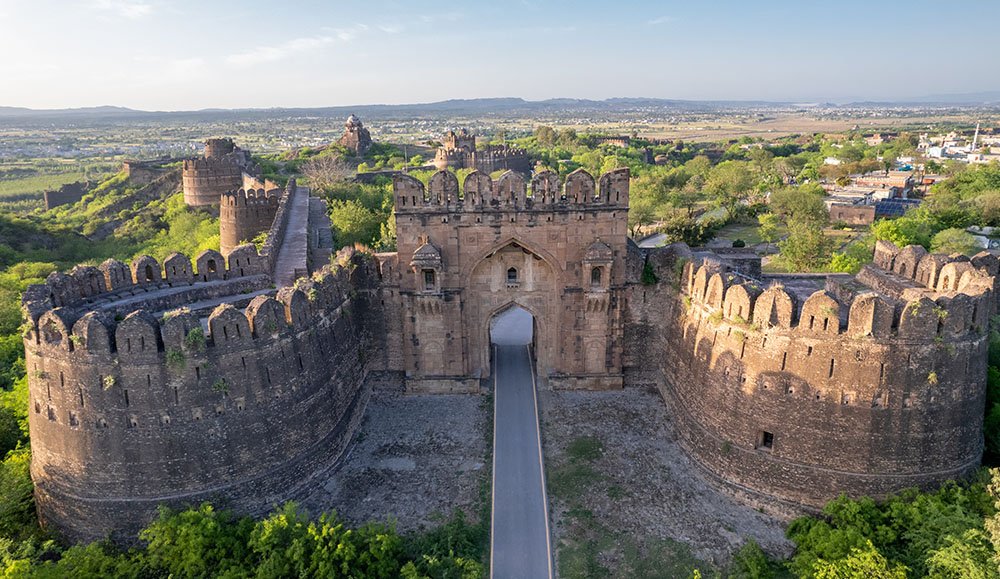
Inside one of the greatest fortresses of South Asia — the 16th-century Rohtas Fort, a UNESCO World Heritage Site — there is a small domed shrine that almost no tourist itinerary mentions. It marks the birthplace of Mata Sahib Kaur, the woman Sikh history honours as the Mother of the Khalsa. She was born here, in the village settled within the fort’s walls, on 1 November 1681, and the modest gurdwara of her Janam Asthan (birthplace) still stands about a hundred steps inside the fort’s main gate. This Janam Asthan Mata Sahib Kaur, Rohtas travel guide tells her story, explains why this quiet shrine deserves your pilgrimage, and gives you everything practical — the best time to go, how to reach Rohtas Fort, and how to combine the visit with one of Pakistan’s great Sikh heritage sites next door.
Quick Facts
- Location: Rohtas village, inside Rohtas Fort, about 10 km south of Dina on the GT Road, Jhelum District, Punjab, Pakistan
- Famous For: The birthplace of Mata Sahib Kaur Ji (born 1 November 1681), wife of Guru Gobind Singh and revered as the Mother of the Khalsa
- Nearest City: Dina (10 km north); Jhelum city about 20 km away
- Accessibility: By road from the GT Road; the shrine is about a hundred steps inside the fort’s main gate, in a residential locality — ask for the caretaker, as it is usually kept locked
- Known Landmarks: The domed Janam Asthan structure (rebuilt under Maharaja Ranjit Singh), Rohtas Fort’s massive gates and walls, Gurdwara Chowa Sahib at the Kabuli Gate
- Best For: Sikh pilgrims, heritage travellers, photographers, and anyone exploring Rohtas Fort beyond its battlements
Why Visit Janam Asthan Mata Sahib Kaur, Rohtas
Rohtas Fort draws visitors for its own sake — four kilometres of 16th-century walls, twelve monumental gates, a masterpiece of military architecture. But the fort is also a living village, and inside its main gate, down a lane of houses, stands a shrine that reframes the whole visit: the birthplace of one of the most revered women in Sikh history. Most fort visitors walk straight past the turn-off without knowing it is there. You will not.
Mata Sahib Kaur’s place in Sikh history is extraordinary. Born here as Sahib Devi to Bhai Ramu Bassi, she married Guru Gobind Singh — the founder of the Khalsa — and after his passing she guided the young Khalsa community with a steadiness that earned her the title “Mother of the Khalsa.” To this day, at the conclusion of Sikh congregational prayer, her name is recited alongside the Guru’s. Standing at the spot where her life began, inside a fortress built a century before her birth, is a genuinely moving experience for pilgrims — and a fascinating one for any traveller interested in how history layers itself in this country.
The shrine itself is humble, and that humility is part of its power. The domed Janam Asthan was rebuilt during the reign of Maharaja Ranjit Singh, when the old building was demolished and replaced — yet even that 19th-century structure is now withering, and the shrine is usually kept locked. Visiting is therefore an act of remembrance as much as sightseeing: you come to honour a legacy, to ask the caretaker to open the doors, and to add your footstep to the slow work of keeping this heritage alive. Sikh pilgrim groups (jathas) have been visiting for years, and their photographs show a small, serene, deeply atmospheric place.
And the combination is unbeatable. Within the same fort walls you can walk the great Sohail and Kabuli Gates, visit Gurdwara Chowa Sahib — the gurdwara of Guru Nanak at the fort’s northwestern gate — and then find Mata Sahib Kaur’s birthplace. Two gurdwaras, one World Heritage fortress, one day: few heritage circuits in Punjab offer this much meaning in so compact an area.
History of Janam Asthan Mata Sahib Kaur, Rohtas
Mata Sahib Kaur Ji was born on 1 November 1681 in Rohtas village, then settled within Rohtas Fort, in the family of Bhai Ramu Bassi. Before taking Amrit her name was Mata Sahib Devan Ji (also recorded as Sahib Devi). Her father was an ardent Sikh of Guru Gobind Singh, and the devout atmosphere of her home shaped a girl remembered as sweet-natured, quiet and deeply drawn to Gurbani. On 18th Visakhi, Samvat 1757, she was married to Sri Guru Gobind Singh Ji.
Her historical significance unfolded after the Guru’s passing. As the Khalsa faced its most dangerous decades, Mata Sahib Kaur provided guidance, issued hukamnamas (edicts) and held the community together — the role for which Sikh tradition honours her as the Mother of the Khalsa. That is why, at the end of the Ardas (the Sikh congregational prayer), the congregation recites the names of Mata Sahib Kaur and Guru Gobind Singh together. She passed away in 1747, and her memory is kept at gurdwaras across the Sikh world.
The shrine at her birthplace carries its own layered history. The original structure was repaired — and in fact demolished and rebuilt as a new domed building — during the reign of Maharaja Ranjit Singh, who also assigned 27 ghumaon of land and Rs 260 for the gurdwara’s upkeep. The rebuilt shrine stands in a locality just inside the fort’s main gate, its dome visible behind the houses from about a hundred steps away. After Partition the shrine remained locked for more than 150 years in total; it was re-opened to mark the tercentenary of the martyrdom of the Sahibzadas, and pilgrim jathas have visited since — including a documented UK yatra in November 2016. In recent years adjacent houses have been acquired with the aim of expanding the gurdwara complex, and the shrine remains under the care of a local caretaker.
The fort around it is older than the shrine by more than a century: Sher Shah Suri built Rohtas Fort in the mid-16th century, and it later served as a headquarters for Maharaja Ranjit Singh’s administration of the northwest. The village inside the walls has been continuously inhabited ever since — which is why a 17th-century birthplace survives here at all.
Top Things to Do in Janam Asthan Mata Sahib Kaur, Rohtas
Pay Respects at the Janam Asthan
The heart of the visit. The domed shrine sits in a residential lane about a hundred steps inside the fort’s main gate — ask any local for “Mata Kaur Ji da gurdwara” and you will be pointed the way. It is usually locked, so ask for the caretaker in advance or on arrival. Cover your head, remove your shoes, and spend a quiet moment at the birthplace of the Mother of the Khalsa.
Walk the Walls of Rohtas Fort
No visit is complete without the fortress itself: four kilometres of walls, twelve gates including the monumental Sohail Gate and the Shishi Gate, and sweeping views over the Jhelum countryside. The fort is a UNESCO World Heritage Site and one of Pakistan’s great monuments — give it at least two to three hours.
Visit Gurdwara Chowa Sahib
At the fort’s Kabuli Gate stands Gurdwara Chowa Sahib, associated with Guru Nanak — the first Sikh Guru. Combining it with Mata Sahib Kaur’s Janam Asthan means paying respects at shrines linked to both the founder of the faith and the Mother of the Khalsa in a single visit.
Explore the Village Inside the Fort
Rohtas is a living village of several thousand people inside 16th-century walls. Walk its lanes, see the old stepwells (baolis), the Haveli of Man Singh and the Rani Mahal area, and talk to the residents — many families have lived within these walls for generations.
Photograph the Gates at Golden Hour
The fort’s gates — especially Sohail Gate, with its massive bastions — are magnificent in late-afternoon light. The Janam Asthan’s dome, glimpsed above the village rooftops, makes a poignant counterpoint to the military grandeur.
Famous Places In and Around Janam Asthan Mata Sahib Kaur, Rohtas
- Rohtas Fort — the UNESCO World Heritage fortress itself: walls, 12 gates, baolis and palaces.
- Gurdwara Chowa Sahib — Guru Nanak’s gurdwara at the Kabuli Gate of the fort.
- Sohail Gate — the fort’s most monumental entrance, a masterpiece of 16th-century military architecture.
- Tilla Jogian — the sacred hill of the Nath yogis, visible on the horizon, a major pilgrimage site in its own right.
- Jhelum city — the district centre on the Jhelum river, about 20 km away, with its own colonial-era heritage.
How to Reach Janam Asthan Mata Sahib Kaur, Rohtas
Rohtas Fort — and the shrine inside it — lies about 10 km south of Dina, a town on the historic GT Road in Jhelum district. The fort is well signposted from the highway.
- From Islamabad: About 110 km via the GT Road through Dina — roughly 2 to 2.5 hours by car. This is the easiest approach.
- From Lahore: About 250 km via the GT Road (or motorway to Gujranwala, then GT Road) — roughly 4 to 4.5 hours.
- From Karachi: Fly to Islamabad (about 2 hours) and drive — the fort is a comfortable day trip or overnight from the capital.
- Nearest airport: Islamabad International Airport, about 110 km away.
- By train: Dina has a railway station on the main Karachi–Peshawar line; from Dina, take a rickshaw or van the 10 km to the fort.
- Finding the shrine: Enter the fort through the main gate, walk about a hundred steps into the residential locality, and ask for the caretaker of Mata Sahib Kaur Ji’s Janam Asthan — locals know it well.
Route Details
- From Islamabad, take the GT Road east toward Jhelum, passing through Gujar Khan to Dina (about 100 km).
- At Dina, follow the signposted road south to Rohtas Fort (10 km).
- Park near the fort entrance and enter through the main gate on foot.
- Walk about a hundred steps into the village locality inside the gate; ask residents for the Janam Asthan and its caretaker.
- Combine with Gurdwara Chowa Sahib at the Kabuli Gate before leaving.
Where to Stay in Janam Asthan Mata Sahib Kaur, Rohtas
Rohtas is a village — stay in Dina, Jhelum or Islamabad. Dina has budget guesthouses adequate for a simple overnight stop, minutes from the fort. Jhelum city, about 20 km away, offers mid-range hotels and is the most practical base for a two-day trip covering the fort and the river city. Islamabad, 110 km away, has the full range from luxury to budget and makes Rohtas an easy day trip. Most visitors do the fort — including the Janam Asthan and Gurdwara Chowa Sahib — in a single long day from Islamabad or Jhelum.
Where to Eat: Local Foods of Janam Asthan Mata Sahib Kaur, Rohtas
This is the Punjab of the GT Road, and the food is classic Punjabi. Sarson da saag with makki di roti in winter, desi-ghee parathas, tandoori chicken, seekh kebab and dal fry from the highway dhabas around Dina, and thick lassi in tall glasses — the Jhelum belt does lassi properly. Sweet shops in Dina and Jhelum sell barfi, jalebi and patisa. If you are offered langar (the free community kitchen) at a gurdwara, accept it graciously — it is a central Sikh tradition of equality and service. Dhaba meals are hearty and budget-friendly; carry drinking water for the fort walk, as there are no restaurants inside the walls.
Weather in Janam Asthan Mata Sahib Kaur, Rohtas
The Jhelum plain has hot summers, a proper monsoon and cool winters. The fort’s open ramparts offer no shade, so winter and spring are by far the best seasons for a long walking visit.
| Season | Temperature Range | Conditions |
|---|---|---|
| Winter (Nov–Feb) | 5°C – 20°C | Cool, clear and crisp; the ideal season for the fort and shrine |
| Spring (Mar–Apr) | 18°C – 32°C | Pleasant and green; excellent for photography |
| Summer (May–Jul) | 32°C – 45°C | Hot and dry; visit early morning only, with ample water |
| Autumn (Aug–Oct) | 25°C – 38°C | Monsoon humidity easing; late October turns pleasant |
Language and Culture of Janam Asthan Mata Sahib Kaur, Rohtas
Punjabi is the mother tongue of the Rohtas area, with Urdu widely spoken and understood. The culture is Punjabi — warm, direct and hospitable — overlaid with the deep Sikh heritage of the region. Gurdwara etiquette is essential: cover your head (carry a scarf or use the provided rumals), remove shoes and wash hands and feet before entering, dress modestly, and never bring alcohol or tobacco onto gurdwara premises. Sit on the floor with everyone else if langar is served. Ask the caretaker’s permission before photographing inside the shrine, and keep your voice low — this is a place of devotion, not a tourist attraction.
Shopping in Janam Asthan Mata Sahib Kaur, Rohtas
Dina and Jhelum’s bazaars cover the shopping on this trip. Look for Punjabi jutti (embroidered footwear), khaddar fabric, phulkari embroidery pieces and brass and copper handicrafts. Dry fruits and desi ghee from the GT Road shops make good-value food souvenirs. Religious souvenirs — small kirpans, kara bracelets and Sikh literature — are sometimes available from shops near the gurdwaras; buy respectfully and from legitimate sellers.
Local Events and Festivals
The gurdwara’s traditional calendar records a fair on the 15th of Kattak Suddi (the bright fortnight of the month of Kartik, usually falling in October–November) — a historic observance tied to the shrine. Sikh pilgrim jathas also visit Rohtas periodically, most notably around major Gurpurabs. Because the shrine is small and usually kept locked, confirm locally — through the caretaker or the Evacuee Trust Property Board’s gurdwara administration — whether any gathering is planned around your visit, and time a trip for a jatha visit if you want to experience the shrine at its most alive.
Travel Tips for Janam Asthan Mata Sahib Kaur, Rohtas
Packing Essentials
A headscarf for gurdwara visits, modest clothing covering shoulders and knees, comfortable walking shoes for the fort’s uneven paths, sunscreen, a hat and at least a litre of water per person — the fort is large and exposed.
Safety Tips
Rohtas Fort and village are safe for visitors, including families and foreign pilgrims. Stay on the main paths — the fort has old stepwells and unrailed drops. Visit in daylight, keep valuables discreet, and arrange your return transport from Dina in advance if travelling late.
Money & Connectivity
Carry cash: there are no card facilities at the fort or village, and the nearest ATMs are in Dina and Jhelum. Mobile signals from the major networks cover the GT Road corridor and the fort area adequately.
Best Time to Visit Janam Asthan Mata Sahib Kaur, Rohtas
October to April — the ideal season
Cool, dry and clear — perfect for walking the fort’s four kilometres of walls and for the quiet lanes around the shrine. October–November may coincide with the traditional Kattak fair observance at the gurdwara.
May to September — the hot season
The Jhelum plain is hot and the fort’s ramparts are fully exposed. Visit at sunrise, carry plenty of water, and keep the walking to the cooler hours.
Final Thoughts
The Janam Asthan of Mata Sahib Kaur is not a grand monument — and that is precisely its meaning. In a fortress built for emperors and armies, the most quietly powerful stop is a small domed room in a village lane: the birthplace of the woman the Khalsa calls Mother. Pilgrims come for devotion; heritage travellers come for the story; both leave understanding Rohtas Fort a little more deeply.
Pair it with Gurdwara Chowa Sahib at the Kabuli Gate, walk the great walls in the late-afternoon light, and you will have spent a day inside one of the richest heritage sites in Punjab — a World Heritage fortress holding two gurdwaras and four centuries of layered history. Come in winter, come with respect, and ask the caretaker to open the doors. Some places reward the traveller who knocks.
FAQs
Where is Janam Asthan Mata Sahib Kaur located?
Inside Rohtas Fort, in the village locality about a hundred steps inside the fort’s main gate — 10 km south of Dina on the GT Road, Jhelum District, Punjab.
Who was Mata Sahib Kaur?
The wife of Guru Gobind Singh, born here on 1 November 1681, revered in Sikh tradition as the Mother of the Khalsa for guiding the community after the Guru’s passing. Her name is recited with the Guru’s at the end of the Sikh Ardas.
What is the best time to visit?
October to April, when the weather is cool and dry — ideal for walking the fort and visiting the shrine. The traditional fair on the 15th of Kattak Suddi falls in October–November.
How do I reach Rohtas Fort from Islamabad?
Drive about 110 km east on the GT Road via Gujar Khan to Dina (2–2.5 hours), then 10 km south to the fort. Dina also has a railway station on the main line.
Is the shrine open to visitors?
It is usually kept locked — ask for the caretaker on arrival (locals will direct you). Cover your head, remove shoes, and dress modestly, following standard gurdwara etiquette.
Can I combine it with other sites?
Yes — Gurdwara Chowa Sahib at the fort’s Kabuli Gate is the natural pairing, and the fort itself (a UNESCO World Heritage Site) needs 2–3 hours. Tilla Jogian and Jhelum city are nearby options.
Where should I stay?
Dina has budget guesthouses; Jhelum city (20 km) has mid-range hotels; Islamabad (110 km) offers the full range and makes Rohtas an easy day trip.
What food should I try in the area?
Classic Punjabi fare — sarson da saag and makki di roti in winter, tandoori and kebabs from GT Road dhabas, thick lassi, and sweets from Dina and Jhelum’s bazaars.
Continue the Sikh heritage trail with the Gurdwara Chowa Sahib, Rohtas travel guide — and browse the full Explore Pakistan collection for more journeys.