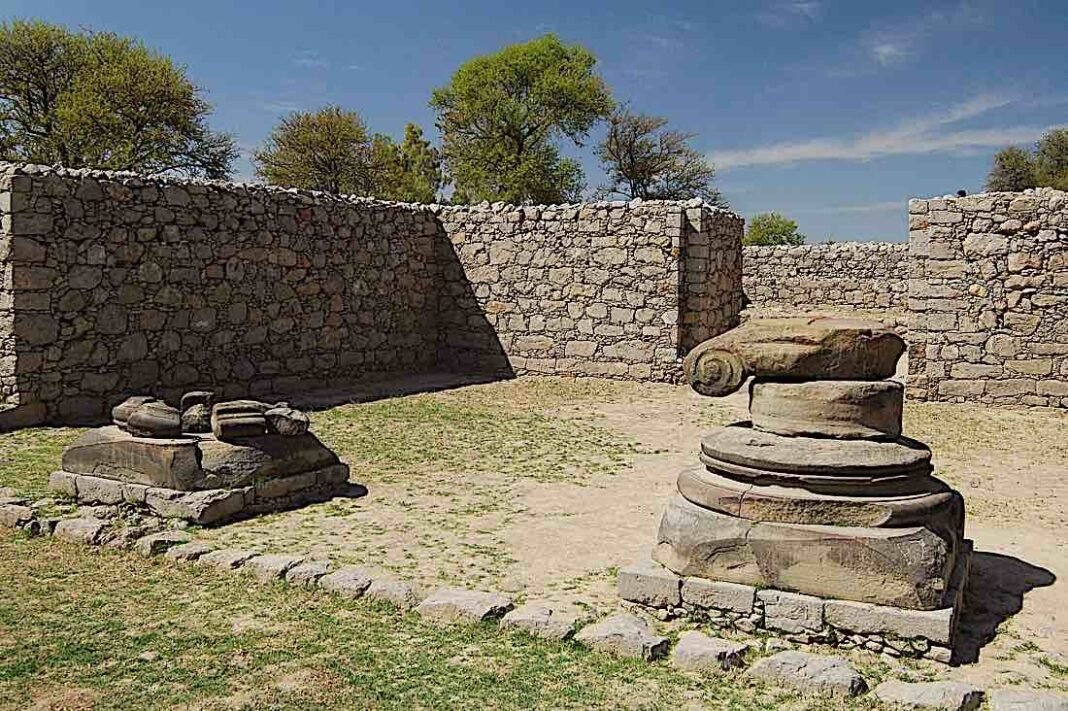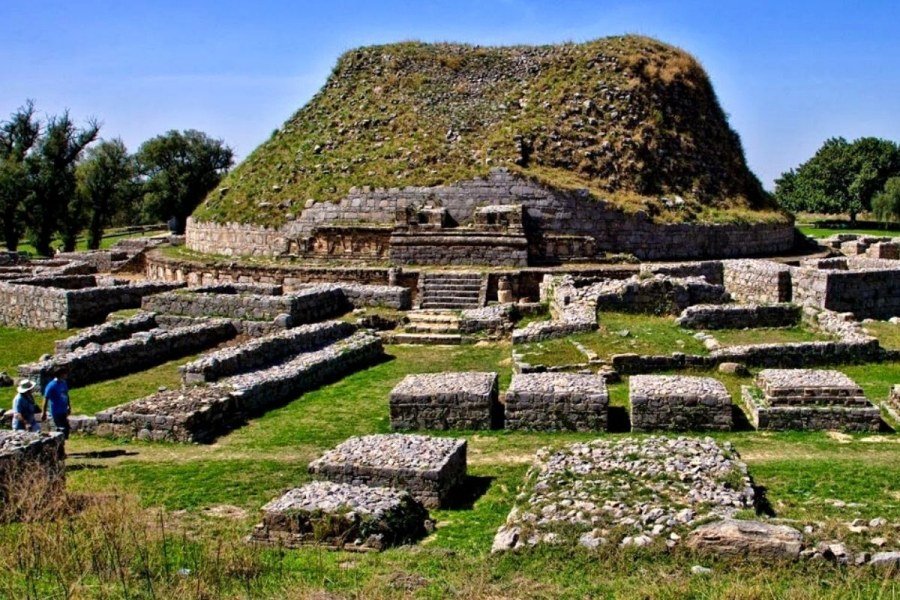
Every famous ruin has a forgotten sibling, and at Taxila that sibling is Jandial Temple 2. While travelers gather at the main Jandial Temple, with its celebrated Ionic columns and Greek plan, a second temple mound, known to archaeologists as Mound D or Jandial D, sits quietly a little to the west, holding the foundations of another classical temple that was first dug up in 1863-1864, nearly fifty years before its famous neighbor. If the main Jandial Temple is Taxila’s Greek celebrity, Jandial Temple 2 is its mystery, and for travelers who like their history unfiltered and crowd-free, it is a small adventure worth having.
This is not a polished tourist attraction. There are no ticket counters, no plaques, no souvenir stalls. There is a mound, a field, the faint geometry of ancient foundations, and the knowledge that you are standing where the ancient high road to Gandhara once ran, between two Greek-era temples. This Jandial Temple 2 Taxila travel guide is written for the curious: the archaeology devotee, the photographer of quiet places, and the traveler who wants to say they walked the ground between the temples. Pair it with our full Jandial Temple, Taxila travel guide, and the two sites together make one of the most unusual half-days in the valley.
Quick Facts
- Location: Mound D, a little west of the main Jandial Temple, Taxila, Punjab, roughly 0.5 km from Jandial Temple along Jandial Temple Road
- Famous For: The lesser-known second temple of the Jandial complex, with a plan similar to the main temple and a large front porch about 58 feet across
- Nearest City: Taxila (minutes away); Islamabad about 40 km to the southeast
- Accessibility: Reached on foot across fields from the main Jandial Temple; best combined with a car-based day trip from Islamabad or Rawalpindi via the Grand Trunk Road
- Known Landmarks: Temple foundations on Mound D, the line of the ancient high road to Gandhara that ran between the two mounds
- Best For: Serious archaeology fans, off-the-beaten-path explorers, photographers of quiet landscapes
- Best Time to Visit: October to March, when the fields are green and walking is comfortable
Why Visit Jandial Temple 2, Taxila
Because the best travel stories are the ones nobody else has. Ask a hundred visitors to Taxila if they have heard of Jandial Temple and a handful will nod. Ask about Jandial Temple 2 and you will get blank stares, which means the mound, the field, and the view are all yours. In a valley where the big sites draw buses, this is one of the few places where you can still feel like an explorer rather than a tourist.
Because it completes the Jandial story. The main temple gets all the attention, but the archaeologists who worked here in the nineteenth century found something remarkable: a second temple, on its own mound, laid out on a very similar plan, with a great front porch measuring some 58 feet. Two temples, side by side, with the ancient highway to Gandhara running between them. Standing on Mound D and looking east toward the main Jandial mound, you are looking at a sacred landscape the way its builders saw it, not a single monument but a pair, flanking the road that carried merchants, monks, and armies toward the northwest.
Because it is a window into the earliest archaeology of the subcontinent. Jandial D was excavated in 1863-1864, in the very first years of the Archaeological Survey of India, when the science of digging up the past in this region was barely born. Walking here connects you not just to the Greeks of the second century BCE but to the Victorian-era pioneers who first tried to read these mounds. For anyone who loves the history of archaeology itself, that layering is delicious.
And because honesty is part of the appeal: this is a site for the imagination, not for spectacle. The remains are foundations, not columns. But travelers who have stood on Mound D at sunset, with the wheat moving in the wind and the main temple’s mound dark against the sky, tend to remember it longer than they remember the crowded stops. If you are building an Explore Pakistan journey through the country’s ancient places, this is the quiet chapter.
History of Jandial Temple 2, Taxila
The documented history of Jandial D begins in 1863-1864, when excavators working in the first campaigns of the Archaeological Survey of India opened the mound west of Jandial and uncovered the foundations of a temple. This was decades before Sir John Marshall’s famous 1912-1913 excavation of the main Jandial Temple, which means Jandial D is, in a sense, the elder discovery of the pair, even though it never received the fame or the conservation attention of its neighbor.
What the excavators found was a temple with a plan very similar to the main Jandial Temple, including a notably large front porch measuring about 58 feet. The likeness of the two plans is the strongest clue to the building’s date and purpose: if the main temple belongs to the Greek horizon of Taxila, the second-century BCE world of the Indo-Greek city of Sirkap, then its sibling on Mound D very likely belongs to the same world and the same century. Some accounts describe it as possibly built under the Greeks in the second century BCE, just like the main temple.
The setting matters as much as the stones. Between Jandial and Jandial D ran, most probably, the ancient high road to Gandhara, the great northwest highway of the ancient world. Temples flanking a sacred road is a pattern familiar from the classical Mediterranean, and here it appears in the Punjab: two sanctuaries watching over the route that linked Taxila to the cities of Gandhara and, beyond them, to Central Asia. To walk the ground between the mounds today is to walk a road that has carried traffic for more than two thousand years.
Unlike the main temple, Jandial D was never developed into a managed visitor site. No columns were re-erected, no protective roofing was built, and the foundations were left to the fields. That neglect is a loss for scholarship, but it has preserved something rare: an archaeological site in something close to its excavated state, unmediated by modern presentation. What we know of it comes down through the early survey reports and the comparative study of its plan against the main temple. Future excavation and conservation may one day give Mound D the attention it deserves; until then, it waits.
Top Things to Do in Jandial Temple 2, Taxila
Trace the Foundations on Mound D
The central activity here is slow looking. Walk the top of the mound and pick out the lines of the foundations, the great front porch, and the chambers behind it, and hold the main temple’s plan in your mind as a key. With the Jandial Temple guide fresh in your memory, the two buildings rhyme with each other across the fields, and the comparison is the whole point of the visit.
Walk the Ancient High Road Between the Mounds
Stand on Mound D, face east toward the main Jandial mound, and you are standing on or beside the line of the ancient high road to Gandhara. Walk the ground between the two temples slowly. This is one of those rare travel moments where the landscape itself is the monument: a highway two millennia old, flanked by sanctuaries, now a farm track between wheat fields.
Photograph the Twin-Mound Landscape
The visual payoff of Jandial D is the wider view, not close-up stonework. From the mound you get the main temple’s mound on one side, Sirkap’s low ridge on the other, and the hills ringing the Taxila valley all around. Come in the golden hour before sunset, when the mounds throw long shadows across the fields, and bring a wide-angle lens.
Combine With the Main Jandial Temple and Sirkap
Jandial D makes no sense as a standalone trip; it makes perfect sense as the second stop on a Jandial morning. Do the main temple first, where the Greek plan is clearest, then walk or drive the short distance west to Mound D to complete the pair, then continue south to Sirkap’s Greek streets. Three Greek-era sites in one morning, within a couple of kilometers: that is a day no other valley in Pakistan can offer.
Famous Places In and Around Jandial Temple 2, Taxila
- Jandial Temple (main) – the celebrated Greek temple 0.5 km east; start here; see our Jandial Temple travel guide
- Sirkap – the Indo-Greek walled city just south, with its grid plan and stupas
- Taxila Museum – the valley’s treasure house of Gandhara art, a short drive east
- Bhir Mound – Taxila’s oldest city layers; see our Bhir Mound travel guide
- Dharmarajika Stupa – the great Mauryan-era stupa complex east of the museum
- Jaulian Monastery – the hilltop Buddhist monastery, one of the valley’s most beautiful sites
- Gandhara Art Village – Taxila’s living craft village; see our Gandhara Art Village travel guide
- Khanpur Dam – the blue reservoir north of Taxila for an afternoon wind-down
How to Reach Jandial Temple 2, Taxila
You reach Jandial Temple 2 the same way you reach the main Jandial Temple, and then you go a little farther on foot. The complex sits about 40 km northwest of Islamabad in the Taxila valley, served by the Grand Trunk Road. Because Mound D is not a developed site, you will be walking across open ground, so wear proper shoes and come in the cool of the morning.
From Islamabad: About 40 km, 1 to 1.5 hours. Take the Grand Trunk (N-5) Road northwest through Tarnol to Taxila, then follow signs toward Sirkap and Khanpur Road to Jandial Temple Road. Park at the main Jandial Temple and walk west across the fields to Mound D, roughly 0.5 km.
From Lahore: About 380 km via the M-2 motorway to Islamabad, then the GT Road to Taxila, roughly 5 to 6 hours. Plan it as part of an overnight Taxila-Islamabad trip.
From Karachi: About 1,450 km. Fly to Islamabad International Airport and hire a car or driver for the 35 to 40 km run to Taxila.
Nearest airport: Islamabad International Airport, about 35 to 40 km away, with taxis and ride-hailing cars at the terminal.
Road conditions and transport: The metalled roads to the Jandial area are good year-round. Local vans and buses run between Islamabad, Rawalpindi, and Taxila on the GT Road, with rickshaws and taxis for the last stretch. But for Mound D specifically, a private car or hired driver is strongly recommended: you need the flexibility to park at the main temple and walk, and there is no public transport to the mound itself. Carry water, as there are no shops at either mound.
Route Details
- Drive from Islamabad on the Grand Trunk Road northwest to Taxila (via Tarnol).
- Follow signs for Sirkap and Khanpur Road, then Jandial Temple Road to the main Jandial Temple.
- Explore the main temple first to learn the Greek plan.
- Walk west from the main mound across the fields to Mound D (about 0.5 km); the ground between the mounds follows the line of the ancient high road to Gandhara.
- Return the same way, then continue south to Sirkap and east to the Taxila Museum.
Where to Stay in Jandial Temple 2, Taxila
Stay where you would stay for the main Jandial Temple: there is no accommodation at the mounds themselves, and none is needed. Taxila town has simple, budget-friendly hotels and guesthouses along the GT Road, perfectly adequate for travelers who want a dawn start among the ruins. Most visitors do better basing themselves in Islamabad, 40 km away, with its full range from luxury hotels to comfortable mid-range options and guesthouses. A driver for the day from Islamabad covers both Jandial mounds, Sirkap, and the museum in a single unhurried loop. Adventurous travelers sometimes overnight near Khanpur Dam to the north for the scenery, but confirm arrangements in advance. There is no camping at the archaeological mounds.
Where to Eat: Local Foods of Jandial Temple 2, Taxila
Eat in Taxila town, not at the mounds. The dhabas along the GT Road serve the Potohar region’s hearty Punjabi staples: nihari and haleem simmered overnight, daal with blistering tandoori roti, chana chaat, kebabs, and thick sweet lassi in steel glasses. A full dhaba lunch costs very little and tastes like the region itself. Pack water and snacks for the mounds, because nothing is sold at either temple site. In winter, the roadside sellers between Taxila and Khanpur stack Khanpur’s famous kinnows and oranges in glowing pyramids; buy a bag for the drive. Back in Islamabad in the evening, the city’s food streets and Margalla-road restaurants offer everything from desi barbecue to continental fare.
Weather in Jandial Temple 2, Taxila
Mound D shares the main temple’s open, shadeless Potohar climate, and because you will be walking across fields between the mounds, the season matters even more here. Winter is king: cool, green, and comfortable. Summer is punishing: hot, bright, and exposed. The monsoon months turn the field paths muddy.
| Season | Temperature Range | Conditions |
|---|---|---|
| Winter (Dec-Feb) | 5-18°C | Cool with occasional morning fog; the best season for walking between the mounds. Bring a warm layer. |
| Spring (Mar-Apr) | 15-30°C | Green fields and wildflowers; lovely light for photography of the twin-mound landscape. |
| Summer (May-Jun) | 30-42°C | Fiercely hot and fully exposed; attempt only at dawn with plenty of water, or skip until cooler months. |
| Autumn (Sep-Nov) | 18-32°C | Clear and cooling; a fine shoulder season with golden post-monsoon light. |
Note: July and August bring monsoon rain; paths between the fields can be waterlogged.
Language and Culture of Jandial Temple 2, Taxila
The Potohar plateau speaks Punjabi in its Potohari dialect, with Urdu universal and English workable with guides and hotel staff. The fields around Mound D are working farmland, so the local culture you meet here is the farming Punjab: hospitable, curious, and quick with a greeting. Walk on field paths rather than through standing crops, ask before crossing close to a farmhouse, and accept the offered chai if you can; it is the region’s handshake. At the mound itself, treat the foundations as the protected archaeology they are: look, photograph, but do not move stones or dig.
Shopping in Jandial Temple 2, Taxila
There is nothing to buy at Mound D, which is part of its charm, so plan your souvenir stop elsewhere. The Taxila Museum shop is the best single stop in the valley for books on Taxila and Gandhara, postcards, and small replicas. Taxila’s bazaars offer everyday Punjabi goods and sweets, and the winter kinnow sellers on the Khanpur road are a seasonal delight. For a wider selection, Islamabad’s markets, from Jinnah Super to the craft shops of Saidpur Village, are an easy drive back at the end of the day.
Travel Tips for Jandial Temple 2, Taxila
Packing Essentials
Sturdy walking shoes are essential: you will be crossing uneven field ground between the mounds. Hat, sunglasses, and sunscreen matter even more here than at managed sites, because there is no shelter at all. Carry at least a liter of water per person, plus snacks. A phone with GPS or an offline map helps you orient the two mounds, and a copy of the main temple’s site plan, from a guidebook or the museum, turns foundation lines into architecture.
Safety Tips
The Taxila valley is a routinely visited tourist area. Go in daylight, ideally with a companion, since Mound D is isolated; let your driver know your plan and expected return time. Watch for uneven ground, loose stones, and field irrigation channels. In the monsoon season, skip the inter-mound walk if the fields are waterlogged.
Money & Connectivity
Carry cash in rupees for tickets at the managed sites, parking, food, and driver payment; small notes help. ATMs are in Taxila town and across Islamabad and Rawalpindi. Mobile coverage from the major networks is generally good across the valley, including around the mounds.
Best Time to Visit Jandial Temple 2, Taxila
Winter (December to February) – The Walking Season
This is when Mound D is at its best: cool air, green fields, firm paths, and soft light. Morning fog can be atmospheric, but wait for it to lift before walking the fields. Combine both mounds, Sirkap, and the museum in one crisp winter day.
Spring (March to April) – The Beautiful Season
Wildflowers in the field margins and wheat ripening around the mounds make spring the prettiest time to photograph the twin-mound landscape. Temperatures are kind to long walks.
Summer (May to August) – Not Recommended
May and June bring brutal heat to the exposed fields; July and August add monsoon mud. If you must come, do the inter-mound walk at first light and spend the hot hours in the Taxila Museum.
Autumn (September to November) – The Quiet Season
Clear skies and cooling air return, and the fields empty of summer’s intensity. October and November offer comfortable walking and fine light with very few visitors.
Final Thoughts
Jandial Temple 2 will never be the headline of a Taxila trip, and that is exactly why it deserves a place in one. It is the other half of the Jandial story: a second Greek-era temple on its own mound, found by the first generation of subcontinental archaeologists, flanking the ancient road to Gandhara. The remains are modest, but the experience, two mounds, one ancient highway, and a valley full of history, is anything but.
Go with the main temple’s plan in your head and good shoes on your feet, walk the ground between the mounds, and let the quiet do the rest. Some places you visit for what is there; Jandial D you visit for what it lets you imagine. Pair it with Sirkap and the museum, and you will have spent a day inside one of the most fascinating centuries in Pakistan’s past. For more inspiration, browse our Hunza Valley guide or the snowy slopes of Malam Jabba when you are ready for the mountains.
FAQs
Where is Jandial Temple 2 located?
On Mound D, a little west of the main Jandial Temple in Taxila, Punjab, about 0.5 km from the main temple and roughly 40 km northwest of Islamabad.
What is Jandial Temple 2?
The foundations of a second classical-style temple near the main Jandial Temple, excavated in 1863-1864, with a plan similar to the main temple and a large front porch about 58 feet across, possibly also dating to the Greek period of Taxila in the second century BCE.
What is the best time to visit Jandial Temple 2?
October to March, when the weather is cool and the field paths between the mounds are comfortable to walk.
How do I reach Jandial Temple 2 from Islamabad?
Drive the Grand Trunk Road to Taxila (about 40 km, 1 to 1.5 hours), park at the main Jandial Temple, and walk about 0.5 km west across the fields to Mound D.
Is Jandial Temple 2 safe for tourists?
Yes, as part of the well-traveled Taxila valley. Visit in daylight, preferably with a companion since the mound is isolated, and wear sturdy shoes for the uneven ground.
Is Jandial Temple 2 good for families?
It suits families with older children who enjoy history and walking; the site has no facilities, shade, or railings, so it is less ideal for very young children than the managed sites.
Where should I stay when visiting Jandial Temple 2?
In Taxila town for a budget overnight near the sites, or in Islamabad (40 km away) for the widest choice of hotels, using a hired driver for the day.
What is the ancient high road between the two Jandial temples?
The ancient high road to Gandhara, the northwest highway of the ancient world, most probably ran between the main Jandial mound and Mound D, with the two temples flanking the route.