Most travelers who come to Larkana have one name on their lips: Mohenjo-daro. And rightly so — the great Indus city is one of the wonders of the ancient world. But ten kilometers west of the city, rising out of flat green farmland beside the Indus Highway, stands a quieter mound with a story just as fascinating. This is Jhukar-jo-Daro — the “Mound of Jhukar” — the place where archaeologists discovered what happened after the Indus Valley Civilization. If Mohenjo-daro shows you a civilization at its peak, Jhukar shows you the sequel: the centuries when the great cities emptied and a new culture, with its own pottery, seals and way of life, took root in the same soil. This Jhukar Mound, Larkana travel guide will show you why this overlooked mound deserves a place on your Sindh itinerary, when to visit, and how to make the most of the trip.
## Quick Facts
– **Location:** about 10 kilometers west of Larkana city, near the village of Mithodero, on the left side of the Larkana-Mehar Road (N55 Indus Highway), Larkana District, Sindh
– **Altitude:** the flat Indus plain — this is a lowland heritage visit, not a mountain trip
– **Famous For:** being the type-site of the Jhukar culture (c. 2000-1800 BCE), the post-Harappan culture that succeeded the Indus Valley Civilization; the highest mud mound in Larkana district; excavations by N. G. Majumdar in 1928 and by Rafiq Mughal in 1973-74
– **Nearest City:** Larkana itself (roughly 10 km); Sukkur is around 80-100 km to the northeast
– **Accessibility:** easy — a short drive or rickshaw ride from Larkana on the N55 highway; the mound sits in open farmland near Mithodero village
– **Known Landmarks:** the mound itself, rising above the surrounding fields; Mohenjo-daro, the UNESCO World Heritage site, about 25 km away
– **Best For:** history lovers, archaeology students, photographers, off-the-beaten-path travelers, and anyone pairing Mohenjo-daro with its lesser-known sequel
## Why Visit Jhukar Mound, Larkana
There are places you visit for spectacle, and places you visit for the story. Jhukar Mound is firmly the second kind — and the story is a remarkable one. When the great Indus cities like Mohenjo-daro and Harappa went into decline around 1900 BCE, history did not simply stop in Sindh. Life continued, changed, and adapted. The Jhukar culture — named after this very mound — is what archaeologists call the chapter that came next: a post-Harappan way of life with its own distinctive painted pottery, circular seals with geometric designs, and settlements that carried on in the shadow of the abandoned cities. Standing on the mound at Jhukar, you are standing on the exact spot where scholars first defined that chapter of human history. That is not a claim many places on earth can make.
The second reason to come is the atmosphere. Unlike Mohenjo-daro, which draws tour groups and school buses, Jhukar is almost always empty. You will likely have the mound entirely to yourself, with only the sound of the wind, birds over the rice fields, and perhaps a farmer working nearby. For travelers who find their best moments in quiet places — where you can sit, look at the land, and let your imagination do the work — Jhukar delivers something the famous sites cannot: solitude with substance.
Third, Jhukar completes the Mohenjo-daro experience. Most visitors leave the great city with one burning question: what happened to these people? Why did the streets empty? Jhukar is the beginning of the answer. Archaeologists found Jhukar-style pottery in the uppermost layers of Mohenjo-daro itself, proof that life lingered on and transformed rather than vanishing overnight. Visiting both sites in the same trip turns a sightseeing day into a genuine journey through time — from the planned streets of the mature Harappan period to the humbler, resilient settlements of the centuries that followed.
Finally, there is a practical, almost moral argument: this site needs visitors. Reports over the years have flagged encroachment around the mound — rice mills, brick kilns, houses and fields pressing in on a protected archaeological site. Places that people visit get noticed; places nobody visits get forgotten. Your trip, your photographs, your curiosity — they all add a small weight to the argument that Jhukar matters and deserves protection. Come for the history, and leave knowing you helped make the case for preserving it.
## History of Jhukar Mound, Larkana
The story of Jhukar begins more than 4,000 years ago, in the final centuries of the Indus Valley Civilization. The mature Harappan period — the era of Mohenjo-daro’s Great Bath, its covered drains and grid-planned streets — flourished from roughly 2600 to 1900 BCE. Then, for reasons scholars still debate (shifting rivers, climate change, the breakdown of trade networks), the great urban centers began to thin out. In the southern Indus plain, around Mohenjo-daro, Chanhudaro, Amri and Jhukar itself, a new cultural pattern emerged from the changes. Archaeologists call it the Jhukar phase, dated to roughly 2000-1800 BCE, overlapping with the end of the Harappan phase and persisting after it.
The mound entered the modern historical record in 1928, when the archaeologist N. G. Majumdar of the Archaeological Survey of India explored and excavated it. Majumdar’s work identified the remains of the late Harappan culture of the Chalcolithic period here, and the site’s distinctive pottery gave its name to the entire Jhukar culture. Over fifty rooms of varying sizes, built of sun-dried bricks, were uncovered on the mound, along with a masonry well sunk to a level below the room floors — evidence of a real settlement, with houses, water and daily life, not just a scatter of potsherds. Among the finds were coins and inscribed sealings, including issues of the Kushan king Vasudeva and his successors, showing that the mound was occupied or at least visited well into the early centuries CE, long after the Jhukar period itself.
Decades later, in 1973 and 1974, the Pakistani archaeologist Rafiq Mughal returned to Jhukar to establish a clear stratigraphical position for the site — in plain terms, to work out exactly which layers belonged to which period. Mughal identified three phases of the Jhukar occupation — early, middle and late — based on the ceramics, structures and floor levels. His work confirmed what the American archaeologist Jonathan Mark Kenoyer would later emphasize: the Jhukar phase represents gradual change, with new groups of elites emerging with different ceramic styles, circular seals with geometric designs replacing the square Harappan seals, the Indus script surviving only on pottery, and the old standardized cubical weights discontinued. It was not an invasion or a clean break — it was a transformation.
The Jhukar culture’s fingerprints have since been found far beyond this one mound. Jhukar-style ceramics appear in the upper levels of Mohenjo-daro itself, at Chanhudaro, at Amri, and even at distant sites like Dholavira and Lothal in Gujarat. After the Jhukar phase came the Pirak phase (roughly 1800-800 BCE), and the region’s story continued through the centuries — through Persian, Greek, Mauryan, Scythian and Kushan rule — each leaving its trace in Sindh’s soil. The coins of Vasudeva found at Jhukar are a small, tangible reminder that this mound was never just a prehistoric curiosity; it sat in a landscape that people kept living in, trading through, and building on for millennia.
Today Jhukar-jo-Daro is a protected archaeological site under the antiquities authorities of Sindh, but protection on paper and protection on the ground are different things. A 2010 report in Dawn described the mound vanishing “bit by bit” under the pressures of time and encroachment — rice mills, brick kilns, rice fields and houses crowding a site where visitors seldom find any attendant. Floods in 2022 washed small clay pots and carved fragments out of the mound near Mitho Dero, a reminder that the soil here is still full of the past. The mound endures, but it needs friends. That is where you come in.
## Top Things to Do in Jhukar Mound, Larkana
### Walk the Mound and Read the Landscape
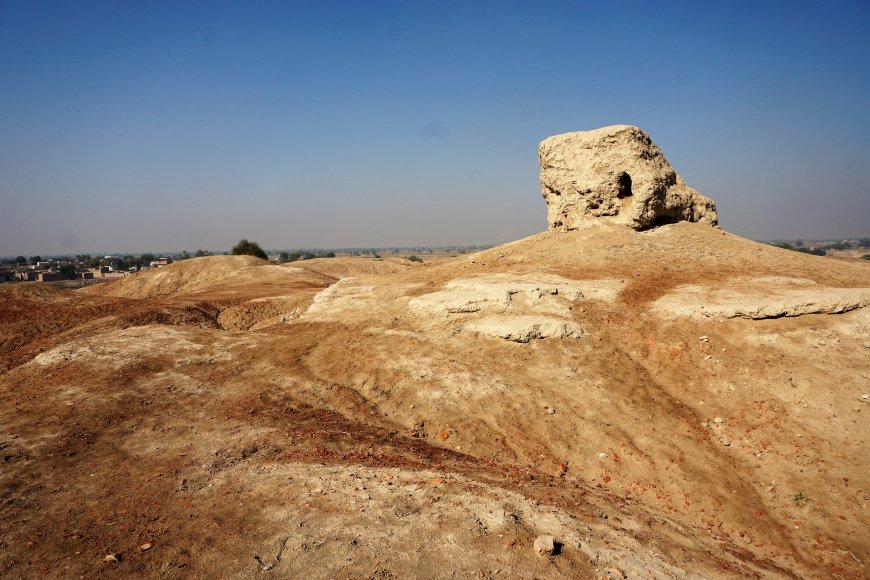
The single best thing to do at Jhukar is also the simplest: walk it slowly. The mound rises above flat farmland, and from the top you get a sweeping view of the Indus plain — green fields, irrigation channels, the thin line of the N55 highway, and on a clear day the hazy distance toward Mohenjo-daro. Look down at the ground as you walk: the soil of an archaeological mound is different from ordinary earth, packed with ancient brick fragments and potsherds. You are literally walking on 4,000 years of debris — the collapsed walls, broken pots and ash of generations. Take your time, bring water, and wear a hat; there is no shade on the mound.
### Trace the Story of the Jhukar Culture
Before you visit, spend an evening reading about the Jhukar phase — the painted pottery with its bold geometric and plant motifs, the round seals that replaced the square Harappan ones, the disappearance of the Indus script. Then stand on the type-site where it was all defined and let the abstraction become concrete. This is one of the few places in Pakistan where an ordinary traveler can grasp a genuinely important archaeological concept firsthand: civilizations do not always fall with a bang; sometimes they fade, adapt and become something new. If you travel with students or curious teenagers, Jhukar is a wonderful open-air classroom.
### Photography at Golden Hour
Jhukar is a photographer’s dream precisely because it is so unmanicured. The mound’s earthy tones against the green of the surrounding fields, the long shadows of early morning or late afternoon, the occasional farmer or grazing buffalo for scale — it all composes beautifully. The best light is in the hour before sunset, when the low sun rakes across the mound’s surface and brings out every contour. Drone photographers will find the aerial perspective especially rewarding: the mound’s shape, its relationship to the village and the highway, and the patchwork of fields around it. (Fly respectfully and keep clear of the village homes.)
### Pair It with Mohenjo-daro for the Full Story
Jhukar on its own is a quiet half-day; Jhukar combined with Mohenjo-daro is one of the great heritage days in Pakistan. Start early at Mohenjo-daro (about 25 km from Jhukar, roughly a 30-40 minute drive from Larkana), spend the morning in the Great Bath and the stupa mound, visit the excellent site museum, then drive out to Jhukar in the late afternoon for the “sequel.” The contrast is the point: the monumental planning of the mature Indus city, then the humbler mound where the next chapter began. Few travelers anywhere in the world get to walk both ends of a civilization’s story in a single day.
### Explore Larkana’s Own Heritage
Since you are in Larkana anyway, give the city itself an hour or two. The Tajjar Building in Jinnah Bagh — an 1832 brick mausoleum turned colonial library turned city museum — is a gem, and our City Museum / Tajjar Building, Larkana travel guide will show you why it is worth your time. Jinnah Bagh itself is a pleasant green pause in a busy city. Together, Mohenjo-daro, Jhukar and the Tajjar Building give you ancient, post-ancient and colonial Larkana in one trip — a depth most visitors miss entirely.
### Famous Places In and Around Jhukar Mound, Larkana
– **Mohenjo-daro** — the UNESCO World Heritage city of the Indus Valley Civilization, about 25 km away; allow a full morning and the site museum
– **City Museum / Tajjar Building, Larkana** — the 1832 brick mausoleum in Jinnah Bagh, now Larkana’s city museum; perfect pairing for the same day
– **Mohenjo-daro Museum** — the site museum’s collection of seals, jewelry, pottery and the famous “Dancing Girl” context displays
– **Larkana city bazaars** — for ajrak, Sindhi embroidery and ralli quilts after your heritage touring
– **The Indus riverbanks near Mohenjo-daro** — for sunset views over the river that made this whole civilization possible
## How to Reach Jhukar Mound, Larkana
Getting to Jhukar is straightforward: get to Larkana first, then it is a short hop west on the N55.
**From Karachi:** Larkana is roughly a 6-hour drive from Karachi (around 450 km) via the M-9 motorway and N-55 Indus Highway — a comfortable day’s drive on mostly good roads. Regular air-conditioned coach services run between Karachi and Larkana from the city’s main bus terminals; from the Larkana bus stand, hire a rickshaw or private car for the 10 km run out to the mound. Travelers short on time can fly into Sukkur and drive down.
**From Lahore:** this is a long journey — a full day’s drive via the motorway network (M-4, M-5) south through Multan and Sukkur, then west to Larkana. Most visitors from Punjab break the trip in Sukkur or Multan. The more practical option is to fly Lahore-Karachi or Lahore-Sukkur and continue by road.
**From Islamabad:** similar to Lahore — fly to Sukkur or Karachi and drive, or commit to a very long road journey via the M-2/M-4/M-5 corridor. Given the distances, flying to Sukkur (about 105 km of driving from Larkana) saves a full day.
**Nearest airport:** Mohenjo-daro’s domestic airport sits just 28 km from Larkana, but scheduled services are limited — check current availability before planning around it. The reliable option is Sukkur Airport (SKZ), about 105 km of driving from Larkana, with regular connections to Karachi, Lahore and Islamabad. Jinnah International Airport in Karachi is the main international gateway.
**Road conditions:** the N-55 Larkana-Mehar Road is a paved highway in reasonable condition; the mound itself is in farmland just off the road, reachable by car, and the final approach may be on a village track. Winter (November-February) offers the best driving conditions; summer heat makes midday travel exhausting; the monsoon months can leave rural tracks muddy.
**Transport options:** a private or hired car is by far the easiest way to reach the mound and combine it with Mohenjo-daro in one day. Rickshaws and qingqis can get you from Larkana to Mithodero village, but for the flexibility to stop, photograph and explore, hire a car with a driver for the day from Larkana — it is inexpensive by Pakistani standards and transforms the trip.
### Route Details
1. Reach Larkana city via the N-55 Indus Highway (from Sukkur/Shikarpur side) or the Larkana-Khairpur road network.
2. From central Larkana, head west on the Larkana-Mehar Road (N55) toward Mehar/Dadu.
3. After roughly 10 km, look for the village of Mithodero on your route — the mound lies to the left (south) of the highway near the village.
4. Ask any local for “Jhukar-jo-Daro” — villagers know it well. The mound is visible from the road, rising above the fields.
5. Park on the village track and walk up. There is no ticket office and usually no attendant — you are on your own, which is part of the charm and part of the responsibility: take only photographs.
## Where to Stay in Jhukar Mound, Larkana
There is no accommodation at the mound itself — you will base yourself in Larkana city, 10 km away, which has a reasonable range of options for a Sindhi district city.
**Mid-range hotels** cluster along Larkana’s main roads and near the city center. These are clean, air-conditioned establishments with attached bathrooms, room service and usually a restaurant — perfectly comfortable for heritage travelers, and inexpensive compared to Karachi or Islamabad rates. Book ahead during the winter tourist season (December-February) when Mohenjo-daro draws its biggest crowds.
**Budget guesthouses** and small hotels near the bus stands and bazaars offer basic rooms at very low prices. They are simple but serviceable if you are traveling on a tight budget and plan to spend your days out at the sites rather than in the room.
**What not to expect:** Larkana is not a resort town — there are no luxury resorts or boutique heritage hotels here. Travelers wanting high-end comfort should look to Sukkur (about two hours away) or plan Jhukar as a day trip from a Sukkur base. For most visitors, one or two nights in a Larkana mid-range hotel is the sweet spot: arrive in the evening, do Mohenjo-daro in the morning and Jhukar in the afternoon, and leave the next day.
**Camping:** not recommended at the mound. There are no facilities, no water and no security, and summer temperatures make it punishing. This is a day-visit site.
## Where to Eat: Local Foods of Larkana
Larkana sits in the heart of Sindh, and its food is classic Sindhi — hearty, spiced and deeply satisfying after a morning in the sun at the mound.
**Sai bhaji** is the dish to seek out: a slow-cooked Sindhi staple of spinach, lentils and vegetables, usually eaten with hot bhugha chawal (rice cooked with browned onions) or roti. It is nutritious, flavorful and found at every proper Sindhi dhaba in the city. **Sindhi biryani** — with its potatoes, plums and extra kick of green chilies — is another essential; Larkana’s versions are as good as anywhere in the province.
**Fish lovers** should try the local river fish preparations. Sindh’s Indus and its canals yield fresh fish that Larkana’s dhabas fry or curry simply and well. **Dal pakwan** — crisp fried flatbread with chana dal — makes a superb Sindhi breakfast before an early start for the mound.
For cooling down, **lassi** and **thadal** (the traditional Sindhi cooling drink of almonds, poppy seeds and spices) are everywhere in summer. Sweet lovers should look for **mawa-based sweets** and **jalebi** fresh from the karahi in the bazaars.
**Where to eat:** the dhabas and restaurants along Larkana’s main roads serve all of the above at budget-friendly prices — a full dhaba meal typically costs very little by city standards. Mid-range hotel restaurants offer the same dishes in more comfortable settings. Stick to busy, popular spots where the turnover is high and the food is fresh. Carry your own drinking water for the mound visit itself — there are no food stalls at the site.
## Weather in Jhukar Mound, Larkana
Larkana has one of the most extreme climates in Pakistan — famously, ferociously hot in summer and pleasantly mild in winter. The mound offers zero shade, so weather genuinely shapes your experience here. Plan around the heat, not just the calendar.
| Season | Temperature Range | Conditions |
|—|—|—|
| Winter (Nov-Feb) | 5°C to 22°C | The perfect season — cool mornings, warm sunny afternoons, clear skies; ideal for walking the mound |
| Spring (Mar-Apr) | 20°C to 38°C | Warming up fast; March is still pleasant, April afternoons get harsh |
| Summer (May-Jul) | 35°C to 50°C | Brutal — Larkana is among Pakistan’s hottest cities; avoid midday outdoor visits entirely |
| Autumn (Aug-Oct) | 28°C to 42°C | Monsoon humidity in August-September, easing by October; still hot but improving |
The practical rule is simple: visit between November and February, go early in the morning or late in the afternoon, and carry more water than you think you need. Summer visits are possible only at dawn, and even then the heat is serious — this is not a season for casual sightseeing.
## Language and Culture of Jhukar Mound, Larkana
**Language:** Sindhi is the mother tongue of Larkana and the language you will hear in the bazaars, on the rickshaws and in Mithodero village. Urdu is widely understood, especially by younger people and in hotels and restaurants. English works in hotels and with educated guides but do not count on it in the village — a few Sindhi greetings (“Assalam-o-Alaikum” works everywhere; “Mehrbani” for thank you) go a long way.
**Culture:** this is deep Sindh — the land of Shah Abdul Latif Bhittai, of Sufi shrines, of ajrak and topi, and of a hospitality tradition that treats guests as a blessing. People here are proud of their heritage and genuinely pleased when outsiders take an interest in it. If a villager near the mound offers you tea or wants to show you around, accept graciously — some of the best guiding at Jhukar comes from locals, not guidebooks.
**Etiquette:** dress modestly (loose, covering clothing for both men and women is the respectful default in rural Sindh). Ask before photographing people. The mound is a protected archaeological site — do not dig, do not pocket potsherds or bricks, and do not climb on any exposed ancient walls. Leave the site exactly as you found it, or better.
## Shopping in Jhukar Mound, Larkana
There are no souvenir shops at the mound — do your shopping in Larkana city, where the bazaars are full of authentic Sindhi crafts.
**Ajrak** is the essential purchase: the block-printed shawl in deep indigo, black and crimson that is Sindh’s most famous textile and a symbol of honor and hospitality. Buy from established cloth merchants rather than street hawkers for the real hand-blocked article. **Sindhi topi** — the embroidered cap with its distinctive mirror work — is another classic, lightweight and easy to pack.
**Ralli quilts**, the patchwork bedspreads sewn by Sindhi women, are beautiful, practical souvenirs, and **Sindhi embroidery** — on cushion covers, wall hangings and kurtis — makes for distinctive gifts. Larkana’s bazaars also sell **lacquered bangles**, **traditional khussas** (embroidered shoes) and excellent **dates** from the region’s orchards.
There are no shopping malls worth a traveler’s time in this equation — the bazaars are the experience. Bargain politely and with a smile; it is expected and part of the fun.
## Travel Tips for Jhukar Mound, Larkana
### Packing Essentials
Sun protection is non-negotiable: a wide-brimmed hat, sunscreen and sunglasses. Carry at least two liters of water per person — there is nothing to drink at the mound. Wear sturdy walking shoes; the mound surface is uneven and scattered with brick fragments. A camera with a zoom lens is ideal for both the mound’s textures and the birdlife over the fields. Pack a small first-aid kit, wet wipes and snacks. In winter, bring a light jacket for cool mornings that turns into t-shirt weather by noon.
### Safety Tips
The Larkana region is generally calm for daytime heritage visits, and the route from the city to the mound is a busy highway. Travel in daylight, go with a companion or hired driver rather than alone, and let your hotel know your plans. The mound itself is unguarded — stick to the visible paths, watch your footing on the uneven surface, and be cautious around the edges. Keep valuables minimal and out of sight. As with anywhere in rural Pakistan, respect local norms, and you will find people helpful rather than hostile.
### Money & Connectivity
**Cash is king** — there are no ATMs, card machines or ticket counters at the mound, so carry enough rupees for transport, food and small purchases. Larkana city has banks and ATMs on its main roads; withdraw there before heading out. **Mobile signals** from all major Pakistani networks (Jazz, Telenor, Zong, Ufone) work fine in Larkana and along the N55 highway; coverage at the mound itself is generally adequate for calls. Download offline maps before you go — village tracks are not always well signposted.
## Best Time to Visit Jhukar Mound, Larkana
### Winter (November to February) — The Ideal Window
This is when Jhukar is at its best: cool, clear days around 15-22°C, perfect for climbing the mound, walking the fields and photographing the site in crisp light. Mornings can be genuinely chilly (single digits in December-January), so layer up. This is also peak season for Mohenjo-daro, so book Larkana hotels a little ahead.
### Spring (March to April) — The Shoulder Season
March is still very workable, with warm days and pleasant mornings. By April the heat is building and midday visits become uncomfortable. If you come in spring, do the mound at 7-8 AM and retreat to the city by late morning.
### Summer (May to July) — Avoid If You Can
With temperatures pushing toward 50°C, summer is genuinely hostile for open-air archaeology. Only consider a dawn visit (arrive by 6 AM, leave by 8:30), and even that is for the hardy. Most travelers should simply choose another season.
### Monsoon and Autumn (August to October) — Improving
August and September bring humidity and occasional rain that can turn village tracks muddy. October is the turning point — still warm, but the worst of the heat breaks and the landscape greens up. Late October can be a lovely, crowd-free time to visit.
## Final Thoughts
Jhukar Mound will never have the crowds, the gift shops or the grandeur of Mohenjo-daro — and that is exactly its gift. It is a place for travelers who read the plaque and want to know what happened next; who prefer a quiet mound and a big story to a famous ruin and a tour bus. The Jhukar culture’s quiet centuries — the painted pots, the round seals, the resilience of ordinary life after the cities faded — deserve to be remembered, and there is no better place to remember them than the mound that gave them their name.
Pair it with Mohenjo-daro, give Larkana’s own heritage an hour, eat well in the city’s dhabas, and go home with a story most Pakistan travelers never hear. The mound has waited 4,000 years. It can wait for the right season — but it should not have to wait for visitors. For more inspiration on where to go next, browse our Explore Pakistan collection, or head north for the mountains with our Malam Jabba and Hunza Valley guides.
## FAQs
**Where is Jhukar Mound located?**
Jhukar-jo-Daro is about 10 km west of Larkana city in Sindh, near the village of Mithodero on the left side of the Larkana-Mehar Road (N55 Indus Highway). It is roughly 25 km from Mohenjo-daro.
**What is the Jhukar culture?**
The Jhukar culture (c. 2000-1800 BCE) is the post-Harappan culture of the southern Indus plain, named after this mound where it was first identified. It is characterized by distinctive painted pottery, circular seals with geometric designs, and settlements that continued after the decline of the great Indus cities.
**Who excavated Jhukar Mound?**
The site was first explored and excavated by N. G. Majumdar in 1928, and re-excavated by the Pakistani archaeologist Rafiq Mughal in 1973-74, who established its three-phase stratigraphy (early, middle and late Jhukar).
**What is the best time to visit Jhukar Mound?**
November to February, when Larkana’s weather is cool and clear (5-22°C). Avoid May-July, when temperatures can approach 50°C and the shadeless mound becomes dangerous at midday.
**How do I reach Jhukar Mound from Larkana?**
Drive or take a rickshaw 10 km west on the N55 Larkana-Mehar Road toward the village of Mithodero; the mound is visible from the road on the left side. Hiring a car with a driver for the day is the easiest option and lets you combine it with Mohenjo-daro.
**Is Jhukar Mound safe for families?**
Yes, as a daytime visit. The site is quiet and the walk is easy, though the surface is uneven — supervise children, carry water and sun protection, and travel in daylight with a hired driver.
**Can I combine Jhukar with Mohenjo-daro in one day?**
Absolutely — and you should. Mohenjo-daro (about 25 km away) takes a morning; Jhukar fits perfectly into the late afternoon, giving you the great Indus city and its post-Harappan sequel in a single day.
**Where should I stay when visiting Jhukar Mound?**
Base yourself in Larkana city (10 km away), which has mid-range hotels and budget guesthouses. There is no accommodation, food or water at the mound itself, so carry everything you need for the visit.