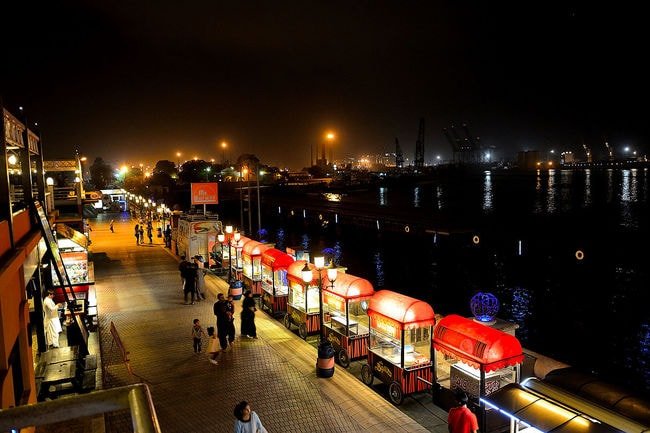
Every great port city has a spot where its history, its food and its sea breeze come together — and in Karachi, that spot is the Jinnah Bridge, better known to generations of Karachiites as the Native Jetty, or “Netty Jetty.” This is where the city meets its harbor: a 19th-century British causeway turned into one of Pakistan’s most beloved food streets, a gleaming 1990s flyover looping above it, fishing boats bobbing in Chinna Creek below, and eagles wheeling overhead as visitors toss them meat for blessings. It is at once a monument, a market, a viewpoint and an evening out. If you want to understand Karachi — its colonial bones, its trading soul, its love of eating by the water — start here. This Jinnah Bridge (Native Jetty), Karachi travel guide will show you why this waterfront deserves your evening, the best time to go, and everything you can do around it.
## Quick Facts
– **Location:** between Kharadar and Keamari on Chinna Creek, Karachi, Sindh — at the southwest end of M. A. Jinnah Road
– **Altitude:** sea level — this is a waterfront visit, all about the creek, the harbor and the Arabian Sea breeze
– **Famous For:** the historic Native Jetty Bridge (built 1861-1864, one of Karachi’s oldest bridges); the modern circular Jinnah Bridge flyover (opened 1997); Port Grand Food and Entertainment Complex, built on the old bridge; the tradition of feeding birds and fish for blessings
– **Nearest City:** Karachi itself — Saddar and Kharadar are minutes away
– **Accessibility:** very easy — right in the city at the end of M. A. Jinnah Road; reachable by car, ride-hailing, bus or train (Karachi City Station is nearby)
– **Known Landmarks:** Port Grand, the Karachi Port Trust Building, Keamari Boat Basin, Manora Island across the water
– **Best For:** families, food lovers, photographers, evening outings, history buffs, and anyone who wants Karachi’s most atmospheric sunset
## Why Visit Jinnah Bridge (Native Jetty), Karachi
The first reason is the sheer layering of history in one small stretch of waterfront. The Native Jetty Bridge began as a mole — a stone causeway — built between 1861 and 1864 at a cost of Rs 643,440, named after Charles Napier, the British general who conquered Sindh. For over a century it was the umbilical cord between Karachi and its port, carrying goods, people and a railway line. Then, between 1993 and 1997, engineers looped a modern circular flyover — the Jinnah Bridge — around and above it, and in 2011 the old bridge found its third life as Port Grand, a waterfront food street. Standing here, you can read 160 years of Karachi in a single glance: colonial engineering below, 1990s infrastructure above, and 21st-century leisure all around. Few places in Pakistan compress the story of a city so neatly.
The second reason is the food. Port Grand turned the historic bridge into Karachi’s most scenic dining destination — dozens of eateries serving everything from desi BBQ and biryani to fast food, Chinese and fresh seafood, all with the creek glittering beside you and the port’s lights beyond. Karachiites famously answer “what is there to do in Karachi?” with “eat,” and this is where they come to do it. An evening here — grazing from stall to stall as the sun drops into the Arabian Sea — is one of the essential Karachi experiences.
Third, the Native Jetty is a working waterfront, not a museum piece. Below the bridges, fishing boats and launches bustle in Chinna Creek; from the nearby Keamari Boat Basin, boats leave for Manora Island and the fishing villages of Baba and Bhit islands. You can watch the great cargo ships of the Karachi Port slide past, see fishermen mending nets, and feel the pulse of the trade that built this city. It is the rare tourist spot that is also, unselfconsciously, real life.
Finally, there is the peculiar, touching tradition of the birds. For generations, Karachiites have come to the Native Jetty to feed meat to the eagles circling overhead and flour balls and scraps to the fish below — an act of sadaqah, voluntary charity, believed to earn divine reward and ward off evil. Researchers trace the ritual back to the bridge’s earliest days, begun by the city’s Hindu residents and continued by Muslims after them. Watching hundreds of eagles swoop for tossed morsels against the sunset is unforgettable — and it tells you something about Karachi’s soul that no guidebook quite captures.
## History of Jinnah Bridge (Native Jetty), Karachi
Karachi’s modern story begins with its harbor. After the British conquered Sindh in 1843, Sir Charles Napier envisioned Karachi as a great commercial port. In 1854 the main navigation channel was dredged and a mole — a massive stone causeway — was constructed to link the growing town with the anchorage. The harbor engineer Walker’s proposals followed: the Keamari Groyne (completed 1863), the Manora Breakwater (1870-1874), and bridges over the mole and the creek. Construction of the Native Jetty Bridge — also called the Napier Mole Bridge — began in 1861 and finished in September 1864, at a total cost of Rs 643,440. An additional railway bridge was built alongside it, and the port’s first wharves followed in the 1880s. The bridge did exactly what it was built to do: Karachi boomed, becoming by 1899 the largest wheat and cotton exporting port in South Asia, fattened further by the American Civil War’s cotton demand and the opening of the Suez Canal in 1869.
For more than a century the old bridge served the port faithfully. But by the late 20th century, traffic had outgrown it. Between 1993 and 1997, the Karachi Port Trust replaced its function with a new structure: the Jinnah Bridge, a circular one-way reinforced-concrete flyover 1,262.7 meters long, named after Muhammad Ali Jinnah, forming the southwest terminus of M. A. Jinnah Road. The old Native Jetty Bridge — known as the Napier Mole Bridge until 1982 — fell into disrepair and misuse after the new flyover opened.
Its rescue came from an unlikely direction: dinner. In 2003 the Karachi Port Trust issued a public tender for the historic bridge’s development, and the Grand Leisure Corporation won the bid at Rs 130 million, eventually investing around a billion rupees. In 2011 the old bridge reopened as the Port Grand Food and Entertainment Complex — a waterfront promenade of restaurants, shops and walkways set on the 19th-century structure, in the very center of the Jinnah Bridge flyover loop. What had been a crumbling colonial relic became Karachi’s favorite evening destination, preserving the old bridge by giving it a new purpose.
Meanwhile the jetty kept its older customs. The bird-feeding tradition — visitors tossing meat to eagles and food to fish as an act of charity — has continued through every era of the bridge’s life, a folk practice older than Pakistan itself. And at the waterline below, the Keamari Boat Basin carries on the jetty’s original job: its rebuilt jetty, opened in June 2021, ferries residents and visitors to Manora and the Baba and Bhit islands, just as boats have done here for generations. The Jinnah Bridge today is thus three things at once: a Victorian causeway, a 1990s flyover, and a living waterfront — which is precisely why it rewards a visit.
## Top Things to Do in Jinnah Bridge (Native Jetty), Karachi
### Dine Your Way Along Port Grand
This is the headline act. Port Grand’s promenade packs in dozens of food outlets — desi BBQ joints, biryani counters, fast-food franchises, Chinese restaurants, ice cream parlors and seafood specialists — spread along the historic bridge with open views of Chinna Creek. Come hungry and graze: start with something grilled, wander the walkway as the sky changes color, and finish with chai or kulfi by the water. Weekday evenings are relaxed; weekends are festive and crowded, with families, couples and groups of friends filling every bench. There is a modest entry ticket system that has varied over the years, so carry some cash along with your cards.
### Watch the Sunset Over Chinna Creek
Time your visit for the golden hour. From the Port Grand walkway or the public areas near the jetty, the sun drops behind the port’s cranes and the masts of anchored ships, turning the creek gold and rose. Cargo vessels glide past, fishing boats putter home, and the eagles come out in force. It is the best free show in Karachi — bring a camera, find a railing spot early on weekends, and just watch the working harbor wind down for the day.
### Feed the Birds — and Understand the Tradition
Join one of Karachi’s most distinctive rituals: buy a small bag of meat scraps or flour balls from the vendors near the jetty and toss them to the circling eagles, crows and kites, or into the water for the fish. For the participants it is sadaqah — charity that earns spiritual reward, wards off the evil eye, and seeks forgiveness. The practice reportedly dates back to the bridge’s construction era in the 1850s-60s, begun by Karachi’s Hindu residents and continued across communities ever since. Whether or not you share the belief, participating respectfully is a window into the city’s living culture. Go early in the morning or late afternoon when the birds are most active.
### Take a Boat from Keamari to the Islands
The Keamari Boat Basin, a short drive from the bridge, is the launch point for Karachi’s island escapes. Public launches and wooden boats run to **Manora Island** — about a 15-minute crossing past the great ships of the port — where you will find a beach, the historic Manora lighthouse and picnic spots. Boats also serve the fishing communities of **Baba and Bhit islands**. Public fares are modest (expect roughly Rs 100-300 per person to Manora; private boats cost more and the fare is negotiable — always agree the price before boarding). Carry your CNIC, as check posts may ask for identification, and go in the morning for the calmest water.
### Do an Evening Crabbing Tour
For something truly local, book an evening crabbing cruise from Kemari. These 3-4 hour trips take you out among the anchored ships in a traditional boat while the crew cooks fresh crabs, prawns, fish and potato snacks on board — a floating feast under the port lights, far from the city’s noise. Boats typically take small groups, tours run in the evening till around midnight, and the combination of sea breeze, city lights and spicy seafood is pure Karachi magic. Book through a reputable operator and confirm the menu, timing and price in advance.
### Photograph the Waterfront
Photographers get a full palette here: the colonial-era stonework of the old bridge, the sweeping curve of the Jinnah flyover, the KPT Building’s handsome colonial facade, container ships and naval vessels, fishing dhows, wheeling eagles, and the neon of Port Grand after dark. The Lakshminarayan Mandir tucked beneath the bridge’s span is a remarkable sight in itself — a seaside Hindu temple older, locals say, than the jetty. Dawn gives you soft light and working boats; dusk gives you drama.
### Famous Places In and Around Jinnah Bridge (Native Jetty), Karachi
– **Port Grand Food and Entertainment Complex** — the food street on the historic 1864 bridge; the heart of the evening
– **Keamari Boat Basin** — the rebuilt jetty (opened 2021) for boats to Manora, Baba and Bhit islands
– **Manora Island** — beach, historic lighthouse and picnic spots, 15 minutes by boat
– **Clifton Beach and Bagh Ibne Qasim** — Karachi’s famous seafront park; see our Clifton Beach travel guide and Bagh Ibne Qasim travel guide
– **Abdullah Shah Ghazi Shrine** — the beloved Clifton shrine overlooking the sea; our shrine travel guide covers it
– **Empress Market and Saddar** — colonial-era market halls and bazaars, minutes inland from the bridge
– **Frere Hall** — Karachi’s iconic colonial building in its gardens, an easy add-on to a heritage day
## How to Reach Jinnah Bridge (Native Jetty), Karachi
The bridge sits at the southwest end of M. A. Jinnah Road, between Kharadar and Keamari — right in the city, not on its outskirts. If you are already in Karachi, reaching it is trivial; if you are coming from elsewhere in Pakistan, fly or ride into Karachi first.
**From Islamabad:** roughly 1,400 km by road via the M-2, M-4 and M-5 motorways and the M-9 into Karachi — a two-day drive for most people, or a single very long day for the determined. The sensible option is the short flight to Jinnah International Airport (under two hours), then a 30-45 minute drive to the bridge depending on traffic.
**From Lahore:** roughly 1,200 km via the M-3/M-4/M-5 corridor and M-9 — again, most travelers fly (about 1 hour 45 minutes) or take the overnight train. Karachi City Station and Karachi Cantt Station both connect to Lahore and the rest of the rail network; Karachi City Station is especially convenient, sitting close to the bridge area.
**From within Karachi:** the bridge is at the end of M. A. Jinnah Road — follow it southwest from Saddar and you cannot miss the flyover loop. From Clifton and DHA, take Mai Kolachi Road past the Boat Basin toward Keamari. Ride-hailing apps (Careem, inDrive, Uber where available) will get you there cheaply from anywhere in the city; tell the driver “Port Grand” and every Karachi driver knows it.
**Nearest airport:** Jinnah International Airport (KHI), Karachi’s main international gateway, about 30-45 minutes by car depending on traffic.
**Road conditions:** you are on city roads throughout — M. A. Jinnah Road and Mai Kolachi Road are major arteries. Traffic is the only variable: avoid rush hours (8-10 AM, 5-8 PM) if you are on a schedule, and expect heavy but manageable congestion on weekend evenings near Port Grand itself.
**Transport options:** private car, ride-hailing, auto-rickshaw and the city’s bus network all serve the area. For the full experience, arrive by car or ride-hailing in the late afternoon, stay through sunset and dinner, and ride back after the crowds thin.
### Route Details
1. From Jinnah International Airport, take Shahrah-e-Faisal west, then turn onto M. A. Jinnah Road heading southwest through Saddar.
2. Follow M. A. Jinnah Road to its southwestern end — the road terminates at the Jinnah Bridge flyover loop over Chinna Creek.
3. For Port Grand, follow the signs into the complex at the center of the loop; parking is available on site.
4. For the Keamari Boat Basin and island boats, continue past the bridge toward Keamari along the waterfront road.
5. From Clifton/DHA: take Mai Kolachi Road west past the Boat Basin area; the bridge and Port Grand are signposted.
## Where to Stay in Jinnah Bridge (Native Jetty), Karachi
You will not sleep on the bridge — but Karachi’s hotel districts put you within easy reach of it.
**Luxury:** Karachi’s five-star hotels cluster along Shahrah-e-Faisal and in Clifton/DHA — full-service properties with sea views, multiple restaurants, pools and spas. These are the choice for travelers who want maximum comfort and are happy with a 20-40 minute drive to the bridge.
**Mid-range:** Saddar, PECHS and Gulshan-e-Iqbal offer solid three-star hotels and serviced apartments at reasonable rates, many within 15-25 minutes of the Native Jetty. This is the sweet spot for most visitors: comfortable, well-located and good value.
**Budget:** guesthouses and budget hotels around Saddar, Burns Road and the Cantt station area are plentiful and very inexpensive. They are basic but clean enough, and they put you closest to the old city’s food streets — a second culinary front to explore after Port Grand.
**Tip:** if the waterfront is your priority, look at Clifton’s mid-range options — you get the sea breeze, easy access to both the bridge (via Mai Kolachi Road) and the beach, and Karachi’s best dining streets nearby.
## Where to Eat: Local Foods of Karachi
Karachi is Pakistan’s undisputed food capital, and the Native Jetty area sits at the delicious intersection of its street food, seafood and food-street cultures.
**At Port Grand** you can eat your way across cuisines without leaving the bridge: smoky **seekh kebabs and malai boti** from the BBQ counters, **chicken tikka and chargha**, **biryani** (Karachi’s beloved, potato-inclusive, extra-spicy version), **Chinese** (a Karachi obsession), **fast food**, and **kulfi, rabri and fresh juices** for dessert. Most outlets are mid-range in price — a satisfying dinner for two costs far less than a comparable night out in the Gulf or the West.
**Kemari seafood** is the area’s other great draw. The fishing community around the boat basin fries and grills the day’s catch — **fried fish, prawns (jheenga), and crab** — simply, with masala and lemon. Small seafood dhabas near the jetty serve it budget-friendly and fresh; the evening crabbing cruises cook it for you on the boat.
**Beyond the waterfront**, you are minutes from Karachi’s legendary food streets: **Burns Road** (nihari, sajji, fresh juices, desserts) and **Boat Basin / Khadda Market** (BBQ and desi). A Karachi food trip pairs naturally with a bridge evening — do Burns Road for lunch and Port Grand for dinner, and you will understand why Karachiites pity everyone else’s food.
**Drinks:** fresh **sugarcane juice**, **lassi**, and **doodh patti chai** are everywhere. In summer, nothing beats a chilled **falooda** after the sea breeze has worked up your thirst.
## Weather in Jinnah Bridge (Native Jetty), Karachi
Karachi’s coastal climate is far gentler than the interior’s — moderated by the Arabian Sea, humid rather than scorching, with a famous sea breeze that makes evenings pleasant for most of the year.
| Season | Temperature Range | Conditions |
|—|—|—|
| Winter (Nov-Feb) | 10°C to 25°C | The golden season — clear skies, cool sea breeze, perfect for long waterfront evenings |
| Spring (Mar-Apr) | 22°C to 35°C | Warming up; pleasant evenings, hot afternoons; still good for sunset visits |
| Summer (May-Jul) | 28°C to 40°C | Hot and very humid; daytime is uncomfortable but sea-breeze evenings remain lively |
| Monsoon/Autumn (Aug-Oct) | 26°C to 36°C | Monsoon showers (July-September), humid; October dries out and cools |
The practical takeaway: the bridge is an evening destination, and Karachi evenings are pleasant nearly year-round. Winter is ideal; summer visitors should simply arrive after 6 PM when the breeze kicks in. The monsoon can bring sudden downpours — check the forecast in July-September.
## Language and Culture of Jinnah Bridge (Native Jetty), Karachi
**Language:** Urdu is the city’s lingua franca — everyone from the Port Grand vendor to the boat captain speaks it. You will also hear Sindhi, Balochi, Pashto, Punjabi, Saraiki and English in the mix; Karachi is Pakistan’s great linguistic melting pot. English works fine in restaurants and hotels.
**Culture:** the Native Jetty distills Karachi’s identity: a trading port built by many peoples. The Keamari waterfront’s fishing communities — Baloch, Sindhi and Kutchi fishermen among them — have worked these waters for generations, and their boats, nets and fish markets are part of the scenery. The bird-feeding sadaqah tradition shows the city’s spiritual side; Port Grand shows its love of a good night out. Karachiites are famously direct, hospitable and proud of their city — ask for recommendations and you will get an enthusiastic, detailed answer.
**Etiquette:** this is a relaxed, cosmopolitan part of the city — dress codes are easygoing by Pakistani standards, though modest dress is still appreciated. The jetty area gets crowded on weekend evenings; keep valuables secure, as you would in any busy waterfront. Do not attempt to swim in Chinna Creek — it is a working harbor with strong currents and boat traffic. Respect the bird-feeding ritual as a religious practice, not a photo prop.
## Shopping in Jinnah Bridge (Native Jetty), Karachi
Port Grand itself has shops and kiosks selling handicrafts, souvenirs, clothes and snacks — convenient for picking up gifts without leaving the waterfront. For serious shopping, the bridge’s central location puts Karachi’s great bazaars within easy reach.
**Empress Market** in Saddar — the colonial-era market hall minutes from the bridge — is the classic stop: spices, dry fruits, crockery, pets and everyday goods under a beautiful 19th-century roof. **Zainab Market and Bohri Bazaar** nearby are famous for affordable clothes, fabrics and street fashion. **Burns Road’s** food shops double as take-home treats (dry fruits, sweets, spices).
For modern retail, Karachi’s well-known malls — including Dolmen Mall in Clifton — are a short drive away. But the honest advice is this: the Native Jetty evening is for eating and strolling, not for mall-hopping. Do your souvenir run at Empress Market the next morning, when the light is good and the bargaining is fresh.
## Travel Tips for Jinnah Bridge (Native Jetty), Karachi
### Packing Essentials
Light, breathable clothing for the humidity; a light jacket or shawl for winter evenings when the sea breeze turns cool. Sunscreen and sunglasses if you arrive before sunset. Comfortable walking shoes — you will stroll a lot on the Port Grand promenade. A camera or a phone with a good night mode for the harbor lights. Carry your **CNIC or passport** — check posts around the port and island boats may ask for ID.
### Safety Tips
The Port Grand complex is well-managed, well-lit and family-friendly, with security at entry — it is one of Karachi’s safest evening spots. The surrounding jetty and Keamari areas are busier and more working-class; they are fine in the evening crowds but keep phones and wallets secure, avoid isolated stretches late at night, and use ride-hailing rather than wandering unfamiliar lanes after dark. On boats, choose licensed operators, wear the provided life jackets, and do not overload small launches. Karachi’s street crime is real but largely avoidable with basic urban awareness.
### Money & Connectivity
**ATMs and banks** are plentiful in Saddar and Clifton, minutes away — withdraw before your evening out. Port Grand’s outlets generally accept cards, but the bird-feed vendors, small dhabas and boat operators are **cash-only**, so carry rupees. **Mobile signals** from all major networks (Jazz, Telenor, Zong, Ufone) are strong across the area, with good 4G coverage — you will have no trouble hailing a ride home or live-streaming the sunset.
## Best Time to Visit Jinnah Bridge (Native Jetty), Karachi
### Winter (November to February) — Perfect
This is Karachi at its finest: daytime highs in the low 20s, cool sea-breeze evenings, clear skies. You can arrive at 4 PM, watch the sunset, dine at leisure and stroll till late in complete comfort. This is also peak season — expect Port Grand at its liveliest on weekends.
### Spring (March to April) and Late Autumn (October) — Excellent
Warm days, genuinely pleasant evenings. The sunset is a little later, the crowds a little thinner, and the experience just as good. October, as the monsoon humidity breaks, is a particularly sweet spot.
### Summer (May to July) — Evenings Only
Daytime heat and humidity make afternoon visits punishing — but Karachi never sleeps, and the bridge comes alive after 6 PM when the sea breeze arrives. Plan a late dinner, not a sunset stroll, and you will still have a great night.
### Monsoon (July to September) — Check the Sky
Karachi’s monsoon brings bursts of heavy rain and occasional urban flooding. The bridge is still worth visiting between showers — rain-washed sunsets over the creek can be spectacular — but check the forecast, wear quick-dry shoes, and have a backup plan.
## Final Thoughts
The Jinnah Bridge — the Native Jetty, Netty Jetty, Napier Mole, whatever name your Karachiite friend uses — is the rare landmark that works on every level. History buffs get a 160-year story in stone and concrete. Food lovers get one of Pakistan’s great dining promenades. Photographers get ships, eagles and sunsets. Families get a safe, festive evening by the water. And everyone gets that particular Karachi feeling: a port city entirely at ease with itself, eating well as the sun goes down over the creek.
Come for the sunset, stay for dinner, take the boat to Manora the next morning — and you will have done Karachi properly. For more of the city’s seafront, see our Clifton Beach and Bagh Ibne Qasim guides, or browse the full Explore Pakistan collection for your next destination.
## FAQs
**Where is Jinnah Bridge (Native Jetty) located?**
It spans Chinna Creek between Kharadar and Keamari in Karachi, at the southwest end of M. A. Jinnah Road. The modern Jinnah Bridge is the circular flyover (opened 1997); the historic Native Jetty Bridge (built 1861-1864) now houses the Port Grand food street at the center of the loop.
**What is Port Grand?**
Port Grand is a food and entertainment complex built on the historic 1864 Native Jetty Bridge, opened in 2011. It offers dozens of restaurants, shops and a waterfront promenade with views over Chinna Creek — Karachi’s most popular evening dining destination.
**What is the best time to visit Jinnah Bridge?**
November to February, for cool, clear evenings. Year-round, the best time of day is late afternoon through evening — arrive around 4-5 PM for sunset, stay for dinner.
**How do I get to the Native Jetty from Saddar or Clifton?**
From Saddar, follow M. A. Jinnah Road southwest to its end at the bridge. From Clifton/DHA, take Mai Kolachi Road toward Keamari. Ride-hailing apps will take you door to door — ask for “Port Grand.”
**Can I take a boat to Manora Island from here?**
Yes — boats leave from the nearby Keamari Boat Basin (rebuilt jetty opened 2021) for Manora (about 15 minutes), and for Baba and Bhit islands. Public fares are modest; agree private-boat prices before boarding and carry your CNIC.
**Is the Native Jetty safe for families?**
Yes. Port Grand is well-lit, managed and family-friendly with security at entry. The surrounding jetty area is fine in the evening crowds; use normal urban awareness after dark.
**What is the bird-feeding tradition at the Native Jetty?**
Visitors feed meat scraps to eagles and food to fish as sadaqah (voluntary charity), a practice reportedly dating back to the bridge’s construction era in the 1850s-60s. Vendors near the jetty sell feed, and mornings and late afternoons are the liveliest times.
**What should I eat near Jinnah Bridge?**
At Port Grand: BBQ, biryani, seafood and desserts. Around Kemari: fresh fried fish, prawns and crab from the fishing community’s dhabas. Nearby Burns Road is legendary for nihari and traditional sweets.