Taxila has no shortage of famous ruins — the great Dharmarajika stupa, the grid-planned streets of Sirkap, the hilltop monastery of Jaulian. But ten kilometers from the Taxila Museum, on the quiet left bank of the Haro River, sits a site with the most intriguing name in the valley and one of its best-kept secrets: Jinnan Wali Dheri, the “Mound of Demons.” This is among the best-preserved Buddhist monastic complexes in the entire Taxila valley — a 4th-5th century monastery with its stupa, monks’ cells and rare mural paintings, destroyed by the White Huns fifteen centuries ago and excavated only in the 2000s. It has no crowds, no gift shop and barely a signpost — just ancient brickwork, green fields, and a story that runs from the Kushan Empire to a haunted nickname. If you want Taxila without the tour buses, this is where you come. This Jinnan Wali Dheri, Taxila travel guide will show you why the “Mound of Demons” deserves your visit, when to go, and how to find it.
## Quick Facts
– **Location:** about 10 km from the Taxila Museum, on the left bank of the Haro River, near the village of Bhera, Taxila valley, Punjab
– **Altitude:** the Taxila valley floor (roughly 500-600 meters) — an easy lowland heritage visit
– **Famous For:** one of the best-preserved Buddhist monastic complexes in the Taxila valley; rare Gandharan mural paintings of the Buddha and worshippers; the evocative local name “Mound of Demons”; destruction by the White Huns in the 5th century
– **Nearest City:** Taxila itself; Islamabad is about 35 km to the southeast
– **Accessibility:** moderate — reachable by a zigzag road from the Jaulian side, but the final approach is rough; a sturdy car and a local guide are recommended
– **Known Landmarks:** the main stupa and its votive stupas, the monastery courtyard with 17 cells, the Taxila Museum (10 km), the Haro River
– **Best For:** history lovers, archaeology enthusiasts, photographers, Buddhist heritage travelers, and off-the-beaten-path explorers
## Why Visit Jinnan Wali Dheri, Taxila
The first reason is rarity. Wall paintings from the Gandharan Buddhist world are exceptionally scarce — most of Taxila’s art that survives is stone sculpture. But in the corridor of Jinnan Wali Dheri’s monastery, excavators found fragments of mural paintings depicting the Buddha and figures of worshippers, one of the earliest forms of wall painting ever found in Gandhara. A 3rd-century fresco discovered here in 2004 lay broken into 700 pieces under half a meter of ash and debris; painstakingly recovered, it now rests in the Taxila Museum. Standing in the corridor where those paintings once glowed on the walls, you are in contact with something genuinely rare — the painted, colorful Buddhism of late antiquity, not just its carved stone.
The second reason is preservation. Jinnan Wali Dheri is consistently described as one of the best-preserved monastic complexes in the Taxila valley. The main stupa, its encircling chapels, the votive stupas, and the monastery with its cells and central hall survive in legible, walkable form across 1.4 acres. Unlike the heavily restored showpieces, this site was conserved with American-donated funds and opened to the public in the early 2010s with a light touch — what you see is substantially what the archaeologists found. For travelers who want to read a ruin rather than just photograph it, that authenticity matters.
Third, there is the name — and the story behind it. “Jinnan Wali Dheri” is not an ancient name at all. Locals gave it to the mound after human skeletons were found scattered on its surface, and the “Mound of Demons” acquired a haunted reputation that kept treasure hunters and the merely curious at a respectful distance. There is something delicious about a Buddhist monastery — a place of meditation and compassion — remembered by its neighbors as the hill of demons. The skeletons, the haunting, the White Hun destruction: the site wears its drama well.
Finally, solitude. The great Taxila sites draw school groups, foreign tour groups and weekend crowds from Islamabad. Jinnan Wali Dheri draws almost nobody — visitor accounts consistently mention empty courtyards, locked gates, no caretaker, and the freedom to explore at your own pace. If your idea of a perfect heritage visit is a quiet ruin, a good camera and time to think, few places in Punjab deliver it better. Come in winter light, and you may have fifteen centuries of history entirely to yourself.
## History of Jinnan Wali Dheri, Taxila
To understand Jinnan Wali Dheri, you need the deep history of Taxila itself — one of the great crossroads cities of the ancient world. Taxila sat on the trade routes between Central Asia, India and the West, and every empire that mattered wanted it. The Achaemenid Persians held it; Alexander the Great passed through in 326 BCE; the Mauryan emperor Ashoka (3rd century BCE) made it a center of Buddhism; Indo-Greek kings minted coins here; and under the Kushan emperor Kanishka (whose reign is dated to 127-151 CE), Taxila became a jewel of the Buddhist world, its monasteries and stupas rising across the valley. Gandharan art — the extraordinary fusion of Greek, Roman, Persian and Indian styles that gave the Buddha a human face — flourished in this environment.
Jinnan Wali Dheri belongs to the later chapters of that story. The monastic complex dates to the 2nd-5th centuries CE, with the main monastery’s square plan and masonry assigned to the 4th century. The complex is compact but complete: a main stupa (smaller than Taxila’s great stupas, but elegant), votive stupas to its north and south, a stupa court ringed with chapels facing the main shrine, an upper-court votive stupa, and on the eastern side the sangharama — the monastery — with its cells arranged around a courtyard, a central hall, and even a water tank at its heart. The whole site measures about 100 meters by 75 meters, rising 5 meters above the surrounding fields.
Then came the catastrophe. In the 5th century CE, the White Huns — the Hephthalites — swept through Gandhara, and Taxila’s Buddhist establishment never recovered. The monastery at Jinnan Wali Dheri was destroyed, apparently by fire; the mural paintings collapsed as the building burned. Among the finds were coins of the Kushan period and a silver coin of the White Huns themselves, alongside pots, jewelry, jars and bowls — the everyday possessions of the monks, frozen at the moment of disaster. The antiquities recovered are preserved today at the Taxila Museum. Some scholars note the destruction may have involved Sasanian or Persian invaders from the west; either way, the great Kushan Buddhist world ended here in ash.
The site then slept for fifteen centuries, known only to the villagers who named it for its demons. Treasure hunters dug into it illegally before the Department of Archaeology intervened, and systematic excavation began in the early 2000s under project directors including Dr. Muhammad Ashraf Khan (2003-2006), uncovering the monastery’s 17 cells, the stupa court and the precious mural fragments. Conserved with funds donated by the United States, the site was inaugurated for the public around 2010-2012. Taxila as a whole has been a UNESCO World Heritage Site since 1980 — and Jinnan Wali Dheri is one of its most atmospheric, least-visited components.
## Top Things to Do in Jinnan Wali Dheri, Taxila
### Walk the Stupa Court
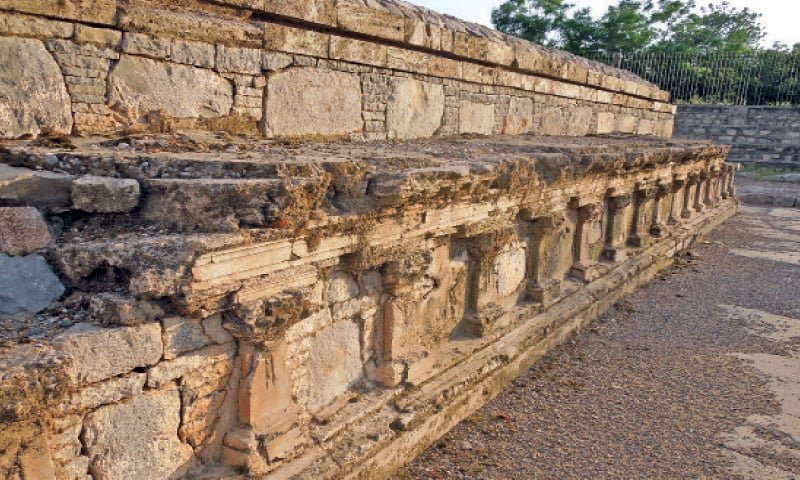
Begin at the heart of the complex: the main stupa and its ring of chapels. The stupa is smaller than Taxila’s great monuments, which makes it more intimate — you can walk right around it, study the chapels that face it from the enclosure wall, and see the two late-period platforms at the eastern corners. Notice the masonry: the semi-ashlar and diaper pattern stonework of the 4th century, laid by craftsmen working in a tradition centuries old. This is the devotional core where monks circumambulated the shrine, and walking it yourself is the simplest way to feel the rhythm of monastic life.
### Explore the Monastery Cells
On the eastern side lies the sangharama — the monastery proper — with its 17 cells arranged around a courtyard, a central hall, and a water tank at the center. Step into the cells (mind the uneven floors) and imagine them as they were: small, plain rooms where monks slept, studied and meditated, each opening onto the shared courtyard. The corridor leading toward the main stupa is where the famous mural fragments were found — look at the walls and picture them painted with the Buddha and his worshippers in mineral colors. Few places in Pakistan let you stand this close to the daily life of ancient Buddhism.
### Hunt for the Paintings’ Story
You will not see the great fresco here — the 700 fragments recovered in 2004 are safe in the Taxila Museum — but knowing the story transforms the visit. The paintings collapsed when the White Huns burned the monastery in the 5th century; excavators found them under half a meter of ash. Before your trip, look up the Taxila Museum’s Gandharan collection online, then visit the museum itself (10 km away) after the site to see the recovered antiquities — Kushan coins, jewelry, pottery — and whatever mural fragments are on display. Site plus museum is the complete experience.
### Photograph the Valley Landscape
Jinnan Wali Dheri sits amid lush, fertile farmland on the Haro’s banks, and the contrast of ancient brick against green fields and big Punjab skies is superb. The site is compact enough to photograph comprehensively in an hour: wide shots from the field edge, details of the masonry, the stupa against the sky. Winter mornings bring mist on the Haro and soft golden light; late afternoons give long shadows across the courtyard. With no crowds to work around, you can take your time over compositions.
### Make It a Taxila Circuit
Jinnan Wali Dheri pairs beautifully with its neighbors. Combine it with the hilltop **Jaulian monastery** — our Jaulian Buddhist Monastery travel guide covers that stunning site — plus **Mohra Muradu**, the **Dharmarajika stupa**, and the excavated cities of **Sirkap** and **Bhir Mound** (see our Bhir Mound travel guide). The **Taxila Museum** ties it all together with its world-class Gandharan sculptures. A two-day Taxila trip — museum and city sites on day one, Jinnan Wali Dheri and Jaulian on day two — is one of the great heritage weekends in Pakistan.
### Famous Places In and Around Jinnan Wali Dheri, Taxila
– **Jaulian Buddhist Monastery** — the hilltop monastery with panoramic valley views; our Jaulian travel guide has the details
– **Taxila Museum** — the essential companion visit: Gandharan sculptures, the Jinnan Wali Dheri antiquities, Kushan coins and jewelry
– **Dharmarajika Stupa** — Taxila’s great 3rd-century BCE stupa, attributed to the Mauryan emperor Ashoka
– **Sirkap** — the excavated Indo-Greek city with its grid streets and the double-headed eagle stupa
– **Bhir Mound** — the earliest Taxila city mound; see our Bhir Mound travel guide
– **Badalpur Stupa and Monastery** — another fine monastic site; our Badalpur travel guide covers it
– **Khanpur Dam** — the blue reservoir in the hills, popular for boating and picnics after a heritage day
## How to Reach Jinnan Wali Dheri, Taxila
Taxila is one of the easiest major heritage destinations in Pakistan to reach — it sits right on the Grand Trunk Road corridor, about 35 km northwest of Islamabad.
**From Islamabad:** the simplest approach. Drive northwest on the N-5/Grand Trunk Road (or the M-1 motorway to the Taxila interchange) — roughly 45 minutes to an hour to Taxila town. From the Taxila Museum area, the site is about 10 km further, on the left bank of the Haro River near Bhera village, approached by a zigzag road from the Jaulian side. A local driver who knows the Taxila sites is invaluable for the last stretch.
**From Lahore:** about 4-5 hours via the M-2 motorway to Islamabad, then onward to Taxila — an easy day trip or an overnight stay. Many Lahore visitors combine Taxila with Islamabad in a single weekend.
**From Karachi:** fly to Islamabad (about 2 hours) and drive to Taxila, or take the train to Rawalpindi and continue by road. Given the distance, this is at minimum a two-day trip — but Taxila rewards it.
**Nearest airport:** Islamabad International Airport (ISB), about an hour’s drive from the site.
**Road conditions:** the GT Road and motorway to Taxila are excellent. The final approach to Jinnan Wali Dheri is the weak link — visitor accounts consistently mention poor road conditions, rough tracks and occasionally locked gates with no caretaker present. A car with decent ground clearance helps; in the monsoon, the track can get muddy. Go in daylight and allow extra time for finding the turn.
**Transport options:** a hired car with a driver from Islamabad or Rawalpindi is the best option — negotiate a full-day Taxila circuit covering the museum, Jinnan Wali Dheri, Jaulian and Sirkap. Public transport (wagons and buses on the GT Road) can get you to Taxila town, but reaching the site itself without private transport is difficult.
### Route Details
1. From Islamabad, take the Grand Trunk Road (N-5) northwest toward Taxila (or the M-1 motorway, exiting at Taxila).
2. Visit the Taxila Museum first — it orients you brilliantly, and the staff can give current directions to Jinnan Wali Dheri.
3. From the museum, head toward the Haro River / Jaulian side — the site is about 10 km out, near Bhera village on the river’s left bank.
4. Follow the zigzag road up toward the Jaulian area; Jinnan Wali Dheri lies in the fields below. Ask locals for “Jinnan Wali Dheri” — the name is well known locally.
5. Park at the field edge and walk in. There is usually no ticket office or caretaker; if the gate is locked, ask in the nearby village — someone will know who holds the key.
## Where to Stay in Jinnan Wali Dheri, Taxila
There is no accommodation at the site — base yourself in Taxila town, Wah Cantt, or Islamabad/Rawalpindi.
**Taxila and Wah Cantt** have a handful of mid-range hotels and guesthouses catering to business travelers and heritage tourists. They are functional and inexpensive, and they put you 15-30 minutes from the site — ideal for an early start.
**Islamabad** (about an hour away) offers the full range: five-star hotels in the Blue Area and along Jinnah Avenue, boutique guesthouses in F-6/F-7, and budget options throughout the city. Most heritage travelers stay in Islamabad and do Taxila as a long day trip or a two-day circuit with an overnight in Taxila.
**Budget:** guesthouses and small hotels in Taxila town and Rawalpindi are very affordable. For the adventurous, the PTDC-style motels and rest houses in the region offer basic comfort at low prices — book ahead in the winter season.
**Camping:** not practical at the site itself (no facilities, and it is an archaeological protected area). This is firmly a day-visit destination.
## Where to Eat: Local Foods of Taxila
Taxila sits in Punjab’s hearty food belt, and the dhabas along the GT Road are an attraction in their own right.
**Desi breakfast** is the move: **halwa puri**, **nihari** with fresh naan, **paye**, and thick **lassi** in clay cups. The dhaba clusters near Taxila town and on the GT Road do these brilliantly and cheaply — eat where the truck drivers eat.
For lunch and dinner, expect classic Punjabi fare: **chicken karahi** and **mutton karahi** cooked in desi ghee, **daal fry** with tandoori roti, **seekh kebabs**, and **chargha** (whole fried chicken). **Saag with makkai di roti** in winter is a seasonal highlight, served with white butter and lassi.
**Khanpur Dam’s** lakeside restaurants (an easy add-on to your Taxila day) serve **fresh fried fish** — a pleasant change after the ruins. And no Punjab trip is complete without **fresh sugarcane juice** (rooh afza optional) from a roadside stall.
**Where to eat:** the GT Road dhabas between Islamabad and Taxila are reliably good and budget-friendly — a full meal for two costs very little. Taxila town has simple restaurants; for more variety, eat in Islamabad before or after your site visits. Carry water and snacks for Jinnan Wali Dheri itself — there are no food stalls at the site.
## Weather in Jinnan Wali Dheri, Taxila
The Taxila valley has a classic Punjab foothill climate: cold, sometimes foggy winters; hot summers; and a real monsoon. The site is fully exposed, so time your visit for comfort.
| Season | Temperature Range | Conditions |
|—|—|—|
| Winter (Nov-Feb) | 0°C to 18°C | Crisp, clear days; cold mornings with occasional fog; the best season for ruins |
| Spring (Mar-Apr) | 15°C to 32°C | Pleasant and green; March is lovely, April warms up |
| Summer (May-Jul) | 28°C to 42°C | Hot and draining; visit only in the early morning |
| Monsoon/Autumn (Aug-Oct) | 24°C to 36°C | Monsoon rains July-September; October clears beautifully |
Winter is the prime season — the low sun, clear air and green wheat fields make the valley gorgeous, and the Taxila Museum is a warm refuge between outdoor sites. December-January mornings can be near freezing with fog on the Haro, so layer up and plan site visits for 10 AM onwards on foggy days. Avoid May-June afternoons entirely.
## Language and Culture of Jinnan Wali Dheri, Taxila
**Language:** Punjabi is the local tongue, with Hindko widely spoken in the Taxila-Wah area; Urdu is universally understood, and English works in hotels and with educated guides. A smile and “Assalam-o-Alaikum” open every door.
**Culture:** this is Punjabi hospitality country — generous, direct and food-obsessed. The valley is also one of Pakistan’s great Buddhist heritage landscapes, and there is a quiet pride in that: Taxila’s Gandharan past is taught in schools and celebrated in the museum. You may meet local guides whose families have lived beside these ruins for generations.
**Etiquette:** Jinnan Wali Dheri is a protected archaeological site and, for the world’s Buddhists, sacred ground. Do not climb on the stupa or walls, do not remove stones or bricks, and do not deface anything — the mural fragments survived 1,500 years; let them survive your visit. Dress modestly, ask before photographing villagers, and keep noise down: this is a place of the dead and of meditation, whatever the “demons” nickname suggests.
## Shopping in Jinnan Wali Dheri, Taxila
There are no shops at the site — but Taxila town and the museum area offer some of the most interesting (and trickiest) souvenir shopping in Pakistan.
**Gandharan art replicas** are everywhere: stucco and stone Buddhas, bodhisattvas and friezes. A frank warning — the market is flooded with fakes, some quite convincing. Buy only from reputable dealers, ask for provenance in writing, and never buy anything claimed to be an “original excavated” piece (that is illegal and almost certainly a lie). The **Taxila Museum shop**, when open, is the safest source for legitimate reproductions and books.
**Taxila’s bazaars** also sell everyday Punjabi goods: **khussas** (embroidered shoes), **shawls**, **pottery** from local kilns, and excellent **seasonal fruit** — the valley’s orchards produce fine citrus and guavas in winter. **Books on Gandharan art and Taxila’s history** from the museum shop make the best souvenirs of all: they deepen everything you saw.
There are no shopping malls at the site, and you will not miss them — the GT Road’s dhaba-and-bazaar strip is entertainment enough.
## Travel Tips for Jinnan Wali Dheri, Taxila
### Packing Essentials
Sturdy walking shoes with grip — the site’s surfaces are uneven ancient brick. Sun protection (hat, sunscreen, sunglasses) for the exposed courtyards. At least 1.5 liters of water per person; there is no drinking water at the site. A camera with a wide-angle lens for the compact complex. In winter, a warm jacket for cold mornings that you can shed by midday. Snacks — the nearest food is back in Taxila town.
### Safety Tips
The Taxila area is generally safe for tourists and heavily visited by school and foreign groups. The specific cautions for Jinnan Wali Dheri are practical, not security-related: the approach road is rough, so drive carefully; the site is unguarded, so go in daylight and preferably with a companion or driver; watch your footing on the ancient masonry; and in summer, the heat is the real hazard — start early. Keep the site’s location saved offline, as signage is minimal.
### Money & Connectivity
**Carry cash** — there are no ATMs, ticket counters or card facilities at the site (entry arrangements are informal). Taxila town and the GT Road have banks and ATMs; Islamabad’s are 45 minutes away. **Mobile signals** from all major networks work well across the Taxila valley, including at the site — 4G coverage is generally good. Download the area on offline maps before leaving the GT Road, as the village tracks are poorly signposted.
## Best Time to Visit Jinnan Wali Dheri, Taxila
### Winter (November to February) — The Best Season
Cool, clear days (5-18°C), green fields, crisp light on the brickwork — winter is when Taxila’s ruins look their best and feel most comfortable. This is peak heritage season: the museum is busy, the valley is beautiful, and an early start lets you do Jinnan Wali Dheri plus Jaulian in one glorious day. Pack for cold mornings.
### Spring (March to April) — Lovely
March brings wildflowers to the field margins and comfortable temperatures. April warms up but remains very doable, especially with morning visits. A fine shoulder season with fewer crowds than winter.
### Summer (May to July) — Mornings Only
The valley bakes (up to 42°C), and the shadeless site becomes punishing by 10 AM. If summer is your only option, arrive at opening, carry double water, and retreat to the air-conditioned museum by late morning.
### Monsoon and Autumn (August to October) — Mixed
July-September rains can make the approach track muddy and the masonry slippery — check conditions locally. October is the turnaround: clear skies return, the landscape is washed green, and the crowds have not yet arrived. Late October is a hidden gem of a window.
## Final Thoughts
Jinnan Wali Dheri is Taxila for people who have already fallen in love with Taxila — or for travelers who want to skip straight to the part with no crowds. The “Mound of Demons” packs a complete monastic world into 1.4 acres: the stupa court, the painted corridor, the monks’ cells, the water tank, and fifteen centuries of silence since the fires of the White Huns. It asks a little effort to reach and rewards it many times over.
Pair it with the Taxila Museum’s treasures and the hilltop splendor of Jaulian, eat well on the GT Road, and go home knowing you have seen one of Gandhara’s most intimate survivals. For the rest of the valley, our Jaulian, Bhir Mound and Badalpur guides await — or browse the full Explore Pakistan collection.
## FAQs
**Where is Jinnan Wali Dheri located?**
About 10 km from the Taxila Museum on the left bank of the Haro River, near Bhera village in the Taxila valley, Punjab — approached by a zigzag road from the Jaulian side.
**Why is it called the “Mound of Demons”?**
It is a local nickname, not an ancient name. Villagers called it Jinnan Wali Dheri (“Mound of Demons/Jinns”) after human skeletons were found scattered on the mound’s surface, giving it a haunted reputation.
**How old is Jinnan Wali Dheri?**
The Buddhist monastic complex dates to the 2nd-5th centuries CE, with the main monastery assigned to the 4th century. It was destroyed by the White Huns in the 5th century and excavated in the 2000s.
**What can I see at the site?**
A main stupa with votive stupas and chapels, a monastery with 17 cells around a courtyard, a central hall and water tank, and the corridor where rare Gandharan mural paintings of the Buddha were found. The recovered antiquities are in the Taxila Museum.
**What is the best time to visit?**
November to February, for cool clear weather. Avoid summer afternoons; October and March-April are good shoulder seasons.
**How do I reach Jinnan Wali Dheri from Islamabad?**
Drive about 45-60 minutes to Taxila via the GT Road or M-1, then about 10 km more toward the Haro River/Jaulian side. A hired car with a driver who knows the Taxila sites is strongly recommended for the rough final approach.
**Is Jinnan Wali Dheri suitable for families?**
Yes, as a daytime outing combined with the Taxila Museum. The site is compact and the walking is easy, though surfaces are uneven — supervise children, carry water and snacks, and note there are no facilities on site.
**Can I combine it with other Taxila sites in one day?**
Easily. The classic circuit is the Taxila Museum, Jinnan Wali Dheri, Jaulian monastery and Sirkap — a full, glorious day from an Islamabad or Taxila base.