SpaceX Starship Catch Marks Reusability Milestone
A SpaceX Starship catch by the launch tower’s giant mechanical arms marked a first for reusable rockets on Saturday, after the spacecraft spent 22 hours in orbit around Earth.
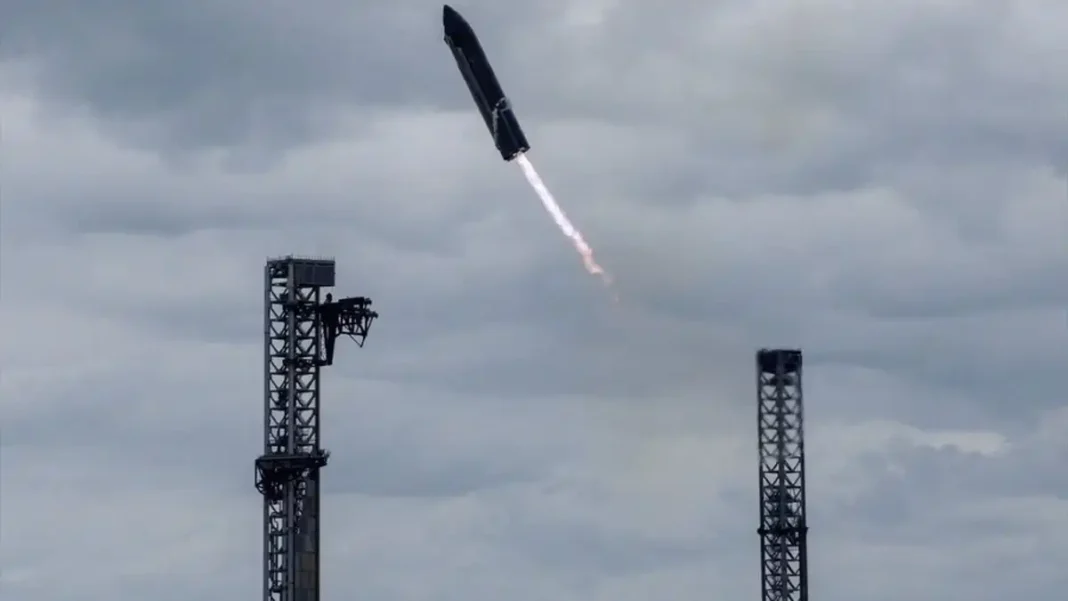
Starship 42 returned from its voyage and descended for the first time into the arms of the Texas tower it had launched from a day earlier, a catch essential to SpaceX’s decade-long effort to build a fully reusable rocket.
The 52-metre-tall Starship fell out of thick clouds over the company’s Starbase launch site, reignited its engines to flip itself vertical, and slowly descended into the tower’s “Mechazilla” arms, engines still roaring. Charred from re-entry heat, the ship shut down its engines and hung still.
“That was the missing link, the holy grail of spaceflight,” SpaceX mission commentator Dan Huot said of the ship catch.
The Express Tribune reported the catch on Sunday, citing Reuters.
SpaceX Starship catch ends longest mission yet
The Super Heavy booster carried Starship to space on Friday from Starbase in Texas, but it failed to return to the launch pad about 10 minutes after liftoff, ending the plan to recover both parts for the first time.
But the upper stage’s return after 14 orbits over 22.5 hours marked a key milestone in the multibillion-dollar development of the rocket.
Starship deployed 26 Starlink satellites on Friday night at about 260 kilometres in altitude, then fired an engine on Saturday to begin its plunge over the Pacific Ocean.
It faced blistering heat as its orbital speed of some 17,000 miles per hour slowed to a supersonic free-fall above the Gulf Coast of south Texas.
With its fins folded back, two small fittings near the top hooked onto the tower’s arms, and the vessel hung a few hundred feet off the ground.
Musk and SpaceX engineers began inspecting the ship within hours. “Ship 42 looks great!” Musk wrote on X.
Why the catch matters for reusable rockets
SpaceX’s lead in the global launch industry rests on its Falcon 9 rocket, which has launched more than 700 times since 2010. That rocket’s first stage is reusable, but its second stage, the part that delivers payloads into orbit, is discarded into the ocean after each flight.
With Starship, Musk wants a rocket that can fly to space and back like a commercial aeroplane, with minimal refurbishment between flights.
Saturday’s recovery is a key step, but SpaceX has yet to recover both stages in one mission, which would mark the first-ever return of an orbital launch system.
The heat shield is another hurdle. Its hundreds of black hexagonal tiles are not yet fully reusable, and SpaceX is working on new designs that will need little or no refurbishment.
What the milestone means for the Moon and Mars
SpaceX has spent more than $15 billion on Starship. NASA has provided $3.2 billion under a contract worth more than $4 billion, won in 2021, to return humans to the Moon using Starship.
NASA expects Starship and another Moon lander, under development by Jeff Bezos’ Blue Origin, to start crewed Moon flights in 2028, though several milestones remain for both.
For Starship, those milestones include demonstrating complex fuel transfers between tanker rockets in orbit, a critical process that will let the ship travel beyond Earth’s orbit to the Moon.
Musk sees Starship as the future workhorse for SpaceX’s Starlink satellite business, as well as for ambitions to put data centres in orbit, return humans to the Moon and, eventually, settle on Mars. SpaceX launched Starship V3 in a successful debut earlier this year, and the Artemis 2 mission carried humans back to lunar orbit in April. Europe’s Euclid telescope has also mapped 900 million galaxies, and the stakes reach beyond spaceflight, as Pakistan weighs its own strategic imperatives in the space era.
Frequently asked questions
What happened to Starship on Saturday?
Starship 42 returned from a 22-hour flight in orbit and was caught by the mechanical arms of the launch tower at SpaceX’s Starbase site in Texas.
Why is the catch important?
It is the first time the Starship upper stage has been caught after returning from orbit, a key step towards a fully reusable rocket.
What went wrong with the booster?
The Super Heavy booster failed to return to the launch pad about 10 minutes after liftoff on Friday, so SpaceX did not recover both stages.
How many Starlink satellites did Starship deploy?
Starship deployed 26 Starlink satellites in orbit on Friday night while cruising about 260 kilometres above Earth.
When will Starship carry astronauts to the Moon?
NASA expects crewed Moon flights using Starship to begin in 2028, though several development milestones, including in-orbit fuel transfer, remain.