Scientists at CERN have found evidence of a rare particle decay that happens only once in about 10 billion cases. The result, announced on November 3, ends a search that has lasted more than four decades.
The observation comes from the Large Hadron Collider beauty (LHCb) experiment at CERN’s Large Hadron Collider near Geneva, and involves a particle called a Bd meson decaying into a muon and an antimuon.
Researchers combined data collected in 2024 and 2025 with measurements from earlier runs between 2011 and 2018, and the combined result reached a statistical significance of 3.2 sigma. That is enough to claim evidence for the decay, but it falls short of the five-sigma standard needed to call it a confirmed discovery.
Why this rare particle decay matters
Rare decays are prized by physicists because they test the Standard Model, the framework describing the known particles and forces of nature. The model predicts exactly how often a Bd meson should decay into two muons, and any clear departure from that prediction would point to unknown particles or forces.
The measured rate matches the Standard Model: scientists measured about 1.14 Bd decays into two muons per 10 billion decays, close to the predicted figure, while a related decay, of Bs mesons into two muons, came in at about 3.25 per billion, also in line with the theory.
The result therefore confirms the Standard Model once more, while setting tighter limits on theories that predict new physics. Physicists call this frontier the “zeptoverse”: a scale of a billionth of a trillionth of a metre, where new particles and forces may hide.
A 42-year hunt for the Bd decay
The hunt for this decay began in 1984. The Bd meson is a short-lived particle made of a beauty quark and a down antiquark, decaying in about one and a half trillionths of a second, and only a tiny fraction of those decays produce two muons.
An earlier attempt using data up to 2018 could not confirm the decay. The breakthrough came from the upgraded LHCb detector, which began operating in 2024 and collects data five times faster than before: data from 2024 and 2025 alone reached three sigma, and adding the earlier measurements lifted the result to 3.2 sigma.
The paper was posted on the arXiv preprint server on October 30 and has been submitted to the journal Physical Review X. It has not yet been peer reviewed.
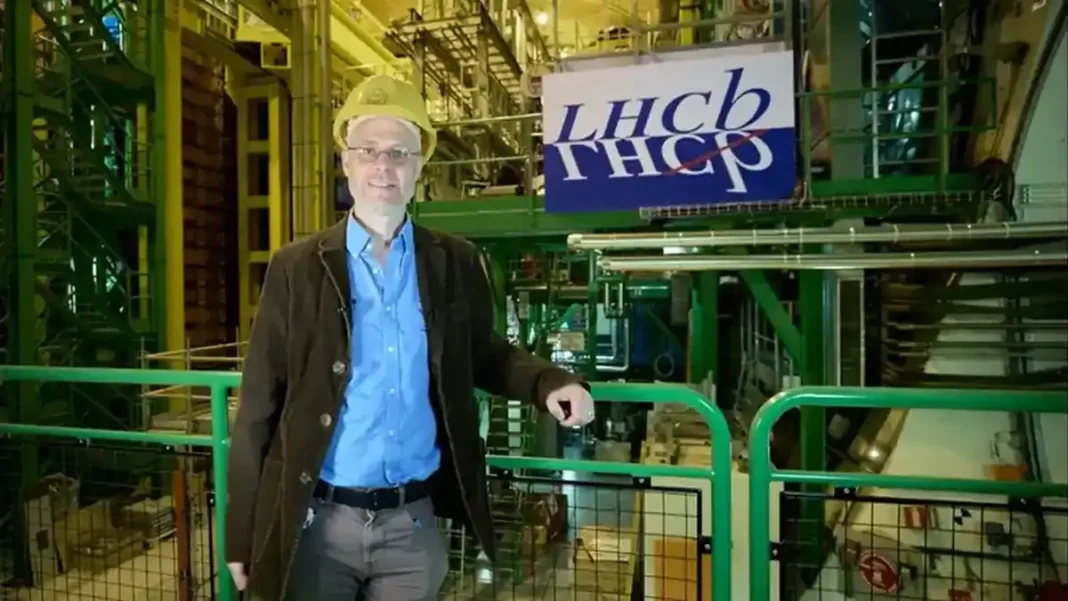
Professor Chris Parkes of the University of Manchester led the international LHCb collaboration through the construction of the upgrade. He is pictured with the LHCb experiment in the photograph above. Niladri Sahoo, a particle physicist at the University of Birmingham, convenes the LHCb Very Rare Decays working group that carried out the analysis. The University of Manchester covered the announcement in detail, and ProPakistani reported the finding on Monday.
What comes next for the LHCb experiment
The upgraded detector will keep collecting data into the early 2030s, and that larger dataset should let physicists study the decay with far greater precision. Further upgrades planned for the 2030s aim to raise collision rates by another order of magnitude, which could push the result past the five-sigma mark for a confirmed discovery.
The sister decay, Bs to two muons, was first observed jointly by LHCb and the Compact Muon Solenoid (CMS) collaboration in 2015, and together the two measurements give physicists a sharp tool for testing the Standard Model and hunting for physics beyond it.
For Pakistan, the result carries a direct link. Pakistan has been an associate member of CERN since July 2015, and Pakistani scientists and engineers contribute to its experiments and technology work, as reflected in coverage of university research in QS Asia rankings 2027: Pakistan universities. The science of climate and discovery also features in COP31 opens in Antalya, while university collaboration with industry is covered in NCERT and HEC sign cybersecurity MoU and the role of new technology in learning appears in Lahore VXR festival brings VR art to life.
Frequently asked questions
What did CERN’s LHCb experiment find?
The LHCb collaboration found evidence that a Bd meson decays into a muon and an antimuon. The decay happens only about once in every 10 billion Bd decays, and the result reached 3.2 sigma significance.
Is this a confirmed discovery?
No. A significance of 3.2 sigma counts as evidence in particle physics, but a confirmed discovery needs five sigma. The paper has been submitted to Physical Review X and has not yet been peer reviewed.
What is a Bd meson?
A Bd meson is a short-lived particle made of a beauty quark and a down antiquark. It decays in about one and a half trillionths of a second. Only a tiny fraction of Bd mesons decay into two muons.
Why do rare decays matter to physicists?
Rare decays test the Standard Model, which predicts how often they should happen. A clear departure from the prediction would point to unknown particles or forces. This result matches the model and tightens the limits on new theories.
What happens next in the search?
The upgraded LHCb detector will collect a much larger dataset into the early 2030s. Further upgrades in the 2030s should raise collision rates again, which could push the result past the five-sigma threshold for a confirmed discovery.