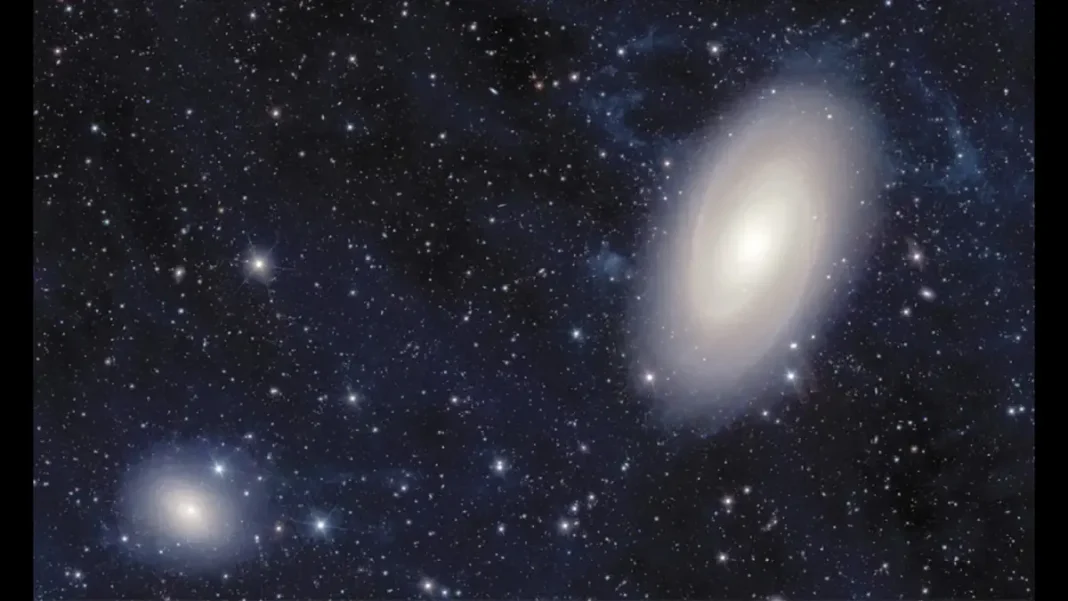
Euclid Maps 900 Million Galaxies in First Big Release
The European Space Agency has released its first big collection of data from the Euclid telescope. Euclid maps 900 million galaxies in the release, as scientists probe the puzzling cosmic components dark matter and dark energy. The release marks a major step in building the largest three-dimensional atlas of the cosmos ever made.
The data, unveiled on Thursday, covered a survey of the sky equal to about 9,500 times the size of the moon as seen from Earth. The mission aims to complete the atlas, spanning more than a third of the sky, in 2031.
The release covered around 13 months of Euclid observations, totalling 1.7 petabytes of data, or 1.7 million gigabytes. Previous releases had covered only a few days of observations.
“It marks a major milestone for ESA’s Euclid mission and for everyone involved,” said astrophysicist Valeria Pettorino, the mission’s project scientist.
Euclid maps 900 million galaxies to trace the cosmic web
Euclid was launched from Florida in 2023. Its task is to track how the universe has expanded and how its structure has formed over time. It also gathers evidence on the nature of dark energy and dark matter, and on the role of gravity on large scales.
“Euclid will not just take images of galaxies in the sky, in two dimensions, but will also measure their distance, the third dimension. This will tell us where galaxies are in space and time, across 10 billion years, and in all directions beyond our galactic plane,” Pettorino said.
Galaxies do not spread evenly through space. They cluster along filaments, with vast empty regions between them, forming a network called the cosmic web. Euclid will rebuild that web and track how it has grown.
“Galaxies cluster along filaments, surrounded by empty space, and form a network that we call the cosmic web. Euclid will reconstruct the cosmic web and how it has grown over time. This is important because the exact configuration of the cosmic web, how many clusters or voids are there, how fast it changed, depend on the properties of dark energy and dark matter,” Pettorino said.
The new data still covers only 14 per cent of the total sky area Euclid is due to survey in visible and near-infrared light over six years. The data release will be completed next year, with the first results on dark energy and dark matter.
Why dark matter and dark energy matter
The breakdown of the cosmos is stark. Ordinary matter, the stars, planets, gas and dust we know, makes up only about 5 per cent of the contents of the universe. Dark matter accounts for about 27 per cent, and dark energy for about 68 per cent.
Dark matter is known only from the pull of its gravity on galactic scales. Dark energy is thought to drive the faster and faster expansion of the universe. Neither emits or absorbs light, so neither can be seen directly.
That is where Euclid’s method comes in. Light from distant galaxies bends as it passes normal matter and dark matter in the foreground, an effect called gravitational lensing. By mapping how that light warps, scientists can trace where the unseen matter sits.
The survey will also test whether our picture of gravity itself holds on the largest scales. If the cosmic web grew faster or slower than theory predicts, the data will show it.
Space science has been moving fast this year. SpaceX’s Crew-13 mission blasted off for the International Space Station last month, while governments argued over nature and science funding at the COP17 talks. That dispute showed how hard it has become to fund big science.
Euclid’s release is a reminder of what that funding buys. A single telescope, working for just over a year, has now charted 900 million galaxies. By 2031, it aims to chart the shape of the universe itself.
Frequently asked questions
How many galaxies has Euclid mapped?
The first big data release covers observations of more than 900 million galaxies, gathered over about 13 months.
What is the cosmic web?
It is the network of filaments along which galaxies cluster, with vast empty voids between them. Euclid will reconstruct how that web has grown over time.
What are dark matter and dark energy?
Dark matter, about 27 per cent of the universe, is invisible material known from its gravity. Dark energy, about 68 per cent, is thought to drive the accelerating expansion of the universe.
When will Euclid finish its map?
The mission aims to complete the largest-ever three-dimensional atlas of the cosmos, covering more than a third of the sky, in 2031. The first results on dark energy and dark matter are due next year.