India Duty-Free Access Threatens Pakistan GSP Plus
Textile exporters have warned that duty-free access for Indian textile products to European Union and British markets could erode Pakistan’s competitive advantage under the Generalised Scheme of Preferences Plus, known as Pakistan GSP Plus. They say improved trade concessions for competing countries will intensify competition and hurt the country’s export potential.
SITE Association of Industry President Abdul Hadi said Pakistan’s GSP Plus status with the EU had been a cornerstone of its export performance, providing duty-free access to the European market for about 89 per cent of textile and apparel exports. He warned that this advantage was gradually eroding as rival exporters gained better terms.
Why exporters fear losing the Pakistan GSP Plus edge
Hadi said rising industrial production costs and changes in global trade patterns had also emerged as threats. Modernisation and value addition had become essential, alongside policy stability and the exploration of new, non-traditional markets.
The textile sector accounts for about 60 per cent of the country’s export earnings, with exports of $18 billion in fiscal year 2025-26. During the first quarter of fiscal year 2026-27, textile exports increased 5.26 per cent year on year to $5.026 billion, although maintaining this growth remained a major challenge because of rising production costs and global competition.
Hadi said Pakistan continued to rely heavily on exports of relatively low-value-added products, including yarn, fabric and home textiles. This limits opportunities to generate higher earnings. He urged industries to adopt modern technology and asked the government to offer investment incentives for technical textiles, branded garments and other high-margin products.
Declining domestic cotton production has increased the industry’s dependence on imported raw materials, with expenditure on cotton imports rising 54.9 per cent in fiscal year 2024-25. Hadi called for measures to improve domestic output and strengthen links between the agricultural and industrial sectors to ensure quality raw materials at affordable prices.
What the EU-India deal changed
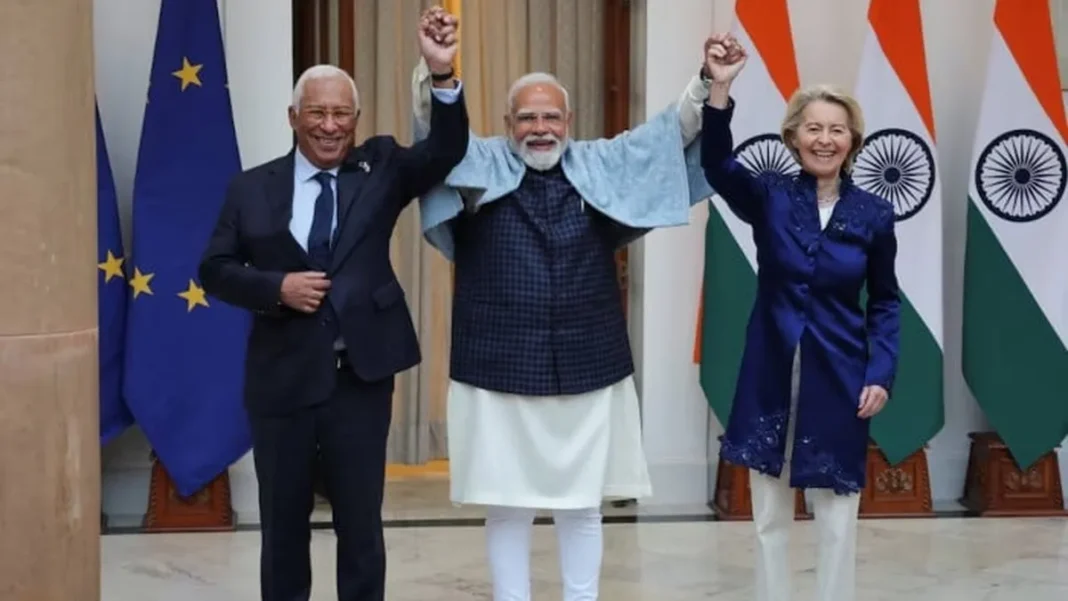
The European Union and India concluded a free trade agreement on January 27, 2026, after nearly two decades of talks. Under the deal, India secured immediate duty-free access for all of its textile and apparel tariff lines, removing duties that previously ranged between nine and 12 per cent on garments and home textiles.
The agreement also grants India near-zero tariff access across almost the entire EU market, covering leather and footwear, electronics, gems and jewellery, chemicals and seafood. Trade analysts describe the deal as full-spectrum preferential access rather than incremental liberalisation.
For Pakistan, the shift removes a tariff shield it held over Indian exporters in its largest single market. The EU takes about a quarter of Pakistan’s total exports, and textiles dominate that trade. With Indian exporters now matching Pakistan on tariffs, competition in Europe will turn more sharply on price, scale, speed and reliability.
Pakistan’s exporters face this contest with higher energy and production costs at home and a product mix weighted toward basic yarn and fabric. That combination explains why industry leaders now press for modernisation, higher-value products and new markets at the same time as they ask for policy stability.
What happens next for textile exporters
Feature Pakistan earlier reported textile exporters warning of a steep decline in October-December shipments, citing weak Western demand, freight costs up 1.5 to 2.5 times and an unimplemented export finance rate. The GSP Plus warning adds a structural threat to those near-term pressures.
Exporters now want the government to back technical textiles and branded garments with investment incentives, rebuild domestic cotton output and cut the cost disadvantages that leave mills exposed. Without those steps, they argue, Pakistan risks losing market share in Europe even while its overall textile exports still grow.
Related coverage: Textile Exporters Warn of Steep Decline in October-December, Pakistan, Bangladesh See Billion-Dollar Trade Potential, Pakistan Scraps Business Rules in Companies Act Push, and Aurangzeb Sees Fiscal Deficit at 22-Year Low.
Frequently asked questions
What is Pakistan GSP Plus?
GSP Plus is the European Union’s Generalised Scheme of Preferences Plus, which gives Pakistan duty-free access to the EU market for about 89 per cent of its textile and apparel exports.
Why does India’s duty-free access matter for Pakistan?
The EU-India free trade agreement gives Indian textile exporters immediate duty-free access to Europe, removing the tariff advantage Pakistan held over India in its largest export market.
What do Pakistani exporters want?
Exporters want modern technology, investment incentives for technical textiles and branded garments, stronger domestic cotton output and policy stability to compete on more than price.