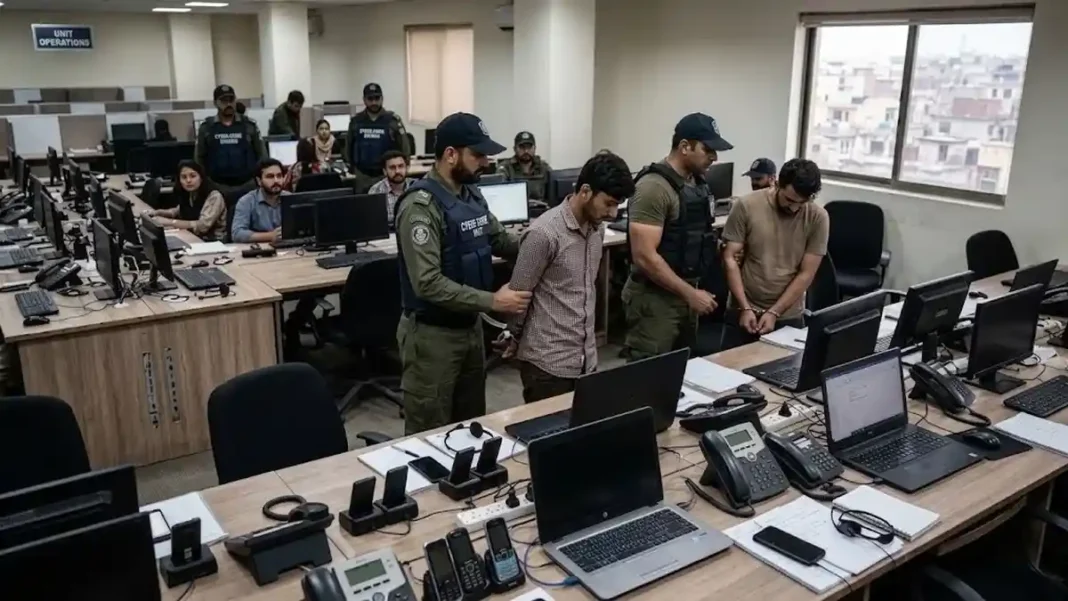
Pakistan’s National Cyber Crime Investigation Agency (NCCIA) has registered a case against 130 people over their alleged involvement in an organised cyber fraud network operating from KASA Tower in Bahria Town Phase VIII, Rawalpindi. The NCCIA Rawalpindi cybercrime network allegedly targeted Malaysian nationals through fake bank calls, impersonation of Malaysian police officers and threats of criminal proceedings.
The case was registered under Sections 13, 14 and 16 of the Prevention of Electronic Crimes Act, 2016, as amended in 2025, read with Sections 34, 383, 419, 420 and 109 of the Pakistan Penal Code. The legal provisions cover electronic and cybercrime offences, common intention, extortion, cheating by personation, cheating and dishonestly inducing the delivery of property, and abetment.
The allegations have not been tested in court. The registration of a case does not establish guilt, and the role of each person named must be established through evidence and due legal process.
How the alleged scam worked
According to the first information report (FIR) seen by ProPakistani, the investigation began after a source report and the completion of an NCCIA enquiry. After obtaining search and seizure warrants from the competent court in Rawalpindi, NCCIA officials raided the premises in Bahria Town Phase VIII.
Investigators allege that people working at the premises contacted Malaysian nationals through Voice over Internet Protocol applications while impersonating bank customer service representatives. Victims were reportedly told that suspicious or unauthorised transactions had been detected in their bank accounts.
The callers allegedly transferred victims to other people posing as Malaysian police officers. Some reportedly wore police uniforms and used an office-style background during video calls to make their claims appear genuine. Victims were then threatened with allegations of money laundering, criminal cases and legal proceedings, and were allegedly pressured into transferring money.
Investigators further allege that the proceeds were received through Malaysia’s Touch ‘n Go eWallet service and then converted into cryptocurrency through different channels.
Who police say ran the network
The FIR describes an alleged hierarchy. A Malaysian national identified only as “Jack” was reportedly operating from Cambodia and allegedly directing the operation from abroad. Mohamad Shawalludin was identified as the alleged local supervisor, while Hew Wei Lun was described as the manager responsible for the call centre’s operations.
The document also refers to several Pakistani nationals allegedly using the assumed names Sohail, Rich, Martin and B, who are suspected of facilitating the operation. In addition, it mentions a Chinese national reportedly living in Sector D-12, Islamabad, who allegedly received cryptocurrency from the operators and provided equivalent amounts in Pakistani currency in cash.
The FIR lists 130 people and includes their passport particulars. According to the NCCIA case record, the 130 people arrested in connection with the alleged operation are Malaysian nationals. Their visas had reportedly expired, and they were allegedly living in Pakistan without valid immigration status while carrying out cybercrime activities. Those claims about immigration status and involvement remain subject to verification and further legal proceedings.
The case was registered after an Istighasa report and permission from the competent authority. Sub-Inspector Amjad Bilal of NCCIA Rawalpindi is named in connection with the registration proceedings, while Sub-Inspector Liaqat Ali has been assigned the investigation.
What remains unknown
The FIR does not specify the total amount allegedly defrauded, the confirmed number of victims, the value of cryptocurrency involved or the amount of money recovered during the raid. The identities and individual roles of the alleged facilitators, along with the complete financial trail, remain subject to investigation. ProPakistani’s report stresses that registration of a case does not establish that every person named knowingly took part in the alleged offences.
NCCIA Rawalpindi cybercrime network and the wider crackdown
This case is the latest in a series of NCCIA operations against call centres accused of targeting foreign nationals. On September 29, the NCCIA arrested 61 people during a raid on an illegal call centre in Rawalpindi’s Commercial Market, Satellite Town, allegedly used to threaten foreign nationals while posing as a loan recovery operation, seizing 155 laptops and 71 mobile phones.
In August, Pakistani authorities arrested more than 500 foreign nationals across operations in Islamabad linked to illegal call centres. And on October 27, three NCCIA officers represented Pakistan at the International Alliance Against Cyber-Fraud convention in China, alongside delegations from 46 countries.