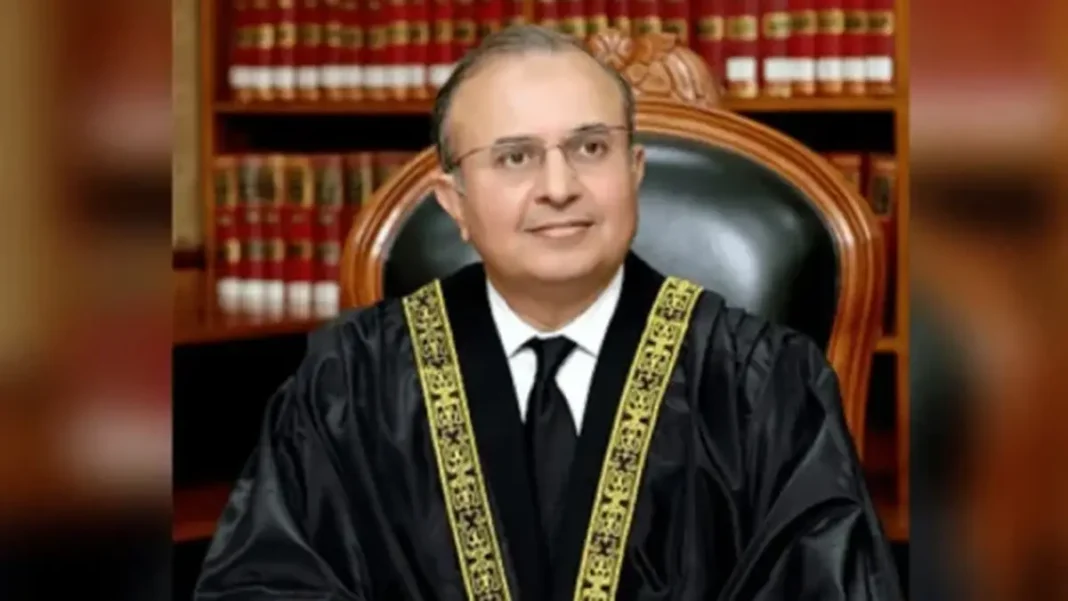
ECP Objects to Ex-Judge Shah’s Election Remarks
The Election Commission of Pakistan on November 4, 2026, objected to the Mansoor Ali Shah remarks about the 2023 ruling on elections in Punjab and Khyber Pakhtunkhwa and the reserved seats case involving the Pakistan Tehreek-i-Insaf. The commission said it was unfortunate that a retired judge was taking a position against the Constitution and the law.
Shah made the remarks on October 29 at an event organised by the United States-based Community Alliance for Peace and Justice. He was asked about his dissenting opinion in the 2023 Supreme Court ruling on provincial elections and whether it marked a turning point and the start of a division within the court.
In a statement on Wednesday, the commission said Shah’s remarks ignored basic constitutional and legal facts related to election matters and judicial decisions. It said it was highly inappropriate to present the judicial record for specific purposes through selective quotations, incomplete perspectives and one-sided interpretations.
Mansoor Ali Shah remarks: the 2023 polls ruling
In 2023, the Supreme Court took suo motu notice of the delay in provincial elections and directed, by a 3-2 verdict, that elections should be held within 90 days in Punjab and Khyber Pakhtunkhwa. Shah was one of two judges who dissented. He and the other dissenting judge said the suo motu proceedings initiated by then chief justice Umar Ata Bandial were wholly unjustified and had been initiated with undue haste.
In their detailed reasoning, the dissenting judges argued that the court had dismissed the suo motu hearing by a majority of 4-3, not 3-2, and that the 4-3 outcome should therefore be treated as the order of the court. That claim set off a fierce debate, with the government at the time arguing that the ruling was a 4-3 decision in its favour rather than a 3-2 verdict against it.
At the October 29 event, Shah returned to that dispute. He said the then chief justice was forming like-minded benches, with three or four judges attending to most cases. He said judges had gathered in the ante-room and agreed to wait, but days later a bench took up the matter under suo motu powers, which he denounced as a one-man show. He said two judges, Yahya Afridi and Athar Minallah, had dismissed the petitions, and the bench was later reconstituted, sparking the 4-3 and 3-2 debate.
The reserved seats case
Shah also defended the 2024 verdict in the reserved seats case, in which the PTI was declared eligible for seats reserved for women and minorities, in a setback to the ruling coalition. He recalled that the court had said the PTI was a political party and it was wrong to deprive it of its symbol, and illegal.
“We said that the PTI was a political party and it was wrong to deprive them of their symbol, and illegal,” he said, recalling that the decision was one that nobody liked.
The commission rejected that account. It said the election symbol was subject to transparent intra-party elections under Sections 208 and 209 of the Elections Act 2017. It added that, to date, the PTI had not been able to fulfil that requirement. The party was supposed to hold intra-party elections by June 30, 2021, and the commission had given it three chances, but the party failed to hold them, the statement said.
As a result, the commission said, the party’s election symbol was withdrawn, and that withdrawal was upheld by the Supreme Court in 2025.
What the ECP said about reserved seats
The commission said the PTI held intra-party elections after five years, and its proceedings remained pending because the party itself had taken a stay order from a high court. Only parties that contested elections had a right to reserved seats, the commission said, and such parties had to submit a preferred list of candidates before the elections, which the PTI had not done. A party also had to win at least one seat, and independent members were not entitled to reserved seats.
“If the PTI was entitled to the reserved seats, then Articles 51 and 106 of the Constitution and Section 104 of the Elections Act 2017 become ineffective,” the commission argued.
The commission’s recent election work includes a show-cause notice to the MQM-P over intra-party polls, covered in ECP Show-Cause Notice to MQM-P Over Party Elections, and its review of Islamabad local poll preparations, covered in ECP Reviews Islamabad LG Elections Prep. The government has also sought opposition names for an electoral reforms panel, covered in Government Seeks Names for Electoral Reforms Panel.
Frequently asked questions
What did the ECP object to?
The commission objected to former judge Mansoor Ali Shah’s remarks at an October 29 event about the 2023 polls ruling and the reserved seats case.
What was Shah’s position on the 2023 ruling?
Shah dissented from the 3-2 verdict ordering polls within 90 days in Punjab and KP, arguing the suo motu proceedings were unjustified and that the court had dismissed the matter by 4-3.
Why did the PTI lose its election symbol, according to the ECP?
The commission says the PTI failed to hold transparent intra-party elections as required by Sections 208 and 209 of the Elections Act 2017, despite three chances.
Who is Mansoor Ali Shah?
He is a former senior puisne judge of the Supreme Court who resigned in November 2025 after the 27th Constitutional Amendment was signed into law.
Did the ECP announce any action against Shah?
No. The commission issued a statement objecting to his remarks and setting out its own account of the record, but it did not announce proceedings against him.