Air Pollution Costs Pakistan 6.5% of GDP
Air pollution costs Pakistan around 6.5 per cent of GDP every year, while causing more than 248,000 early deaths, according to business and environmental experts. The Overseas Investors Chamber of Commerce and Industry (OICCI) says dirty air has become one of the country’s most severe public health and economic challenges, and it is now weighing on foreign investment as well.
Net foreign direct investment fell 34 per cent to $1.64 billion in FY26, while total foreign investment, including portfolio flows, plunged 74 per cent to just $451 million. The State Bank of Pakistan has linked the weakness in investment inflows mainly to governance concerns and policy uncertainty, but experts say environmental conditions now shape investment decisions too. Tribune reported the OICCI statement and the expert interviews behind the estimates.
The health burden behind the figure
The human cost sits behind the economic estimate. National average concentrations of fine particulate matter (PM2.5) rose by 7 per cent between 2013 and 2023, while ground-level ozone rose by 16 per cent between 2010 and 2020. Today, 92 per cent of the population lives in areas where PM2.5 levels exceed the World Health Organisation’s interim target of 35 micrograms per cubic metre, while the entire population lives in areas that breach national air quality standards.
Children bear a heavy share of the burden. Those under five account for 18 per cent of air pollution-related deaths. The University of Chicago’s Air Quality Life Index estimates that air pollution cuts average life expectancy by 3.8 years, with losses reaching as much as seven years in the most polluted areas. The World Bank puts the yearly cost of environmental damage, with air pollution as its largest part, at nearly 6 per cent of GDP.
Why air pollution costs Pakistan so much
For investors, dirty air has become a practical problem, not an abstract one. Sajjeed Aslam, a partner at Sustainability LLC in the United States, said high pollution levels make it harder for companies to persuade foreign staff to move to major cities such as Lahore, while winter smog and the closures that come with it disrupt business and economic activity.
International funds with environmental and climate-related mandates also check air quality and sustainability indicators before they place capital, he said. Karachi Urban Lab acting Director Muhammad Toheed said clean air was not merely an environmental demand but an economic necessity. Experts argue that stricter emissions standards, cleaner fuels and reliable public transport should be treated as economic investments rather than added costs, since preventing pollution is far cheaper than dealing with its long-term effects.
Where the pollution comes from
The sources are broad, and experts warn against blaming one culprit alone. In Lahore, vehicles account for 35 per cent of fine-particle pollution, followed by heavy industry at 28 per cent and brick kilns at 17 per cent, while crop-residue burning adds to pollution during the winter months.
Toheed cautioned against attributing the whole crisis to vehicles. Fossil fuels contribute heavily through transport, power generation and industry, but household fuels, crop-residue burning, waste burning and industrial emissions also play a large part. The OICCI called for stricter enforcement of industrial emissions standards, faster adoption of cleaner transport and greater support for firms moving towards sustainable production.
What could bring the numbers down
The crisis is not beyond control, experts say, because much of the country’s air pollution comes from domestic sources that policy can reach. The World Bank-backed $300 million Punjab Clean Air Programme aims to cut PM2.5 concentrations by 35 per cent over a decade, including 600 electric buses and 5,000 super seeders to discourage crop-residue burning.
Experts also want Euro-5 fuel at all petrol pumps by 2027 and Euro-6 by 2030, alongside mandatory continuous emissions monitoring for major industrial units and public disclosure of pollution data. International experience shows that sustained action works: Beijing cut its annual average PM2.5 level from 89.5 to 58 micrograms per cubic metre between 2013 and 2017, with studies attributing about 80 per cent of the improvement to emissions cuts rather than favourable weather.
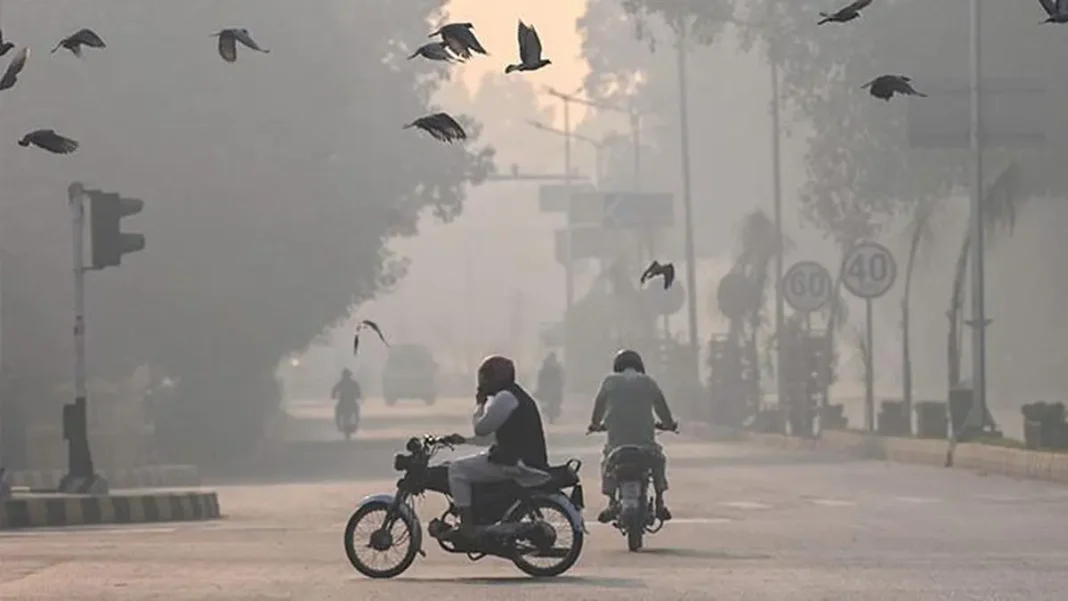
The warning lands as Punjab’s smog season bites. Feature Pakistan has tracked the crisis in the province, including Punjab smog AQI readings, fines for smoke-emitting vehicles in Lahore and Faisalabad’s AQI scrutiny. Dawn reported earlier this week that Lahore’s air quality index had crossed 530, into the hazardous range, with Gujranwala recording 606, which shows how fast the seasonal spike arrives.
Frequently asked questions
How much does air pollution cost Pakistan?
Experts put the cost at around 6.5 per cent of GDP, including the impact of lead exposure, through early deaths, health spending and lost productivity. The World Bank estimates environmental damage at nearly 6 per cent of GDP a year, with air pollution as its largest part.
How many people die early because of air pollution?
More than 248,000 people die early every year, according to the State of Global Air figures cited by the OICCI. Children under five account for 18 per cent of air pollution-related deaths.
Why are foreign investors concerned about air quality?
Investors weigh climate risks and sustainability when they choose destinations, funds with environmental mandates check air quality data, and firms struggle to persuade foreign staff to move to heavily polluted cities. Winter smog closures also disrupt business activity.
What is being done to cut air pollution?
The $300 million Punjab Clean Air Programme aims to cut PM2.5 levels by 35 per cent over a decade through electric buses and super seeders. Experts also want Euro-5 fuel at all pumps by 2027, Euro-6 by 2030, continuous emissions monitoring and public pollution data.