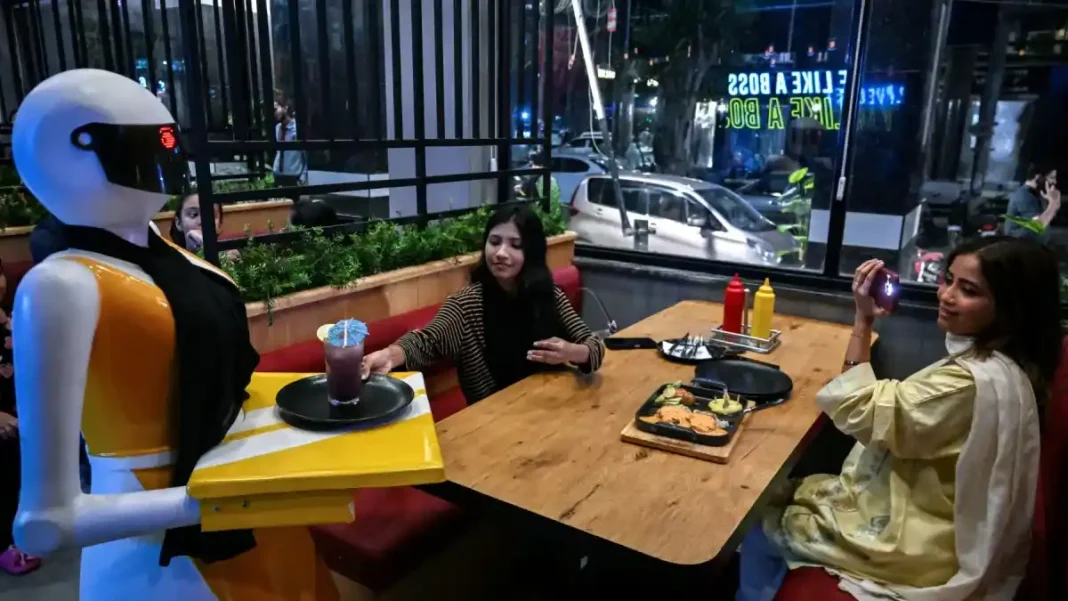
One of the Karachi robot waitresses glides between dining booths at a neon-lit restaurant, carrying a fresh pizza to a waiting family. “Welcome to Sicilian. My name is Robia,” she announces in an electronic voice, her red LED eyes blinking as she looks down at the diners.
Robia works alongside Jojo, her fellow robot waitress. Both are the DIY creations of Pakistani engineer Syed Osama Aziz, who is giving Karachi’s dining scene a sci-fi twist. While agile humanoids built in the United States, China and elsewhere draw global attention, robotic staff are still a rare sight in Pakistan.
Both robots have round white heads with dark visors like motorcycle helmets, and each wears a black shawl around its neck, styled like a dupatta. They now serve customers at The Sicilian restaurant in Karachi, and families are flocking to watch them work.
Built in Pakistan, mostly from local parts
Aziz, who also established The Sicilian restaurant, developed the machines using mostly locally manufactured parts. He designed their circuit boards and programmed them in his own lab.
“The equipment, the things needed to make robots, are not so easily available here, so we had to arrange them,” he told AFP.
The duo were developed through his robotics company, Cobot, with help from friends and some electronic components imported from abroad. His workshop manufacturing the robots is located in Multan.
In China and other East Asian countries especially, robots are an increasingly common sight, shuttling food to customers in chain restaurants and taking on other jobs from cleaning to greeting hotel guests. They remain a novelty in Pakistan, where Aziz’s home-grown creations are attracting curious diners.
When the robots arrive at a table, customers must either take the food off their serving tray themselves or wait for a human member of staff to assist them.
Families flock to meet the robots
For now, the robots are proving a hit with families, who flock to the restaurant to watch the machines in action. Children reach out to touch them while their parents snap photographs and selfies.
“The best thing about it is that it introduces itself,” excited customer Ahmer Zameer told AFP, explaining that the robot also “tells you what things you can order”.
Young customer Sonia Dilosker said she was impressed by the androids’ appearance and preferred their approach to serving customers, “because it is a machine and without any emotions”.
Restaurant staff say the novelty has brought a surge in customers, with some travelling from across the sprawling port city to meet the robots. “Our business has grown. People are coming from far away for this. They have seen a robot for the first time here,” staff member Hellen told AFP. “People are excited to see this.”
What comes next for the Karachi robot waitresses
Aziz hopes to make his creations more sophisticated in the future. “Our plans are to add camera-based processing and image-processing features,” he said.
“That means the robot will also recognise you by looking at you, and it will remember what you ordered last time, and accordingly it will be able to give you better suggestions.”
The project is a small but telling sign of Pakistan’s growing tech ambitions. Services exports rose 22.6 per cent, led by IT, and home-grown hardware projects like Cobot’s show that local engineering talent is moving beyond software. Even 100 Karachi schools are now running on solar panels, another sign of practical technology reaching everyday life in the city.
For Aziz, the robots are only the start. If the camera upgrades work as planned, Robia and Jojo could soon greet regulars by sight and suggest their usual order before they even ask.
Frequently asked questions
Where can you see the Karachi robot waitresses?
Robia and Jojo serve customers at The Sicilian restaurant in Karachi. They were built by Pakistani engineer Syed Osama Aziz through his robotics company, Cobot.
Are the robots made in Pakistan?
Yes, mostly. Aziz designed their circuit boards and programmed them in his own lab, using mostly locally manufactured parts, with some electronic components imported from abroad. His workshop is in Multan.
What will the robots be able to do next?
Aziz plans to add camera-based processing so the robots can recognise customers, remember what they ordered last time and suggest dishes accordingly.
How much do the robots do on their own?
When the robots reach a table, customers must take the food off the serving tray themselves or wait for a human member of staff to help them.