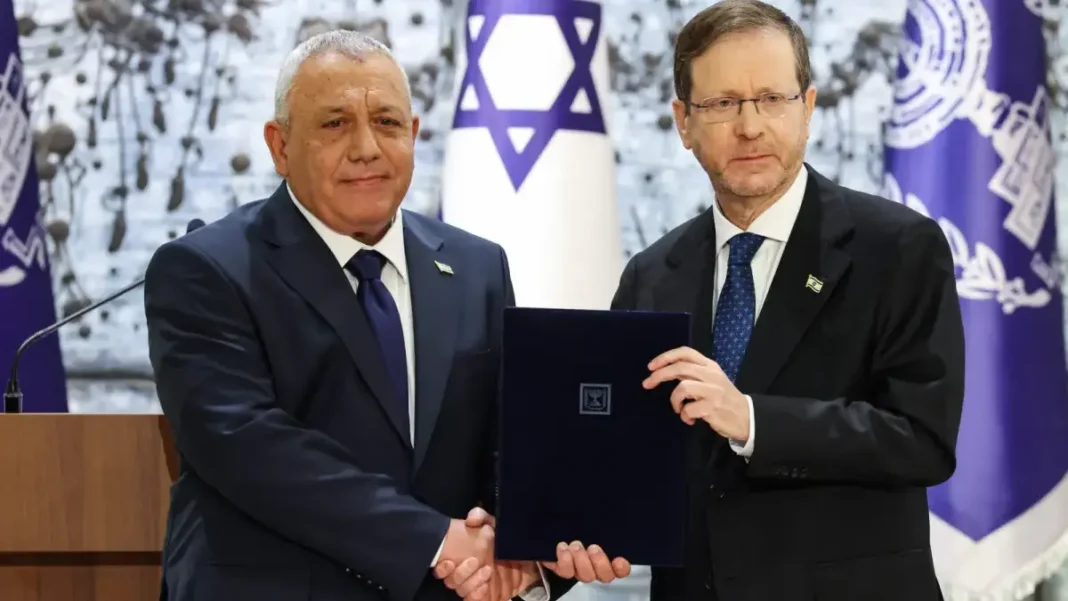
The Eisenkot government formation began on Sunday, as Gadi Eisenkot formally received the mandate to form Israel’s next government, Dawn reported, and warned that the country faces a diplomatic crisis as coalition talks begin. The former military chief, 66, accepted the task from President Isaac Herzog at a ceremony in Jerusalem, giving him 28 days to build a coalition.
“We are in a state of emergency, approaching a point of no return for the State of Israel,” Eisenkot said. “We are in the midst of a devastating diplomatic crisis. Even our closest friends and strategic allies are saying their relationship with Israel must be reassessed.”
Eisenkot vowed to form a national emergency government, saying: “We must form a national emergency government. This will require creative and unconventional political steps.” He has signalled he is willing to start with a minority government, relying on outside votes from Arab parties, before bringing other lawmakers in — though he does not intend to swear one in this week, even if he reaches a deal sooner.
Eisenkot received the mandate on Saturday evening, after Herzog’s week of talks following the October 27 election: 67 of the 120 Knesset members recommended him, against 46 for Netanyahu.
A ceremony, and a warning
Eisenkot appealed to Netanyahu’s Likud party and to the far-right Religious Zionism party of Finance Minister Bezalel Smotrich to join a government, but only with himself as prime minister.
Eisenkot government formation: three paths to a majority
The Eisenkot government formation faces three possible routes, and each one carries a serious obstacle. The first is a minority government of the four Jewish opposition parties, which hold 48 of the 120 Knesset seats, backed by Arab parties on key votes. The second is a coalition with the ultra-Orthodox parties that Eisenkot and his allies have shunned in the past. The third is a unity government with Netanyahu.
He has set four conditions for any party that joins him: recognition of Israel as a Jewish and democratic state, national service for all citizens, recognition of Hamas as a terrorist organisation, and a commitment to destroy its military and governing capacity. He has 28 days, with a possible 14-day extension. If he fails, Netanyahu will probably get his chance. If he also fails, new elections could follow.
Lieberman’s shift on the ultra-Orthodox
The hardest obstacle sits with Avigdor Lieberman. The Yisrael Beiteinu leader has ruled out a minority government that depends on Arab parties, and he has ruled out a unity government with Netanyahu. He argues a minority government would be short-lived and would only strengthen Netanyahu.
On Sunday, however, Lieberman dropped a veto he had held for years, signalling a willingness to sit with the ultra-Orthodox parties, Shas and United Torah Judaism, to build a 61-lawmaker coalition without the Arab parties. He said he had to make difficult decisions to remove Netanyahu.
The ultra-Orthodox exemption from military service has become a sore point for many Israelis, as reservists serve repeated tours of duty. Eisenkot was due to meet Bennett on Sunday evening, followed by talks with Lieberman on Monday.
Netanyahu’s unity call
Netanyahu, Israel’s longest-serving prime minister, called in a video statement on Saturday for a unity government of all Zionist parties to preserve a Jewish state. “This is the will of the people and the need of the hour,” he said, ruling out a coalition with Arabs, who make up 21 per cent of Israel’s population. He gave no sign of whether he would serve under Eisenkot.
Eisenkot shares many of Netanyahu’s hawkish views: he opposes Palestinian statehood, says Hamas’s military wing must be destroyed, and warns Netanyahu has no mandate for another attack on Iran. He has also vowed to end settler violence against Palestinians in the West Bank.
What happens next
The talks will decide whether Israel gets a new government or heads back to the polls. The region is watching: three tankers caught fire in the Strait of Hormuz in recent weeks, and an Aramco building was damaged in Riyadh. Eisenkot’s first test comes this week, in his meetings with Bennett and Lieberman. If he turns the 48-seat bloc into a working majority, he will break nearly two decades of Netanyahu rule. If he cannot, the mandate passes back to Netanyahu.
Frequently asked questions
Who is Gadi Eisenkot?
Gadi Eisenkot, 66, is a former chief of staff of the Israel Defense Forces who led the centrist Yashar party in the October 27 election.
How long does Eisenkot have to form a government?
He has 28 days from Sunday, November 8, with a possible 14-day extension. If he fails, Netanyahu will probably get his chance.
Why is forming a government so difficult for Eisenkot?
His four-party bloc holds only 48 of the 120 Knesset seats. A minority government would need Arab party support, which Lieberman rejects.
What did Eisenkot say about Israel’s diplomatic position?
He said Israel faces a devastating diplomatic crisis, with even its closest allies saying their relationship with Israel must be reassessed. He warned the country was approaching a point of no return.
What is Netanyahu’s position?
Netanyahu has called for a national unity government of all Zionist parties, ruling out a coalition with Arab parties. He has given no sign of whether he would serve under Eisenkot’s leadership.