Pakistan-US academic exchanges will grow closer after Deputy Prime Minister and Foreign Minister Ishaq Dar and former US diplomat Robin Raphel agreed on Tuesday to promote contact between think tanks and academic institutions in the two countries.
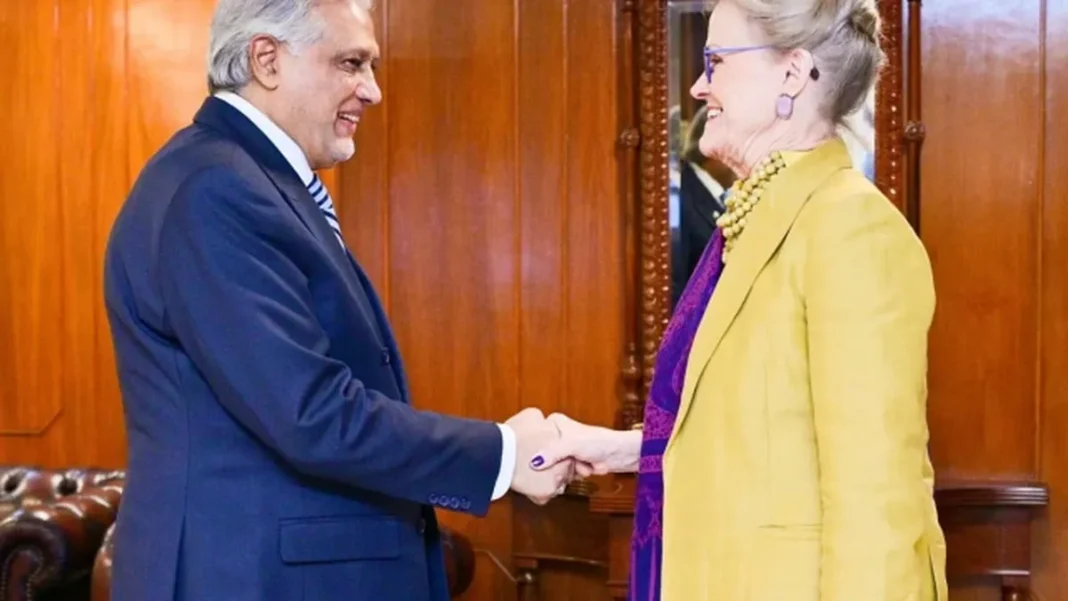
The understanding was reached during a meeting in Islamabad between Deputy Prime Minister and Foreign Minister Ishaq Dar and former US assistant secretary of state for South Asian affairs Robin Raphel, Tribune reported, citing a statement issued by the Foreign Office.
Raphel called on Dar at the Foreign Office. The two sides discussed matters of mutual interest, the statement said, and agreed to encourage closer contact between research institutions and universities in the two countries.
Dar welcomed the positive direction of Pakistan-US relations and stressed the need for sustained engagement to strengthen bilateral cooperation further.
A relationship on a steadier footing
The meeting came on a day when Washington moved to fill a long-vacant post in Islamabad. Earlier on Tuesday, US President Donald Trump nominated Charge d’Affaires Natalie Baker as the next US ambassador to Pakistan, paving the way for a permanent envoy after a gap of nearly two years.
The White House announced the nomination in a list of appointments sent to the US Senate on Monday. If confirmed, Baker will become the first US ambassador to Pakistan since Donald Blome left the post in early 2025. Trump’s nomination of Natalie Baker as the next US ambassador now awaits Senate confirmation.
The nomination fits a broader thaw in the relationship. Ties between the two countries warmed markedly during 2025 and 2026, moving from a cold phase to a more practical engagement under Trump’s second term. The shift followed Trump’s role in brokering a ceasefire between Pakistan and India after their brief conflict in May 2025, an intervention Prime Minister Shehbaz Sharif has repeatedly praised.
In March 2025, Trump had already praised Pakistan’s counterterrorism efforts during a national address, a signal that policy was turning. After the May ceasefire, Shehbaz nominated Trump for the Nobel Peace Prize, saying his intervention had helped save millions of lives. Trump, in turn, praised both the prime minister and Chief of Defence Forces Field Marshal Asim Munir, and invited the field marshal to a luncheon, the first such meeting for a Pakistani military chief.
Why Pakistan-US academic exchanges matter
The agreement reached on Tuesday is modest in form but points at a gap the two sides have talked about for years. Think tanks and universities shape how each country understands the other, and direct contact between them can steady a relationship that has often swung with events.
For Pakistan, stronger academic links also carry a practical pull. Overseas Pakistanis sent home $3.89 billion in October, and the large Pakistani community in the United States remains one of the country’s closest human bridges to Washington. Student and scholar exchanges build on those ties and give young Pakistanis a direct route into American research and classrooms.
No timetable or programme was announced for the exchanges. The Foreign Office statement recorded the agreement in principle, leaving the detail to follow-up contact between institutions on both sides.
Dar’s wider diplomatic push
The meeting with Raphel was part of a busy diplomatic stretch for Dar. He has also been pressing Pakistan’s case on water, defending the country’s rights under the Indus Waters Treaty and warning against attempts to use water as a weapon.
Meanwhile, Prime Minister Shehbaz Sharif is in Turkiye for the COP31 leaders’ summit, where climate and regional issues top the agenda. The two tracks, taken together, show Islamabad working several diplomatic fronts at once: climate, water, and now a softer push on academic and policy dialogue with Washington.
What happens next
The test of Tuesday’s understanding will be whether institutions follow through. Think tank exchanges need funding, visas and willing partners, and academic links need formal agreements between universities. None of that was spelled out in the Foreign Office statement.
Still, the meeting adds another strand to a relationship that has steadied over the past year. With a permanent ambassador likely to take up the post in Islamabad soon, the ground is set for the kind of sustained contact Dar called for.
Frequently asked questions
Who is Robin Raphel?
She is a former US assistant secretary of state for South Asian affairs who served in the role in the 1990s. She called on Deputy Prime Minister Ishaq Dar in Islamabad on Tuesday.
What did Dar and Raphel agree on?
They agreed to encourage closer exchanges between think tanks and academic institutions in Pakistan and the United States, to promote mutual understanding and dialogue on regional and international issues.
Who is the next US ambassador to Pakistan?
President Donald Trump has nominated Natalie Baker, currently the charge d’affaires in Islamabad. Her nomination is subject to confirmation by the US Senate.
Why has there been no permanent US ambassador in Pakistan?
The post has been vacant since Donald Blome left in early 2025, leaving a gap of nearly two years before Baker’s nomination.
What changed in Pakistan-US relations in 2025?
Relations warmed after Trump’s role in brokering a ceasefire between Pakistan and India in May 2025, followed by closer counterterrorism cooperation and high-level contact, including a luncheon for Field Marshal Asim Munir.