


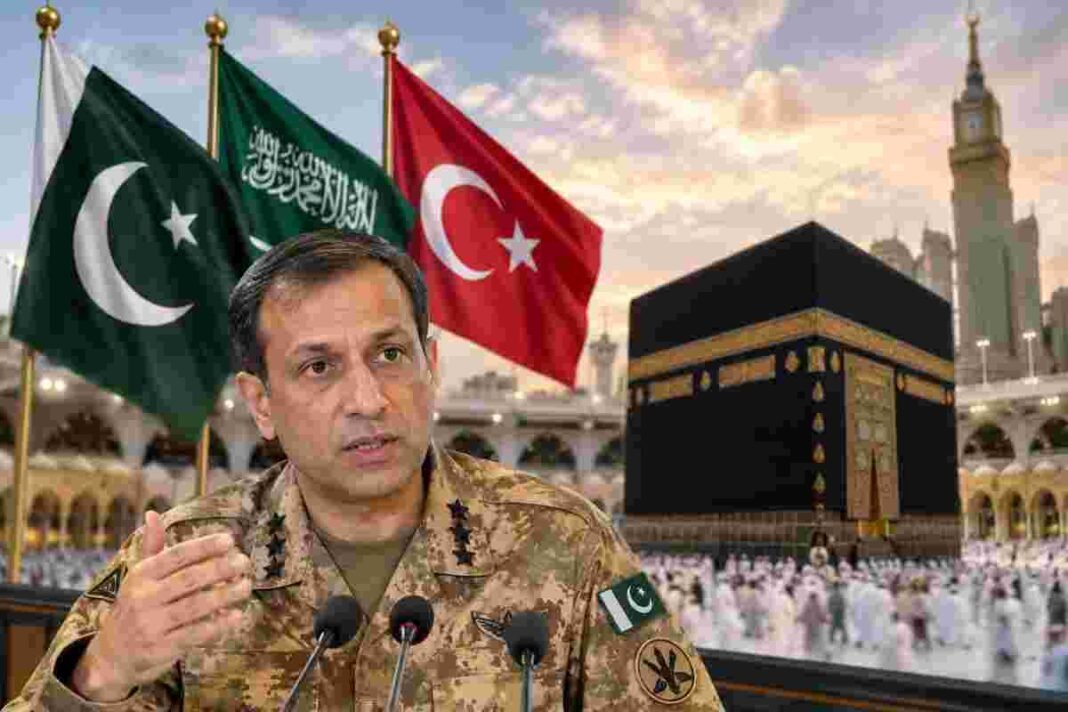
ISLAMABAD: Director General Inter-Services Public Relations Lieutenant General Ahmed Sharif Chaudhry has said the Makkah Agreement should not be described as a Muslim alliance. He stressed that the three-country defense pact carries no aggressive intentions against any state. (The Express Tribune)
Speaking during an interview with Al Arabiya, the DG ISPR explained Pakistan’s position on the recently signed defense arrangement. He said Pakistan, Saudi Arabia and Türkiye developed the pact to strengthen collective defense and regional stability.
According to Lieutenant General Ahmed Sharif Chaudhry, the Makkah Agreement contains no element of aggression, intervention, or regional expansion. Instead, the three countries designed the arrangement around collective deterrence and defensive cooperation. (The Express Tribune)
He also rejected the idea that the pact represents a wider Muslim military alliance. The agreement currently connects Pakistan, Saudi Arabia and Türkiye through a formal framework for defense coordination.
The DG ISPR said the arrangement did not emerge from a single sudden regional development. Rather, decades of political, strategic and defense relations among the three countries created the foundation for closer cooperation.
Pakistan, Saudi Arabia and Türkiye signed the joint defense agreement in Makkah on August 7, 2026. The official framework aims to strengthen collective deterrence, while an armed attack against one participating country would count as an attack against all three. (عكاظ)
Furthermore, the Makkah Agreement reflects the long-standing strategic relationships among the participating states. Ahmed Sharif Chaudhry said people around the world already understand the depth of ties that connect the three countries.
He added that all three states also maintain their own relationships with other countries, alliances and international groups. Therefore, the defense arrangement complements their existing partnerships rather than replacing or competing with them. (The Express Tribune)
Meanwhile, the DG ISPR addressed questions about how the three countries would implement the pact. He explained that governments and armed forces normally keep sensitive operational details away from the public domain.
For this reason, Pakistan, Saudi Arabia and Türkiye will determine the operational aspects of the Makkah Agreement among themselves. The participating governments will decide how they coordinate military and defense-related cooperation under the framework.
The three countries have already taken steps to strengthen the pact’s institutional structure. Officials from Pakistan, Saudi Arabia and Türkiye met in Istanbul on August 31 and agreed to deepen strategic coordination, collective deterrence and defense cooperation. (UNA)
The meeting also supported plans to create a permanent secretariat in Saudi Arabia. The three governments also agreed to strengthen cooperation in defense industries, joint production and military technologies. (UNA)
Ahmed Sharif Chaudhry also discussed the possibility of adding more countries in the future. He said peace-oriented countries that support regional security could potentially join the Makkah Agreement.
However, any future expansion would require a decision from the three existing members. Pakistan, Saudi Arabia and Türkiye would therefore determine whether another country could join the defense framework.
At the same time, the DG ISPR addressed Pakistan’s relations with China. He said Islamabad maintains strategic ties with Beijing, and the new defense arrangement does not change the nature of that relationship.
Pakistan continues to maintain separate strategic partnerships with different countries based on its national interests and regional cooperation. Therefore, officials do not view the Makkah Agreement as a replacement for Pakistan’s existing strategic relationships.
The agreement has attracted greater attention amid recent security tensions in the Middle East. Pakistan’s Foreign Office has also described the arrangement as defensive and said Islamabad would act according to its provisions while supporting regional peace and dialogue. (Arab News)
Still, Ahmed Sharif Chaudhry stressed the broader purpose of collective deterrence rather than confrontation. His comments aimed to clarify that the Makkah Agreement focuses on defense, stability and cooperation among the participating states.
The official agreement itself says the three countries want to strengthen common security and support peace and stability in the region and beyond. It also establishes closer defense cooperation while treating an armed attack on one member as an attack on all three. (عكاظ)
For Pakistan, Saudi Arabia and Türkiye, the Makkah Agreement now provides a formal structure for decades-old defense and strategic ties. At the same time, Pakistani military officials maintain that the pact carries no aggressive ambitions and should not be interpreted as a broader Muslim military alliance. (The Express Tribune)