Quick Facts
- Location: Central Hunza, Gilgit-Baltistan — just below Karimabad, on flat land near the Hunza River, about 90 km (2.5 hours) from Gilgit on the Karakoram Highway
- Altitude: around 2,300 metres (7,500 feet)
- Famous For: Being the oldest settlement on the Silk Road in Hunza (over 1,000 years old), its 40-foot Tamurkux watchtower, four centuries-old mosques, and two UNESCO Asia-Pacific Heritage Awards for conservation
- Nearest City: Gilgit (about 90 km); Karimabad is the immediate neighbouring town
- Accessibility: Easy — right on the Karakoram Highway; walkable from Karimabad; local guides available at the village
- Known Landmarks: Tamurkux watchtower, the four historic mosques, the old stone reservoir, Ganish Khun’s 39 heritage houses, sacred rocks
- Best For: History lovers, architecture and photography enthusiasts, cultural travellers, families — anyone who wants to see Hunza’s living heritage rather than just its scenery
Why Visit Ganish Village
Everyone comes to Hunza for the postcard views — Rakaposhi towering over apricot orchards, the turquoise ribbon of the Hunza River, the fairy-tale forts of Altit and Baltit. But the forts show you how Hunza’s kings lived. Ganish shows you how everyone else lived — and it has been showing visitors for over a thousand years. This is the oldest settlement on the ancient Silk Road in the Hunza Valley, a fortified village of stone houses, watchtowers and carved wooden mosques that was already old when the great caravans of Central Asia stopped here for water and shelter. If Hunza is the jewel of the north, Ganish is the setting that holds it.
What makes Ganish extraordinary is that it is not a museum. It is a living village. Families still live in the old stone houses of Ganish Khun, the historic core. The ancient reservoir still holds glacier meltwater. Butter is still wrapped in birch bark and stored under the cold water, exactly as it has been for centuries — and if you are lucky, a villager may offer you a sweet made from it. The narrow alleys still follow the maze-like defensive layout designed to confuse invaders. Walking here feels less like touring a heritage site and more like being briefly admitted into a thousand-year-old way of life that refused to die.
And the world has noticed. Ganish’s conservation — the careful restoration of its mosques and settlement fabric — won UNESCO Asia-Pacific Heritage Awards in 2002 and 2003, putting this small Hunza village on the global heritage map. For the thoughtful traveller, Ganish is the essential counterpoint to Hunza’s natural splendour: come for the mountains, but don’t leave without walking the alleys where Silk Road history still breathes. It is quiet, it is authentic, and it will be the part of Hunza you remember longest.
History of Ganish Village
Ganish is believed to have been established around the 10th century AD, making it the oldest and first settlement on the ancient Silk Road in Hunza — and one of the oldest continuously inhabited settlements in the entire region. Long before the Karakoram Highway existed, caravans travelling between Central Asia and the Indian subcontinent stopped at Ganish, and the settlement grew into a fortified stronghold to protect the trade passing through it. Some believe the name “Ganish” comes from the Burushaski language, associated with the idea of gold — perhaps reflecting its importance as a trade hub, perhaps its treasured heritage.
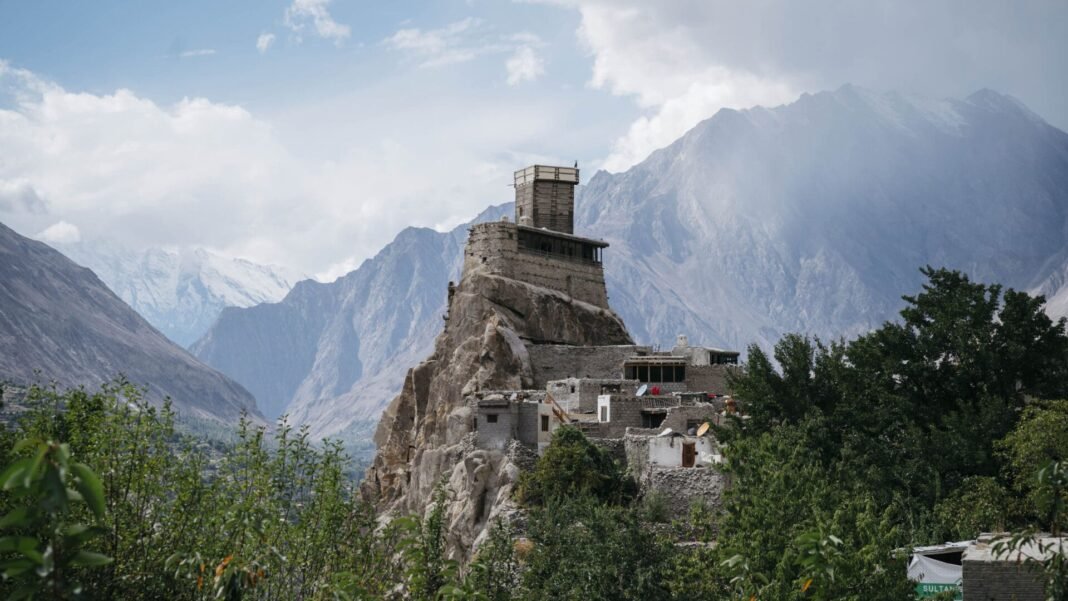
Defence shaped everything about old Ganish. The settlement was designed as a fortress: originally 14 watchtowers guarded the approaches (a few still stand), fortified walls ringed the core, and the alleys were laid out as a deliberate maze of narrow lanes and cul-de-sacs to disorient attackers. The Tamurkux watchtower, roughly 40 feet high, once gave lookouts a commanding view of the approaches from the river. The village earned a fierce reputation — some call it the “land of warriors and king makers,” because Ganish men fought in the historic battles with neighbouring Nagar across the river and played roles in decision-making during Hunza’s royal era. Legend even says Ganish warriors practised river-crossing techniques in the village’s stone reservoir before crossing the Hunza River to raid Nagar villages.
With the spread of Islam, the leading families of the area — the Yarikutz, Rupikutz, Kuyokutz and Mamorokutz — constructed four mosques and watchtowers dating to the 16th and 17th centuries, richly carved in wood in the distinctive Hunza style. The historic core, Ganish Khun, still contains 39 houses dating back to the 15th century, built of local stone and timber around open spaces, ancient chinar, mulberry and willow trees testifying to the settlement’s great age.
The 20th century was hard on Ganish. A flood in 1960 damaged the old fabric, and the construction of the Karakoram Highway through the village in the 1970s cut through its historic layout. The centuries-old mosques and towers were decaying from time and lack of resources — until a landmark restoration effort, assisted by support from Norway and Spain through the Aga Khan Cultural Services Programme (AKCSP), brought the structures back to something of their old glory. That restoration won Ganish the UNESCO Asia-Pacific Heritage Award in 2002 for the mosques and again in 2003 for the settlement as a whole. Today the village stands as a model of community-led heritage conservation in the Karakoram — a thousand-year-old settlement, still inhabited, still standing, still telling its story.
Top Things to Do in Ganish Village
Climb the Tamurkux Watchtower
The roughly 40-foot Tamurkux watchtower is Ganish’s signature structure — a timber-and-stone tower from the days of Hunza’s wars with Nagar. The climb up is a tight squeeze through the old timbers, but the view from the top across the valley to Rakaposhi is worth every awkward step. It is the single best vantage point for understanding why this spot was chosen: you can see every approach an enemy — or a caravan — might take.
Visit the Four Historic Mosques
The four 16th- and 17th-century mosques, built by Ganish’s leading families, are masterpieces of Hunza woodcraft — richly carved wooden pillars, beams and prayer niches, some 100 to 400 years old. Their restoration is what clinched the UNESCO award. Step inside quietly, admire the carving, and remember these are living places of worship, not exhibits.
Wander the Maze Alleys of Ganish Khun
The oldest cluster of the village — Ganish Khun, with its 39 heritage houses — is best explored on foot with no particular destination. The narrow lanes, stone walls, wooden balconies and sudden small courtyards are a photographer’s dream. A local guide (available at the village entrance) can point out the defensive features hidden in the layout and tell you which families have lived in which houses for generations.
See the Ancient Stone Reservoir
Behind a shaded, tranquil tank at the village’s heart sits the old stone reservoir, fed by glacier meltwater. This is where the famous butter-storage tradition continues — butter wrapped in birch bark keeps under the cold water for years. It is a small, quiet spot that captures Ganish’s living-heritage character better than any monument.
Look for the Sacred Rocks
Old sacred rocks near the village carry carvings and markings from far earlier eras — a reminder that people held this ground holy long before the Silk Road caravans came. Ask a guide to point them out; they are easy to miss on your own.
Stay for Village Life
Unlike a fort or museum, Ganish rewards slow time. Sit in a courtyard, accept the tea you will inevitably be offered, watch children play in lanes their ancestors walked a thousand years ago. The village’s S-shaped road cutting through its heart, the apricot and mulberry trees, the sound of the Hunza River below — this is the Hunza that mass tourism usually misses.
Famous Places In and Around Ganish Village
- Karimabad — Hunza’s principal town, directly above Ganish, with bazaars, cafes and guesthouses — see our Aliabad Hunza travel guide for the wider valley
- Baltit Fort — the 700-year-old former residence of the Mirs of Hunza, a short drive away
- Altit Fort — over 1,000 years old, the oldest monument in the region — details in our Altit Fort travel guide
- Rakaposhi viewpoint — the great 7,788-metre peak dominates the view across the river in Nagar territory
- Hunza River — the turquoise river below the village, once crossed by Ganish raiders heading for Nagar
- Attabad Lake — the stunning blue lake further up the valley, an easy day trip from Karimabad
How to Reach Ganish Village
Ganish is one of the easiest heritage sites in the Karakoram to reach — it sits essentially on the Karakoram Highway (KKH), just below Karimabad in central Hunza. If you can get to Hunza, you can get to Ganish.
From Islamabad: The classic route is Islamabad → Mansehra → Naran/Babusar Top (summer) or via the Karakoram Highway through Besham and Chilas (year-round) → Gilgit → Hunza. Islamabad to Gilgit is roughly 600 km and takes 12–14 hours by road; most travellers break the journey overnight in Naran, Besham or Chilas. From Gilgit, Ganish is about 90 km — roughly 2.5 hours — further up the KKH. Alternatively, fly from Islamabad to Gilgit (about 1 hour, weather permitting) and drive 2.5 hours to Hunza.
From Lahore: Drive or fly to Islamabad first, then follow the Islamabad route above. This is a multi-day journey — plan at least 2 days each way by road.
From Karachi: Fly to Islamabad, then fly or drive to Gilgit/Hunza as above. The full overland journey from Karachi is 2,000+ km and not practical for a short trip.
Nearest airport: Gilgit Airport (about 90 km / 2.5 hours away); Skardu Airport is a longer but sometimes more reliable alternative.
Road conditions: The KKH to Hunza is paved and open year-round via the Besham–Chilas route. The Babusar Top route (via Naran) is shorter but only open roughly June to October. In winter, check for closures on the high passes and carry warm clothing — Hunza gets properly cold. Within Hunza, Ganish is walkable from Karimabad; local taxis and hotel shuttles cover the short distances.
Route Details
- Islamabad → Mansehra → (Babusar/Naran in summer, or Besham–Chilas year-round) → Gilgit.
- Gilgit → Hunza on the Karakoram Highway (about 90 km, 2.5 hours) — the road follows the Hunza River through spectacular gorge scenery.
- On reaching central Hunza/Karimabad, follow signs for Ganish Village — it lies just below Karimabad on the old KKH alignment.
- Park at the village entrance (a small admission booth may be staffed; if not, walk in and someone will find you) and explore on foot with a local guide.
Where to Stay in Ganish Village
Ganish itself is a heritage village rather than a hotel strip, but Karimabad — minutes away — is Hunza’s main tourist hub with options at every level.
Luxury: The Serena hotel in Karimabad (Hunza Serena Inn) is the area’s flagship luxury stay, with gardens, mountain views and full amenities. Book well ahead in peak season (June–September).
Mid-range: Karimabad and nearby Aliabad have numerous mid-range hotels and guesthouses with hot water, heating and excellent valley views. PTDC motels also operate in the region.
Budget and guesthouses: Family-run guesthouses in and around Ganish and Karimabad offer simple, clean rooms with legendary Hunza hospitality at very reasonable rates — often including home-cooked breakfast.
Camping: Not typical in the village itself, but campsites and camping-friendly guesthouses exist around Karimabad and along the valley.
Where to Eat: Local Foods of Ganish Village
Hunza’s food is famous across Pakistan — simple, wholesome mountain fare that locals credit for their legendary longevity. In Ganish and Karimabad, don’t miss chapshuro (the beloved Hunza meat-filled flatbread, like a local pizza), diram fiti (a sweet wheat-and-apricot dish), tumuro tei, bataring daudo, and hearty daal and vegetable curries made with glacier-water produce.
Apricots are Hunza’s soul food — fresh in summer, dried year-round — along with apricot oil, walnuts, almonds and mulberries. Cafes in Karimabad serve everything from traditional Hunza dishes to pizza and coffee for less adventurous palates. A full local meal typically costs around PKR 400–800 per person. Try the sea buckthorn juice, a tart local berry drink packed with vitamin C.
Weather in Ganish Village
At around 2,300 metres, Ganish enjoys Hunza’s celebrated mountain climate — crisp air, brilliant sunshine and low humidity. Summers are warm but rarely oppressive; winters are cold and snowy. The famous clear autumn skies of October make it a photographer’s favourite season.
| Season | Temperature Range | Conditions |
|---|---|---|
| Winter (Dec–Feb) | -10 to 2°C | Cold with snowfall; the village looks magical but some guesthouses close. Heavy clothing essential. |
| Spring (Mar–May) | 5–18°C | Blossom season — apricot, cherry and apple blossoms transform the valley. A superb time to visit. |
| Summer (Jun–Aug) | 18–30°C | Warm days, cool nights; lush green orchards. Peak tourist season — book ahead. |
| Autumn (Sep–Nov) | 5–20°C | Golden foliage, harvest time, crystal-clear mountain views. Arguably Hunza’s finest season. |
Ranges are approximate; nights run several degrees cooler than days in every season.
Language and Culture of Ganish Village
The people of central Hunza are the Burusho, and their language is Burushaski — a fascinating language isolate unrelated to any other known tongue. Urdu is widely spoken, and English is common in the tourist-facing guesthouses and shops of Karimabad.
Religiously, the community is predominantly Ismaili Muslim (followers of the Aga Khan), known for an emphasis on education, pluralism and community development — you will notice the excellent schools and health facilities, many supported through Aga Khan institutions. Visitors are welcomed warmly, but remember you are walking through people’s homes and a living place of worship: dress modestly, keep voices down near the mosques, ask before photographing residents, and remove shoes where indicated. The famous Hunza hospitality is real — accept offered tea and food graciously.
Shopping in Ganish Village
Karimabad’s bazaar, minutes from Ganish, is the shopping hub: dried apricots, apricot oil, walnuts and almonds, handwoven shawls and caps, walnut-wood carvings, and Hunza’s distinctive embroidered textiles. Local honey and sea buckthorn products make excellent gifts. Small shops near Ganish sell simpler souvenirs. There are no shopping malls in the area — the bazaar is the authentic experience. Bargaining is gentle and expected in souvenir shops; food prices are generally fixed.
Travel Tips for Ganish Village
Packing Essentials
Layered clothing year-round (mountain weather shifts fast), sun protection (the high-altitude sun is fierce even when it’s cool), comfortable walking shoes for the village’s uneven lanes, a warm jacket for evenings even in summer, and a camera with plenty of storage.
Safety Tips
Hunza is widely considered one of Pakistan’s safest tourist regions, with very low crime and a community accustomed to visitors. Standard mountain sense applies: stay on paths, carry water, and respect the old structures — don’t climb on walls or towers beyond the designated viewpoints.
Money & Connectivity
ATMs exist in Karimabad and Aliabad but can run dry in peak season — carry cash, as village shops and guides don’t take cards. Mobile signals (SCom, Jazz, Telenor, Zong) work in Karimabad and around Ganish, though data speeds vary. SCom has traditionally had the strongest local coverage in Gilgit-Baltistan.
Best Time to Visit Ganish Village
Spring Blossom (March–April) — Magical
Apricot and cherry blossoms blanket the valley in white and pink. Arguably the most beautiful two weeks in Hunza — and Ganish’s old stone lanes framed by blossom are unforgettable.
Summer (June–August) — Peak Season
Warm, green and fully open, with all hotels and restaurants running. Best for combining Ganish with the wider valley (Attabad Lake, Khunjerab). Book accommodation early.
Autumn (September–October) — Photographer’s Choice
Golden poplars, harvest activity, and the clearest mountain views of the year. Fewer crowds than summer, and the light on the old village is spectacular.
Winter (November–February) — For the Hardy
Snow-dusted lanes and a deeply peaceful village, but bitter cold and limited services. Only for travellers prepared for real winter conditions.
Final Thoughts
Ganish is the Hunza most visitors never quite see — the Hunza of a thousand years of Silk Road mornings, of watchtowers and carved mosques, of butter stored in glacier water and lanes designed to outwit invaders. It takes only a couple of hours to walk, but it reframes everything else you see in the valley: the forts, the orchards, the impossibly blue river all make more sense once you’ve stood in the village where Hunza’s story began.
Come in blossom season or golden autumn, hire a local guide at the gate, walk slowly, and listen. For the full valley journey, pair it with our Explore Hunza Valley guide — and browse the Explore Pakistan collection for where to go next.
FAQs
Where is Ganish Village located?
Ganish is in central Hunza, Gilgit-Baltistan, just below Karimabad on the Karakoram Highway — about 90 km (2.5 hours’ drive) from Gilgit, on flat land near the Hunza River at around 2,300 metres altitude.
Why is Ganish Village famous?
It is the oldest settlement on the ancient Silk Road in Hunza — over 1,000 years old — with a 40-foot watchtower, four 16th–17th-century carved wooden mosques, and two UNESCO Asia-Pacific Heritage Awards (2002, 2003) for its conservation.
What is the best time to visit Ganish Village?
March–April for the blossom season, June–August for full summer access, and September–October for golden autumn foliage and the clearest views. Winter is beautiful but very cold with limited services.
How do I reach Ganish Village from Islamabad?
Drive or fly to Gilgit (12–14 hours by road via Besham–Chilas, or about 1 hour by air), then drive 2.5 hours up the Karakoram Highway to Hunza. Ganish sits just below Karimabad, walkable from the town centre.
Is Ganish Village safe for families?
Yes — Hunza is among Pakistan’s safest tourist regions, and Ganish is a peaceful, walkable heritage village ideal for families, including children and older travellers.
Where can I stay near Ganish Village?
Karimabad, minutes away, has the full range: the luxury Serena hotel, mid-range hotels and PTDC motels, and many family-run budget guesthouses with home-cooked food.
What local food should I try in Ganish?
Chapshuro (meat flatbread), diram fiti, fresh and dried apricots, walnuts, and sea buckthorn juice — the wholesome Hunza diet the valley is famous for.
Can I go inside the old watchtower and mosques?
The Tamurkux watchtower can be climbed (it’s a tight squeeze but worth it), and the historic mosques can be visited respectfully — they are living places of worship, so dress modestly and keep quiet inside. A local guide will show you around.