Quick Facts
- Location: Inside the old walled city of Peshawar, Khyber Pakhtunkhwa — on one of the highest points of the city
- Altitude: Around 360 metres above sea level (Peshawar valley floor)
- Famous For: A 160×160-metre Mughal-era caravanserai (Sarai Jahanabad, built 1641) layered over one of the oldest continuously inhabited spots in South Asia — linked by archaeologists to Kanishka’s great stupa and the Buddha’s alms bowl
- Nearest City: Peshawar itself; Islamabad is about 170 km away via the M-1 motorway
- Accessibility: Very easy — inside the city, reachable by car, rickshaw, or on foot from the old city bazaars. Peshawar has an international airport and motorway links to Islamabad and Lahore.
- Known Landmarks: The Mughal serai gateways (east and west), Gorakshanath Hindu temple, on-site archaeological museum, the well of Rani Dadi, excavated ancient layers
- Best For: History lovers, culture seekers, photographers, and families — an easy half-day stop that pairs perfectly with Peshawar’s bazaars and forts.
Why Visit Gor Khatri
There are places where history is displayed, and there are places where it is simply piled up — layer upon layer, with no apologies. Gor Khatri is the second kind. Stand in its great square courtyard and you are standing where, according to the archaeologists, a Persian-era fire temple once burned, where the Kushan emperor Kanishka may have raised his great stupa, where the Chinese pilgrim Xuanzang came looking for the Buddha’s giant alms bowl, where a Mughal princess built a caravanserai for Silk Road travelers, where a Sikh governor made his headquarters, and where the British-era police later parked their fire engines. Few city blocks on earth have been so many things to so many centuries.
That density is exactly why Gor Khatri belongs on your Peshawar itinerary. Peshawar is one of the oldest living cities in South Asia, and Gor Khatri is its memory palace — the one site where you can read the city’s whole biography in a single afternoon. The Mughal gateways frame the courtyard with proper imperial geometry; the excavated corners reveal ancient foundations going down through the centuries; a mosque stands on one side and a Hindu temple on the other, which tells you everything about the Peshawar that was.
It is also, refreshingly, an easy visit. No trekking, no permits, no 4×4 — just walk in through the old city and let the layers do the work. Pair it with the Bala Hisar Fort, the Sethi merchant houses, and a food crawl through Qissa Khwani Bazaar, and you have the perfect Peshawar day. Our Bala Hisar Fort travel guide makes the natural companion piece. For the full spread of northern destinations, see Explore Pakistan.
Come for the Mughal architecture, stay for the deep time. Gor Khatri rewards the visitor who slows down: read the excavation layers, find the old well where children still drop coins and make wishes, and imagine the camels, monks, princesses, and policemen who all crossed this same courtyard.
History of Gor Khatri
The name itself is a clue to the site’s age. “Gor Khatri” is usually translated as the “Grave of the Kshatriya” (the warrior caste), and local tradition has long treated this elevated ground as sacred. The celebrated British archaeologist Alexander Cunningham — the founder of the Archaeological Survey of India — identified Gor Khatri as the site of Kanishka’s great stupa, the monumental tower raised by the Kushan emperor Kanishka in the 2nd century CE over what were believed to be relics of the Buddha. The Pakistani archaeologist Ahmad Hasan Dani went further, identifying it as the place where the famous tower of the Buddha’s alms bowl once stood.
These identifications rest on the memoirs of Xuanzang, the Chinese Buddhist pilgrim who visited the Gandhara region in the early 7th century CE and paid glowing tribute to Peshawar and Kanishka’s stupa. Xuanzang also described a site where the Buddha’s giant bowl was kept — and many historians argue that site is Gor Khatri. The Mughal emperor Babur, who visited the place and recorded its importance in his autobiography, the Baburnama, adds another imperial witness to the site’s significance. Professor S.M. Jaffar, in his classic “Peshawar: Past and Present,” identified Gor Khatri with an old Hindu pilgrimage spot where devotees performed the Sardukahr ritual.
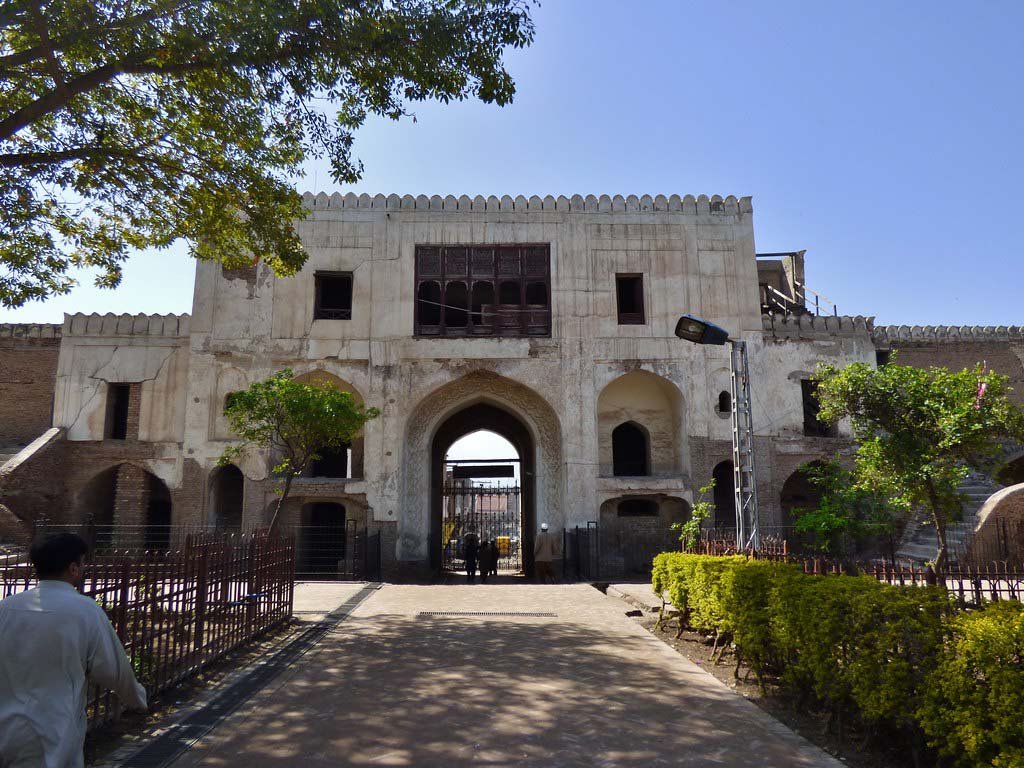
The visible Gor Khatri, however, is Mughal. In 1641, Jahan Ara Begum — the daughter of the emperor Shah Jahan — built a caravanserai on the ancient mound and named it Sarai Jahanabad. For the caravans of the overland trade, she provided the full Mughal traveler’s kit: a Jama Masjid, a hammam (bathhouse), and two wells, all inside a fortified square compound about 160 by 160 metres, entered through two prominent gateways on the east and west. It is a textbook Mughal serai, and one of the finest surviving in the region.
The Sikhs gave the site its next incarnation. After taking Peshawar, they converted Gor Khatri into the residence and official headquarters of their governor, the Italian mercenary general Paolo Avitabile, who ruled Peshawar from 1838 to 1842 — and they built a Hindu temple dedicated to Shiva within the compound. From 1917 to 2002, the complex served far more prosaically as a police headquarters and fire brigade station; the fire brigade building of 1917 still stands. Modern excavations have peeled back the layers beneath all of this, revealing remains that archaeologists associate with the ancient Gandharan capital in the region — evidence of Persian, Greek, Buddhist, Hindu, Mughal, Sikh, and British presence stacked like geological strata. The complex today also houses a museum in the old serai, and the whole quadrangle sits on Gorakhnath Temple Road, its name preserving the Hindu past.
Top Things to Do in Gor Khatri
Walk the Mughal Serai Courtyard
Enter through one of the two great gateways and take in the full 160-metre square of the caravanserai. The geometry is pure Mughal: a fortified quadrangle built for caravans, with the cells and chambers that once housed travelers, merchants, and their animals lining the southern and western sides. Imagine the courtyard as Jahan Ara’s builders left it — camels resting in the shade, water flowing in the tanks, the call to prayer from the Jama Masjid she built for the travelers.
Visit the Archaeological Museum
The museum housed in the complex displays finds from the excavations at Gor Khatri and the surrounding region — the material evidence of those stacked civilizations. It is the best place to make sense of what you are walking over: pottery, coins, and artifacts from the Buddhist, Hindu, Mughal, and later periods.
See the Excavated Layers
Parts of the compound have been excavated down through the centuries, and you can look at the exposed foundations and stratigraphy — the literal layers of Peshawar’s history. Guides and signage explain what each level represents. This is the closest you will come to time travel in the old city.
Visit the Gorakshanath Temple and the Mosque
The Hindu temple at the center of the complex — associated with the Gorakhnath tradition — and the Mughal-era mosque stand as quiet testimony to the religious plurality of old Peshawar, where Hindus, Muslims, Buddhists, Sikhs, and others lived and worshipped side by side. Be respectful at both: cover your head where custom requires, remove shoes, and keep your voice down.
Find the Well of Rani Dadi
Tucked in the complex is an old well attributed to Rani Dadi, a Hindu noblewoman. It survives behind railings, and local children still drop coins into it and make wishes — a small, living folk tradition inside an archaeological site. It is one of those details that makes Gor Khatri feel inhabited rather than merely preserved.
Famous Places In and Around Gor Khatri
- Bala Hisar Fort: Peshawar’s great fort, minutes away — see our Bala Hisar Fort travel guide.
- Sethi Mohalla: The stunning carved-wood merchant mansions of old Peshawar, a short walk from Gor Khatri.
- Mahabat Khan Mosque: The 17th-century Mughal mosque, one of the finest in the city.
- Qissa Khwani Bazaar: The legendary “Street of Storytellers” — bazaar, food, and atmosphere.
- Peshawar Museum: The region’s great Gandharan Buddhist art collection, a short drive away.
- Islamia College and Khyber Bazaar: Colonial-era landmarks and market streets of the cantonment side.
How to Reach Gor Khatri
Gor Khatri is inside Peshawar’s old walled city, so reaching it is simply a matter of reaching Peshawar. From Islamabad, take the M-1 motorway — about 170 km, roughly 2 to 2.5 hours of smooth driving. From Lahore, the route runs via the M-1/M-2 motorway network through Islamabad, about 5–6 hours. From Karachi, fly to Peshawar’s Bacha Khan International Airport (about 2 hours) — the road journey is very long and not recommended for a short trip.
Within Peshawar, Gor Khatri sits in the old city near the historic bazaars. Take a rickshaw or a Careem/ride-hailing car to the old city, then walk — the lanes around Gorakhnath Temple Road are part of the experience. If you are driving yourself, park outside the old city core and walk in; the lanes are narrow and congested. Combine the visit with the Sethi houses, Mahabat Khan Mosque, and Qissa Khwani Bazaar, all within walking distance of each other.
Road conditions are excellent on the motorways in all seasons; the old city lanes are walkable year-round. As with any old-city visit, go in daylight, keep valuables discreet, and consider hiring a local guide at the site or through your hotel — the history is dense, and a good guide makes it come alive.
Route Details
- Islamabad → Peshawar: M-1 motorway, ~170 km, 2–2.5 hours. (From Lahore: M-2 to Islamabad, then M-1; 5–6 hours total. From Karachi: fly to Peshawar.)
- Peshawar city → old city: rickshaw or ride-hailing to the walled city area.
- Walk to Gor Khatri on Gorakhnath Temple Road; allow 2–3 hours for the complex and museum.
- Continue on foot to Sethi Mohalla, Mahabat Khan Mosque, and Qissa Khwani Bazaar.
Where to Stay in Gor Khatri
You do not stay at Gor Khatri — you stay in Peshawar, and the city offers the full range. The cantonment and University Town areas have the best-known hotels, from comfortable mid-range options to well-established upper-range properties, all within a 15–25 minute drive of the old city. Guesthouses in University Town are popular with domestic travelers and offer good value.
For atmosphere, a few heritage-style guesthouses operate in and around the old city — ask locally, as these change hands. Budget travelers will find simple hotels near the railway station and in the Saddar area. Wherever you stay, plan your Gor Khatri visit for the morning: the light is better for photography, the museum is fresh, and you will have the afternoon free for the bazaars. Book ahead during wedding season and public holidays, when Peshawar’s hotels fill up.
Where to Eat: Local Foods of Gor Khatri
Peshawar is one of Pakistan’s great food cities, and Gor Khatri sits within walking distance of its most famous kitchens. The non-negotiable dish is the chapli kebab — the flat, spiced minced-meat kebab fried in animal fat, best eaten at the old city’s legendary kebab houses. From there, work your way to Namak Mandi for the salt-and-meat karahi (the “namkeen” style, seasoned with almost nothing but salt and tomatoes), Qissa Khwani Bazaar for Peshawari kulfi and falooda, and any old-city dhaba for qehwa (green tea), the city’s social lubricant.
For the full experience, eat where the shopkeepers eat: the dhabas around the bazaars serve daal, sabzi, fresh tandoori naan, and lassi at prices that will make you laugh — a full meal for a few hundred rupees. Peshawar’s dry fruits and honey are worth buying to take home. If you have one food stop after Gor Khatri, make it the chapli kebab quarter; if you have two, add Namak Mandi at night, when the karahi shops are at their liveliest.
Weather in Gor Khatri
Peshawar has a hot semi-arid climate, and Gor Khatri is an open courtyard — there is no shade except the buildings themselves. The pleasant window is October to March, when daytime temperatures are mild and perfect for walking the old city. Summer (May to August) is fiercely hot, and sightseeing is best confined to early morning; the monsoon brings some rain in July and August but little relief from the heat.
| Season | Temperature Range | Conditions |
|---|---|---|
| Winter (Dec–Feb) | 4°C to 19°C | Cool, crisp, and ideal; foggy mornings possible |
| Spring (Mar–Apr) | 15°C to 30°C | Pleasant; excellent for old-city walking |
| Summer (May–Aug) | 28°C to 42°C | Very hot; visit early morning, carry water; monsoon showers Jul–Aug |
| Autumn (Sep–Nov) | 18°C to 35°C | Cooling down; October–November very pleasant |
Language and Culture of Gor Khatri
Peshawar is a Pashtun-majority city where Pashto is the language of the street and Hindko is widely spoken in the old city; Urdu works everywhere and English is understood in hotels. The culture is famous for hospitality — the Pashtun code of melmastia (hospitality to guests) is not a slogan here but a lived practice — and for a certain directness that visitors quickly warm to.
Dress modestly: shalwar kameez or long trousers, and women should keep shoulders covered and carry a scarf, particularly around the mosque, temple, and shrine areas of the complex. Ask before photographing people in the bazaars. At the temple and mosque, remove shoes and follow the custodians’ guidance. Bargaining in the bazaars is expected and good-natured — offer about two-thirds of the asking price and meet in the middle. If you are offered qehwa by a shopkeeper, accept it; refusing hospitality is the one real faux pas.
Shopping in Gor Khatri
The lanes around Gor Khatri are some of Peshawar’s oldest shopping streets. What to buy: the Peshawari chappal (the city’s iconic leather sandal — get them handmade to your feet), khaddar and woolen fabrics, tribal jewelry, dry fruits (chilgoza pine nuts, almonds, apricots) from the old city’s dry-fruit merchants, and Peshawari honey. Sethi Mohalla’s woodwork shops sell carved boxes and furniture for those with transport.
Qissa Khwani Bazaar and Khyber Bazaar are the main market streets, both walkable from the site. Prices are generally lower than in Islamabad or Lahore for the same goods — Peshawar remains a trading city first. There are no shopping malls at the site itself (and none needed); for modern mall shopping, Peshawar’s newer commercial areas on University Road serve that purpose on a different day.
Travel Tips for Gor Khatri
Packing Essentials
Comfortable walking shoes (the old city’s lanes are uneven), sun protection, a scarf, a water bottle, and a small daypack. In winter, a warm jacket for the mornings; in summer, a hat and extra water. Cash in small denominations for the bazaars.
Safety Tips
The old city is busy and safe in daylight for tourists who take normal precautions: keep valuables out of sight, stay aware in crowds, and use registered rickshaws or ride-hailing rather than unmarked transport. Check current travel advisories for Khyber Pakhtunkhwa before your trip, as elsewhere in Pakistan. Hiring a local guide adds both context and ease of movement through the lanes.
Money & Connectivity
ATMs are plentiful in Peshawar’s commercial areas — withdraw before heading into the old city, where cash is king and cards are rarely accepted. All mobile networks work well in the city, with strong 4G coverage around the site.
Best Time to Visit Gor Khatri
October to March: The Best Season
Cool, dry weather made for walking. The courtyard, the excavations, and the bazaars are all at their most enjoyable, and the winter light is beautiful on the Mughal brickwork.
April and September: Shoulder Season
Warm but very doable, especially in the mornings. Fewer domestic tourists than in winter.
May to August: Hot Season
Peshawar’s summer is intense. Visit at opening time, retreat to the museum and shaded chambers at midday, and save the bazaars for the evening when the city comes alive.
Final Thoughts
Gor Khatri is Peshawar in miniature: ancient, layered, and utterly itself. In a single courtyard you can touch the Buddhist, Hindu, Mughal, Sikh, and British chapters of a city that has been continuously inhabited for more than two thousand years — and then walk out into bazaars that are still writing the next chapter. It is the rare archaeological site that does not feel like a museum piece, because the city never stopped using it.
Give it a morning, give the bazaars the afternoon, and give Peshawar’s kebabs the evening. Start with our Bala Hisar Fort travel guide to plan the full day, and keep Explore Pakistan open for wherever you go next.
FAQs
Where is Gor Khatri?
Gor Khatri is an archaeological site inside the old walled city of Peshawar, Khyber Pakhtunkhwa, on one of the highest points of the city.
What is Gor Khatri famous for?
Its 1641 Mughal caravanserai (Sarai Jahanabad), built by Jahan Ara Begum, daughter of Shah Jahan — and its far older history, identified by archaeologists with Kanishka’s great stupa and the site of the Buddha’s alms bowl described by the Chinese pilgrim Xuanzang.
Who built Gor Khatri?
The visible complex was built as a caravanserai in 1641 by the Mughal princess Jahan Ara Begum. The mound beneath it has far older layers — Buddhist, Hindu, and earlier — going back over two thousand years.
What is the best time to visit Gor Khatri?
October to March, when Peshawar’s weather is cool and ideal for walking the old city. Summer is very hot.
How do I reach Gor Khatri?
Reach Peshawar via the M-1 motorway from Islamabad (~170 km, 2–2.5 hours) or by air, then take a rickshaw to the old walled city and walk to Gor Khatri on Gorakhnath Temple Road.
Is Gor Khatri suitable for families?
Yes — it is an easy, flat, half-day visit with a museum, and it pairs well with Peshawar’s bazaars and food streets for a full family day out.
What should I eat near Gor Khatri?
Peshawar’s famous chapli kebabs, Namak Mandi’s salt karahi, Peshawari kulfi, and endless cups of qehwa — all within walking distance in the old city.
Is there an entry fee for Gor Khatri?
Access arrangements at the site have varied over the years; carry a small amount of cash in case of a nominal ticket or guide fee, and check locally on the day.
What else can I see near Gor Khatri?
Bala Hisar Fort, Sethi Mohalla’s carved-wood mansions, Mahabat Khan Mosque, Qissa Khwani Bazaar, and the Peshawar Museum’s Gandharan collection are all nearby.
How much time do I need at Gor Khatri?
Two to three hours covers the courtyard, gateways, excavations, temple, mosque, and museum comfortably.